You’re probably looking at one of two realities right now.
Either your team is still doing outreach the old way. A rep gets a list, opens LinkedIn, skims a website, copies a sequence, swaps in a first name, and hopes volume covers the lack of context. Or you’ve already figured out that generic outbound doesn’t cut it, but scaling relevance still feels painfully manual.
That tension sits at the center of what is cold outreach today. It’s still proactive contact with people who didn’t ask to hear from you. But the game has changed. The difference now isn’t whether outreach is cold. It’s whether the seller knows something useful, timely, and specific before reaching out.
The teams building pipeline consistently aren’t sending perfect templates. They’re catching moments. A leadership change. A hiring pattern. A funding event. A strategic shift hiding in plain sight. Outreach works when the message arrives with context, not just copy.
The End of an Era for Traditional Cold Outreach
A rep starts Monday with a list of accounts and no context. They know the territory is good. They know the product can help. What they don’t know is why any of these companies should care right now.
That’s where traditional cold outreach breaks down.
The old model treated outbound like a brute-force activity problem. More emails. More calls. More touches. The logic was simple. If enough messages go out, some meetings will land. In practice, that approach burns time, hurts morale, and trains teams to mistake activity for precision.
Outreach today looks different.
The best reps still prospect aggressively, but they don’t contact accounts in a vacuum. They look for movement. They want a reason that makes the message feel earned. If a company just hired a revenue leader, launched a new initiative, or started hiring around a problem your product solves, that outreach isn’t random anymore. It has shape.
Genuine cold outreach still exists. But good outbound now starts with context.
That shift matters because buyers are overloaded. A stranger asking for time without a point of view feels like work. A stranger showing up with relevant timing feels like help.
This is also why account selection matters more than ever. Broad targeting with weak context creates noise. Tight targeting with a clear trigger creates conversations. Teams building smarter outbound programs often borrow from account-based thinking, where account choice and timing matter as much as message quality. That’s the operating model behind strong account-based lead generation.
What changed isn’t the need for outreach. Revenue teams still need it. What changed is the standard. “Cold” no longer has to mean uninformed.
See Salesmotion in action
Take a self-guided interactive tour — no signup required.
Cold Warm and Triggered Outreach Explained
Many teams use the word outreach as if it means one thing. It doesn’t. There are three distinct versions, and they behave very differently in the field.
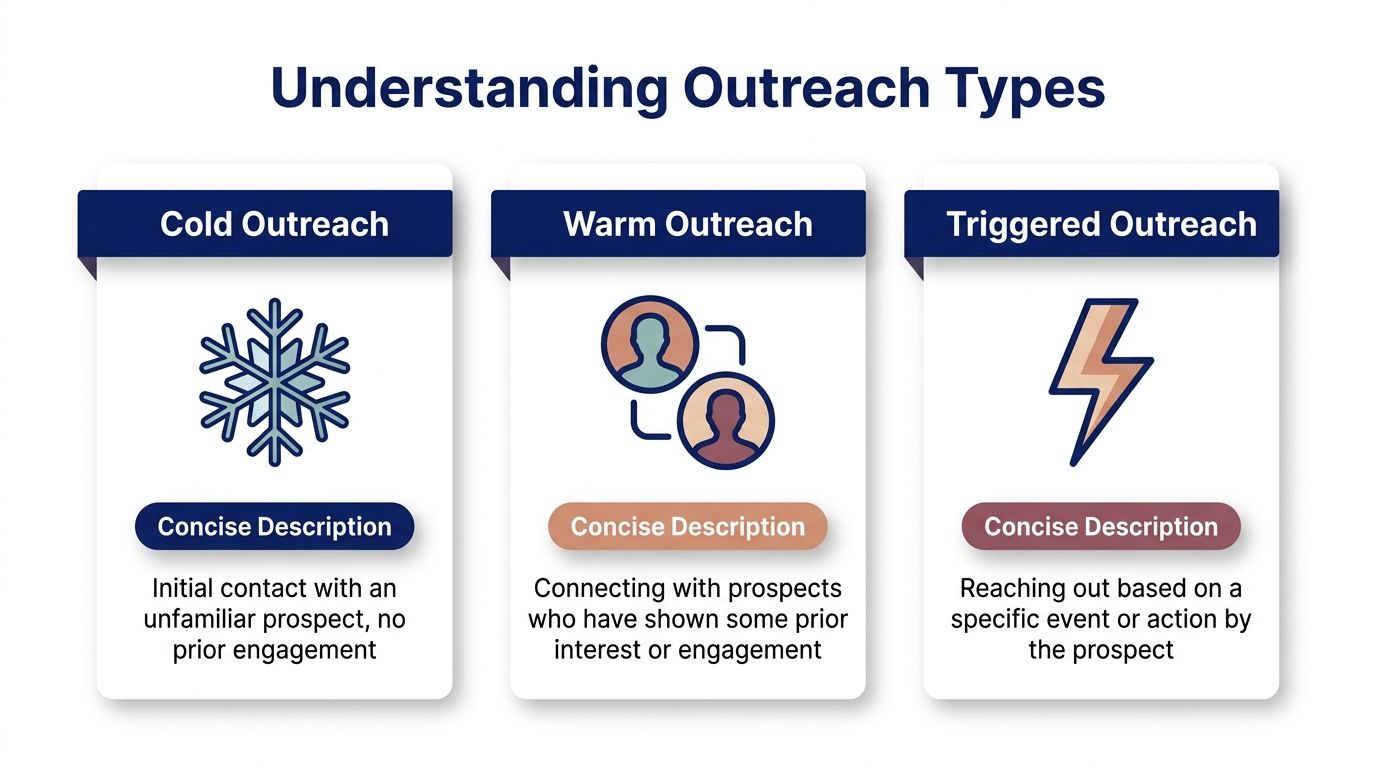
Cold outreach
Cold outreach is contact with someone who has no prior relationship with you and hasn’t shown visible interest. No referral. No inbound hand raise. No previous conversation.
Think of it as knocking on a door without knowing whether anyone inside has a reason to talk. That doesn’t mean it never works. It means the burden of relevance is entirely on the seller.
A basic example:
- You email a VP of Sales because the company matches your ideal customer profile.
- You call a Head of Marketing because similar firms buy your product.
- You send a LinkedIn message based only on role and company fit.
That’s still valid outreach. It’s just the hardest version to execute well.
Warm outreach
Warm outreach starts from some form of existing familiarity. The prospect may know your company, have engaged with content, share a connection, or have been referred.
Warm outreach is closer to visiting someone who already recognizes your name. You still need a good reason to talk, but you’re not starting from zero trust.
Warm can come from:
- A referral from a customer or partner
- A previous event conversation
- A prospect who visited your site or engaged with your posts
- A reply from another stakeholder in the same account
Warmth doesn’t guarantee conversion. But it lowers resistance.
Triggered outreach
Triggered outreach is the modern version many teams should build toward. You reach out because something happened.
That event might be:
- A new executive hire
- A funding announcement
- A set of job postings tied to an initiative
- A strategic comment in an earnings call
- A leadership move that changes priorities
This is less like knocking on a random door and more like arriving when the prospect is already dealing with a change you understand. That’s why triggered outreach usually feels more natural. The message is anchored in a real situation.
If you want a deeper breakdown of what qualifies as a useful trigger, this guide on what is a trigger event is a practical place to start.
The simple way to decide
Use this lens:
| Outreach type | Starting condition | Main challenge | Best use |
|---|---|---|---|
| Cold | No prior connection | Earning attention from scratch | New market coverage |
| Warm | Some familiarity exists | Converting mild awareness into action | Referrals, engaged leads |
| Triggered | A meaningful event occurred | Acting fast with relevant context | High-priority outbound |
Triggered outreach isn’t magic. It’s still outbound. But it fixes the biggest weakness in classic cold prospecting: lack of timing.

“The account and contact signals are key for reaching out at important times, and the value-add messaging it creates unique to every contact helps save time and efficiency.”
Daniel Pitman
Mid-Market Account Executive, Black Swan Data
The Three Channels of Modern Outreach
Many outreach programs fail because they overcommit to one channel. Usually email.
That’s understandable. Email scales, it’s easy to automate, and it gives managers something neat to report on. But relying on one channel leaves too much to chance.
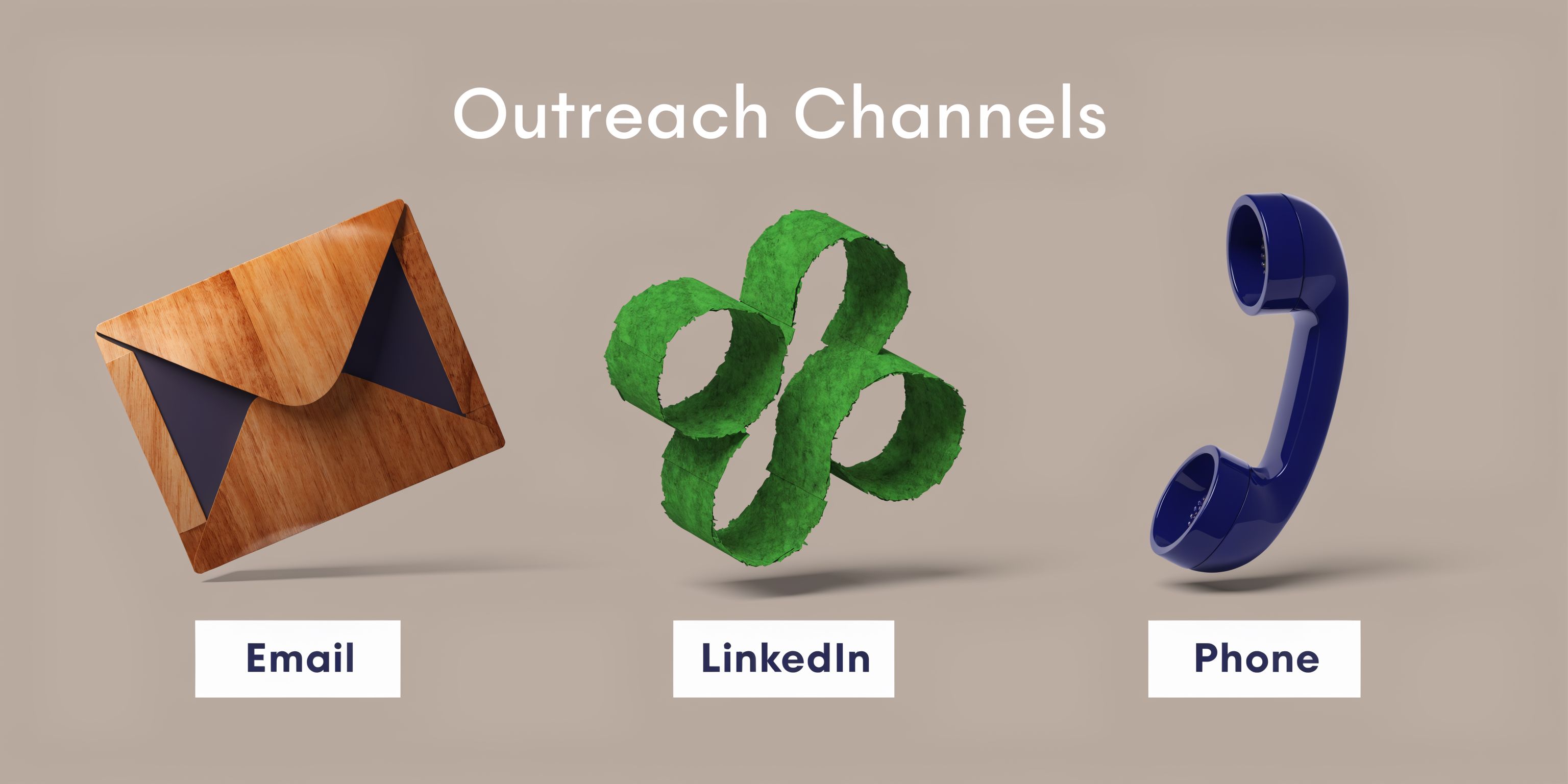
Email is the workhorse
Email is still the most scalable outbound channel. It’s where many teams start, and for good reason. You can tailor messaging, test angles, and run structured follow-up without disrupting the buyer’s day.
The upside is reach. The downside is competition. Every executive inbox is crowded with messages that sound interchangeable.
Global 2025 benchmarks from billions of cold emails show average reply rates of 3 to 5.1%, and out of 100 emails, a typical campaign yields roughly 3 replies and 1 meeting booked, according to LevelUp Leads’ cold email benchmarks. That’s not a reason to abandon email. It’s a reason to stop expecting generic email alone to carry pipeline.
LinkedIn adds credibility and context
LinkedIn works differently. It gives prospects a quick way to sanity-check who you are, what your company does, and whether your outreach is grounded in a professional context.
It’s also useful before the message. Reps can learn how a stakeholder talks about their priorities, what initiatives the company is hiring around, and how leadership frames change.
A good LinkedIn touch doesn’t need to be a pitch. Sometimes it just reinforces recognition before an email or call lands.
Phone creates real conversations
Phone is still the fastest path to an honest answer. Not always a meeting. Often not a perfect conversation. But it gives you immediate signal.
The phone is where a rep can test whether timing is wrong, whether ownership sits elsewhere, or whether the message is hitting the right problem. It also lets strong reps create trust through tone, clarity, and confidence in a way text can’t.
A call doesn’t need to close the deal. It often needs to sharpen the next move.
The Core Advantage is Coordination
These channels work best together, not separately.
According to Martal’s B2B cold email statistics, coordinated omnichannel sequences combining email, phone, and LinkedIn touchpoints outperform single-channel email-only approaches by 287% in overall conversion impact, with the optimal touch architecture requiring 8 to 12 total touchpoints to book meetings with cold prospects.
That finding matches what experienced teams already know. Buyers don’t consume outreach in a straight line. They notice an email, ignore it, see your profile later, then answer a call because your name feels familiar.
If you’re weighing channel strategy, this comparison of cold calls vs cold emails is useful because it frames the decision correctly. It’s not either-or. It’s what role each channel should play in the sequence.
A practical channel split
A healthy sequence usually treats channels like this:
- Email for narrative: Explain the problem, timing, and value clearly.
- LinkedIn for presence: Create familiarity and reinforce credibility.
- Phone for discovery: Confirm relevance, objection, urgency, or redirect.
Single-channel outreach feels efficient. Multi-channel outreach is what gets seen.
Best Practices That Turn Cold into Gold
The gap between outreach that gets ignored and outreach that gets replies usually isn’t effort. It’s discipline.
Much weak outbound fails before the buyer evaluates the offer. The message looks generic, the timing feels arbitrary, and the sender hasn’t earned enough trust to deserve attention.

Relevance gets screened before it gets read
A 2024 analysis found that cold messages are filtered subconsciously, and only those with context, proximity, and relevance advance. It also found that warm-path messages see 45% reply rates versus the typical 8% for cold outreach that fails these psychological pre-read filters, according to The BD School’s analysis of cold outreach.
That’s the right way to think about outbound. Buyers don’t read every message and then decide. They dismiss most of them almost instantly.
So the first job of outreach isn’t persuasion. It’s passing the filter.
What disciplined reps do differently
The reps who consistently book meetings tend to follow a few core principles:
- Start with a reason now: If the outreach doesn’t answer “why this account, why this person, why today,” it’s not ready.
- Personalize the problem, not just the greeting: Adding a first name isn’t personalization. Referencing a business change, hiring pattern, or strategic initiative is.
- Lead with buyer context: A strong first sentence shows you understand what may be changing inside the account.
- Keep the ask light: Cold outreach should open a conversation, not force a full sales cycle into one message.
- Write for scanning: Executives don’t study cold messages. They skim for relevance.
Practical rule: If your first two lines could be sent to fifty other companies unchanged, the message is still generic.
The message should sound like homework was done
Here’s the difference in practice.
Weak: “Hi Sarah, I work with SaaS teams to improve pipeline efficiency. Would you be open to a quick chat?”
Better: “Hi Sarah, I noticed your team is hiring into enterprise sales while expanding RevOps ownership. That usually creates pressure on process consistency and visibility across stages. Worth comparing notes if that’s on your side right now.”
The second version doesn’t say more. It says something more grounded.
Deliverability is part of message quality
A good message that lands in spam is still a failed campaign.
That’s why operational hygiene matters. Before blaming copy, it’s smart to check if your emails go to spam and rule out inbox placement problems. A lot of teams diagnose an outreach issue as a messaging issue when the message isn’t even reaching the primary inbox consistently.
Value beats cleverness
Good outreach isn’t about sounding witty or polished. It’s about being easy to understand and hard to dismiss.
The simplest test is this: does the prospect immediately see that you picked them for a reason?
If the answer is no, the message is still cold in the worst sense of the word.

“All of the vendors that I've worked with, all of the onboarding that I have had to deal with, I will say, hands down, Salesmotion was the easiest that I have had.”
Lyndsay Thomson
Head of Sales Operations, Cytel
How Signal-Driven Intelligence Makes Outreach Relevant
The biggest shift in outbound over the last few years isn’t a new channel or a new prompt trick. It’s the move from static targeting to signal-driven outreach.
That means the rep isn’t just asking, “Does this account fit our ICP?” They’re asking, “What changed here that makes this a good time to start a conversation?”
What counts as a signal
A business signal is an external sign that something meaningful is happening inside the account.
Common examples include:
- A new CRO, CMO, or VP hire
- A funding round
- An executive mentioning a new priority publicly
- Hiring patterns that point to a fresh initiative
- Org changes that suggest restructuring or budget movement
- A competitor reference in an earnings call or interview
Not every signal matters equally. Some are weak context. Others create a opening.
According to Salesmotion’s cold outreach best practices, cold outreach anchored to real business signals like leadership changes or funding rounds generates 3 to 5x higher reply rates. The same source notes that a new VP hire signal can produce an 18% reply rate, a 4.5x improvement over generic 4% industry trend messages.
That difference makes intuitive sense. A generic trend says, “This issue exists in your market.” A signal says, “Something specific changed inside your company.”
Why signals work better than generic personalization
Much personalization is cosmetic. It references a city, a podcast appearance, or a sentence from the About page. That can help, but it rarely changes the buyer’s willingness to engage.
Signals work because they imply motion.
A new executive often brings a fresh mandate. A funding event often creates urgency to execute. A wave of role-specific hiring usually points to operational change. Those situations create active problems, budgets, or at least internal conversations.
That’s why signal-based outreach tends to feel more legitimate. The seller isn’t manufacturing urgency. They’re reacting to it.
Relevance gets stronger when the message explains the change and the likely consequence of that change.
The manual version doesn’t scale
In theory, any rep can do this manually.
They can read company press releases, track leadership changes on LinkedIn, monitor job boards, scan interviews, and build a point of view before sending a note. In practice, few teams can do that consistently across a real territory.
Manual signal-hunting creates three problems:
- Research takes too long
- Good reps find context inconsistently
- Important changes get noticed too late
That’s where AI-based prospecting tools changed the workflow. Not because they write prettier emails, but because they watch for movement continuously and turn raw information into usable selling context.
If you’re evaluating the broader category, understanding what is intent data helps. Intent data tells you who may be researching. Signals tell you what changed and why that change matters now. The strongest outbound teams combine both ideas.
Before and after messaging
The contrast is easiest to see in a message example.
Generic outreach “Hi James, I work with revenue teams to improve forecasting and pipeline visibility. Open to a quick intro next week?”
Signal-driven outreach “Hi James, saw the company recently brought in a new VP of Sales. Those leadership changes usually lead to tighter inspection around pipeline quality, handoff consistency, and forecast confidence. If that’s becoming a focus internally, I can share how similar teams approached it.”
The second note does three things better:
- It explains why the rep reached out now
- It links the event to a likely business consequence
- It invites a conversation without overselling
What intelligent outreach systems change
The strongest AI-assisted workflows don’t replace reps. They remove the dead time around rep work.
A modern system should help teams:
- Find high-value changes across target accounts
- Filter weak noise from actionable triggers
- Turn signals into plain-English talking points
- Draft outreach that sounds informed instead of automated
- Route timing signals into the rep’s existing workflow
That last point matters. A signal is only useful if the team can act on it quickly.
Cold outreach used to mean initiating a conversation from zero. In practice, the best version of outbound in 2026 starts with a trigger, a point of view, and a clear reason the message exists.
Measuring What Matters Key KPIs for Outreach Success
A rep can send 500 emails in a week, show a healthy open rate, and still produce nothing the pipeline can use. I see that mistake in outbound reviews all the time. Activity looks strong on the dashboard. Buyer interest is weak in practice.
The fix is simple. Measure outcomes that reflect relevance, timing, and conversion quality.
Start with business results, then trace the path back
A useful outreach scorecard follows the progression from first response to booked conversation:
- Meetings booked: Did the campaign create sales conversations with the right accounts?
- Positive replies: Did prospects respond with genuine interest, context, or a clear next step?
- Reply rate: Did the message earn engagement at all?
- Bounce rate and deliverability health: Did your emails reach valid inboxes consistently?
That sequence changes how teams manage performance. Open rates and send volume can help diagnose a delivery issue, but they do not show whether the message matched a buyer problem. Privacy protections also make opens less dependable than they used to be. That is why strong teams treat opens as a supporting signal, not the headline metric.
Signal-driven outreach adds another layer. It is not enough to know that a sequence performed well. Managers need to know which triggers produced the result. A reply tied to a funding event, hiring push, or leadership change says more than a generic reply from a broad list pull.
What to track every week
A practical manager dashboard usually includes:
| KPI | Why it matters |
|---|---|
| Reply rate | Quick read on whether the message is earning attention |
| Positive reply rate | Separates polite responses from real sales interest |
| Meetings booked | Shows whether outbound is creating pipeline conversations |
| Bounce trend | Protects sender reputation and list quality |
| Meetings by trigger type | Reveals which signals are worth scaling |
| Time from signal to first touch | Shows whether the team is acting while the trigger is still relevant |
That last metric matters more now than it did a few years ago. Timing used to depend on a rep noticing a change, researching the account, and writing a message before the moment passed. Autonomous AI agents change that operating model. They can monitor accounts continuously, detect meaningful changes, draft context-aware messaging, and push the rep to act while the trigger still has force.
That is how outreach stops being cold in practice.
If your team still wants visibility into opens, use them carefully. Tools that support email open tracking can help reps spot engagement patterns or test subject lines, but open data should never outweigh replies, meetings, and conversion by trigger.
The management question that improves performance
Ask a harder question than, “Did we send enough?”
Ask which signals led to positive replies, which messages turned those replies into meetings, and how quickly the team acted once the signal appeared.
That is the scorecard that helps reps improve. It also shows where AI-assisted, signal-driven outreach is doing work manual prospecting cannot do at scale.
Common Mistakes to Avoid and Compliance Notes
Many outreach problems aren’t caused by the channel. They come from lazy execution.
HubSpot data cited by EBQ’s cold calling statistics roundup shows that 42% of salespeople find prospecting to be their toughest challenge, while 69% of email senders report declining performance from generic outreach. That tracks with what many sales leaders see firsthand. The issue usually isn’t whether outbound works. It’s whether the team is giving buyers a relevant reason to engage.
The mistakes that sink campaigns
A few patterns show up again and again:
- Using stale data: Bad contacts and outdated roles waste touches before the message even starts.
- Writing seller-first copy: Prospects don’t care about your platform's new features. They care whether you understand what’s changing on their side.
- Stopping too early: Good sequences need follow-up discipline across channels.
- Treating all triggers equally: Some signals are weak. Others indicate urgency. Teams that don’t separate them dilute their effort.
- Automating without judgment: AI can speed up research and drafting, but bad prompts on bad inputs still create bad outreach.
Compliance is a quality issue too
A lot of teams treat compliance as a legal box-check. It’s more useful to think of it as professional standards for outbound.
GDPR, CAN-SPAM, and related rules vary by region and use case, so legal counsel should define your exact operating boundaries. But the practical habits are straightforward:
- Contact people with a legitimate business rationale
- Keep data accurate
- Be clear about who you are
- Make opt-out paths easy
- Don’t mislead in the subject line or message body
High-quality outreach usually aligns with compliance by default. Relevant targeting, honest messaging, and respectful follow-up are good selling habits and safer operating habits.
The fear around compliance often comes from teams sending low-context, high-volume messaging. That’s exactly the kind of outreach buyers dislike anyway.
If your outreach is timely, specific, and useful, you’re already moving in the right direction.
Sales teams don’t need more noise. They need better timing, better context, and a faster way to turn account changes into conversations. Salesmotion helps revenue teams do exactly that with AI agents built for research, signals, and personalized prospecting, so reps can spend less time digging and more time starting relevant conversations that build pipeline.