Financial services firms spend over $600 billion a year on technology --- banks alone account for the majority --- and global fintech investment continues to reshape how banks, asset managers, and insurance companies buy technology. Yet the financial services buying process remains one of the most complex in B2B, layered with compliance reviews, third-party risk assessments, and multi-year procurement cycles. Selling into this vertical requires patience, precision, and a deep understanding of regulatory pressure.
TL;DR: Financial services buyers prioritize compliance, security, and regulatory readiness above all else. Successful sellers lead with risk reduction, navigate multi-stakeholder committees across business lines, and time outreach to regulatory deadlines, compliance cycles, and digital transformation initiatives. Each finserv sub-segment --- banks, insurance, asset management, and fintech --- has distinct procurement patterns that require tailored approaches.
Understanding the Financial Services Buyer
Banks, fintechs, asset managers, and insurance companies each operate under different regulatory frameworks, but they share a procurement culture defined by risk aversion. Every technology purchase goes through vendor risk management, information security review, and often legal and compliance sign-off before a contract is executed.
According to BDO's 2026 fintech predictions, bank-fintech relationships are evolving rapidly, with sponsor banks demanding deeper compliance oversight from technology partners. This means vendors selling into financial services must demonstrate not just product capability, but regulatory sophistication.
Budget cycles in financial services typically follow calendar-year planning, with Q3/Q4 budget finalization. However, regulatory deadlines create off-cycle budget releases. For example, the EU's Digital Operational Resilience Act (DORA) took full effect in January 2025, forcing financial institutions to invest in operational resilience technology on compressed timelines. In the US, the Basel III Endgame re-proposal is expected in 2026 with implementation beginning in 2027, which will drive significant capital modeling and risk technology investments at banks with over $100 billion in assets.
The compliance-first culture means that vendor qualification often takes 3 to 6 months before a commercial conversation even begins. Sellers who treat compliance as an afterthought lose deals to competitors who lead with certifications and risk documentation upfront.
Selling to Different Financial Services Segments
"Financial services" is not one market --- it is four distinct sub-segments with different regulatory regimes, budget structures, procurement timelines, and decision-making cultures. Treating them as interchangeable is one of the most common mistakes vendors make.
Banks (Commercial, Retail, and Investment)
Banks operate under the most formalized procurement processes in financial services. Regulated by the OCC, Federal Reserve, and FDIC in the US (and equivalent bodies internationally), banks face annual examination cycles that dictate technology priorities. OCC examiners review vendor risk management practices, information security controls, and operational resilience at least annually for large banks.
Procurement pattern: Structured RFPs with scoring rubrics, 5 to 8 stakeholders across business, technology, risk, compliance, and procurement. Enterprise sales cycles run 9 to 18 months. Budget decisions are heavily influenced by examination findings and consent orders.
How to win: Reference other bank clients. Demonstrate understanding of the interagency guidance on third-party risk management. Proactively provide SOC 2 Type II reports and penetration test results. Banks move slowly, but they renew contracts for years once you are in.
Insurance Companies
Insurance is regulated at the state level in the US (by state departments of insurance) and faces distinct capital requirements under frameworks like the NAIC Risk-Based Capital standards. Insurance procurement is heavily influenced by actuarial and underwriting leadership, not just IT.
Procurement pattern: Longer evaluation cycles than banks (often 12 to 24 months), smaller procurement teams, and a strong preference for vendors with existing insurance industry references. Budget decisions are tied to loss ratios, regulatory rate filings, and annual actuarial reviews.
How to win: Speak to actuarial and underwriting use cases, not just sales or marketing efficiency. Insurance buyers evaluate technology through the lens of risk reduction and claims management. State-level regulatory variation means that multi-state carriers have complex compliance matrices --- showing you understand this complexity builds credibility.
Asset Managers and Wealth Management Firms
Asset managers (hedge funds, private equity, mutual fund complexes) are regulated primarily by the SEC and FINRA. Their procurement is driven by portfolio performance, client reporting requirements, and compliance obligations like Form 13H filings, Form ADV updates, and the SEC's Regulation S-P safeguards rule.
Procurement pattern: Faster than banks (3 to 9 months), smaller deal sizes at mid-market firms but significant enterprise budgets at the largest asset managers. Technology decisions are often driven by the COO or Head of Operations rather than the CIO. Compliance with SEC examination priorities --- including cybersecurity and custody safeguarding --- is a consistent buying trigger.
How to win: Show how your solution supports SEC examination readiness. Demonstrate understanding of the fiduciary duty framework. Asset managers are more willing to pilot new technology than banks, so offer a 30 to 60 day proof of concept to accelerate procurement.
Fintechs
Fintechs are technology-forward and faster-moving, but their regulatory burden is growing. Sponsor bank relationships, state money transmitter licenses, and increasing OCC scrutiny of bank-fintech partnerships mean that fintechs now face many of the same compliance requirements as banks themselves.
Procurement pattern: Fastest in financial services (1 to 6 months), price-sensitive, and driven by product-led evaluation. Fintechs often prefer self-serve demos and usage-based pricing. However, compliance-adjacent purchases still require legal and risk sign-off.
How to win: Lead with product, not paperwork. Offer free trials or sandbox environments. But have compliance documentation ready --- fintechs increasingly need to demonstrate to their sponsor banks that their own vendors meet bank-grade security standards.

“The moment we turned on Salesmotion, it became essential. No more hours on LinkedIn or Google to figure out who we're talking to. It's just there, served up to you, so it's always 'go time.'”
Adam Wainwright
Head of Revenue, Cacheflow
The Regulatory Calendar: Compliance and Examination Signals
The financial services regulatory calendar creates predictable buying windows throughout the year. Understanding these cycles lets you time outreach to moments when institutions are actively evaluating vendors.
Basel III Endgame (US Banks)
The revised Basel III Endgame rule is expected to be re-proposed in 2026 with implementation beginning as early as 2027. While the final calibration is still being determined --- the original 2023 proposal called for a 16 to 20 percent increase in capital requirements, later revised down to 9 percent, and now expected to be roughly capital-neutral --- banks cannot defer preparation. Data lineage, risk-weighted asset calculation, and capital modeling all require technology investment regardless of the final numbers.
Selling signal: Banks posting roles for Basel implementation leads or risk quantification specialists. Earnings call language about "capital optimization" or "risk-weighted asset modeling."
SOX Audit Cycles (All Public Financial Institutions)
Every publicly traded financial institution undergoes annual SOX Section 404 internal controls assessments. The cycle follows a predictable pattern: planning and scoping in Q2, risk assessment and control testing in Q3, and external audit in Q4 through year-end. Any material weakness or control deficiency identified during the audit creates immediate budget for remediation technology.
Selling signal: Look for 10-K filings that disclose material weaknesses or significant deficiencies in internal controls. These disclosures are public and create urgency for technology purchases that address the identified gaps.
PCI DSS v4.0 (Payments Companies and Banks)
PCI DSS v4.0 became the only active standard as of March 2024, and 51 previously future-dated requirements became mandatory on March 31, 2025. These include expanded multi-factor authentication requirements for all access to cardholder data environments, payment page script security controls, software bill of materials (SBOM) obligations, and targeted risk analysis documentation. Any vendor selling to payments-adjacent companies should understand these requirements and be prepared to demonstrate compliance.
Selling signal: Companies that process payments and are hiring for PCI compliance roles, or that have recently engaged Qualified Security Assessors (QSAs), are actively investing in their compliance posture.
OCC and SEC Examination Cycles
The OCC conducts ongoing supervision of national banks and federal savings associations, with annual examination cycles for the largest institutions. Examination findings, Matters Requiring Attention (MRAs), and consent orders are powerful buying signals because they create non-discretionary spending requirements. The SEC Division of Examinations publishes annual examination priorities --- for 2026, these include fiduciary duty, custody safeguarding, cybersecurity, and Regulation S-P compliance.
Selling signal: OCC consent orders and SEC deficiency letters are often public. Monitor regulatory enforcement actions for your target accounts. An institution under a consent order has a fixed timeline to remediate, which means compressed procurement cycles and willingness to pay premium prices.
DORA, MiCA, and PSD3 (EU-Regulated Institutions)
The EU's DORA took full effect in January 2025, MiCA established the first comprehensive crypto-asset regulatory framework in the EU, and PSD3 (the proposed third Payment Services Directive) will extend open banking requirements and impose new operational standards. For any vendor selling to EU-regulated financial institutions, aligning your value proposition to these frameworks is essential.
CFPB Section 1033 / Open Banking (US)
The CFPB's Section 1033 rule on personal financial data rights was finalized in October 2024, with the largest banks originally required to comply by April 2026. The rule requires financial institutions to make consumer data available to authorized third parties upon request. While the implementation timeline remains in flux due to litigation and a reopened rulemaking process, banks and fintechs are already investing in API infrastructure, data security, and consent management technology to prepare.
Selling signal: Institutions hiring for open banking, API integration, or data portability roles. Earnings call references to "consumer data rights" or "data sharing frameworks."
Key Decision Makers and Their Priorities
Chief Information Officer / Chief Technology Officer
CIOs and CTOs at financial institutions evaluate technology architecture, scalability, and integration with core banking systems. They care about uptime SLAs, disaster recovery, and whether your solution fits their modernization roadmap. With 75 percent of banks globally intending to replace their core systems by 2026 and the core banking modernization market projected to grow at 24 percent CAGR, CIOs are focused on cloud migration, API-first architecture, and progressive modernization strategies.
Chief Risk Officer / Chief Compliance Officer
These roles have effective veto power over any technology purchase that touches customer data, regulatory reporting, or operational processes. They evaluate vendor risk scores, SOC 2 reports, penetration test results, and regulatory alignment. The CRO is particularly influential at banks facing Basel III Endgame preparation, OCC examination remediation, or consent order compliance.
Business Line Leadership
Heads of Investment Banking, Wealth Management, Commercial Banking, or Insurance evaluate solutions based on revenue impact, client experience improvement, and competitive advantage. They are often the champions who initiate the buying process but cannot close without CRO/CCO approval.
Procurement and Vendor Management
Financial services procurement teams run structured RFP processes with scoring rubrics, reference checks, and detailed contract negotiations. They manage the vendor lifecycle and coordinate across business, technology, and compliance stakeholders.
Information Security
InfoSec teams conduct independent security assessments, penetration testing, and architecture reviews. In financial services, these assessments are more rigorous than in most other verticals, often requiring 4 to 8 weeks of dedicated engagement.
“Automatic account profile detail I can use to manage my territory. Using Salesmotion AI to generate value statements per persona, account, etc. Using Salesmotion to give me a starting point based on new hires, or news alerts is critical.”
Adam Wainwright
Head of Revenue, Cacheflow
Finserv-Specific Buying Triggers
Beyond the regulatory calendar, financial services companies generate specific buying signals that indicate active vendor evaluation.
Core Banking System Replacements
When a bank announces a core banking modernization initiative, it signals years of technology investment. The industry is moving away from "big bang" rip-and-replace projects toward progressive modernization and sidecar core strategies, where a modern system runs in parallel with the legacy platform. According to Everest Group's analysis, 40 percent of global banks will be pursuing sidecar core strategies by 2026. These multi-year transformation programs create cascading technology purchases across the organization.
What to watch for: Earnings call language about "core modernization," "cloud migration," or "platform rationalization." Hiring for cloud architects, integration engineers, and transformation program managers. RFI/RFP publications for core banking vendors (Temenos, Thought Machine, Mambu, FIS, Finastra).
Digital Transformation Initiatives
When a bank announces a "digital-first strategy" or a "client experience transformation," those phrases signal technology budget allocation. Earnings calls and investor presentations are the best sources for this language.
Leadership Changes
A new CIO, CTO, or Head of Digital at a financial institution typically triggers a technology review. New leaders in compliance and risk roles also create vendor evaluation windows. A new Chief Risk Officer, in particular, often initiates a full vendor portfolio review in their first 90 days.
M&A Activity
Bank mergers, fintech acquisitions, and insurance consolidation create integration projects that require new technology decisions. The 12 to 24 months post-announcement is a prime buying window.
Regulatory Enforcement Actions
Consent orders, MRAs, and cease-and-desist orders create non-discretionary technology spending. An institution under a consent order has a regulator-imposed deadline and will pay premium pricing for solutions that help them remediate on time.
Cost-Cutting Initiatives
When financial institutions announce efficiency programs or headcount reductions, they often invest in technology to maintain service levels with fewer people. This is counterintuitive but consistently drives technology purchases.
Cacheflow, a CPQ and billing platform later acquired by HubSpot, reduced meeting prep time by 60 percent using Salesmotion to research financial services accounts. Their Head of Revenue, Adam Wainwright, described the result as always being ready for "go time," even on short notice. Read the full case study.
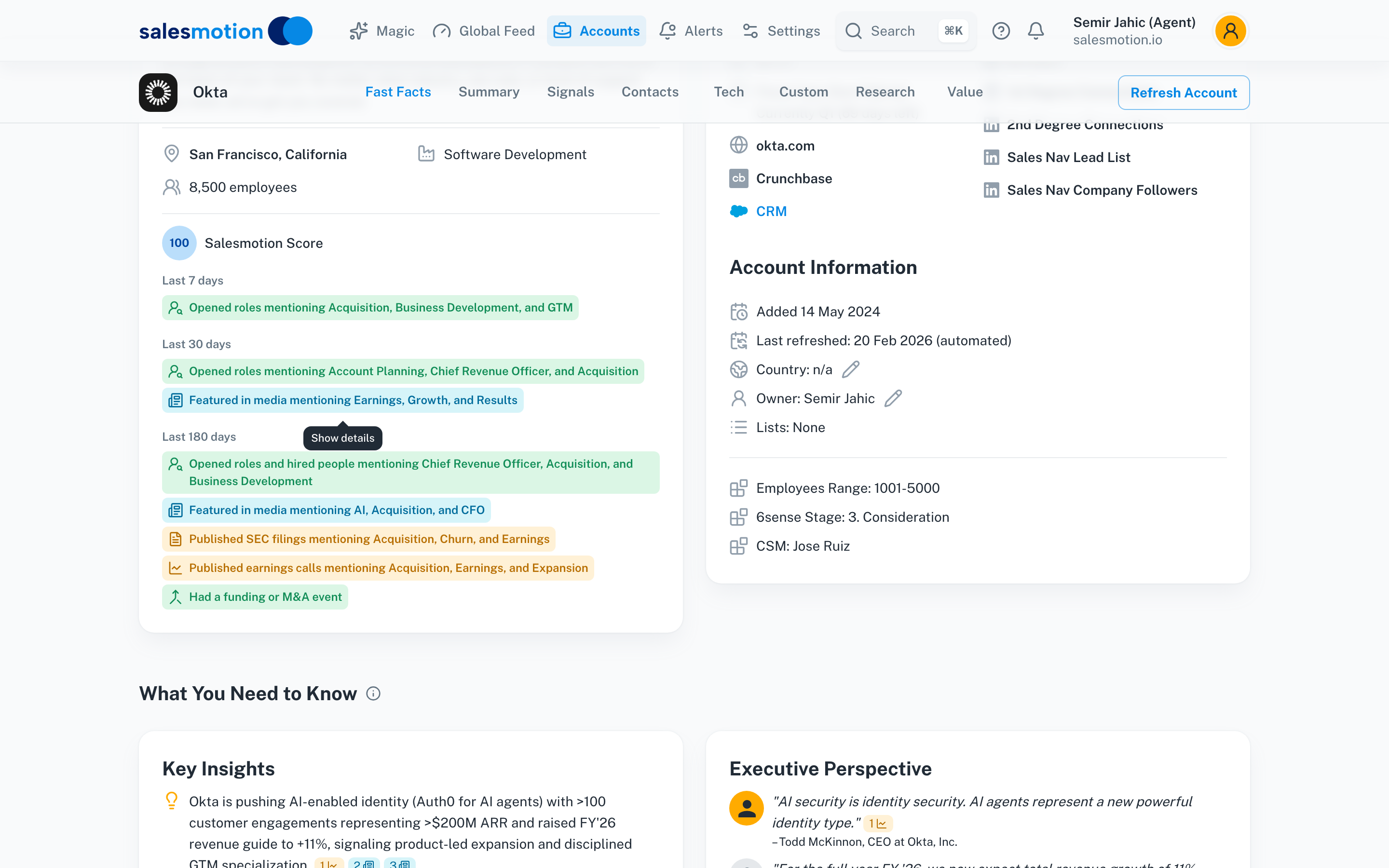 Salesmotion generates a complete account brief in minutes — key insights, executive quotes, opportunities, and talking points — so reps walk into every meeting prepared.
Navigating Third-Party Risk Management at Banks
Third-party risk management (TPRM) is the single biggest procedural obstacle to closing a deal with a bank. The June 2023 interagency guidance from the OCC, Federal Reserve, and FDIC established a unified framework that all US banks must follow. A supplemental guide for community banks was released in May 2024. Understanding how this process works --- and preparing for it proactively --- can cut months from your sales cycle.
The Five-Stage TPRM Life Cycle
The interagency guidance defines five stages for third-party risk management: planning, due diligence and selection, contract negotiation, ongoing monitoring, and termination. Banks apply a risk-based approach, meaning that vendors whose products touch customer data, regulatory reporting, or critical operations face the most rigorous evaluation.
What Banks Ask for During Due Diligence
Expect to provide: SOC 2 Type II reports (not just Type I), penetration test results from the last 12 months, business continuity and disaster recovery plans, financial statements demonstrating vendor viability, data flow diagrams showing where customer data resides and how it is protected, incident response plans, and evidence of employee background checks and security training.
Banks with over $50 billion in assets often use standardized questionnaires like the SIG (Standardized Information Gathering) questionnaire from Shared Assessments, which can run to several hundred questions. Preparing a completed SIG in advance signals sophistication and accelerates the evaluation.
How to Accelerate the TPRM Process
Start the security assessment in parallel with commercial discussions. Do not wait for commercial terms to be agreed before beginning the TPRM process. Send your compliance documentation package in your first or second meeting.
Assign a dedicated compliance liaison. Banks expect a named contact who can respond to security questionnaires, schedule architecture reviews, and coordinate penetration testing. Having this person identified upfront signals organizational maturity.
Proactively address concentration risk. Banks must evaluate whether a vendor creates concentration risk --- too many critical functions with one provider. If your product is adjacent to other vendors the bank already uses, explain how your solution reduces rather than increases concentration risk.
Prepare for ongoing monitoring. TPRM does not end at contract signing. Banks conduct ongoing monitoring of critical vendors, including annual reassessments, SLA tracking, and incident notification requirements. Build these expectations into your contract templates from the start.
For a deeper look at account research for financial services and building contact lists in this vertical, see our dedicated guides.
The Sales Approach That Works
Lead with Compliance Credentials
Your first impression in financial services should include your SOC 2 Type II report, GDPR compliance documentation, and any industry-specific certifications (PCI DSS for payments, ISO 27001 for information security). Sharing these proactively in your first outreach demonstrates that you understand the environment and accelerates the vendor qualification process.
Map the Regulatory Landscape to Your Value Proposition
Financial institutions are navigating major regulatory changes simultaneously: DORA in the EU, the GENIUS Act for stablecoins in the US, MiCA for digital assets, and PSD3 for payments. If your solution helps with any compliance requirement, frame your value proposition around specific regulatory mandates.
For example, instead of "our platform improves sales productivity," try "our platform provides the account intelligence your business development team needs while meeting SOC 2 and GDPR requirements, reducing third-party vendor risk in your supply chain."
Demonstrate Financial Services Domain Expertise
Generic product demos kill deals in financial services. Customize your demo environment with financial services data: banking industry signals, regulatory filing changes, M&A announcements in the sector, and executive moves at financial institutions. Show that you understand their world.
Outreach Templates for Financial Services
Example: Regulatory-Driven Outreach to a CRO
Signal: European bank faces DORA compliance deadline. LinkedIn posts from their risk team suggest they are still building their vendor assessment framework.
Subject line: DORA vendor resilience requirements
Body: With DORA enforcement underway, your vendor risk management framework is likely under review. We work with financial institutions to consolidate vendor intelligence, monitor regulatory changes, and surface compliance-relevant signals across counterparties.
One client reduced their vendor assessment cycle by 40 percent by centralizing intelligence gathering. Worth a conversation to see if there is overlap with your DORA preparations?
Example: Post-Acquisition Outreach to a Head of Commercial Banking
Signal: Regional bank acquired a fintech. Integration is in planning phase.
Subject line: Commercial intelligence for the combined platform
Body: As you integrate the fintech's capabilities into your commercial banking platform, your BD team likely needs updated intelligence on the combined client base. In similar integrations, we have seen teams struggle with overlapping data sources and inconsistent account research across legacy organizations.
Happy to share how other financial institutions have handled this. Would next Tuesday work for a brief call?
Common Mistakes When Selling to Financial Services
Underestimating the compliance timeline. Even if your champion is eager, vendor risk assessment takes 3 to 6 months in financial services. Build this into every forecast and start the compliance process in parallel with commercial discussions.
Treating financial services as one market. Banks, fintechs, asset managers, insurance companies, and payments companies each have different regulatory requirements, buyer personas, and procurement processes. Tailor your messaging, demo, and compliance documentation to the specific type of institution.
Ignoring the Chief Risk Officer. The CRO/CCO can kill a deal at any stage. Proactively engage the risk and compliance team rather than waiting for them to surface objections late in the process.
Failing to provide references. Financial services buyers want to talk to other financial services customers. Generic SaaS references do not carry weight. Build a reference roster of 3 to 5 financial services clients who can speak to your compliance posture and domain expertise.
Not preparing for TPRM. Showing up to a bank deal without a completed SIG questionnaire, current SOC 2 report, and penetration test results is like showing up to a job interview without a resume. Prepare these materials once and keep them updated quarterly.
Pricing without understanding procurement. Financial services procurement teams negotiate aggressively and expect multi-year contract structures. Be prepared for detailed pricing breakdowns, volume discounts, and contract terms that differ significantly from standard SaaS agreements.
Explore the Sales Intelligence for Fintech page for financial services-specific use cases and see how account intelligence helps teams navigate complex buying committees.
Frequently Asked Questions
How long does it take to close a deal with a bank or financial institution?
Enterprise deals at banks typically take 9 to 18 months from first contact to signed contract. The vendor risk assessment alone can take 3 to 6 months. Mid-market fintechs may close in 1 to 6 months with streamlined procurement. Asset managers fall in between at 3 to 9 months. Insurance companies can take 12 to 24 months due to actuarial review cycles. To accelerate timelines, prepare compliance documentation in advance, engage the risk team early, and offer to start the security assessment in parallel with commercial evaluation.
What compliance certifications do I need to sell into financial services?
At minimum, expect SOC 2 Type II certification, GDPR compliance (for European clients), and detailed information security documentation. Payments companies require PCI DSS v4.0 compliance. Some institutions also require ISO 27001 certification, NIST framework alignment, and evidence of regular penetration testing. If you are selling to banks, prepare a completed SIG questionnaire and have your business continuity plan documented. Having these ready before your first meeting signals credibility and saves weeks in the procurement process.
What regulatory deadlines should I track to time my outreach?
Key regulatory catalysts for 2026 include the Basel III Endgame re-proposal (driving risk technology investment at large US banks), DORA enforcement entering its second year in the EU, SEC examination priorities around cybersecurity and Regulation S-P compliance, PCI DSS v4.0 requirements now fully mandatory for payments companies, and the evolving CFPB Section 1033 open banking rule. Monitor OCC enforcement actions and SEC deficiency letters for account-specific buying signals.
How do I navigate third-party risk management at a bank?
Start by understanding the interagency TPRM guidance framework. Prepare your compliance package (SOC 2, penetration test, BCP/DR plan, data flow diagrams, financial statements) before your first meeting. Assign a dedicated compliance liaison. Offer to begin the security assessment in parallel with commercial discussions. Expect the process to take 3 to 6 months for critical vendors and plan your pipeline accordingly.
How do I differentiate my solution in a crowded financial services vendor landscape?
Lead with domain expertise rather than features. Show that you understand the specific regulatory environment, operational challenges, and competitive dynamics of the financial sub-sector you are targeting. Provide customized demos with financial services data, reference customers in similar institutions, and proactively address the top three compliance concerns before the buyer raises them.
Key Takeaways
- Financial services is four distinct markets --- banks, insurance, asset management, and fintech --- each with different regulatory regimes, procurement patterns, and decision timelines. Tailor your approach to the specific sub-segment.
- The regulatory calendar creates predictable buying windows: Basel III preparation, SOX audit cycles, PCI DSS assessments, OCC/SEC examinations, and DORA compliance in the EU. Time your outreach to these cycles.
- Third-party risk management at banks follows the interagency guidance life cycle. Preparing your compliance package proactively can cut months from the sales cycle.
- Core banking modernization, open banking mandates, and regulatory enforcement actions are the highest-intent buying triggers in financial services right now.
- Lead with compliance credentials (SOC 2, GDPR, PCI DSS) and financial services references to accelerate vendor qualification.
- Cacheflow reduced meeting prep time by 60 percent and tripled their average deal size to $18-20K using signal-driven account intelligence. Read the case study.
- For vertical-specific selling guides, see our posts on how to sell to CMOs and marketing leaders and how to sell to education and L&D buyers.
- Visit the Sales Intelligence for Fintech page for industry-specific use cases.