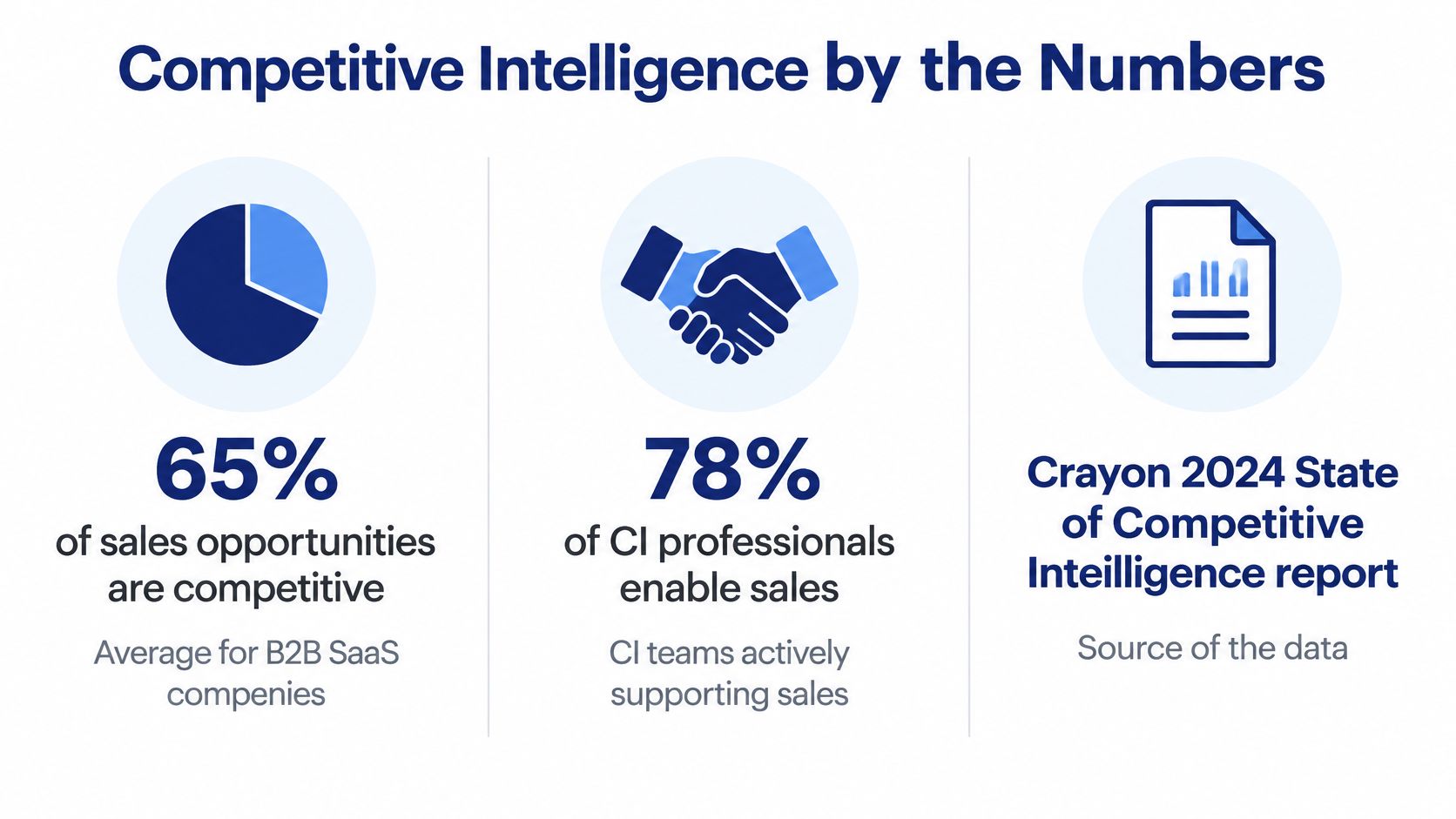
78% of competitive-intelligence professionals enabled sales teams with battlecards in 2024, according to Crayon's State of Competitive Intelligence report. That measures distribution, though, not whether a seller changed a discovery question, challenged an assumption, or won a competitive deal.
If you're deciding how to use competitive intelligence, start with the behavior you want to change. The useful unit isn't a battlecard or an alert. It's a completed workflow with an owner, a time-to-action target, and a deal outcome. More monitoring won't help if nobody knows which signals to trust or what to do next.
How to Run a Decision-First Competitive Intelligence Cycle
For the average B2B SaaS company, 65% of sales opportunities are competitive, while 59% of competitive-intelligence professionals maintain at least 10 battlecards, according to Crayon's 2024 State of Competitive Intelligence report. Competitive context belongs in opportunity planning, not just in the postmortem after a loss.
The failure mode is familiar: a manager forwards earnings clips and a sprawling battlecard, but reps keep using the same talk tracks. The team has collected information without deciding what should change.
Define the decision before collecting evidence
-
Replace broad monitoring with a key intelligence question.
Don't assign someone to track competitor activity. Ask which rival appears in late-stage opportunities, which packaging change could affect renewals, or which capability a rival repeatedly emphasizes.The key intelligence topics process gives managers a practical way to specify their intelligence needs, as described in this peer-reviewed review of competitive-intelligence practice. Give each question an owner, source list, review cadence, and decision rule.
-
Set boundaries around the competition.
Include direct competitors, a class of substitutes, and an emerging alternative. For a workflow-software seller, that might mean competing platforms, outsourced operations, and an internal automation project.
Buyers don't always choose another vendor. They can decide to build, defer, or keep a manual process.
-
Limit the comparison criteria.
Use positioning, product capability, pricing, customer proof, hiring, financial momentum, and implementation risk. Keep a category only when it helps answer the commercial question.If the live objection concerns implementation speed, don't expand the assignment into a complete review of the rival's business. You need evidence about rollout conditions, dependencies, and credible customer outcomes.
Carry the finding into a live opportunity
-
Collect dated public evidence and triangulate consequential claims.
Say prospects repeatedly tell your reps that a rival implements faster. Review the rival's implementation claims, published customer stories, and public documentation.Separate the advertised promise from its conditions. A fast deployment for a narrow use case doesn't establish a fast enterprise rollout with integrations and migration. If independent evidence doesn't resolve that distinction, label the conclusion uncertain.
-
Convert the finding into a seller action.
Write a short response guide rather than a dossier. The opening paragraph should explain the rival's claim fairly; the next should give the rep a discovery question and an approved response supported by your own evidence.Attach an account note with the observed event, implication, confidence, affected stakeholder, and next action. For this objection, the action might be to ask which integrations must be live before the buyer considers implementation complete.
-
Put the hypothesis in the rep's hands before the call.
Distribute the guide only to sellers facing that rival. Ask them to test whether the buyer means technical deployment, user adoption, or measurable business value when they say implementation speed.Record the answer on the opportunity. If the buyer confirms that migration risk matters more than launch speed, the rep should change the deal strategy accordingly.
-
Review actions weekly and outcomes monthly.
In the weekly review, inspect whether the seller used the guidance and what the buyer said. In the monthly review, examine competitive win rate and stage movement.Retire guidance that no longer changes a conversation. Scope creep produces briefs sales won't open; disciplined questions produce guidance reps can use.
Turn Signals into Account Actions
Assign work from a signal map, not from whoever happens to notice an announcement. Treat the response windows below as pilot operating targets, not evidence that every event deserves immediate outreach.
Signal to sales action map
| Signal | Confidence rule | Owner | Act within | Sales action |
|---|---|---|---|---|
| Executive hire or org change | Dated announcement plus a second public source | Account executive | 48 hours | Point-of-view conversation on the new leader's likely priorities |
| Funding round or investor update | Public announcement only; don't infer budget size | AE or sales manager | 48 hours | Outreach tied to the stated use of funds |
| Competitor named in earnings or a late-stage deal | Note the quarter and triangulate the mention | Account executive | 5 business days | Refresh discovery questions and deal strategy |
| Job posting mapped to your product | Initiative signal only, not proof of intent or budget | SDR | 72 hours | Ask what the hire is meant to solve |
| Pricing or packaging change | Dated public source; expire when superseded | AE and CSM | 1 week | Update objection handling and renewal talk tracks |
| M&A or expansion filing | Confirm the filing or release | Sales manager | 48 hours | Trigger an account review and reset stakeholders |
| Hiring surge or tech-stack shift | Label as inference until a second source agrees | Account executive | Weekly review | Form a hypothesis; don't claim a weakness |
Prioritize events that change the account plan
Start with leadership changes and financing announcements because they give the account owner a concrete event to interpret. A new operations leader may warrant a conversation about standardizing regional processes, but a congratulations email doesn't establish relevance.
For funding, use the company's stated use of proceeds. If the announcement names international expansion, discuss the operating requirements of entering those markets. Don't turn a financing amount into an invented software budget.
A competitor mentioned in earnings deserves context before action. Check whether management described a customer, partner, supplier, or rival; those relationships lead to different discovery questions.
Job postings need more restraint. A data-engineering role may indicate an integration initiative, but the useful question is what the hire must solve, not whether the company is ready to buy your platform.
Keep evidence and interpretation separate
Pricing changes deserve a dated refresh of objection handling and renewal guidance. M&A deserves a manager-led review of stakeholders, contracts, and overlapping systems before anyone sends a displacement pitch.
Hiring surges and apparent technology changes remain hypotheses until corroborated. Hiring can indicate demand, a capability gap, or a strategic pivot. The same executive hire can be material to one account and irrelevant to another.
For public-sector opportunities, a resource such as SamSearch's government RFP database can help locate procurement opportunities to investigate. Review the underlying solicitation before translating it into account action, especially its scope, eligibility requirements, and deadlines.
Use account monitoring software to organize the inputs, but keep the qualification decision with the account owner. A detected event isn't automatically a sales task.
Activate only five signal types already appearing in your pipeline. Expand coverage after your team can consistently turn those signals into completed actions.

“We're no longer fishing. We know who the right customers are, and we can qualify them quickly. Salesmotion has had a direct impact on pipeline quality.”
Andrew Giordano
VP of Global Commercial Operations, Analytic Partners
Route Alerts So Reps Act Without Drowning
Unfiltered intelligence can make decisions worse. A Purdue University summary of a questionnaire answered by 124 managers, including senior executives and CEOs in Israeli companies, found that information overload interfered with decision-making and could damage performance; a separate 2024 study of 179 senior managers in Egyptian pharmaceutical companies found that competitive intelligence improved strategic-design collaboration, which supported competitiveness and performance, as covered in the competitive-intelligence embeddedness discussion and empirical study.
The distinction matters. In the Israeli-company findings, embedded intelligence supported customer satisfaction, while its relationship with firm performance operated indirectly through satisfaction. Neither finding gives a sales manager permission to equate more alerts with more revenue.

Give every alert a destination and a decision
Use these routing rules to protect selling time:
- Choose a single action channel. Use Slack or CRM tasks as the rep's queue. Set a daily ceiling based on what the rep can review and act on, rather than forwarding every mention.
- Assign an owner and disposition. Every item needs a named person and a status of do, delegate, or dismiss. A dismissal should explain why the event wasn't relevant.
- Separate verified events from hypotheses. Create opportunity tasks on the signal map's response clock for high-confidence, account-relevant events. Hold weaker inferences for a 20-minute Friday review.
- Avoid copying the whole pod. Give collaborators visibility when needed, but don't confuse visibility with accountability. The named owner remains responsible for the next move.
Say a target account announces an acquisition. The account executive gets the task; the manager joins if territory ownership or stakeholder coverage must change. The SDR doesn't receive a duplicate instruction to send generic acquisition outreach.
Keep the stack lighter than the workflow
Start with public earnings calls, filings, news, job postings, and funding announcements. Add four CRM fields: signal, source date, confidence, and action taken. Keep evidence links in the task or opportunity note.
You don't need another report library. You need a way to distinguish an actionable event from something interesting enough to read later.
Real-time monitoring helps when the event is reliable and relevant to a live account. The operating choice is signal relevance versus volume, not fast monitoring versus slow monitoring.
Practical rule: Embed a few decision-ready signals in the workflow, and stop counting the feed as the program.
Write Outreach from a Real Signal
Accurate competitive information doesn't guarantee better selling. In a three-wave study of 686 customer–salesperson dyads, customer-provided competitive information improved perceived value, share of wallet, and profit margins when sellers used it to position and differentiate, but the benefit depended on adaptive-selling ability and could reverse among low-adaptive sellers, according to the study published in the Journal of the Academy of Marketing Science.
That downside belongs next to the outreach template. A seller who treats an ambiguous event as proof of a competitor's weakness can undermine an otherwise credible conversation.
Use the signal to test a customer-specific hypothesis
Coach this sequence:
- Write a concise competitor hypothesis before the call. State what might matter to this buyer, not everything known about the rival.
- Translate it into a customer implication. Connect the evidence to rollout risk, operating cost, adoption, or another stated priority.
- Prepare two questions that could disprove it. Ask what would make your interpretation wrong.
- Adapt to the buyer's answer. Respect the incumbent relationship and the actual decision criteria.
- Record the result on the opportunity. Capture confirmation, rejection, or uncertainty.
- Compare outcomes later. Evaluate win rate and stage progression against the baseline, rather than praising the email alone.
Consider a hypothetical rival that posts six implementation roles. That's an observation, not proof that it lacks delivery capacity.
Weak email
Your implementation partner is hiring. That suggests they're stretched. Are you open to switching?
The rep has converted hiring into a weakness without evidence. The buyer may know the partner is expanding because business is strong.
Stronger email
Your implementation partner's careers page listed six implementation roles when reviewed on Monday. That may reflect expansion, so I wouldn't assume a delivery issue. Is rollout capacity a constraint for your next launch, or are integrations the bigger concern? If capacity is the issue, I can share an approved customer example showing time to first live workflow.
The seller should insert a real source date before sending and offer only a proof point the team can substantiate. For more message-level guidance, use these principles for sales emails that reference company news.
Let the buyer overturn the interpretation
A newly appointed CRO isn't an automatic rip-and-replace opportunity. Ask what the leader's first two quarters must prove and which current systems support or obstruct that goal.
Require a source date, confidence label, and two independent confirmations before making a consequential claim. Set an expiration or review date so stale evidence doesn't remain in active messaging.
Accurate intelligence becomes a disadvantage when the seller can't adapt it.
Coach one live call a week against this sequence. That's a more useful management intervention than shipping another card without checking how reps use it.
“We have very limited bandwidth, but Salesmotion was up and running in days. The template made it easy to load our accounts and embedding it in Salesforce was simple. It was one of the easiest rollouts we've done.”
Andrew Giordano
VP of Global Commercial Operations, Analytic Partners
Track the KPIs That Prove Influence
Competitive win rate was the most popular CI KPI, and the share of CI leaders measuring program success with KPIs had increased 125% since 2018, according to the survey findings summarized in Infomineo's practitioner framework. The measurement rule is straightforward: alerts, battlecards, and briefs are activity; changed seller behavior and deal outcomes are influence.
Use metrics to make operating decisions
CI impact metrics for a revenue team
| KPI | What to count | How to read it |
|---|---|---|
| Competitive win rate | Competitive deals won divided by competitive deals closed | Most-used CI KPI; compare acted-on signals with ignored signals |
| Signal-to-action rate | Alerts with a logged do, delegate, or dismiss disposition | A low rate means overload or no owner; inspect dispositions separately |
| Time from trigger to outreach | Hours from verified event to first relevant touch | Compare with the baseline and the 48-hour pilot target for executive hires, funding, and M&A |
| CI-influenced opportunities | Opportunities where CRM notes a change in priority, message, or strategy | Don't count an alert that nobody used |
| Stage conversion after a signal | Stage moves within one sales cycle of the touch | Compare with the four-week baseline |
| Win-rate gap | Win rate on completed actions minus win rate on ignored signals | The clearest comparison for whether completed actions are associated with better results |
Use competitive win rate to investigate where guidance helps, not as a company-wide vanity number. Segment by competitor or deal context when the sample supports it.
Treat signal-to-action rate as queue accountability first. Because dismissals count as dispositions, a healthy rate doesn't prove useful selling activity; inspect how many items produced completed outreach or a strategy change.
For response time, use median hours rather than letting a few long delays dominate the picture. Count the first relevant touch, not an automated acknowledgment.
Establish a baseline before celebrating a lift
Baseline four weeks of win rate and median hours-to-touch, then repeat the same window during the pilot. Keep observing stage conversion through a complete sales cycle when deals take longer to resolve.
Choose three metrics for the quarter so managers can act on the dashboard. These signal-based outbound metrics help connect workflow adoption with commercial progress.
In Forrester's survey of 21 organizations, half produced sales battlecards, yet connecting intelligence to measurable business outcomes remained a major hurdle. The win-rate gap helps test that connection, although deal quality, seller skill, and selection bias mean it doesn't prove causation by itself.
A rising alert count with a flat win rate is a warning that the program may still be a content factory. Investigate whether sellers changed anything before increasing monitoring.
Launch a 15-Account Cadence in 30 Days
Run a focused pilot before rebuilding your competitive-enablement library. A 15-account, 30-day cadence is a manageable operating experiment, not a promise that revenue will change within a month.
Select accounts with existing pipeline activity so reps have live decisions to make. A pilot built around dormant accounts may test research coverage without testing whether intelligence helps someone sell.
Finish the Monday setup in one sitting
- Choose 15 target accounts. Favor accounts where the team can identify an active opportunity, a credible expansion path, or a known competitive question.
- Write three intelligence questions from live deals. Use objections, renewal risks, or stakeholder changes that could alter the next conversation.
- Activate the five selected signal types. Leave the rest off until the team demonstrates consistent action.
- Assign one owner per account. Keep the 48-hour response target for executive moves, funding, and M&A.
- Log every action in the CRM. Record what changed, who acted, and what the buyer said.
Before launch, capture the four-week baseline for win rate and median hours-to-touch. Preserve the original cohort rather than replacing difficult accounts with easier ones.
At the end of the pilot, compare signal-to-action rate and time-to-touch with the baseline. Judge commercial influence using the win-rate gap where outcomes are available, and keep following unresolved opportunities instead of declaring success from meetings alone.
Choose tooling around the cadence
Look for coverage of earnings calls, filings, news, job postings, and funding announcements, with delivery into CRM and Slack. Email digests can serve managers who need a summary rather than another live queue; an optional AI-assistant connection can support account preparation.
Salesmotion is one option: our AI account intelligence platform researches accounts, monitors buying signals 24/7, and drafts outreach for B2B sales teams. Intelligence is available in the web app, email digests, Slack, CRM, and through an MCP server connection to an AI assistant. Getting-started help covers account setup, adding the first tracked accounts, and receiving intelligence from the agents.
The tool doesn't replace the manager's operating decisions. Someone still has to select the accounts, approve the interpretation, and coach the conversation.
Intelligence doesn't cause revenue by itself. It changes priority, timing, and the point of view; the rep still runs the conversation.
At the final review, decide which signals deserve continued attention, which response targets were realistic, and which guidance buyers found relevant. Run the 15-account cadence before rebuilding the battlecard library.
Salesmotion offers cited account research, buying-signal monitoring, and draft outreach to help reps turn external events into relevant conversations. Visit Salesmotion to set up your first tracked accounts and put the 15-account, 30-day cadence into practice.