Your launch lead forwards a press release on a Tuesday morning. A competitor has moved its lead asset into Phase 3 in your indication, and the trial has been recruiting for months. Within an hour the questions arrive: how did we miss it, does this change our filing sequence, and who needs to know before the commercial review on Friday?
That gap, between a signal becoming public and a team acting on it, is where life sciences competitive intelligence lives. The clip is never the deliverable. The decision is.
What Life Sciences Competitive Intelligence Really Means
The press release is the last chapter, not the first. By the time a rival announces a Phase 3 start, the registry entry has usually been live for months, the clinical operations job postings have been up for weeks, and the language on the previous earnings call has already shifted.
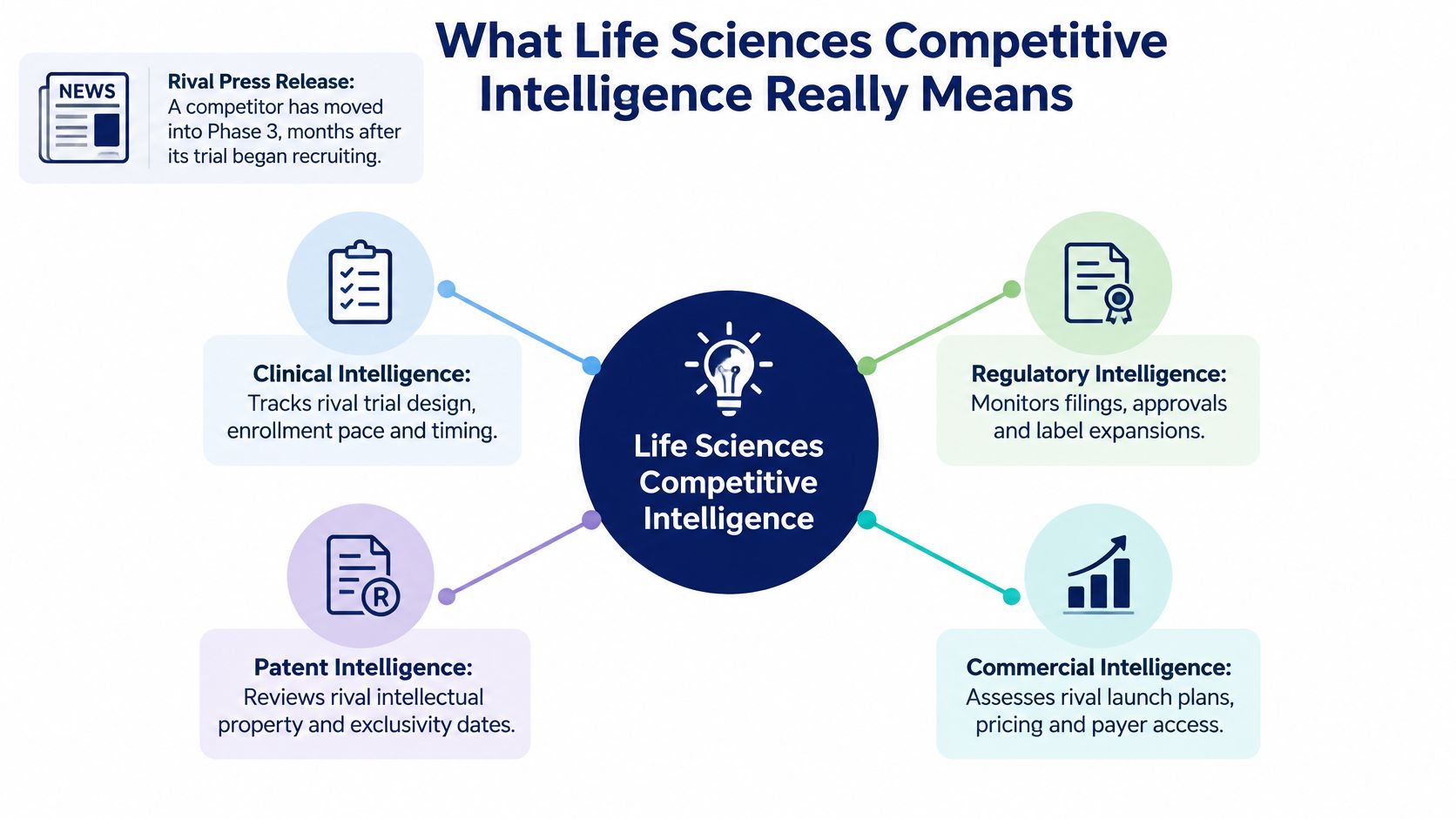
Life sciences competitive intelligence is the continuous, source-backed tracking of what competitors are doing across clinical development, regulatory filings, patents, licensing deals and commercial launch, translated into decisions for R&D, commercial and business development teams. Tracking is the easy half. Translation is the job.
Here's how the four intelligence streams fit together before we go further.
A forecast, not a report
A weather report tells you it rained. A forecast tells you to move Thursday's site visit. Intelligence works the same way. A weekly digest of competitor headlines is a report. A briefing that says a rival's Phase 3 readout will land in the same congress window as your Phase 2 data, so the advisory board should move, is a forecast.
The forecast framing matters because of sheer volume. The IFPMA innovation report counted more than 12,700 medicines in clinical development worldwide as of October 2024, spanning pharmaceutical companies, biotechnology firms, academic institutions and medical research charities. That same report found more than 285 preventive or therapeutic vaccines in development as of July 2024 and noted the FDA had approved six CAR-T products by August 2024. Drawing on Congressional Budget Office figures, it also put FDA approvals at an average of 38 new drugs a year from 2010 through 2019, 60% more per year than the preceding decade, with a record 59 in 2018.
No team reads that volume directly. Teams read the slice that changes a decision.
Why geography belongs in the definition
A competitor can be clinically advanced in one market, seeking approval in another, and protected by different patent positions in each. "Ahead" is not a single ranking, and a program that leads in Europe may be two years from a U.S. filing.
So the discipline answers three questions, every time:
- Which competitor is moving, at asset and sponsor level, not just at company level.
- How far along it is, judged by phase, regulatory status, patent position and launch footprint.
- What that means for our plans, whether that's a protocol design freeze, a launch sequence or a licensing conversation.
Write those three questions into your team charter. If a monitoring feed can't answer them, it's a news service, not an intelligence function.
Sources to Monitor and How to Link Them
A trial registry update means little on its own. That same update, read next to a hiring post and one sentence from an earnings call, can tell you exactly when a competitor will need a partner. Six source types carry most of the load. Each has a personality, a rhythm and a blind spot.
| Source | What it reveals | Typical change pattern | Main limitation |
|---|---|---|---|
| Clinical trial registries | Trial starts, phases, endpoints, sites, enrollment and status | Updated as sponsors amend records; status changes are often the earliest visible move | Records can lag reality and rarely explain strategy |
| FDA and EMA decision records | Approvals, labels, review classifications and review timing | Changes at decision dates and label updates | Public only after decisions; silent during review |
| SEC filings and earnings calls | Pipeline guidance, budget language, partnering intent and risk disclosures | Quarterly, plus filings around material events | Management language is often cautious and vague |
| Patent and PCT databases | Filing activity, claim scope and jurisdictions | Published with a lag after filing | Filing does not equal a product or launch |
| Press releases and conference abstracts | Data readouts, milestones and scientific direction | Clustered around congresses and deal announcements | Companies choose what to highlight |
| Job postings | Clinical, regulatory, manufacturing and commercial hiring | Continuous, often weeks before a program becomes visible | Postings may be replacements rather than growth |
Filings deserve a note on scale, because the budget language inside them maps to real programs. The Congressional Budget Office reported that pharmaceutical companies spent approximately $83 billion on research and development in 2019. When a company shifts that kind of spending between therapeutic areas, the earnings call usually says so in softer words first.
Where three weak signals become one picture
Individual items mislead. Linked items explain. A connected data model connects trial registrations to intervention names, mechanisms, sponsors, phases, endpoints, enrollment, geography, status changes, publications, regulatory decisions and patents, which is what makes cause-and-effect analysis possible, as Clarivate's life sciences data overview sets out, with one indexed source describing coverage of more than 625,000 trials and linked patent, regulatory, literature and company data.
Say a mid-size oncology sponsor registers a trial across Spain, Poland and Brazil within six weeks. It also posts four clinical operations roles asking for regional start-up experience. On its earnings call, the finance lead mentions "evaluating partnership options for ex-U.S. commercialization." Alone, each item is thin. Together they describe a launch-readiness push into markets the company can't cover alone, which is a partnership conversation with a date attached. Anyone tracking this pattern will recognise it, and there's a useful walkthrough of it in this guide to clinical trial intelligence.
The example also shows why linking matters for accountability. Each of those three signals should carry a name next to it: who owns the watch, who gets alerted, and what decision it feeds. Six weeks later, someone should be able to look back and ask whether the partnership read was right. A feed that can't answer that question is delivering news, not intelligence.
Entity resolution is the operational requirement nobody budgets for. The same asset appears as a code name in one registry entry, a generic name in a patent, a subsidiary as the sponsor and a licensing partner in a press release. Miss those joins and you get duplicate records and an account narrative that falls apart in the meeting.
Score every signal on recency, evidence strength, strategic relevance and potential commercial impact, and keep the underlying source and timestamp attached. Earnings calls are the messiest source of the six because intent hides inside careful phrasing, so reading outside guidance helps. Artul.ai's browse insights on earnings communication covers how companies pair the call with the release and what the wording tends to give away. Whatever the source, store three things every time: the value, the date you captured it, and the link to the original record.

“Salesmotion has been a game-changer for me. I used to spend 12 hours a week on prospect research, now it's down to 4. Plus I'm finding stuff I was totally missing - podcasts, news mentions, the good bits.”
George Treschi
Account Executive, FY25 President's Club, Sigma
Regulatory and Legal Limits on Collection
The instinct to collect everything is the fastest way to build a program that gets shut down. Regulatory knowledge is part of intelligence, not a compliance afterthought, because approval status and actual availability decide whether a rival is a threat this quarter or in three years.
Biosimilars make the point better than any other category. A peer-reviewed overview of biosimilar competition reported that over the 13 years preceding publication, the European Medicines Agency had received 65 biosimilar marketing-authorization applications and approved 55 biosimilars available in the EU market. In the United States, the FDA had granted 26 biosimilar approvals, but only 11 were on the market at the time of the analysis. Adalimumab tells the story: although the FDA had approved biosimilar versions, Humira's exclusivity and patent protections delayed U.S. commercialization, with the first adalimumab biosimilar not expected to launch until 2023.
The line to hold: "Approved" describes a regulatory file. "Available" describes a market. Only the second one takes prescriptions away from you.
The boundary is not grey, it's just unglamorous
| Information type | When it applies | Practical rule |
|---|---|---|
| Public registries, filings and published results | Trial records, SEC filings, approvals, press releases | Collect freely; log the source link and capture date |
| Material non-public information | Insider knowledge from deals, financing or unreleased data | Do not use; escalate to legal and compliance immediately |
| Confidential material from third parties | Former employees, vendors, customers or expert networks sharing private documents | Decline the material; keep interviews to general market views |
| Personal data on named contacts | Lists of clinicians, investigators or executives | Check consent and local data rules before storing or contacting |
| Competitor data used in external materials | Sales decks, publications, payer dossiers | Route through medical, regulatory and legal review; cite the source |
| Approved but not commercially available | Biosimilars, delayed launches, exclusivity periods | Verify launch dates, patents and access before calling it a threat |
Two habits keep a program clean without slowing it down. First, every item carries its source and capture date, which makes the "where did this come from" question a thirty-second answer rather than an investigation. Second, anyone can escalate a doubtful input to legal before it enters the repository, and nobody gets penalised for asking.
A simple test works for the borderline cases: if you would not want the document quoted on the front page of a trade publication, it doesn't enter the repository. General market views from an expert conversation are fine. Their slide deck is not.
Reading Trial and Regulatory Signals Correctly
A single event is a data point. Two or three that point the same way is a decision input. The skill is in knowing which deltas matter and what they usually mean before topline data exists.
Status changes do the early work. A trial moving from recruiting to active, not recruiting suggests enrollment is complete and a readout is closer. A protocol amendment that rewrites the primary endpoint points to a strategy reset or an ongoing regulatory dialogue. A sudden spread of recruiting countries signals preparation for regional filings. A new trial in an adjacent indication hints at platform reuse. Each one justifies reopening the launch timing question.
What an approval actually tells you
In 2024, the FDA's Center for Drug Evaluation and Research approved 50 novel drugs, and 37 of them, or 74%, cleared on the first review cycle, according to the FDA's 2024 novel drug approvals summary. First-cycle approval is a timing signal as much as a scientific one: it means the competitor's commercial organization has probably been building in parallel, and payer conversations have already started.
The evidence base under an approval is thinner than commonly assumed. A PLOS ONE analysis of 2024 FDA novel-drug approvals found the average number of trials supporting an approval had fallen to 1.39, with 69.4% of products approved on a single trial and only 5.6% on three or more. That makes one central study unusually informative. Read its endpoint, comparator, population and enrollment line by line, because that study may be most of the public evidence anyone has.
Application type is the third layer. In fiscal year 2024, the FDA reported average staff effort of 7,718 full-time-equivalent hours for PDUFA new molecular entity and biologics-license applications, against 2,869 hours for applications that were not NMEs, with total average review effort across reported categories at 10,587 hours, up from 9,821 hours in FY2023, per the FDA's review effort report. A competitor's filing classification therefore hints at how intense, and how slow, its review is likely to be. If the filing-to-decision mechanics matter to your pipeline, this primer on PDUFA, NDA and BLA sales triggers is worth bookmarking.
| Event | What it may signal | First check |
|---|---|---|
| Phase 2 moves to Phase 3 with a broader population | Confidence in efficacy or a plan to widen the market | Compare eligibility criteria and biomarker rules across versions |
| Recruiting changes to active, not recruiting | Enrollment complete and a readout moving closer | Check the primary completion date and any new results postings |
| Protocol amendment changes the primary endpoint | Strategy reset or a regulatory dialogue under way | Compare prior and current protocol text line by line |
| New recruiting countries added | Preparation for regional approvals or launches | Check the site list against known regulatory filing markets |
| FDA approval on the first review cycle | Commercial launch likely within months | Check label scope, launch statements and payer-facing activity |
| New trial in an adjacent indication | Platform reuse or a second-line strategy | Check mechanism, sponsor and shared biomarker criteria |
Write the alert with the changed field, the prior and current values, the source link, a confidence level and one analyst paragraph explaining what it would take to make the change meaningless.
That last element is what separates an alert from a notification. A headline says a competitor expanded a trial. An interpretation says the expansion adds 40 sites in markets with no reimbursement pathway, which suggests regulatory positioning rather than a commercial push.

“The Business Development team gets 80 to 90 percent of what they need in 15 minutes. That is a complete shift in how our reps work.”
Andrew Giordano
VP of Global Commercial Operations, Analytic Partners
How to Build a CI Program That Teams Use
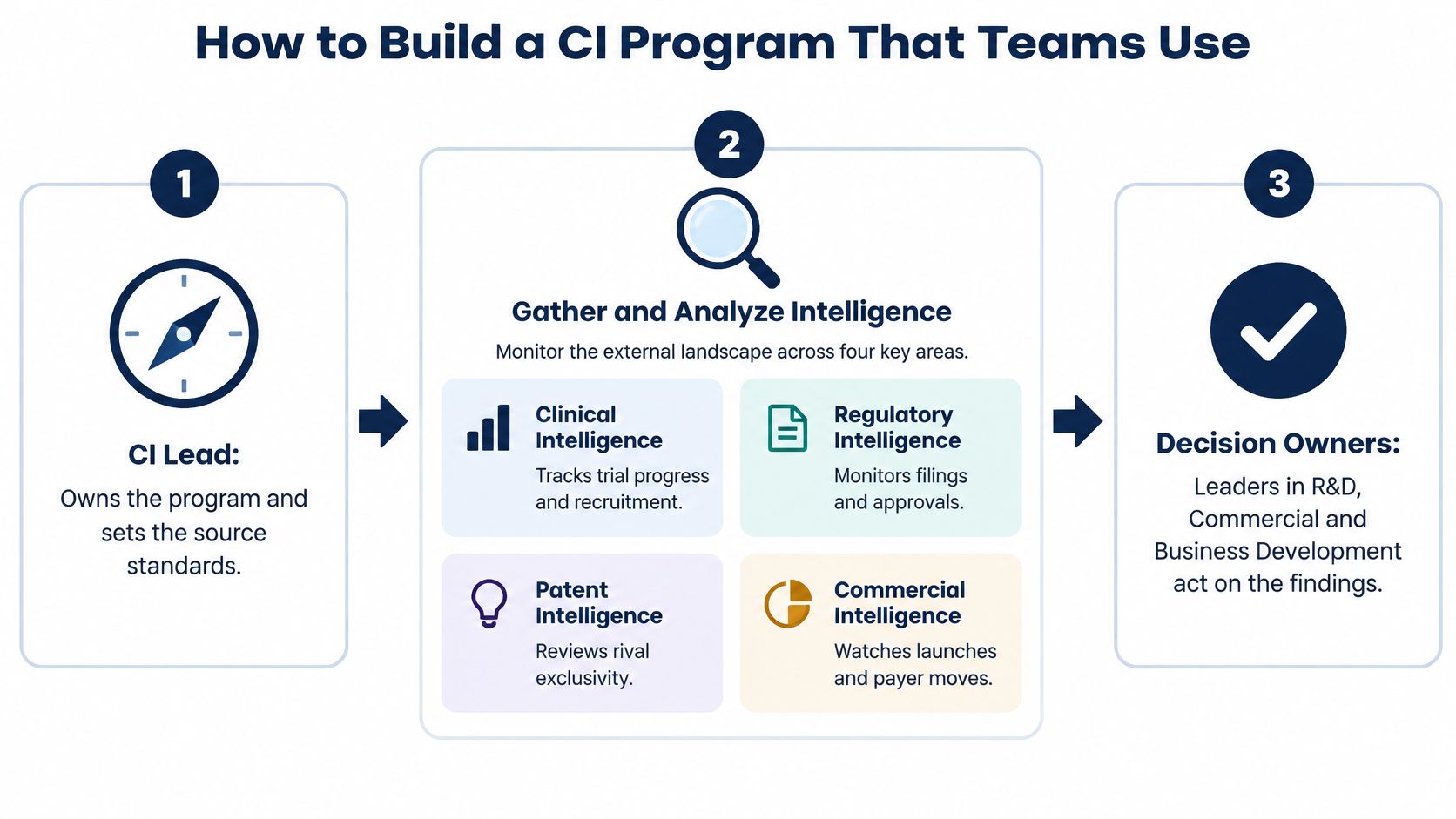
Roles first, because programs fail on ownership long before they fail on data. A CI lead owns the source standards and the decision calendar. Analysts specialise, usually two people covering clinical and regulatory and patent and commercial between them. Decision owners in R&D, commercial and business development agree in advance which questions they need answered and when.
External support is normal rather than a sign of weakness. In 2024, life sciences companies engaged external competitive-intelligence vendors during the preclinical, Phase 1 or Phase 2 stages 64% of the time, according to Sedulo Group's survey reporting. Program design matters as much as resourcing: Sedulo Group's annual survey on the strategic impact of CI found that 64% of larger life sciences organizations with more than 1,000 employees had integrated competitive intelligence into strategic planning. Build the program inside the planning cycle, not next to it.
The six steps, in order
- Collect from the named sources on a fixed rhythm, so the team stops relying on whoever happened to see a press release.
- Validate every item against a primary record. If the registry entry and the press release disagree, the registry wins.
- Score on recency, evidence strength, strategic relevance and commercial impact. A four-point scale beats a paragraph of adjectives.
- Brief in the format the decision needs, which is usually two pages, not twenty.
- Act: name the owner and the date in the brief itself, because unassigned intelligence expires.
- Review what happened, monthly, and keep the record of who acted on what.
Here's how those roles and steps connect in practice.
Tools should stay boring. One shared repository holding the value, source, timestamp and owner for each signal. One alert channel that routes into the place the team already works, whether that's the CRM, Slack or a weekly email. One monthly review of which alerts were acted on and which were noise.
The minimum setup for a small team
For three to five people, skip the platform purchase in month one. Appoint the lead, pick two therapy areas, name ten competitors, and stand up the repository in a spreadsheet with four columns. Add a decision calendar listing the portfolio, launch and licensing decisions coming in the next 90 days. That's enough to run the cycle for a quarter and learn where it breaks.
Measuring Whether CI Changes Decisions
Only 46.1% of CI leaders describe competitive intelligence as playing a critical and consistent role in strategic planning, even though 91% expect its importance to stay steady or grow over the next five years, according to Sedulo Group's life sciences CI survey report. Awareness isn't the bottleneck. Proof is.
The fix is a log rather than a louder dashboard. For every alert the team acts on, record the signal, the date it was known, the decision owner, the decision taken, and the outcome reviewed at a fixed point such as 90 days later. The log answers the audit question. Four metrics answer the influence question:
- Coverage: the share of decisions with logged evidence and a named owner.
- Speed: the share of alerts acted on within the agreed window.
- Influence: the number of decisions where intelligence changed the plan.
- Outcome shifts: fewer late messaging changes, faster protocol amendments, earlier stakeholder engagement.
| Metric | Reported value | Source or owner |
|---|---|---|
| CI leaders describing CI as a critical and consistent role in strategic planning | 46.1% | Recent CI leader survey |
| CI leaders expecting CI's strategic importance to stay steady or grow over five years | 91% | Recent CI leader survey |
| Larger life sciences organizations (over 1,000 employees) with CI built into strategic planning | 64% | Sedulo Group 2024 survey |
| Decisions with logged evidence and a named owner | Rule: 100% of decisions acted on | Internal decision log |
| Alerts acted on within the agreed window | Rule: window agreed when the alert is issued | Internal decision log |
What to report: that an alert preceded a change, not that it caused one. Let the 90-day review judge whether the change helped.
For anyone connecting this to revenue outcomes, the same logic applies to sales intelligence measurement, and there's a practical framing in this piece on the ROI of sales intelligence tools. Review the numbers monthly. If influence is flat while coverage climbs, the team is producing reading material, not intelligence.
Commercial and R&D Playbooks to Run First
Two playbooks cover most of the value in the first quarter. Both end in the same place: a record of what was known, when, who acted, and whether it helped.

Playbook one, commercial launch readiness
- Capture the scope of the approval. Note the approved population, the label language and any launch statements in the same file, because a narrow label tells a different commercial story than a broad one.
- Compare payer and prescriber messaging with your own, line by line. Differences in access framing usually surface before differences in share.
- Check regional filings and access signals. A U.S. approval with no EU submission is a different threat than one with both.
- Brief the field team within two weeks using a one-page comparison, since field memory for anything longer is short.
- Record what changed in your messaging, and who approved the change. That entry is the evidence that the intelligence did something.
Playbook two, R&D protocol benchmarking
When a rival registers a trial, compare the dimensions that decide how the two programs will be read side by side: mechanism of action, line of therapy, biomarker criteria, comparator arm, dosing schedule, endpoints, enrollment target, geographic footprint and expected readout timing. Frameworks used in industry analysis emphasise exactly this kind of validated comparison of trial design, endpoint selection and sponsor positioning, as this clinical landscape analysis framework sets out.
- Convergence is a warning. Repeated use of the same endpoint and patient segment across sponsors suggests crowded competition and a harder differentiation story at launch.
- Divergence is a claim. A novel endpoint, an unusual combination partner or an underserved subgroup often signals an attempt to own a clinical narrative rather than win on efficacy alone.
Review your own protocol against that benchmark before the next design freeze, and log the decision with the evidence behind it. The commercial version of this work is covered in this guide to pharma market intelligence, which maps the same signals onto launch planning.
One caution on ambition. Tie each playbook to a single measurable outcome, such as faster protocol amendments or fewer late messaging changes, and resist the urge to claim every alert produced a result. The trail is what makes the claim credible later.
Start Your First 90-Day CI Sprint
Ninety days is enough to prove the model works, provided the scope stays small and the questions stay decision-shaped.
Days 1 to 30. Name the CI lead. Agree three decision questions with the commercial and R&D owners who will use the output, such as whether to accelerate enrollment or shift a launch sequence. Pick ten competitors and two therapy areas, and write them down so scope creep has something to bump against.
Days 31 to 60. Stand up the repository with value, source, timestamp and owner fields. Switch on alerts for trial status changes and FDA or EMA decisions. Run the two playbooks on the closest competitor, even if the output is imperfect, because the first pass teaches you what the second pass needs.
Days 61 to 90. Score the first month of signals on recency, evidence strength, strategic relevance and commercial impact. Review which alerts were acted on, drop the sources that produced nothing usable, and decide what to automate. Keep the roles from the program build, so the sprint adds process rather than headcount.
If the team would rather offload the monitoring layer, that's a reasonable trade. Salesmotion's Life Sciences module watches for trial starts, phase moves or raises that open a buying window for CRO, CDMO and lab business development teams, which covers the collection work while the decision questions and the log stay in-house.
At day 90, run the only test that matters: count the decisions that changed, not the articles that were read.
Life sciences competitive intelligence only pays off when a signal reaches someone who can act on it, and that's the part Salesmotion is built for. Our agents scan news, filings, hiring activity and dozens of other sources across your target accounts, detect buying signals like trial starts, phase moves and funding rounds, and deliver a brief with the "so what" already spelled out and every claim linked to its source. If you want your team spending its time on decisions instead of monitoring, visit Salesmotion and see how it works on your own account list.