Every CRO and pharma sales team talks about competitive intelligence. Almost none of them have a system that works. The typical setup: a small commercial team manually building battle cards from ClinicalTrials.gov searches, SEC filings, and Google alerts, then stuffing the results into a shared drive nobody checks. By the time the battle card reaches a rep, the data is weeks old, the competitor has already announced their Phase III results, and the conversation is over before it starts. Life sciences competitive intelligence is broken not because teams lack data, but because the manual processes they rely on cannot keep pace with how fast the market moves.
TL;DR: ClinicalTrials.gov is a lagging indicator for competitive intelligence. By the time a trial is registered, hiring patterns, patent filings, and strategic partnerships have already signaled the move months earlier. Leading life sciences sales teams are replacing manual battle card creation with automated signal monitoring that surfaces competitive shifts in real time, not quarterly.
ClinicalTrials.gov Is a Lagging Indicator (and Everyone Knows It)
CRO sales leaders will tell you privately what they will not say in public: ClinicalTrials.gov is too late. The database is invaluable for regulatory compliance and academic research, but as a competitive intelligence source for sales teams, it has a fundamental timing problem.
Under federal law, sponsors must register interventional studies within 21 days of enrolling the first participant. But that registration happens after the sponsor has already selected CRO partners, negotiated contracts, hired clinical operations staff, and begun site selection. The commercial decision is made long before the trial shows up in the database.
Results reporting is even worse. According to NIH enforcement data, only 37% of required trials met the one-year reporting deadline, and the median tardiness was 400 days. That means competitive outcomes from completed trials can lag by more than a year.
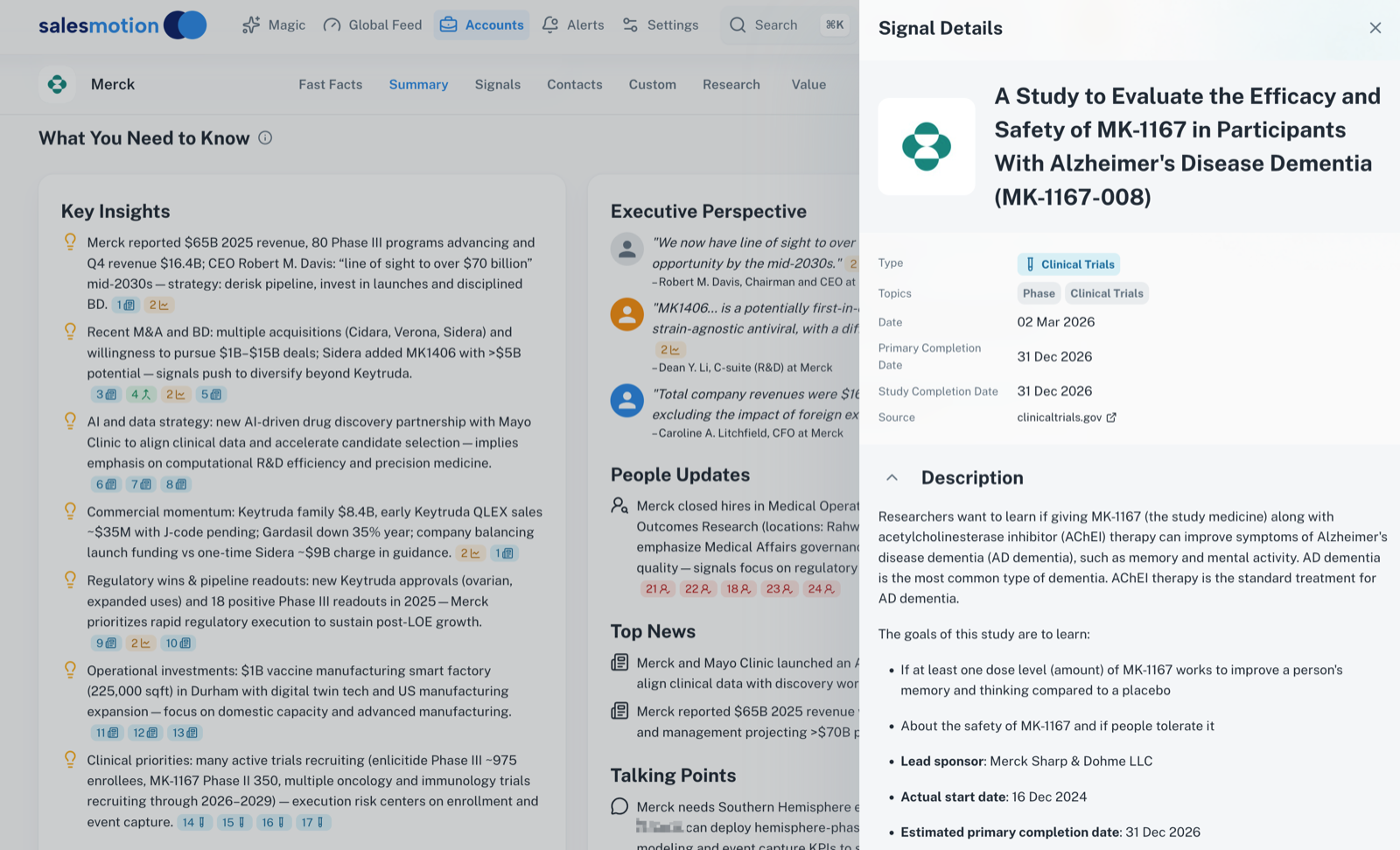 Clinical trial intelligence embedded directly in the account view, replacing manual ClinicalTrials.gov searches.
For sales teams selling into pharma and biotech, this creates a dangerous blind spot. If you are waiting for ClinicalTrials.gov to tell you that a prospect is ramping a new program, you are seeing the signal after the budget has been allocated, the vendor shortlist has been built, and the decision is nearly made.
The teams winning these deals are looking at earlier signals: hiring surges in clinical operations roles, patent filings in new therapeutic areas, earnings call language about "pipeline acceleration," and executive hires that signal commercial readiness. These leading indicators surface 3 to 6 months before a trial hits ClinicalTrials.gov.
How Do Hiring Signals Predict Clinical Pipeline Activity?
The strongest early indicator of a pharma company's clinical pipeline direction is not a press release or a database entry. It is their hiring activity.
When a mid-cap biotech starts posting roles for Clinical Research Associates, regulatory affairs specialists, and medical science liaisons in a specific therapeutic area, they are telegraphing their next move. Each clinical trial phase requires distinct staffing: Phase I needs pharmacology expertise, Phase II needs biostatisticians and protocol designers, and Phase III requires armies of clinical research associates, site monitors, and data managers.
This pattern is well documented. According to IntuitionLabs research on the biopharma job market, regulatory hiring tracks directly with the product pipeline, as companies approaching approval stages ramp up compliance and regulatory affairs teams. Pharmacovigilance hires spike when compounds move through clinical phases and adverse event reporting volume increases.
For a CRO sales team, this is gold. A pharma company posting 15 clinical operations roles in oncology is not doing so for fun. They are preparing for a trial, and they will need CRO services, technology platforms, and operational support.
Here is a concrete example of how this plays out:
The signal: A mid-cap pharma company posts 12 new roles in a two-week span: 8 Clinical Research Associates, 2 Senior Biostatisticians, 1 Director of Regulatory Affairs, and 1 VP of Medical Affairs. All role descriptions reference "oncology" and "Phase III readiness."
The research: Your intelligence platform flags the hiring surge and cross-references it with recent patent filings showing the company secured composition-of-matter patents for a novel checkpoint inhibitor 14 months ago. Earnings call transcripts from the last quarter mention "advancing our lead oncology asset toward registrational studies." The company's largest revenue-generating drug, a cardiovascular blockbuster, faces patent expiration in 18 months.
The outreach: Your rep now has a clear picture. This company is under patent cliff pressure, investing aggressively in oncology as their next growth engine, and staffing for Phase III. The rep references the pipeline expansion, the operational scaling challenge, and the timeline pressure in their outreach. No generic pitch. A conversation grounded in what the company is actually doing.
The result: Instead of competing with 10 other vendors who all saw the ClinicalTrials.gov registration two months later, your team engaged during the planning phase when the company was still building their vendor evaluation criteria.

“Salesmotion is helping Cytel elevate our enterprise sales performance by embedding account intelligence directly into our workflow. The platform gives our commercial team real-time visibility into key account movements.”
Jonathan Burr
Chief Commercial Officer, Cytel
The Patent Cliff Is Rewriting the Competitive Playbook
The pharmaceutical patent cliff is not a future risk. It is happening right now, and it is reshaping how every life sciences sales team should think about competitive intelligence.
According to CNBC, big pharma companies are racing to acquire biotech assets as more than $170 billion in revenue faces patent exposure. Broader industry estimates from DeepCeutix put the figure at over $300 billion in prescription drug revenues losing patent protection between 2025 and 2030, roughly one-sixth of the industry's annual revenue.
2026 is a critical inflection point. Key patents on billion-dollar drugs across diabetes, cardiovascular disease, immunology, and oncology are expiring. Bristol Myers Squibb alone faces approximately $38 billion in at-risk revenue from Eliquis and Opdivo patent expirations. Merck and Pfizer are similarly exposed.
What does this mean for sales teams?
Companies losing patent protection are buying. They need to cut costs, consolidate vendors, and reinvest savings into pipeline development. If you sell operational efficiency tools, analytics platforms, or commercial enablement technology, these companies are in active evaluation mode.
Companies with thin pipelines are acquiring. In 2025, 193 M&A transactions totaling $220 billion took place in the pharma space, according to Ropes & Gray analysis, surpassing the prior year's total deal value. Every acquisition creates integration challenges, new commercial strategies, and technology purchasing decisions.
CROs are picking up the complexity. The global CRO market is expected to reach $125.95 billion by 2030, growing at 8.3% annually from $84.61 billion in 2025, according to MarketsandMarkets. As pharma companies outsource more clinical operations, the CROs servicing them need competitive intelligence to position against each other and identify which sponsors are about to increase outsourcing.
The sales teams that understand this dynamic can read a patent cliff timeline and predict the buying behavior that follows: vendor consolidation, efficiency investments, M&A-driven technology evaluations, and expanded outsourcing to CROs.
Why Do Manual Battle Cards Fail in Life Sciences?
Battle cards should be the competitive intelligence delivery mechanism for sales teams. In practice, they are where competitive intelligence goes to die.
The problem is structural. Life sciences competitive intelligence is not static. A competitor's pipeline can shift with a single FDA Complete Response Letter. A licensing deal can reshape the competitive landscape overnight. A Phase III failure can eliminate a competitor or create a new one.
Research from Lifescience Dynamics found that traditional competitive intelligence methods relying on manual literature reviews and human-curated databases cannot keep up with the volume and velocity of information in the industry. With over 500,000 clinical studies registered globally and more than 20,000 active drug programs, the manual approach simply does not scale.
Consider what a typical CRO competitive intelligence workflow looks like:
- A product marketing manager or sales ops analyst manually searches ClinicalTrials.gov, FDA databases, and PubMed for competitor activity
- They compile findings into a PowerPoint or PDF battle card
- The battle card is uploaded to a shared drive or enablement platform
- Reps may or may not find it, and by the time they do, the data is 2 to 4 weeks old
- The cycle repeats quarterly, sometimes monthly if the team has bandwidth
The gap between "intelligence gathered" and "intelligence used in a conversation" is where deals are lost. Data on battle card effectiveness from Klue shows that 65% of sales reps at mid-market companies report their battle cards are outdated or irrelevant. Meanwhile, teams that update competitive content weekly see 15% higher win rates.
The math is simple. A small commercial team cannot manually track 50 competitors across thousands of clinical trials, patent filings, hiring signals, earnings calls, and regulatory actions, then distill that into battle cards that stay current. The volume of data exceeds human capacity.
This is where automated competitive signal monitoring changes the equation. Platforms like Salesmotion continuously track hiring activity, earnings language, patent filings, leadership changes, and news across your competitive landscape and deliver that intelligence directly to reps. Instead of a quarterly battle card, reps get a living competitive brief that updates as the market moves, not when someone has time to update a slide deck.
See Salesmotion on a real account
Book a 15-minute demo and see how your team saves hours on account research.
What Intelligence-Driven Life Sciences Teams Do Differently
The highest-performing life sciences sales teams share a set of practices that separate them from competitors still running manual processes.
They monitor leading indicators, not lagging databases. Instead of waiting for ClinicalTrials.gov registrations or FDA announcements, they track the signals that precede those events: hiring patterns, patent filings, conference abstract submissions, earnings call language, and executive appointments. (For a full breakdown of which sources to monitor, see our guide to account research for life sciences sales.) A new VP of Commercial Operations at a pharma company is a stronger buying signal than a trial registration because it signals budget authority and technology evaluation.
They map the patent cliff to account prioritization. Teams that understand which prospects face patent expirations in the next 18 to 24 months can predict buying behavior. Companies approaching a cliff are more likely to consolidate vendors, invest in efficiency, and increase outsourcing. This is account prioritization based on market dynamics, not just firmographic fit.
They use competitive intelligence as a conversation tool, not a reference document. The best reps do not check a battle card before a call. They walk into conversations already knowing what their prospect's competitors announced last week, which therapeutic areas are gaining investment, and what operational pressures are building. That depth of context is what earns a second meeting.
They connect clinical pipeline data to commercial readiness signals. A Phase III readout is a clinical milestone, but it is also a commercial trigger. Companies approaching launches need field force enablement, CRM systems, analytics platforms, and operational infrastructure. Teams that connect the clinical timeline to the commercial buying cycle can engage 6 to 12 months earlier than competitors who wait for the RFP.
Cytel, a life sciences analytics company, consolidated five research tools into a single platform and cut account research time by 50%. Their commercial team now gets real-time visibility into account movements instead of relying on manually assembled competitive briefs.
Building a Life Sciences Competitive Intelligence Stack That Scales
If your team is still running competitive intelligence through manual processes, here is a practical path to modernizing the workflow.
Start with signal categories that matter most in life sciences:
- Hiring signals: Clinical operations, regulatory affairs, commercial leadership, medical affairs
- Financial signals: Earnings call language about pipeline progression, R&D spending changes, commercial investment
- Patent and IP signals: New filings, expiration timelines, licensing agreements
- Regulatory signals: FDA submissions, PDUFA dates, Complete Response Letters, advisory committee meetings
- M&A and partnership signals: Acquisitions, licensing deals, CRO contract awards
- Leadership signals: C-suite changes, especially Chief Commercial Officer, Chief Medical Officer, and VP-level hires in commercial functions
Prioritize accounts by patent cliff exposure and pipeline maturity. Companies facing the largest revenue declines from patent expirations are under the most pressure to act. Cross-reference that with pipeline data: a company with both patent cliff pressure and a strong late-stage pipeline is in active investment mode.
Replace quarterly battle card cycles with continuous monitoring. The goal is not to eliminate battle cards. It is to make them self-updating. When your competitive intelligence platform automatically flags a competitor's new trial registration, leadership hire, or earnings commentary, the information flows to reps without a manual update cycle.
Connect intelligence to outreach timing. The window between a leading signal (hiring surge, patent filing) and a lagging event (trial registration, FDA action) is where the best conversations happen. Time your outreach to the leading signal, not the public announcement.
Key Takeaways
- ClinicalTrials.gov is a lagging indicator for competitive intelligence. By the time a trial is registered, the commercial decisions driving it were made months earlier. Track hiring, patents, and earnings language instead.
- Hiring signals are the strongest leading indicator of clinical pipeline direction. A pharma company staffing for Phase III in a new therapeutic area is telegraphing their next 18 months of purchasing decisions.
- The pharmaceutical patent cliff, with $300 billion or more in revenue losing protection by 2030, is creating urgency across the industry. Companies facing patent expirations are actively buying operational efficiency tools and consolidating vendors.
- Manual battle cards fail at scale because life sciences competitive data changes faster than any team can manually track across thousands of trials, patents, and regulatory actions.
- Intelligence-driven teams monitor leading indicators, map patent cliff exposure to account prioritization, and time outreach to signals that precede public announcements.
- Automating competitive signal monitoring with tools like Salesmotion eliminates the gap between intelligence gathered and intelligence used in conversations.
- For teams evaluating broad market intelligence providers, our GlobalData alternatives guide compares options across coverage, pricing, and life sciences depth.
Frequently Asked Questions
What are the best leading indicators for life sciences competitive intelligence?
Hiring activity in clinical operations and regulatory affairs roles, patent filings in new therapeutic areas, earnings call language about pipeline progression, and executive appointments in commercial functions are the strongest leading indicators. These signals typically surface 3 to 6 months before public events like ClinicalTrials.gov registrations or FDA announcements. Research on biopharma hiring trends confirms that regulatory hiring tracks directly with the product pipeline.
How does the patent cliff affect B2B selling into pharma?
The patent cliff, with over $300 billion in revenue at risk by 2030, creates two selling opportunities. Companies losing patent protection need to cut costs and reinvest in pipeline development, making them active buyers of efficiency and analytics tools. Companies with thin pipelines are acquiring assets, creating integration challenges and new technology purchasing decisions. Mapping patent expiration timelines to your target account list helps prioritize outreach to companies under the most pressure to act.
Why do manual battle cards become outdated so quickly in life sciences?
Life sciences competitive intelligence involves tracking thousands of data points across clinical trials, FDA actions, patent filings, earnings calls, hiring patterns, and M&A activity. Industry analysis from Lifescience Dynamics shows there are over 500,000 registered clinical studies and 20,000 active drug programs globally, a volume that exceeds what manual processes can track. A single FDA decision or Phase III failure can reshape the competitive landscape overnight, making weekly or quarterly update cycles too slow.
How can CRO sales teams use competitive intelligence to win more business?
CRO sales teams can differentiate by tracking which pharma sponsors are ramping new programs (through hiring and patent signals), identifying companies under patent cliff pressure that are likely to increase outsourcing, and engaging during the planning phase before trials are publicly registered. The global CRO market is growing at 8.3% annually to an expected $125.95 billion by 2030, meaning more competition for sponsor contracts and a greater premium on early, well-informed engagement.