Most sales teams treat losing leads like weather. Something that just happens. But when Workato tested 114 B2B companies on their lead response behavior, they found that zero called within five minutes and only one sent a personalized email in that window. The average response took nearly 12 hours. Three-quarters of buyers choose whoever reaches out first, regardless of price or brand. Losing leads is not a market problem. It is an execution problem.
TL;DR: B2B teams lose leads because of slow response times, poor qualification, inconsistent follow-up, and a lack of real-time account intelligence. The fix is not more leads. It is faster, smarter engagement with the leads you already have, backed by signals that tell you when and why to act.
Why Losing Leads Costs More Than You Think
The financial impact of losing leads goes far beyond the missed deal. Consider the compounding costs: marketing spend to generate the lead, SDR time to qualify it, and pipeline forecasts built on opportunities that quietly evaporate. When 79% of leads never convert due to poor nurturing, according to Martal Group's 2026 benchmarks, that is not a funnel leak. It is a structural failure.
Here is what makes it worse. Your lost leads do not disappear. They go to competitors who responded faster, followed up smarter, or simply showed they understood the prospect's situation. In B2B sales, where deals require an average of 31 touchpoints before closing, every dropped interaction sets you further behind.
The real cost calculation looks like this:
| Cost Component | What It Represents |
|---|---|
| Acquisition cost | Marketing spend per lead ($50-$500+ in B2B) |
| Opportunity cost | Revenue from the deal the competitor won |
| Velocity cost | Pipeline slowdown from having to replace lost opportunities |
| Morale cost | Rep frustration from working leads that go nowhere |
Sales leaders who focus only on lead volume miss the point. The highest-performing teams obsess over lead retention, not just lead generation. Improving conversion on existing leads by even 10% typically delivers more revenue than increasing top-of-funnel volume by 50%.
See Salesmotion in action
Take a self-guided interactive tour — no signup required.
The 7 Reasons Your Leads Go Cold
1. You Are Too Slow to Respond
The data here is damning. Businesses that respond within five minutes are 100x more likely to connect and convert than those who wait an hour. Yet 63% of companies never respond at all. And the problem is getting worse: in 2011, 23% of companies failed to respond. By 2024, that number had nearly tripled.
Speed-to-lead is the single biggest controllable factor in lead conversion. When a prospect fills out a form, they are actively thinking about their problem right now. An hour later, they have moved on to the next meeting, the next fire drill, the next vendor.
2. Your Qualification Process Is Broken
Not all leads deserve equal attention. But when only 56% of B2B companies verify leads before passing them to sales, nearly half of SDR and AE effort goes to accounts that were never going to buy.
Broken qualification shows up in two ways. First, unqualified leads flood the pipeline, diluting rep attention. Second, genuinely qualified leads get the same generic treatment as everyone else, so they disengage. The fix requires both a tighter ideal customer profile and real-time signals that tell you which accounts are actually in a buying window.
3. Your Follow-Up Is Inconsistent
Eighty percent of sales happen after five or more touchpoints. But nearly half of reps give up after just one. This gap between what closing requires and what reps actually do is the single largest source of lost revenue in most sales organizations.
The problem is rarely laziness. Reps manage dozens of accounts simultaneously, and without a system to prioritize which leads need attention today, follow-up becomes reactive instead of strategic. The accounts that shout loudest get attention. The ones quietly moving through a buying cycle get forgotten.
4. You Do Not Know What Matters to the Prospect
Here is a stat that should make every sales leader uncomfortable: 82% of B2B decision-makers say salespeople are insufficiently prepared for conversations. Prospects go cold when they sense you do not understand their business, their challenges, or what triggered their interest in the first place.
Generic outreach is the culprit. When every email opens with "I noticed your company is growing" or "I wanted to reach out about your sales goals," prospects learn to ignore you. What they respond to is specificity: a reference to their recent earnings call, a leadership change, or a strategic initiative they announced last quarter.
5. Timing Is Off
A lead that is perfect on paper can still go cold if you reach them at the wrong moment. Maybe they are mid-contract with a competitor. Maybe their budget cycle ended last month. Maybe the champion who was driving the evaluation just left the company.
The challenge is that timing information lives outside your CRM. It sits in earnings transcripts, job postings, press releases, and funding announcements. Without a way to monitor these buying signals continuously, reps are essentially guessing when to engage. And guessing at scale does not work.
6. Marketing and Sales Are Not Aligned
41% of B2B marketers report difficulty aligning marketing-generated leads with sales expectations. This misalignment creates a toxic cycle: marketing sends leads that sales considers unqualified, sales ignores those leads, marketing blames sales for low conversion, and the actual prospect falls through the cracks.
The alignment problem usually traces back to a shared definition gap. Marketing qualifies on engagement (downloaded a whitepaper, attended a webinar). Sales qualifies on intent and fit (right company size, active buying signals, budget authority). Without shared criteria and account scoring based on real buying behavior, the two teams will always talk past each other.
7. Your Data Is Stale
Contact data decays at roughly 30% per year. Job titles change, companies restructure, phone numbers go dead, and email addresses bounce. When reps work from stale data, their outreach hits dead ends, and they waste hours chasing contacts who no longer exist in those roles.
But data decay goes beyond contact information. The context around an account changes constantly. A company that was not a fit six months ago may have just raised a round of funding, hired a new CRO, or announced an expansion into your target market. Static CRM records cannot capture this. You need a living data strategy that continuously refreshes both contact details and account intelligence.

“Consolidation of prospect company information that I can use frequently to be way better informed when I'm doing my outbound, preparing for a meeting, or building relationships. Ease of use and Customer Support is excellent.”
Werner Schmidt
CEO & Co-Founder, Lative
How to Stop Losing Leads: A Practical Framework
Fixing lead loss is not about adding another tool to the stack. It is about building a system where the right information reaches the right rep at the right time. Here is a framework that works.
Step 1: Audit Your Response Process
Map your current lead-to-response timeline end to end. Where does a new lead sit before someone acts on it? Common bottlenecks include:
- Leads sitting in a marketing automation tool for 24+ hours before syncing to the CRM
- Round-robin assignment that sends leads to reps who are out of office or at capacity
- No SLA between marketing and sales on response time targets
Set a hard SLA: every qualified lead gets a personalized response within one hour. Not a template. Not a "just checking in." A response that shows you know who they are and why they raised their hand.
Step 2: Layer Signals Into Your Qualification
Static qualification (company size, industry, title) tells you if a lead could buy. Signal-based qualification tells you if they are likely buying now. The combination is powerful.
Signals that indicate active buying behavior include:
- Leadership changes: A new VP of Sales or CRO often means a mandate to modernize the sales stack
- Hiring patterns: A company posting 5+ SDR roles is expanding pipeline capacity and likely evaluating tools
- Earnings language: Mentions of "sales transformation," "digital selling," or "go-to-market efficiency" on quarterly calls
- Funding events: Series B and beyond often triggers new sales tech purchases
- Competitor displacement: A company dropping a competitor's product creates an immediate window
Account intelligence platforms monitor these signals across public and private sources and surface them as actionable alerts, so reps know which accounts to prioritize before a lead even comes in.
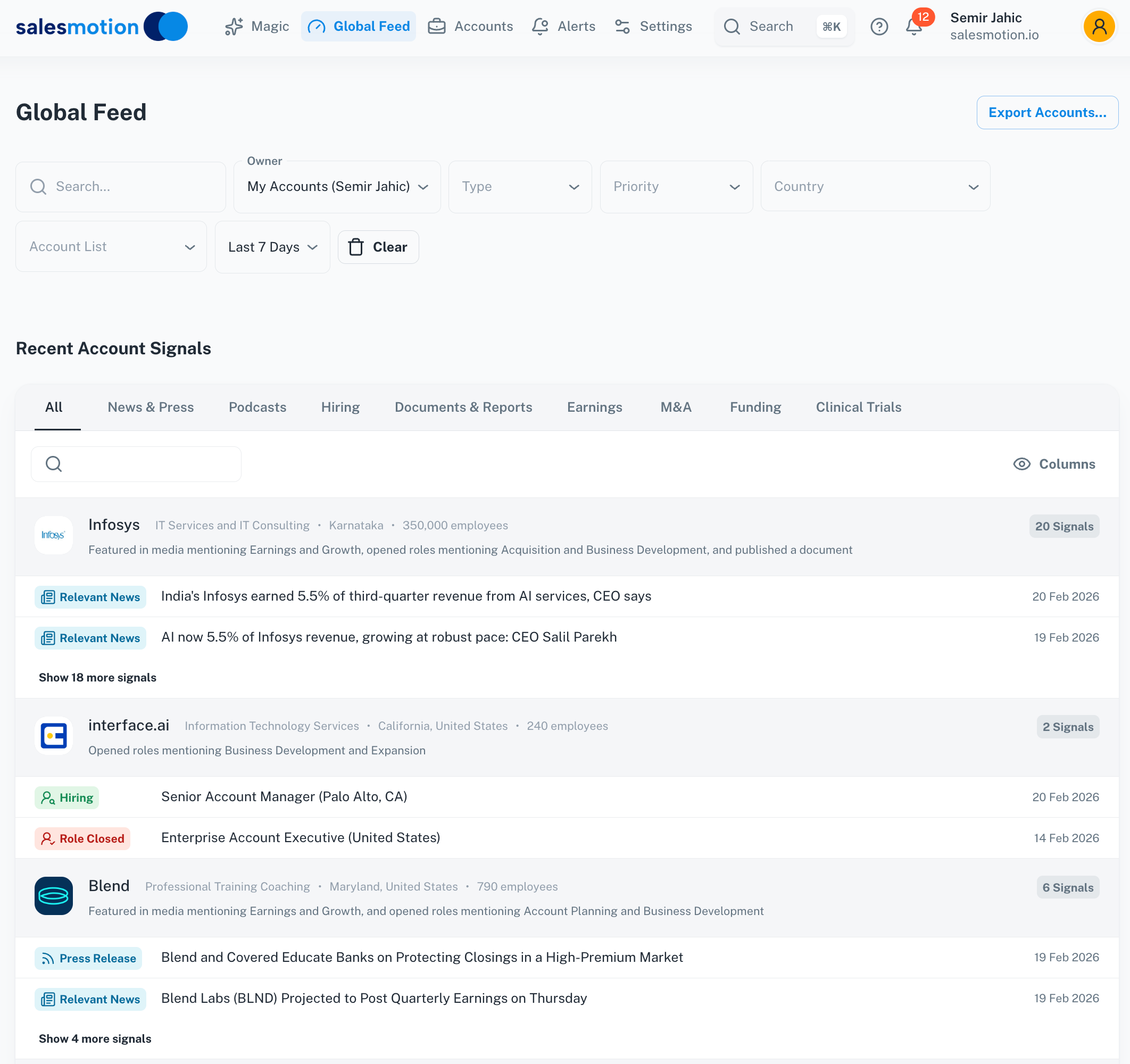 A real-time signal feed surfaces buying signals — from leadership changes to earnings commentary — so reps never miss an active account.
Step 3: Build a Multi-Touch Follow-Up Cadence
The data is clear: most deals require 5-12 touchpoints across multiple channels. But those touchpoints need to be relevant, not just persistent. Here is a cadence framework:
| Touchpoint | Timing | Channel | Content |
|---|---|---|---|
| 1 | Day 0 (within 1 hour) | Personalized response referencing their specific trigger | |
| 2 | Day 1 | Phone | Brief call referencing the email and adding one new insight |
| 3 | Day 3 | Connect request with a note about a shared challenge or signal | |
| 4 | Day 7 | Share a relevant case study or industry insight | |
| 5 | Day 14 | Phone + Email | Follow up with a specific reason to reconnect (new signal, event) |
| 6 | Day 21 | Final check-in with a low-friction ask (quick call, demo link) |
The key is that each touch adds new value. Reps who use account intelligence to personalize every touchpoint see dramatically higher response rates than those running generic sequences.
Step 4: Fix the Marketing-Sales Handoff
Create a shared lead scoring model that both teams agree on. It should include:
- Fit score: Does this account match your ideal customer profile?
- Intent score: Has this account shown buying signals in the last 30 days?
- Engagement score: Has this contact interacted with your content or sales team?
Only leads that hit threshold on all three dimensions get routed to sales as "qualified." Everything else stays in marketing nurture with automated, signal-triggered touchpoints.
Step 5: Keep Your Data Alive
Static data strategies guarantee lead loss. The alternative is continuous monitoring: a system that watches your target accounts for changes and updates your intelligence automatically.
When Analytic Partners implemented continuous account monitoring with Salesmotion, their team went from spending 3 hours per account on manual research to getting 80-90% of what they needed in 15 minutes. That research time savings translated directly into more personalized outreach and a 40% increase in qualified pipeline.
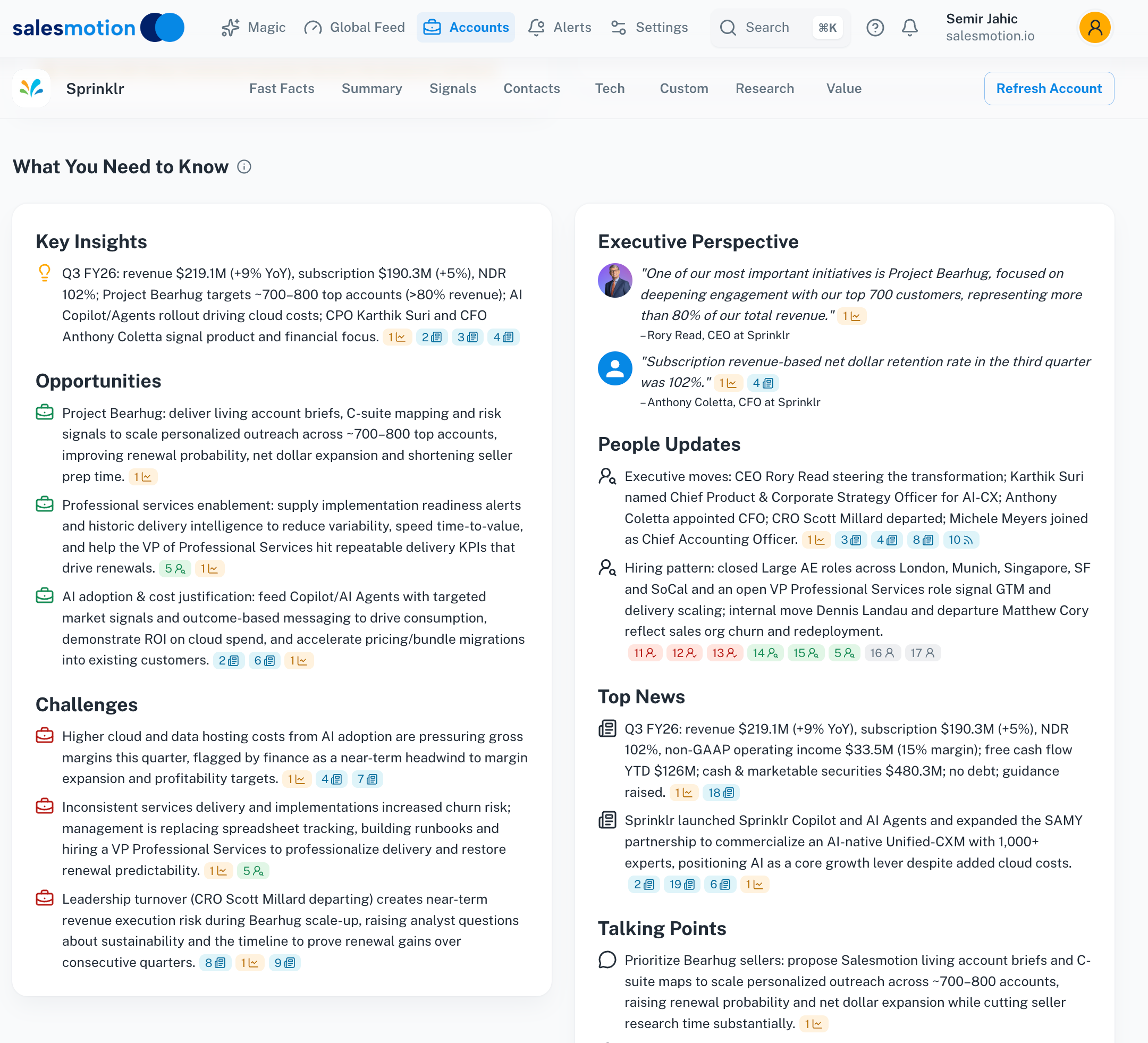 An account intelligence view compresses hours of research into a single summary — combining leadership changes, strategic initiatives, and competitive intelligence.
When to Let a Lead Go
Not every lead is worth saving. Knowing when to stop pursuing a prospect is as important as knowing when to follow up. Here are clear signals that a lead is truly dead:
- No response after 8+ touchpoints across multiple channels over 30+ days
- Explicit "not interested" or "we went with someone else"
- Company no longer fits ICP (downsized, pivoted, or lost funding)
- Champion departed with no replacement in a buying role
- Budget frozen with no timeline for unfreezing
When you let go of dead leads, you free up rep capacity for accounts that are actually showing buying signals. The discipline to stop chasing bad leads is what separates high-velocity teams from busy-but-unproductive ones.

“This is my singular place that very simply summarizes a company's top initiatives, strategies and connects them to my solution. Something I would spend hours researching manually, now it's automated.”
Derek Rosen
Director, Strategic Accounts, Guild Education
Key Takeaways
- Speed kills deals, not competition. Respond within one hour. Companies that respond in five minutes are 100x more likely to convert.
- Qualification requires signals, not just demographics. Static ICP fit is necessary but not sufficient. Layer in real-time buying signals like leadership changes, hiring patterns, and earnings language.
- Follow-up is a system, not a behavior. Build structured multi-touch cadences where each interaction adds new value. Five or more touchpoints are the minimum.
- Data decay is a silent pipeline killer. Contact data decays 30% per year. Use tools that continuously monitor accounts for changes rather than relying on static CRM records.
- Marketing-sales alignment starts with shared definitions. Agree on fit, intent, and engagement thresholds before routing leads.
- Know when to walk away. Free up capacity by cutting leads that show no signal of buying intent after sustained outreach.
Frequently Asked Questions
What is the main reason B2B companies lose leads?
The most common reason is slow response time combined with poor follow-up. According to Setter AI's 2026 analysis, businesses that respond within five minutes are 100x more likely to convert, yet the average B2B company takes over 12 hours to respond. When you pair slow initial response with the fact that most reps give up after one or two follow-ups, the result is a steady stream of lost opportunities.
How many follow-up touches does it take to close a B2B deal?
Research from Belkins and other sources consistently shows that 80% of B2B sales require five or more touchpoints, with complex enterprise deals averaging 31 interactions before closing. High-growth organizations typically execute 16 touches within a two-to-four-week window. The critical factor is not just volume but relevance: each touch should reference something specific about the prospect's situation, whether that is a recent leadership change, a strategic initiative, or an industry trend.
How can I tell if a lead is worth pursuing or should be disqualified?
Focus on two dimensions: fit and timing. Fit means the company matches your ideal customer profile in terms of size, industry, and use case. Timing means they are showing active buying signals, such as posting relevant job openings, discussing relevant challenges in earnings calls, or recently changing leadership. A lead with strong fit but no timing signals should stay in nurture. A lead with neither should be disqualified. Tools that monitor these signals continuously help reps focus on accounts with the highest probability of conversion.
What is the best way to re-engage a lead that has gone cold?
The most effective re-engagement approach is to reference something new and specific about their business. A generic "just checking in" email has near-zero response rates. Instead, monitor the account for fresh buying triggers: a new hire in a relevant role, a funding announcement, a product launch, or a competitive move. When a signal fires, use it as the reason to reconnect. This approach shows the prospect you are paying attention to their business, not just running a sequence.
How does marketing-sales misalignment cause lead loss?
When marketing qualifies leads on engagement metrics (downloads, webinar attendance) and sales qualifies on buying intent (budget, authority, active need), the gap creates friction. Marketing sends leads that sales considers unqualified. Sales ignores those leads or gives them minimal effort. The prospect experiences either silence or a generic pitch that does not match their stage. Fixing this requires a shared scoring model that includes both engagement and intent signals, along with clear SLAs on response times and handoff criteria.