
Ten drugs generated $198.4 billion in global sales in 2025 and accounted for 16.3% of the prescription-drug market, according to Hardman & Co's pharma statistics. Read that again as a revenue leader. A tenth of the market's value sits in a handful of brands, and the formulary decision, patent cliff or competitor readout that touches one of them moves more money than most companies will ever book.
That concentration is the reason pharma commercial intelligence deserves a budget line rather than a folder of clippings. It's the discipline of collecting, connecting and interpreting market, account and stakeholder signals so commercial teams know where demand is forming, which accounts deserve attention and what to do next.
What Pharma Commercial Intelligence Means and Why It Matters Now
Start with the distinction that trips people up. A sales report tells you what shipped last quarter. Intelligence tells you what changed this week, which account it touches and which decision it should alter. One is a rear-view mirror. The other is a windshield.

The stakes are large enough to justify the effort. IQVIA data compiled by Businesstats shows global medicine spending at list prices grew 35% in the five years before 2024, with a further 38% increase projected through 2028 to roughly $2.3 trillion, an implied compound annual rate of 5% to 8%. Manufacturer net sales land lower after rebates, government-mandated discounts and clawbacks, which is precisely why a single formulary win or a single lost access position carries outsized weight.
So the market is big, but it isn't uniform. Growth clusters in specific therapy areas, geographies and accounts, and your team can only cover a fraction of them. That's the gap intelligence fills.
Three signal layers do most of the work, and it helps to keep them separate in your head:
- Market signals cover launch timing, reimbursement and competitor positioning. A label expansion or a payer policy change lands here.
- Account signals cover leadership, pipeline and hiring. A new chief commercial officer or a wave of market access job postings tells you where money is moving.
- Stakeholder signals cover prescriber behavior, payer policy and key opinion leader activity. These tell you who to talk to and what they care about.
Here's the test I'd apply to anything that lands on your desk. Ask three questions. What changed? Who is affected? What should the team do next? A report that answers all three is intelligence. A report that answers two is news with a chart on top.
Practical rule: if a brief can't name the decision it changes, it doesn't belong in the weekly review. File it and move on.
The Signals and Sources That Move Pharma Revenue
Every signal has a home, a refresh rate and a decision attached to it. Map them once and prioritisation stops being a matter of taste.
| Signal | Where it appears | Decision it informs |
|---|---|---|
| Leadership change | Press releases, company websites, professional networks | Which buyer to prioritise and when to re-engage |
| Pipeline or phase move | Company pipeline pages, trial registries, investor decks | Timing of launch-readiness and outsourced service demand |
| Regulatory event | Agency approval notices, label updates, safety communications | What field teams may say and which assets need review |
| Earnings call commentary | Quarterly earnings calls and transcripts | Strategic priorities and budget direction |
| Hiring pattern | Job postings for market access, medical affairs and launch roles | Where investment is building before a formal purchase |
| Financing or deal | Funding rounds, licensing agreements, acquisitions | Change in account ownership and available budget |
| Prescribing or uptake trend | Syndicated prescription and claims data | Whether real demand matches the forecast |
Two source families sit behind that table, and they behave differently.
Public signals arrive fast and cost nothing but attention. Earnings calls, SEC filings, trial registries, press releases and job postings are live within hours, and they're the earliest visible trace of a strategy shift. Licensed data such as syndicated prescription and claims feeds is more representative and more statistically defensible, but it lags by weeks and it costs real money. You need both, and you need to know which one you're looking at when you make a call.
Why one signal rarely decides anything
A phase 2 to phase 3 move on its own is interesting and nothing more. Half the industry has a trial in phase 3. But that same phase move, followed by twelve market access job postings and the arrival of a new commercial operations executive, describes a company building a launch machine. That combination is a buying window.
The mistake teams make is treating signal volume as progress. Fifty alerts a week feels like coverage. Three alerts that each change a decision is coverage.
Edge cases worth planning for
Private companies publish far less, so your public-signal surface shrinks. Job postings, partnership announcements, conference appearances and leadership moves carry proportionally more weight, and you should weight them higher in scoring rather than apologising for thin filings.
Then consider a competitor's late-stage readout. For a physician account, it means a revised talk track and a conversation about sequencing. For a payer account, it means a formulary review request and a health economic argument. Same signal, two different actions, two different owners. Routing it to "the field" as one broadcast wastes it.
A ranking rule you can apply this week
Score each signal from 1 to 5 on how soon it changes a decision, and 1 to 5 on how many accounts it touches. Multiply the two numbers. Anything scoring high on both gets a named owner and a Slack route the same day; anything scoring low on both goes into a monthly digest nobody has to read.
Pairing that rule with trial registries and pipeline pages is where clinical trial intelligence earns its place, because a registry entry updates before the press release and long before the prescription data moves.

“The moment we turned on Salesmotion, it became essential. No more hours on LinkedIn or Google to figure out who we're talking to. It's just there, served up to you, so it's always 'go time.'”
Adam Wainwright
Head of Revenue, Cacheflow
How to Build a Pharma Commercial Intelligence Workflow
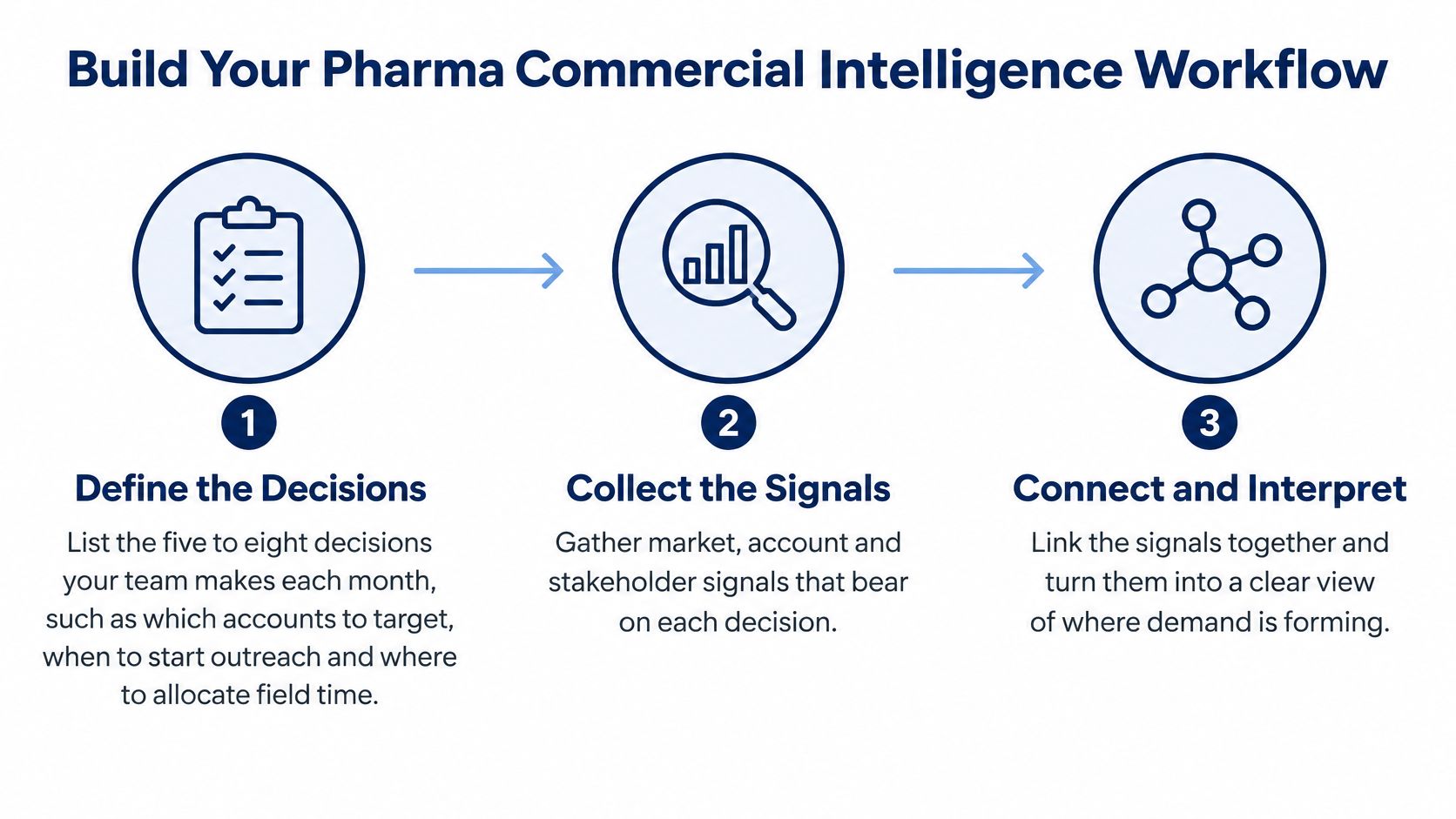
Most programmes fail at the first step, and the failure is quiet. A team buys a data feed, builds a dashboard, and then spends six weeks hunting for a decision the dashboard supports. Work backwards instead.
-
Name the decisions, not the data. Write down the five to eight decisions your team makes each month. Which accounts get field time in the next cycle. When to open outreach on a launch account. Which payer conversation gets escalated to a market access director. Which talk track needs medical review before Friday. Which accounts to stop covering. If a decision isn't on the list, no signal attached to it matters yet.
-
Map sources to decisions. Take the table from the previous section and assign each decision the signal types that bear on it. A launch-timing decision needs pipeline moves, regulatory events and hiring patterns. A retention decision needs prescribing trends and competitive readouts. Anything left unmapped is a signal you can safely ignore for now.
-
Build the data foundation properly. Join sales, prescription and account data while keeping geography, payer, specialty, line of therapy and month intact. That structure lets you decompose a revenue gap into its real cause: lower diagnosis, slower treatment initiation, formulary restriction, weak physician adoption, discontinuation or competitor switching. The common slip here is relying on a single market-share feed, which tells you that you lost share and never tells you where.
-
Attach metadata to every signal. Source, population denominator, observation window and a confidence level. Observational data sources differ in coverage, coding and refresh rate, so a claims-derived signal and a registry-derived signal should never be presented as equally solid. When someone challenges a number in a review, the metadata is the answer.
-
Set rules and thresholds before launch. A leadership change at a priority account triggers a review within 48 hours. A routine press release goes into the weekly digest. Write the rules down so the team isn't renegotiating urgency every Monday.
-
Assign owners and route the output. Every signal type needs one named person, not a shared inbox. Deliver alerts into Slack, email or the CRM with the source linked, so the rep reading it at 7am can check the claim in two clicks.
-
Pilot for 90 days on one therapy area. Measure false positives. If two thirds of your alerts lead nowhere, the thresholds are wrong, not the concept. Widen scope only after you've logged the first decisions that changed because of a signal.
Common slip to avoid: running the pilot across every therapy area at once. You'll generate volume, learn nothing, and lose the argument for budget.
At day 90, a working workflow looks unremarkable from the outside. It's a page of decisions that changed, each with a timestamp, a named owner and the signal that triggered it. That page is the entire deliverable.
Who Acts on Each Signal and How Teams Use It in Practice
Intelligence that lands in one person's inbox creates a bottleneck. The value comes from matching each signal to the team whose decision it changes, with a defined handoff.
Field sales and commercial operations work on a weekly cycle. They act on account signals and leadership changes, refreshing account plans before the next territory cycle and flagging accounts where the buying committee just changed. What they hand to market access is a list of accounts reporting new access friction.
Market access reviews payer policy changes and formulary signals monthly. They translate a coverage update into a position on where prior authorisation is blocking initiation, then hand a revised access argument to brand.
Medical affairs works continuously on trial readouts and safety communications. Their job is keeping field messaging inside approved claims, and their handoff is an approved talk track with the label reference attached.
Brand and marketing review competitor launches and earnings commentary quarterly, adjusting positioning and messaging architecture, then handing field-ready assets to commercial operations.
Business development teams at CROs, CDMOs and clinical services firms run a different cadence entirely. Trial starts, phase moves and manufacturing hiring are their leading indicators, and the handoff is a conversation that starts before a tender exists.
For a deeper view of how account-level ownership works across these groups, this guide to pharma key account management covers the handoff mechanics.
Two illustrative cases
Case one, regional oncology. In the same month, a competitor reports a late-stage readout and a regional payer updates its prior authorisation criteria. The team refreshes account briefs for two priority centres, and medical affairs approves a revised talk track tied to the approved label language. The handoff that made it work was medical affairs signing off before the field saw the brief, not after.
Case two, CDMO business development. A sponsor moves a programme from phase 2 to phase 3 and simultaneously posts manufacturing and quality roles. The BD team opens a conversation about capacity planning before the formal tender is issued. The handoff that made it work was operations flagging the hiring pattern to BD within the week rather than at quarter end.
In 2024, 56% of respondents in Deloitte's survey of 100 biopharma leaders said their organisation needed significant change or full transformation of its commercial function, according to Deloitte's future of commercial in pharma research. Clear handoffs are how that transformation avoids becoming a reorganisation chart.
“Automatic account profile detail I can use to manage my territory. Using Salesmotion AI to generate value statements per persona, account, etc. Using Salesmotion to give me a starting point based on new hires, or news alerts is critical.”
Adam Wainwright
Head of Revenue, Cacheflow
KPIs That Show Whether Your Intelligence Pays Off
Measure the leading indicators first. Revenue takes quarters to respond, and by the time it does, nobody can attribute the movement to a signal.
| KPI | How to calculate it | Review cadence |
|---|---|---|
| Signal-to-action time | Hours from trigger to a logged team action | Weekly |
| Alert precision | Share of alerts that led to a relevant account action | Monthly |
| Pipeline influenced | Qualified opportunities created from intelligence-led outreach | Monthly |
| Win rate on intelligence-led accounts | Won deals divided by opportunities, compared with a matched baseline | Quarterly |
| Research hours saved | Hours per account brief before and after the workflow | Monthly |
| Forecast error band | Actual versus forecast by launch quarter, tracked against a plus or minus 50% band | Quarterly |
The logic behind the order is simple. If signal-to-action time is measured in days and alert precision sits above half, revenue will follow. If either is broken, more dashboards won't fix it.
Forecasts are ranges, not numbers
A peer-reviewed analysis of 102 drug launches found that 55.9% of products had forecast errors exceeding plus or minus 50%, as reported in this analysis of the execution gap in pharma's commercial model. A single revenue number presented to a board is therefore a weak target. It's a coin flip dressed as a plan.
Carry every launch forecast as a base, upside and downside range, and separate the drivers: addressable patients, diagnosis and treatment rates, access constraints, prescriber adoption, persistence, competitive entry and net-price realisation. Each driver gets a distribution rather than a scalar. When a new signal arrives, you update the driver it touches and record why.
That same analysis cites a historical study of 391 US new-molecular-entity launches from 2000 through 2023, which gives you a benchmark for comparing uptake curves across products and segments. Use it to sanity-check your own curve rather than to defend it.
Honest limit: a pilot on a small account list produces noisy results. Compare intelligence-led accounts against matched accounts that received no additional outreach, or you'll be measuring the enthusiasm of the team rather than the workflow.
The review rhythm that holds up is weekly on signal-to-action time, monthly on precision and pipeline, quarterly on win rate and forecast error. If you want a broader set of measures for small commercial teams, this collection of pipeline metrics for small B2B teams covers the underlying maths well.
Regulatory and Data-Privacy Guardrails to Build In Early
A sentence a rep reads on a call is promotion, even when it began as an internal note. The Federal Food, Drug, and Cosmetic Act applies at that handoff.
Prescription-drug promotion must not be false or misleading, and it must present a fair balance of efficacy and risk. Those two standards apply to promotional materials as a class: sales aids, brochures, websites, email, television, and journal advertising. The brief-summary requirement, covering side effects, contraindications, and effectiveness, applies to print and broadcast advertising, as set out in this FDA guidance on prescription-drug advertising.
The handoff works like a pharmacy counter. The bottle does not cross until the label matches the order. A signal can update a scenario inside the commercial team. The words that reach the field still have to match current prescribing information.
Tag each generated message before anyone uses it. An approved label claim can go to field teams. An interpretation, a competitive claim, or an unapproved-use discussion stays back for medical and legal review. "New indication approved" in a research note is a fact about a filing. The sentence a rep says to a physician is a different object, and the gap between them is where compliance problems start.
Manufacturers must submit promotional materials when they are first disseminated or published, generally with Form FDA-2253 and the current prescribing information. If product-news monitoring triggers outreach, that submission belongs in the same workflow as the alert.
Build these checks into the tool:
- Link every message to the label. If the claim cannot be traced to current prescribing information, it does not ship.
- Route drafts through medical and legal review before they reach the field, with the reviewer's name on the record.
- Set an update window after a label change or safety communication so field teams work from current language within days.
- Log who saw which signal, so an audit can reconstruct the sequence.
Score the signal by the decision it would change, then hold it at that checkpoint unless the output is an approved claim. A hiring surge at a health system can justify an account plan. It does not justify a new efficacy sentence.
On privacy, prefer public and licensed sources. Avoid patient-level data unless it is de-identified under a covered contract, apply regional rules such as GDPR to EU personal data, and keep access controls tight. The same discipline that governs securing patient records in nursing homes applies to any workflow handling identifiable health information, whatever the setting.
Have counsel sign off on the workflow before a pilot goes live, and revisit it whenever a new data source is added. Teams comparing competitor moves across therapy areas can use this overview of life sciences competitive intelligence to keep those comparisons inside approved boundaries.
How to Choose a Platform and Start Your First Pilot
Shortlist two or three platforms and score them against the same checklist before anyone signs. The demo is the vendor's best day; the checklist is yours.
| Criterion | What to ask | Red flag |
|---|---|---|
| Data provenance | Which sources feed each signal and how often they refresh | Sources that cannot be named |
| Citation and traceability | Can every brief link back to its source document | Summaries with no links |
| Pharma coverage | Are trial, phase and regulatory events covered, including private companies | Generic B2B news only |
| Compliance support | How are promotional claims checked against label language | No review workflow |
| Integration | Does it deliver into the CRM, Slack and email natively | Manual export only |
| Data handling | Data residency, access controls and contract terms for customer data | No written data-handling policy |
| Proof on your accounts | Will the vendor run your own target list before you sign, and show the briefs | Only generic case claims |
A good answer on provenance names the sources and the refresh rate. A good answer on coverage covers trial starts, phase moves and regulatory events, and handles private companies rather than excluding them. A good answer on proof means you see briefs built on your own accounts, not a slide.
Salesmotion is one platform to test against that list. Its Life Sciences module watches for trial starts, phase moves or raises that open a buying window for CRO, CDMO and lab business development teams, and Cytel reported that research time was cut in half and account planning accelerated by 30%. Treat that as a claim to verify on your accounts, not a promise.
Running the pilot
Pick one therapy area. Load 25 to 50 target accounts. Record your baseline from the KPI table before anything goes live: current signal-to-action time, current research hours per brief, current pipeline from those accounts. Run for 30 to 60 days with the routing rules switched on. If you want a structured way to frame the trial itself, this walkthrough on how to pilot a sales intelligence tool before buying sets out the questions to settle first.
Then compare intelligence-led accounts against matched accounts that received nothing new. Matched means similar size, similar therapy area, similar existing relationship, so the difference you see is the workflow rather than the territory.
If the comparison shows movement, widen the scope to a second therapy area and keep the same measurement. If it doesn't, find out whether the signals were wrong or the routing was. Those are different problems with different fixes.
The next action is concrete. Book the pilot, name one owner for the whole thing, and put the first review date on the calendar before the kickoff call ends. Programmes without a review date become subscriptions.
Salesmotion runs AI agents that monitor your target accounts for the signals this guide describes, from trial starts and phase moves to leadership changes and funding rounds, and turns them into cited account briefs with the "so what" spelled out. Alerts land in Slack, email and your CRM, so the field team sees the change and the next action together. If you're building a pharma commercial intelligence workflow and want the signal layer handled, start by pointing Salesmotion at your target account list.