The prescription shows up in almost every pharma commercial deck: add channels, add personalization, add an intelligence layer, promote the strongest rep to key account manager and hand them a bigger book.
None of that is the actual problem. Teams that stall don't lack channels or data. They lack a shared answer to three unglamorous operational questions. Who owns this account? Who is not allowed to contact this stakeholder this week? Who acts when a payer rewrites a rule on a Tuesday afternoon?
Pharma key account management works when it's built as an internal orchestration system with named owners, suppression windows and trigger routing. A KAM title without those rules is territory selling with a new business card and a longer drive.
Why the Prescriber Call Plan Stopped Being the Plan
A territory manager is promoted to Key Account Manager, Health Systems on a Monday. The bonus plan still pays on calls and scripts. By the third quarter the calls look identical to last year's, and the only thing that changed is the signature line.
That's the trap. The organization now sitting across the table isn't a prescriber with a bigger potential number. The chapter on pharmaceutical key account management from BSP Publications defines the key account as a hospital system, an integrated delivery network, a national or regional payer, a government body, or a large provider group, not a single physician.
What the Account Actually Decides
Those institutions don't buy a product. They decide whether it exists inside their walls.
- Formulary status: whether the medicine is on the list at all, and with what restriction attached.
- Protocols and order sets: which patients get it, in what sequence, and who signs the algorithm.
- Reimbursement and procurement: the contract, the tender, the price, the prior-authorization path.
- The patient pathway: where the therapy sits between referral, diagnosis and the infusion chair.
One drug and therapeutics committee decision can open or close access for thousands or millions of patients, which is the whole reason the account, rather than the prescriber, becomes the unit of planning.
The Discipline the Title Implies
The same chapter is blunt about what KAM is: a coordinated, cross-functional discipline. The account manager aligns medical affairs, market access, health economics and outcomes research, supply, commercial and digital support around the account's priorities. Territory selling could be scored on prescriber reach and product promotion. That scorecard collapses here, because half the work happens in rooms the rep never enters.
Centralized purchasing and payer influence exist in every major market, even though the decision makers differ by country. As health systems consolidate and reimbursement turns on evidence, the account becomes the commercial planning unit by default.
Start the account file with the institution's decision rights rather than the prescriber's preferences. A structured account research process for life sciences sales that names the committee, the payer and the procurement body will do more for the plan than another page of call notes.
The test to run this week: if the only numbers on the scorecard are calls and scripts, the team is still running a territory model, whatever the title says.
Four Tiers for Staffing a Pharma Account Book
Score the current book against this table before anyone hires, promotes or rewrites a plan. Most books fail on the same two rows: too many accounts parked in the top tier, and no named owner anywhere below it.
| Tier | Typical organization | What they control | How to staff |
|---|---|---|---|
| Enterprise | National payer or top integrated delivery network | Formulary, reimbursement, system protocols | Dedicated cross-functional pod |
| Strategic | Large hospital system or government purchaser | Drug committee, procurement, care pathway | Named KAM plus medical and access partners |
| Priority regional | Regional procurement body or specialty network | Local access, contracting, site adoption | Shared KAM with a quarterly plan |
| Watch | Smaller provider group | Prescribing inside protocols set elsewhere | Light coverage, escalate only on a trigger |
Why Equal Coverage Fails on the Math
Global pharmaceutical revenue increased by roughly 280 percent, from about $390 billion in 2001 to $1.48 trillion in 2022, according to the global pharmaceutical sector analysis. Spending clusters hard: the United States and Canada accounted for 49.1 percent of global pharmaceutical consumption, Europe 23.3 percent, China 9.4 percent and Japan 6.1 percent.
The same analysis puts North America at 54.7 percent of estimated 2025 worldwide sales against 23.7 percent for Europe. Innovation access is more lopsided still, with 74.1 percent of sales for new medicines launched between 2020 and 2024 occurring in the United States, versus 15.6 percent across Europe's five largest markets.
That's an argument against uniform coverage, not against Europe. A manager in a market holding 6 percent of consumption and a manager in a market holding half of it shouldn't carry the same account count, the same plan template or the same cadence.
Reading the Four Rows
Enterprise accounts shape national access or a flagship network's entire protocol set. A dedicated pod here means a KAM, an access lead, a medical point of contact and someone from HEOR who can be in the room together, not rotated through on different weeks.
Strategic accounts are where the drug committee, procurement and pathway work lands. They get a named KAM with medical and access partners attached to a single plan, one plan, reviewed quarterly with the account's own language in it.
Priority regional accounts decide local contracting and site-level adoption. A shared KAM on a quarterly plan is enough, provided the plan fits on one page and names the contract dates.
Watch accounts follow protocols set elsewhere. Light coverage, with escalation only when a trigger fires: a formulary shift, a new clinical program, a leadership move.
Separate Scale From Influence
A mid-sized teaching hospital with guideline pull can matter more in year one than a large network that adopts whatever its reference center adopts. Score four things per account: commercial scale, launch influence, reimbursement impact and speed of adoption. Clinical leadership is the fifth and the one most often left off the sheet, which is how a quiet academic center with a protocol committee ends up in the watch tier.
Name an owner only for enterprise and strategic tiers. Everyone else sits on a shared or trigger-based cadence. The mechanics of moving accounts between tiers, and the timing of it, are set out in this guide to tiering accounts in sales.

“Salesmotion empowers me to cultivate a great buyer experience. I'm able to challenge prospects' thinking and be a trusted consultative seller. A major part of this is Salesmotion insights.”
Austin Friesen
Account Executive, FY25 #1 President's Club, Clari
Ownership Rules Across Medical Access and Commercial
The question that stalls most pharma account teams isn't which account to target. It's who is allowed to speak to it, and about what.
Recent industry analysis names the gap directly: unresolved questions about who owns a strategic account, when Medical, HEOR, Market Access and commercial should engage, and how resources get coordinated, per Numerof's commercial model report. Accounts now involve payers, health systems, specialty pharmacies, clinicians and patient-support organizations. There is no single buyer to own.
Who Owns What
| Role | Owns | Must not do | Hands off to |
|---|---|---|---|
| Key account manager | Account plan, stakeholder map, commercial timing | Solo scientific deep-dives | MSL when the question is evidence |
| Medical science liaison | Unbiased scientific exchange | Contracting or promotional claims | KAM or access for economics |
| Market access | Payer policy and reimbursement path | Clinical protocol design | Medical and HEOR for evidence gaps |
| HEOR | Value evidence and outcomes design | Day-to-day detailing | Access and medical for use of the evidence |
| Medical affairs lead | Evidence strategy and MSL deployment | Quota conversations | KAM for engagement timing |
The KAM and MSL boundary breaks first. A KAM hears a clinical objection and wants to answer it on the spot. Answering it is the MSL's job, and a promotional claim dressed up as science costs more than the silence would have.
The access and medical boundary is second. Access wants to know which evidence package a payer will accept. Medical and HEOR decide what can be claimed about that evidence. Market access maps the reimbursement path; it doesn't redesign the clinical protocol to make the path easier.
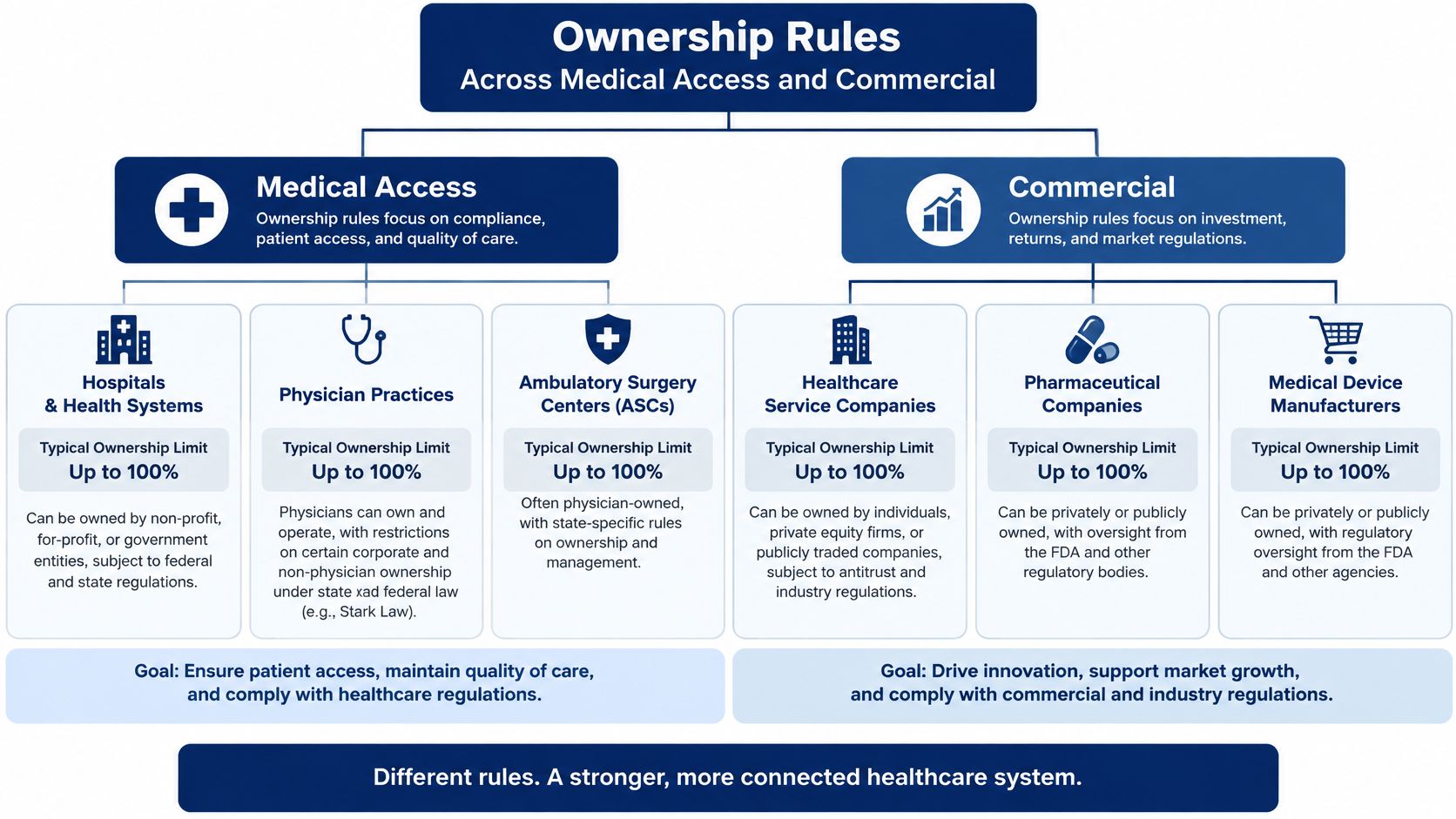
A relationship map that stops at the internal team is a staffing chart, not a stakeholder map. It has to name hospital drug and therapeutics committees, procurement, pharmacy, clinical leaders, guideline bodies, and patient or service representatives, as this market access analysis sets out, and it has to show how those groups constrain each other. A payer rule decides what the pharmacy may dispense. A committee decision decides what the pharmacy stocks. Neither one is the whole decision.
The administrative consequence lands downstream. When prior authorization becomes the bottleneck, the account team needs working knowledge of outsourcing payer approval workflows so the reimbursement conversation matches what the site does at the counter, not what the slide says should happen.
Three Operating Rules
- One named internal owner per account. A person, not a pod. That owner holds the plan and the relationship map and answers for both.
- A suppression window. No two functions contact the same stakeholder in the same week. Pick the window, write it down, and make it visible in the CRM before the next congress.
- An escalation path. A payer policy change, a new market-access leader, a specialty program launch. One route, one owner, one deadline for a decision.
Adding data before governance doesn't improve execution. It just gives more people a reason to email the same clinician in the same week.
A Scorecard for Access Not Just Activity
Calls, emails and meetings attended are not account progress. They're the inputs a territory model measured, and they survive in KAM scorecards mostly because somebody can pull them from the CRM in ten seconds.
Replace them with two bands on two clocks. Leading indicators are what a weekly cadence can see move inside a quarter. Lagging indicators are what a quarterly review reads against a matched comparison group.
Two Bands, Two Clocks
| Measure | Band | Review | A useful signal |
|---|---|---|---|
| Formulary or protocol milestone | Leading | Monthly | Status moved, not just a meeting held |
| Stakeholder engagement quality | Leading | Monthly | Right role engaged, no duplicate outreach |
| Joint clinical or outcomes initiative | Leading | Quarterly | Named owner and a start date |
| Pathway implementation progress | Leading | Monthly | A step completed on the account plan |
| Share and adoption versus matched accounts | Lagging | Quarterly | Ahead of the non-KAM comparison |
| Launch uptake at 18 months | Lagging | Launch review | Faster uptake than matched launches |
| Account revenue versus matched accounts | Lagging | Quarterly | Growth not explained by mix alone |
What the Case Evidence Actually Says
The published numbers are encouraging, and they come with a caveat that has to travel with them. Across four healthcare case studies covering new and established programs, ZS reported that KAM accounts grew 50 percent faster than comparable non-KAM accounts. KAM-supported launches showed 30 percent more growth and 10 percent faster uptake 18 months after launch, with other examples including a twofold increase in clinical trials and a 50 percent share shift within four months.
These are selected cases, not a guaranteed lift. Account choice and execution quality sit inside those numbers. A team that hands its best accounts to the new KAM structure and compares them to the leftovers will beat the residual book and learn nothing worth repeating.
Two Benchmarks Worth Holding Together
Demand for the model is not in question. 94 percent of the most senior pharmaceutical executives treat key account managers as a strategic priority for commercial success, in a ZS survey cited by EY's commercial transformation analysis.
Capability is another matter. A market-access study of a multinational pharmaceutical company in Italy set out five interacting levers and noted that KAM performance should be measured on access milestones, formulary movement, joint clinical initiatives, engagement quality and implementation progress, not on sales activity alone.
The pass rule: keep a tier's coverage only if at least one leading indicator moved and the lagging comparison isn't worse than the matched accounts. If neither happened, what you funded was activity.

“We have very limited bandwidth, but Salesmotion was up and running in days. The template made it easy to load our accounts and embedding it in Salesforce was simple. It was one of the easiest rollouts we've done.”
Andrew Giordano
VP of Global Commercial Operations, Analytic Partners
How to Stand Up Pharma KAM in Six Moves
Ninety days is enough to prove the operating system on a handful of accounts. It isn't enough to prove revenue lift, so don't promise it. Promise owned next actions and a clean comparison, then let the quarters do the rest.
Keep the plan where the work happens. If the account plan still lives across four decks and a spreadsheet, settle that first, and the account planning approach built on Salesforce data is a reasonable place to start.
The Sequence
- Freeze the account universe and tier it. Every name gets one of the four tiers before anyone argues for their favorite hospital. Choose the effort first, assign the people second.
- Map entities and decision rights, enterprise and strategic only. Drug committee, payer, pharmacy, clinical lead, and specifically who has the authority to say no. Leave the watch tier alone for now.
- Write one shared objective per account. Name the action, the single owner, a deadline inside the quarter and the outcome measure. The pharma account planning module from Salesforce makes the same point: a plan links each objective to named actions with accountability, and measures progress through customer satisfaction, formulary access and care-pathway improvement rather than activity volume.
- Publish a governance card. Owner, suppression window, and the escalation route when a policy, a leader or a specialty program changes. One page, in the shared workspace, not in a slide appendix.
- Baseline a matched non-KAM set. Formulary or protocol status, adoption, share and revenue, stamped with an intervention date before any pod starts work. Without that baseline you're measuring how well you picked accounts.
- Run a weekly 30-minute cadence for 90 days. Open actions and new external changes only. No slideware, no status theater, no round-robin updates.
Where It Slips
Move 3 fails most often, and it fails without notice. The plan fills with activities, workshops and engagement moments, none of which has an owner or a date, and by week six nobody can say whether anything moved. If an objective can't name a person and a deadline, it's a wish.
Move 5 fails next. Teams scale the model across a region before any control group exists, then spend the following year arguing about attribution with no data on either side.
Decide now which measures the weekly half hour is allowed to review. Calls and emails aren't on the list. Access milestones, open commitments and new external changes are.
Signal Plays and the Outreach That Backfires
The problem was never volume. In a Deloitte survey of more than 190 healthcare professionals and 50 pharmaceutical executives, 82 percent of executives were satisfied with current engagement strategies while only 28 percent of healthcare professionals were, per Deloitte's customer engagement research. 34 percent of HCPs said sales representatives didn't tailor messages effectively or carry the scientific narrative, and 42 percent cited insufficient interaction with Medical Science Liaisons.
Read those three numbers together and the fix isn't another channel. It's knowing which question the account hasn't had answered yet, and which function should answer it.
Signal, Context, One Owner
The order matters: signal, then context, then owner, then channel. Detect the change, connect it to that stakeholder's role and the account objective, decide which function acts, and only then pick how to reach out. Skip the owner step and you don't have a play. You have a channel.
| What changed | Act within | Who leads | Suppress |
|---|---|---|---|
| Payer policy or prior-authorization change | 48 hours | Market access | Sales product email |
| New market-access or pharmacy leader | One week | Key account manager | Immediate product pitch |
| Specialty program or pathway launch | Two weeks | Medical with access | Uncoordinated MSL and rep visits |
| Public strategy or earnings priority | Before any outreach | Account owner updates the brief | Generic congratulatory note |
| Hiring that matches your use case | One week | Assigned owner after a brief | Multi-thread from every function |
Take a regional payer tightening a prior-authorization rule. The bad version is an all-hands email within the hour, three functions offering to "support", and a rep calling the pharmacy director to ask whether they heard the news. The good version has market access on the phone to the medical director inside 48 hours with the coverage criteria in front of them, sales held to a single check-in note the following week, and the account owner updating the plan with the new rule and the date it takes effect.
What Backfires
- Two functions emailing the same clinician in the same week, with different versions of the same news.
- A portal blast after a formulary win, which turns a committee decision into a marketing moment the account didn't agree to.
- A scientific question answered by a quota-carrying rep, which is the fastest way to lose the MSL's credibility and the account's trust at once.
Signal-based targeting only pays off when the trigger is routed to the right owner and everything else stays quiet. The filter that decides which pharma buying signals may interrupt the week is set out in this guide to pharma buying signals. Pick the owner from the governance card before you pick a channel.
Run the Weekly Cadence on Live Account Signals
Pick one enterprise account and run the next 30 days as a test of the operating system. One named owner, the suppression window, and the leading indicators from the scorecard. Nothing else changes in the first month, and no one gets to add a channel.
The weekly half hour only stays real if the feed behind it is real. Public changes do the work: a trial start, a phase move, a leadership hire, an earnings priority, a policy announcement. Route each one to the function that should act, with the source attached so medical and access can check it themselves rather than taking a summary on trust.
"Salesmotion is helping Cytel elevate our enterprise sales performance by embedding account intelligence directly into our workflow. The platform gives our commercial team real-time visibility into key account movements." Jonathan Burr, Chief Commercial Officer, Cytel
Cytel cut research time in half, accelerated account planning by 30 percent and consolidated five separate research tools into one. Salesmotion works across industries, and its life sciences module finds drug developers by therapeutic area, phase and modality, then watches for trial starts, phase moves or raises, which is exactly the kind of public trigger a KAM cadence can act on.
Then judge the month on owned next actions, not emails sent. Load the tiered account list, set which triggers may interrupt the week and which can wait, and review the leading indicators at day 30. If the only thing that improved was outreach volume, the account model hasn't started yet.
Pharma accounts don't move because a team sent more email. They move when one person owns the account, everyone else knows when to stay quiet, and a real trigger reaches the function that can act on it. Salesmotion is built for that second half of the job: AI agents that research accounts, monitor buying signals across news, filings, hiring and clinical activity, and draft outreach with the source attached, so your cadence runs on evidence rather than memory. Visit Salesmotion to load your tiered book, set the triggers worth interrupting the week for, and see what one enterprise account looks like after 30 days of owned next actions.