82% of surveyed life-sciences executives were satisfied with their customer-engagement strategies, but only 28% of HCPs believed those strategies met their needs, according to Deloitte's analysis of pharma customer engagement. That's not a shortage of marketing activity. It's a mismatch between what teams send and what healthcare professionals need.
Effective pharma lead generation starts with a different question: what changed at this account, who owns the resulting priority, and what can we appropriately offer them now? More channels won't fix an outreach message without a credible answer.
What Counts as a Pharma Lead Now
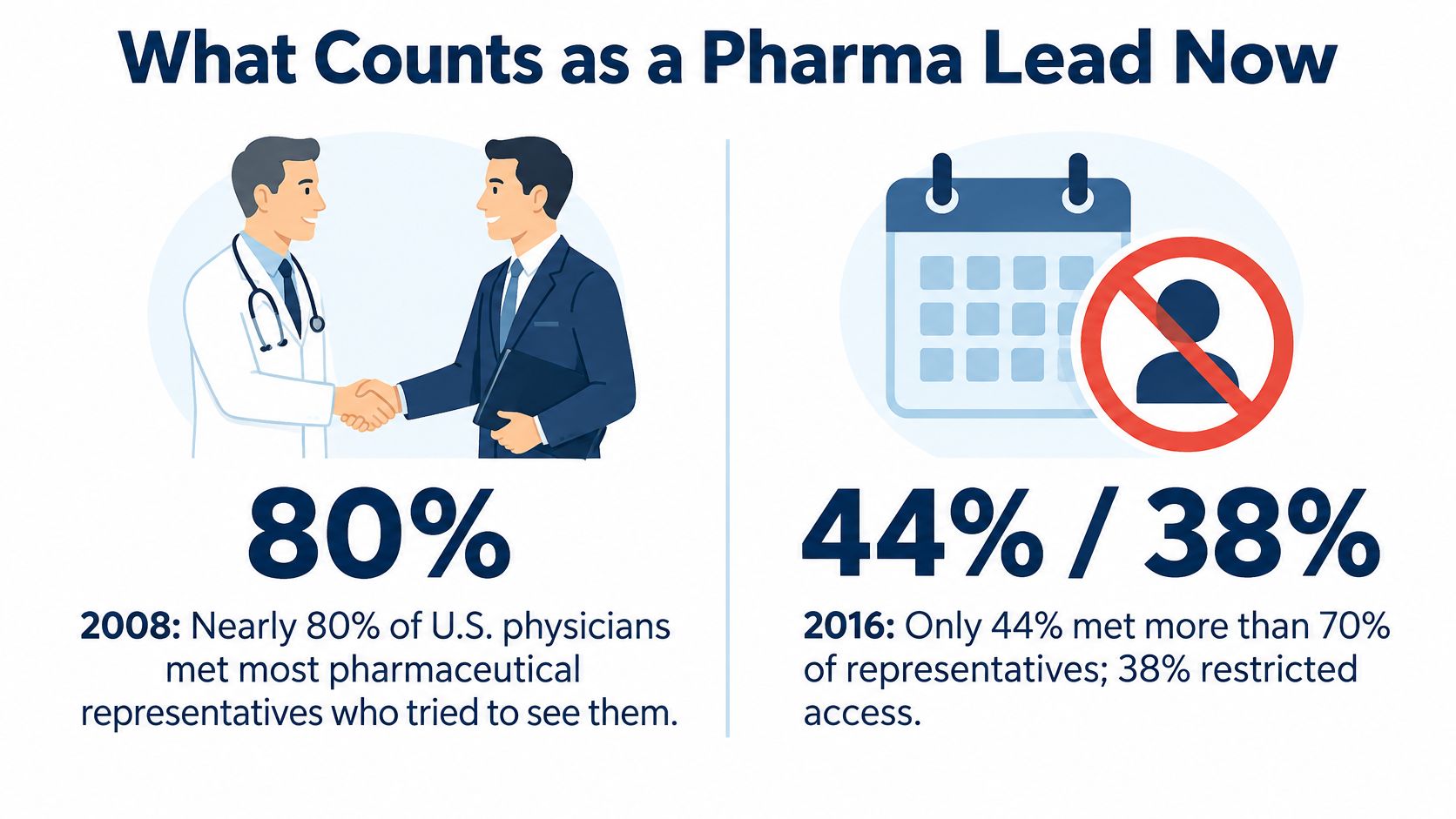
In 2008, nearly 80% of U.S. physicians met most pharmaceutical representatives who tried to see them; by 2016, only 44% met more than 70% of representatives, while 38% restricted access and 18% severely restricted it, according to Fierce Pharma's coverage of physician access. The same analysis found that non-personal promotion already accounted for 53% of outreach, while companies still allocated approximately 88% of sales and marketing spending, about $12 billion, to the sales force.
Those are historical figures, not a current access benchmark. Their operational lesson still matters: assigning a representative to a territory doesn't establish a route to a conversation.
A target name isn't a qualified lead
Say an oncology representative has a specialist on the call plan. The specialty fits, the institution treats the relevant patient population, and the territory assignment is correct. But the clinic restricts visits, the physician hasn't requested information, and the rep has no current reason to interrupt their day.
That's a target contact, not yet a qualified lead. Repeating the call doesn't change its quality.
Now suppose the specialist attends an approved educational program and requests follow-up about a specific topic. The rep has an accessible channel, an expressed information need, and permission to continue the conversation. The useful interaction sits outside the locked clinic door, in a moment the clinician chose.
Practical rule: A specialty match tells you where to look. An accessible stakeholder with a relevant, current need tells you where to act.
Separate clinical and organizational needs
Pharma prospecting also includes selling services, equipment, and research capabilities into pharmaceutical organizations. Those opportunities need different stakeholders and evidence from HCP product promotion.
For example, a laboratory expansion could justify contacting a facilities or research-operations lead about workspace requirements. A resource such as Labs USA's cleanroom-ready benches for drug research belongs in that operational conversation, not in an unrelated prescriber email.
Define a lead as a stakeholder you can reach, with a clinical or organizational priority you can serve, and a reason to engage now. Record those elements separately in the CRM rather than hiding them inside a general lead score.
The filters are access, relevance, and timing. A strong account match without them is still just a name.
Account Signals Worth Acting On
Pharma signals, who to contact, and the next action
| Signal | Stakeholder | Content type | Next action |
|---|---|---|---|
| New indication or label expansion | Medical and market access | Approved disease or product content | Brief those teams with approved content, not a cold benefit claim |
| Formulary or P&T activity | Market access and pharmacy | Access dossier, no benefit claim in social | Map committee stakeholders before outreach |
| Trial start or phase move | Clinical operations and medical affairs | Non-promotional if the use is unapproved | Identify site, partner, or evidence need |
| Guideline update | Specialists in that therapeutic area | Education tied to the guideline change | Offer a compliant briefing |
| New CMO, access, or medical leader | New leader plus an internal coach | Context on stated priorities, no product claim in the first note | Intro within days of the announcement |
| Hiring surge in medical, MSL, or access | Hiring manager | Role-relevant capability conversation | Prioritize the account this week |
| New site or geographic expansion | Local commercial and access lead | Territory and access context | Build the local stakeholder map |
| Funding round or partnership | Business development | Partnership fit, not HCP promotion | Route to BD, not the field force |
A public event becomes useful only when you can name the person responsible for the resulting work. A funding announcement might matter to a clinical-services provider, but it doesn't establish an HCP's need for product information.
Stakeholder mapping deserves its own attention. In a 2024 maturity assessment, 71% of businesses reported difficulty identifying and connecting with key stakeholders in pharmaceutical therapeutic areas because of complex organizational structures, according to Cognition Solutions' Pharma Lead Generation Maturity Assessment.
Distinguish information needs from buying intent
A guideline update can create an educational need without creating a purchasing process. A hiring surge can suggest investment in a capability without proving that the hiring manager wants outside support.
Treat each signal as a hypothesis to investigate. Look for an owner, a stated initiative, and an appropriate asset before deciding that outreach is justified.
Suppose a drug developer announces a new laboratory program. A research-supply seller could use Celonyx Labs' guide to third-party tested peptides for labs as background for understanding procurement questions. That resource doesn't establish that the account needs peptides, confirm supplier suitability, or support a claim about clinical use.
Set a response standard without bypassing review
I would set an internal 48-hour triage target for the highest-priority events. That means verifying the announcement, identifying the stakeholder, and selecting the next action, not rushing an unapproved message out the door.
For a leadership appointment, read what the new leader said. An introduction tied to an announced access initiative is more credible than congratulating them and attaching a generic deck.
For a trial milestone, check whether the service you sell addresses site support, evidence generation, or execution. Don't turn a scientific development into presumed commercial intent.
A disciplined pharma buying-signals workflow should exclude as much as it includes. A news item without a relevant stakeholder and an approved next step isn't a lead. Irrelevant personalization is still irrelevant outreach, even when every detail is accurate.

“Salesmotion helps you spot signals from prospect accounts, news items / job hiring alerts etc that indicate that now is a good time to reach out with a well-crafted message.”
Rob Douglas
Director of Sales, icit business intelligence
Compliance Before the First Send
How to classify a pharma lead asset before launch
| Asset | Class | What it may say | Review |
|---|---|---|---|
| Branded banner or name-only ad | Reminder | Drug name only, no indication or outcome | Light check against reminder rules and eligibility |
| Landing page with an indication or outcome | Product-claim | Benefit plus risk on the same screen, plus prescribing-information link | Full MLR before publication |
| Disease-awareness page | Non-product | Condition education, no brand claim | Medical review |
| Gated webinar that states a treatment advantage | Product-claim | Balanced claims, archived script | MLR and applicable interactive-promotion submission review |
| Short social post describing efficacy | Usually unsuitable | Don't run the claim if risk won't fit | Reconsider the platform or use a suitable approved communication |
Classify before writing
Treat each digital touch as a potential promotional communication, not as ordinary B2B copy. U.S. prescription-drug promotion must be truthful, nonmisleading, and balanced, with fair balance grounded in 21 CFR 202.1(e)(5)(ii), as described in the FDA's guidance on character-limited promotional communications.
The distinction between reminder and product-claim promotion changes what the asset needs. The FDA's Bad Ad Program explains that reminder promotion may call attention to a drug's name without indications, dosage recommendations, or other product information, subject to applicable restrictions.
Don't treat “reminder” as an automatic exemption. Have the reviewer confirm eligibility, then classify the entire communication, including imagery and surrounding context.
Keep benefit and risk together
Don't: place an unqualified treatment-benefit claim in a short social post and assume that a safety link fixes it.
Do: use approved, supported benefit language with appropriate risk information in the communication itself. The FDA's social-media guidance says firms should reconsider a platform for a promotional message when its limitations prevent accurate, balanced communication.
A landing page doesn't repair an unbalanced originating post. Separate HCP and consumer journeys, keep disease-awareness assets free of brand claims, and make prescribing information prominent on product-claim pages.
Interactive formats need ownership and archiving controls too. The FDA's interactive promotional-media guidance describes submissions using Form FDA 2253 or 2301, including initial-display submissions and monthly updated listings for certain non-restricted interactive sites where the firm remains an active participant.
Before release, use a documented checklist:
- Preserve the asset record: Store the exact version, approval status, timestamp, geography, and associated prescribing information.
- Control distribution: Apply audience restrictions and suppression rules before sending.
- Review generated copy: Route AI-created promotional drafts through medical, legal, and regulatory review.
- Retain the evidence: Save the public source supporting the personalization.
An account trigger explains why you're writing. It must never become invented evidence of efficacy or an implied unapproved use.
Channels HCPs Will Actually Use
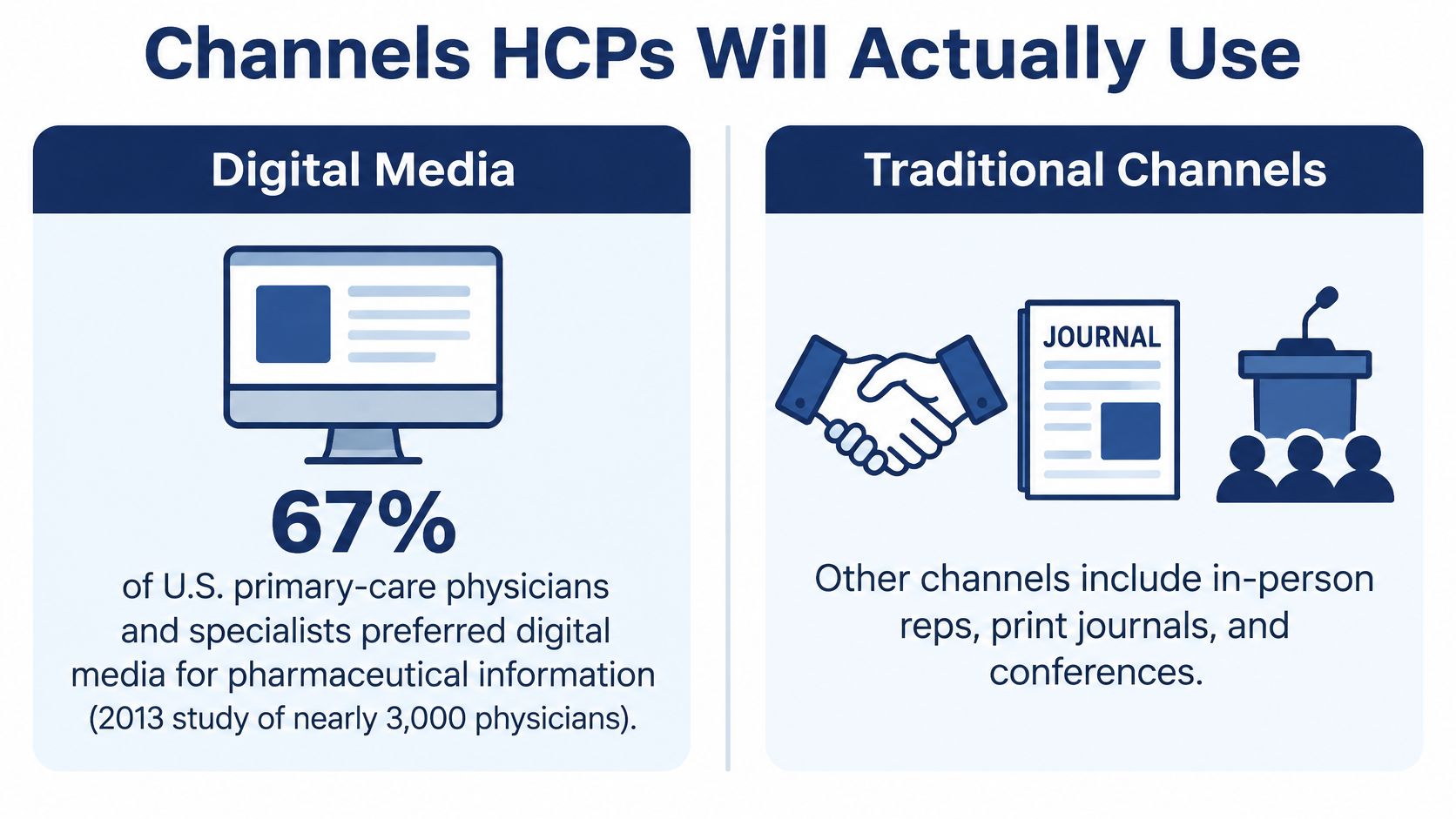
Digital preference and digital participation aren't the same thing. In a 2013 study of nearly 3,000 U.S. primary-care physicians and specialists, 67% preferred digital media for pharmaceutical information versus 20% who preferred representatives; a separate benchmark covering nine of the 25 leading global pharmaceutical companies, with $265 billion in combined revenues, found purely digital campaign participation averaged only 2% to 5%, according to BCG's analysis of biopharmaceutical marketing and sales.
In that physician study, 40% considered digital content more relevant and personalized, 73% cited ease of use and limited time, and 52% wanted representatives to evolve toward coordinating multichannel information. These historical findings support channel choice, not a blanket instruction to replace people with email.
Give each channel a specific job
A library card gives someone access to books. It doesn't mean they'll check out the book you want them to read. Likewise, having an HCP's email address doesn't establish interest in your next campaign.
| Channel | Useful job | Poor use |
|---|---|---|
| Opted-in email or alert | Deliver a timely, relevant update with a clear next action | Send an undifferentiated content sequence |
| Medical webinar | Address an educational question using approved material | Treat registration as proof of commercial intent |
| Field or MSL engagement | Handle a substantive question through the appropriate function | Use a meeting request where a document would suffice |
| Speaker program or congress follow-up | Continue a topic the attendee engaged with | Send generic follow-up to everyone scanned |
| Paid social | Bring suitable reminder or disease-awareness traffic to an approved destination | Compress treatment-outcome claims into inadequate space |
Reserve human time for questions that deserve it. A representative can coordinate approved resources and commercial follow-up; an MSL should handle appropriate scientific exchanges within the organization's medical governance, not become a substitute sales channel.
Your medical sales software should make channel preference, restrictions, prior engagement, and functional ownership visible before someone sends. Otherwise, teams can duplicate outreach or route a scientific question to the wrong person.
The operating rule is simple: pick the channel the stakeholder will open, then put a specific reason in it. Don't ask the recipient to discover the relevance after clicking.

“Automatic account profile detail I can use to manage my territory. Using Salesmotion AI to generate value statements per persona, account, etc. Using Salesmotion to give me a starting point based on new hires, or news alerts is critical.”
Adam Wainwright
Head of Revenue, Cacheflow
From Signal to Qualified Conversation
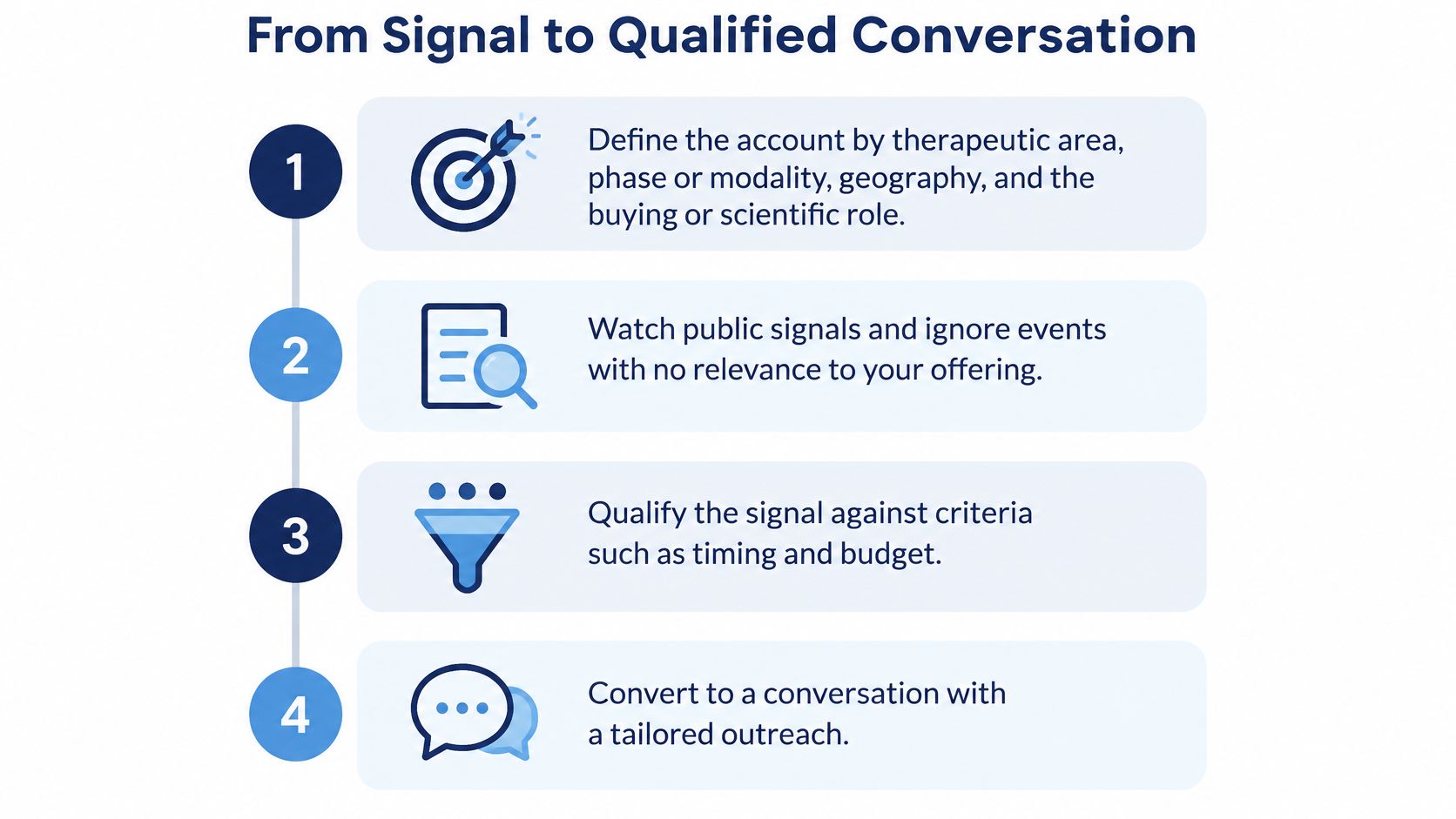
- Define the account. Specify therapeutic area, phase or modality, geography, and the buying or scientific role. Separate HCP engagement from selling services into a drug developer.
- Watch public signals, then discard events without a relevant stakeholder. Preserve the original announcement rather than relying on an unattributed summary.
- Score distinct features: account fit, clinical relevance, recency, stakeholder role, and evidence of intent. A product-information request or substantive medical-webinar engagement should carry more weight than an anonymous page view.
- Apply recency decay and calibrate by country, specialty, account type, and channel. An old interaction shouldn't indefinitely outrank a current, explicit need.
- Attach an already classified asset that addresses the stakeholder's question.
- Send product-claim drafts through MLR and log the evidence behind the personalization. Don't let automated drafting bypass distribution controls.
- Record the account outcome. Capture the response, meeting participants, unresolved question, and subsequent stage change, not only the click.
Measure progression rather than production
In a 2025 survey of 100 pharmaceutical digital decision-makers in North America and Europe, half described their omnichannel maturity as advanced, but only 22% tracked business impact such as revenue or lead generation, according to Graphite's Digital Reality Check. Related findings reported 36% of pharma leaders considered omnichannel successfully integrated and 38% said their companies consistently captured and used engagement data; more than half of respondents had embedded AI in content workflows, while nearly 75% planned to expand it for segmentation or behavioral modeling.
Automation can therefore increase output before teams can explain whether that output helped. Keep leading indicators separate from downstream results.
Leading and lagging measures for pharma lead programs
| Stage | Measure | Healthy read | Trap |
|---|---|---|---|
| Signal detected | Share of alerts with a named stakeholder and approved next step | Most alerts are actionable, not news clips | Treating every headline as a lead |
| Engagement | Reply quality and repeat engagement with indication-specific content | Replies name a need, not just a click | Optimizing open rate |
| Conversation | Meeting conversion and stakeholder coverage on the account | The right role shows up | Counting any booked call |
| Opportunity | Stage change after the engagement | A scientific, access, partner, or trial discussion advances | Form fills labeled as pipeline |
| Outcome | Pipeline, formulary access, trial recruitment, or revenue in a comparable period | Movement versus a control territory | Claiming an email caused a prescription |
Validate the score against real outcomes
IQVIA's ChannelDynamics approach connects channel engagement with content quality, prescribing intent, and commercial performance. Apply that principle by checking whether your highest-scored accounts progress toward the outcome relevant to your team.
A clinical-services seller might measure a feasibility discussion advancing to scoped work. An access team might track a substantive dossier discussion. Neither should be reduced to a generic marketing-qualified lead count.
Use a shared lead-qualification definition so marketing, sales, and medical functions don't attach different meanings to the same status. Compare similar territories and periods, preserve channel attribution, and use control groups where feasible.
A useful score helps someone choose the next account. It doesn't prove that your outreach caused the eventual outcome.
Outreach That Names a Real Reason
The following are hypothetical notes for review, not approved templates. Each starts with a public fact, connects it to the recipient's role, and offers a bounded next step.
A trial milestone creates a scientific question
Suppose a mid-size oncology biotech announces a Phase 3 start in non-small cell lung cancer and posts medical-affairs roles. A clinical-services team has a reviewed, non-promotional briefing on site-support questions and can substantiate the examples it contains.
Your announcement describes the start of your Phase 3 study in non-small cell lung cancer.
For your medical-affairs team, we can share a short non-promotional briefing on site-support questions peers are asking, with the supporting sources.
Would a 20-minute scientific exchange be useful to assess which questions are relevant to your program?
The signal is the announced trial start. The role is the head of medical affairs, the asset class is non-promotional scientific material, and the single ask is a scientific exchange.
The phrase “questions relevant to your program” makes room for discovery rather than pretending to know the team's needs. Nothing in the note says the investigational agent works, predicts trial success, or turns a development milestone into a treatment recommendation.
The hiring posts can help identify organizational priorities internally. They don't need to appear in the email unless they materially improve the reason to write.
A pharmacy priority calls for an access conversation
Now suppose a regional health system says in an earnings update that specialty-drug spending and P&T workload are rising. A manufacturer's access team has an approved indication-specific summary and the associated prescribing information.
Your earnings update identified rising specialty-drug spending and additional P&T workload.
For your pharmacy review team, we have an approved access summary for the relevant indication, accompanied by the prescribing information.
Would you like me to send that packet for your review?
Here, the signal is the health system's stated workload, the role is the pharmacy director, and the asset class is approved access material. The ask is permission to send the packet, not an immediate sales meeting.
The note offers information without promising lower costs or better clinical outcomes. The reference to an approved packet doesn't make the email automatically compliant, but it keeps the proposed follow-up specific and reviewable.
Cut the empty introduction
A weak opener merely congratulates the organization on its growth and asks for calendar time. It contains no role-specific need; adding an unsupported outcome claim would create a regulatory problem rather than solve the relevance problem.
A careful rep could spend hours assembling the announcement, stakeholder context, and suitable asset. The value lies in the cited reason, not in making the email longer. When writing sales emails that reference company news, keep the first line factual, the second relevant to the role, and the third focused on a specific next step.
Run the Next Accounts on Signals
I would test this approach with 25 target accounts in a single therapeutic area for 30 days. Treat that as an operating experiment, not a promised performance benchmark.
Use Find, Research, Reach out to keep the pilot manageable. The purpose is to learn which events produce useful conversations, not to exhaust the contact list.
Give each account a clear disposition
- Find: Select accounts with a public trial start, phase move, raise, formulary comment, or leadership change that could matter to your offering.
- Research: Create a short brief explaining what changed, who owns the resulting work, and which approved asset fits.
- Reach out: Send a reviewed note for each genuine signal. Hold accounts where the evidence, stakeholder, or message isn't ready.
Judge the month on meetings with the appropriate role and documented stage changes. Keep email volume as an operational count, not the definition of success.
Manual stitching of earnings updates, trial announcements, and job posts is where teams can lose their response window. Salesmotion is one way to watch those signals: our life-sciences module finds drug developers by therapeutic area, phase, and modality, and monitors trial starts, phase moves, and raises, alongside clinical-trial signals, earnings analysis, and AI meeting prep.
Cytel has seen 50% less research time after consolidating five research tools into Salesmotion. Analytic Partners saw 40% more qualified pipeline. Those are separate customer outcomes, not forecasts for this pilot.
Keep the list selective: The goal isn't more personalization. It's a cited reason to write, reviewed by the right team, while the signal is still current.
End the test with explicit account decisions: pursue, investigate, or hold. If a lead has no accessible stakeholder, no approved message, and no current signal, leave it off this month's list.
Salesmotion researches target accounts, monitors meaningful changes, and drafts outreach anchored to real signals for your team to review and refine. Visit Salesmotion to explore how account intelligence can support your next signal-first pharma prospecting pilot without replacing your compliance process.