The best sales intelligence tool with a native HubSpot integration depends on what you want to land on the HubSpot record. Choose Salesmotion if you want buying signals and account research on company, deal and contact records: every signal arrives as a note on the company timeline, and Salesmotion cards show why now, what to know and the key people. Choose ZoomInfo or Apollo.io if you want contact data and enrichment written into HubSpot properties, and 6sense or Demandbase if marketing and sales run an intent-led ABM program in HubSpot.
Sales intelligence shopping list this long?
Skip the matrix. Salesmotion combines account intel, signals, and outreach drafts in one tool.
1,000+ public sources monitored 24/7, verified contacts with 200 credits/mo included, $85/mo. Monthly contract, no lock-in.
TL;DR: All twelve tools in this guide connect to HubSpot natively, without Zapier or CSV files. They differ in what they write and where it lands. Salesmotion puts account-level buying signals on the company timeline and research cards on company, deal and contact records (from $85/mo). ZoomInfo and Apollo.io push contact and company data into HubSpot, and Apollo.io syncs deals and activities both ways. 6sense and Demandbase write intent and account scores into HubSpot and show their own cards on records. HubSpot also has its own data enrichment, Buyer Intent, Company Research Agent and Prospecting Agent, covered below.
Top picks
| Tool | Best for | Starting price |
|---|---|---|
| Salesmotion | Buying signals and account research on the HubSpot record | From $85/mo |
| ZoomInfo | Contact and company data pushed into HubSpot | Custom, consumption-based |
| Apollo.io | Two-way sync of contacts, deals and activities | Free; $49–$119/user/mo (annual) |
How We Evaluated These Tools
Salesmotion publishes this guide, and Salesmotion is listed first. Weigh that placement accordingly. Its entry says exactly what it writes to HubSpot, on which plans and what it costs, in the same format as every other tool.
Every integration fact was checked on the vendor's own documentation or HubSpot's own site on 18 November 2026, and each entry links its source. Prices are each vendor's published wording, checked on their pricing pages in October 2026 (10 October for most, 25 October for Clay). Where a vendor does not publish a price, the table says so and does not estimate.
We compared the tools on four things:
- Integration type. Native app, HubSpot App Marketplace listing, Zapier or CSV. All twelve here connect natively.
- What syncs, and where it lands. Company or contact properties, timeline notes or activities, cards on records, lists, or new records.
- Direction. One way into HubSpot, or both ways.
- What it needs. The HubSpot edition or vendor plan the integration requires, where the vendor states one.
The order reflects fit for one buyer: a B2B sales team that runs HubSpot and wants reps to know which accounts to work this week and why. A lower position is not a lower quality score.
Quick Comparison: 12 Sales Intelligence Tools for HubSpot
Integration facts checked on vendor docs on 18 November 2026. Prices as published by each vendor in October 2026.
| Tool | Integration type | What syncs, and where it lands in HubSpot | Starting price | Best for |
|---|---|---|---|---|
| Salesmotion | Native HubSpot app | Signals as notes on the company timeline; score, priority, last signal and signal count as company properties; Salesmotion cards on company, deal and contact records | From $85/mo | Buying signals and account research on the record |
| ZoomInfo | Native HubSpot Connector, plus Enrich for HubSpot | ZoomInfo data pushed to HubSpot records by reps or automation; CRM enrichment and deduplication; HubSpot data imported into ZoomInfo | Custom, consumption-based | Contact and company data in HubSpot |
| Apollo.io | Native | Contacts, accounts and deals in both directions; Apollo emails, calls, meetings, tasks and notes as activities | Free; $49–$119/user/mo (annual) | Prospecting data and sequences with HubSpot as CRM |
| UserGems | Native | New contacts and companies; UserGems contact properties; past and new contact associations; workflow and sequence triggers | Core $40,000/yr, Advanced $75,000/yr, Elite $150,000/yr | Person-level signals such as job changes |
| Common Room | Native app, two-way | Contact fields and new contacts; contacts sent to workflows and sequences; company fields by request | Essential $2,500/mo (billed annually) | Person-level buyer intelligence |
| 6sense | Native apps, listed on the HubSpot App Marketplace | Scores and segment names to fields or custom objects, synced nightly; a 6sense card on company and contact records | Custom, quote-only | Intent-led account-based programs |
| Demandbase | Native, two-way | Demandbase properties on companies and contacts, updated daily; an app card on company and contact records | Custom (platform fee + per-user fee) | ABM on HubSpot Professional or Enterprise |
| Clay | Native (OAuth) | Creates and updates contacts, companies, deals and custom objects; adds records to static lists; imports HubSpot records into Clay | Free; Launch from $60/mo, Growth from $205/mo ($54/$185 annual) | Custom enrichment workflows |
| Cognism | Native | Contacts and companies exported with field mappings; CRM Enrichment writes enriched data back to existing records | Custom, quote-only | Contact data and CRM enrichment |
| Lusha | Native | Revealed contacts and companies pushed into HubSpot; a Lusha widget inside HubSpot | Free (40 credits/mo); Starter $37.45/mo, Pro $52.45/mo (annual) | Quick contact lookups |
| Amplemarket | Native, two-way | Contacts and companies; email, LinkedIn and call activity as timeline engagements, every three hours | Startup from $600/mo (2 users) | Outbound in one tool, with HubSpot as system of record |
| Warmly | Native | Companies and contacts with Warmly properties; chat transcripts on the activity timeline | From $10,000/yr (annual or quarterly) | Website visitor signals for inbound |
The 12 Tools in Detail
1. Salesmotion
What it is. Salesmotion is an AI account intelligence platform with three AI agents. The Signal Agent watches your accounts across 1,000+ public sources, the Research Agent turns what changed into cited account briefs, and the Outreach Agent drafts messages for a rep to review.
What lands in HubSpot. The native HubSpot app matches each Salesmotion account to its HubSpot company, by the linked record first and then by domain.
- Signals on the timeline. Every new buying signal is added to the matched company as a HubSpot note, with the headline, the source and a link to the signal. You choose all signals, only selected signal types, or none.
- Company properties. Score, priority, last signal, signal count and a link back to Salesmotion, in a Salesmotion property group you can use in lists, views and reports.
- Cards on records. The Salesmotion Signals card on company, deal and contact records shows why now, what you need to know, the latest signals with Email and + Task buttons, and the key people. A Summary card fits the right sidebar.
- Owners, fields and accounts. HubSpot owners become account owners, mapped fields sync in the direction you choose, and accounts can be imported from synced owners or a HubSpot list.
Salesmotion syncs every 12 hours, and an admin can sync any time. It never deletes anything in HubSpot. Source: Connecting HubSpot.
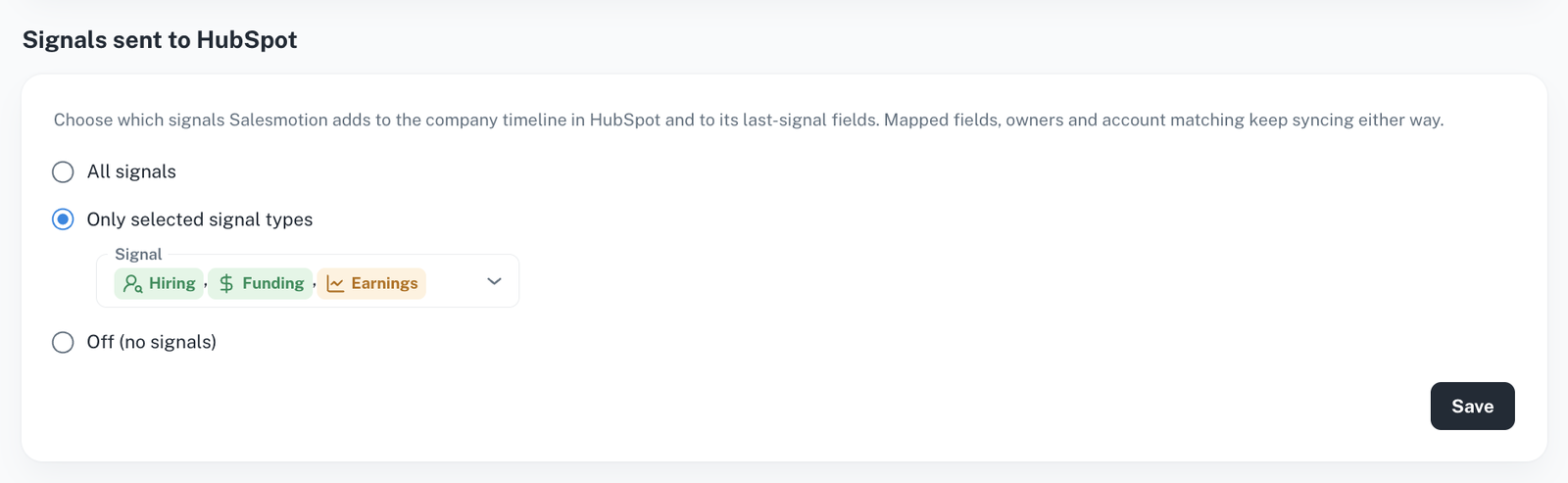 Choose which Salesmotion signals reach the HubSpot timeline.
Pricing. $85/month for individuals on a monthly contract, covering up to 100 accounts. Custom pricing for teams and enterprise. The HubSpot integration is available on every plan: included with Enterprise, and switched on by request on other plans.
Choose it if your reps need a reason to reach out, grounded in something the account said or did, on the HubSpot record they already have open.
2. ZoomInfo
What it is. ZoomInfo is a company and contact database with buyer intent and its Copilot AI sales agent. It connects to HubSpot through the ZoomInfo HubSpot Connector and Enrich for HubSpot.
What lands in HubSpot. ZoomInfo's HubSpot integration page lists an export that brings ZoomInfo intelligence back to HubSpot through seller- or automation-initiated pushes, and data management for CRM enrichment and deduplication. In the other direction, ZoomInfo imports HubSpot data to power its own search filters, Copilot Signals, automation and scoring. ZoomInfo also offers a connector for HubSpot's Prospecting Agent, and its Chrome extension shows a side pane matched to the prospects and customers you open in HubSpot.
Pricing. ZoomInfo does not publish list pricing; its pricing guide says pricing is consumption-based. Vendr reports a median contract of $33,500 a year based on 1,576 purchases.
Choose it if you want HubSpot contact and company records filled and kept current from one large database.
3. Apollo.io
What it is. Apollo.io combines a contact database with sequences.
What lands in HubSpot. Apollo's HubSpot integration syncs contacts, accounts and deals between Apollo and HubSpot, and pushes Apollo activities, including emails, calls, meetings, tasks and notes. An enrichment-only version enriches existing HubSpot records without two-way sync. Apollo states that the HubSpot integration is available on paid plans.
Pricing. A free tier, then Basic at $49, Professional at $79 and Organization at $119 per seat per month on annual billing.
Choose it if your reps prospect and sequence in Apollo.io and you want deals and activity kept in step with HubSpot.
4. UserGems
What it is. UserGems unifies buyer signals and first-party data into person-level intelligence for outbound and ABM, with 30+ native signals, a Research Agent and an MCP server.
What lands in HubSpot. UserGems states it has a native integration with HubSpot. It creates new contacts and companies, writes UserGems contact properties such as past company and no-longer-at-company flags (property list), associates a past contact with their new record, and can trigger HubSpot workflows and sequences.
Pricing. Three tiers priced per year: Core at $40,000, Advanced at $75,000 and Elite at $150,000.
Choose it if your best pipeline comes from people moving jobs and past champions, and you want those people created and flagged in HubSpot.
5. Common Room
What it is. Common Room is a buyer intelligence platform built around the person and the buying committee.
What lands in HubSpot. Common Room describes a bidirectional integration with HubSpot CRM. It updates and creates HubSpot contacts, with the fields you map, and can send contacts to HubSpot workflows and sequences. Company field sync is available by request. Common Room states the HubSpot integration is included on all plans.
Pricing. Essential at $2,500/month billed annually; Advanced and Enterprise are quote-only.
Choose it if you want person-level signals turned into HubSpot contacts and workflow enrollments.
6. 6sense
What it is. 6sense is a revenue intelligence platform built on its Signalverse intent network.
What lands in HubSpot. 6sense has a HubSpot listing on the App Marketplace. Its HubSpot integration exports 6sense scores or segment names to custom objects or fields, with nightly data syncs, and the objects synced depend on your 6sense package. The Sales Intelligence integration adds 6sense cards to company and contact records.
Pricing. 6sense does not publish list pricing. Vendr reports a median annual contract value of $62,220 across 386 purchases.
Choose it if marketing and sales run an account-based program on intent data and want those scores in HubSpot.
7. Demandbase
What it is. Demandbase is an account-based marketing platform with sales intelligence, buying groups and advertising.
What lands in HubSpot. Demandbase offers a bidirectional sync with HubSpot CRM. It syncs data to the account and contact objects, creates Demandbase custom properties automatically and updates them daily. An app card shows company fit, intent signals and engagement trends on company and contact records. Demandbase supports only the Professional and Enterprise editions of HubSpot CRM.
Pricing. Demandbase does not publish list pricing; its pricing page describes a platform fee plus a flat fee per user. Vendr reports a median annual contract value of $68,591 across 187 purchases.
Choose it if you run ABM on HubSpot Professional or Enterprise and want fit, intent and engagement next to the record.
8. Clay
What it is. Clay is a data enrichment and workflow platform for teams that build their own list logic.
What lands in HubSpot. Clay's HubSpot integration connects with OAuth. It imports HubSpot objects into Clay, creates and updates contacts, companies, deals and custom objects (custom objects need HubSpot Enterprise), and adds records to static lists. Clay's integration page lists HubSpot under Growth and above, so check which plan you need.
Pricing. A free tier, Launch from $60 a month ($54 billed annually) and Growth from $205 a month ($185 billed annually).
Choose it if you have a GTM engineer who will build enrichment and routing logic around HubSpot.
9. Cognism
What it is. Cognism is a B2B contact data provider.
What lands in HubSpot. Cognism exports contacts and companies to HubSpot using field mappings, and its CRM Enrichment synchronises enriched data back into existing HubSpot records. Cognism's help centre says the HubSpot account should be on Professional or above.
Pricing. Cognism does not publish list pricing; it sells Standard and Pro packages on a credit system.
Choose it if you want contact data exported into HubSpot and existing records enriched on a schedule.
10. Lusha
What it is. Lusha is a contact data tool with a free plan.
What lands in HubSpot. Lusha's HubSpot integration pushes the contacts and companies you reveal in Lusha directly into HubSpot, and adds a Lusha widget inside HubSpot. You can connect directly, without the App Marketplace.
Pricing. A free plan with 40 credits a month, then Starter at $37.45 and Pro at $52.45 per month on annual billing.
Choose it if reps need quick contact lookups and want the result in HubSpot in one click.
11. Amplemarket
What it is. Amplemarket is an outbound platform with data, signals, multichannel sequences and a dialer.
What lands in HubSpot. Amplemarket provides a bi-directional integration with HubSpot. It syncs contacts and companies, pushes email, LinkedIn and call activity to HubSpot as engagements, and updates HubSpot every three hours.
Pricing. Startup at $600/month on an annual term for 2 users; Growth and Elite are quote-only.
Choose it if you want prospecting, sequencing and calling in one tool, with every touch logged in HubSpot.
12. Warmly
What it is. Warmly identifies website visitors and runs inbound chat and outreach. Warmly announced on 30 June 2026 that it has agreed to be acquired by HubSpot.
What lands in HubSpot. Warmly's HubSpot integration creates or updates companies (matched by domain) and contacts (matched by email), creates Warmly custom properties automatically, and adds chat transcripts to the activity timeline. Standard HubSpot fields are filled only when empty, and Warmly never creates deals.
Pricing. Annual pricing from $10,000/year, billed annually or quarterly.
Choose it if inbound is your main channel and you want website visitor activity on HubSpot records.
What HubSpot Itself Offers
HubSpot ships its own enrichment, intent and research tools, so check what your HubSpot subscription already includes before you add a vendor. As of 18 November 2026:
- Data enrichment automatically populates property values on contact and company records. It is available on Starter, Professional and Enterprise hubs and does not consume HubSpot Credits.
- Buyer Intent covers four signal types: visitor intent, research intent, company news and contact-level signals. HubSpot says most buyer intent features require HubSpot Credits.
- Company Research Agent, in beta, researches a company before outreach, including funding signals. It needs Smart CRM Professional or Enterprise and HubSpot Credits.
- Prospecting Agent monitors companies for buying signals using the audiences you configure and generates personalized outreach, using HubSpot Credits per email.
The vendors above add data or signals from their own sources, and several put their own cards on HubSpot records. Running HubSpot's tools next to one or two vendors works, as long as each HubSpot property has one owner.
What to Check Before You Buy
Where the data lands. A property is good for lists, reports and workflows. A timeline note or activity tells the story of what happened. A card on the record is where a rep reads it before a call. Ask each vendor which of the three you get. Our guide to account intelligence CRM integration covers why reps adopt intelligence that lives on the record.
Which HubSpot edition you need. Demandbase supports HubSpot Professional and Enterprise, and Clay's custom-object sync needs a HubSpot Enterprise portal. HubSpot's own Company Research Agent needs Smart CRM Professional or Enterprise.
Direction and duplicates. Two-way sync is useful for deals and activity, and risky for fields two systems both own. Ask how existing records are matched and whether the tool ever overwrites or deletes HubSpot data.
Who has to approve it. If your HubSpot portal uses app governance, a Super Admin approves each app and its permissions first. Plan that step before the trial.
Signals versus contacts. Contact-data tools tell you who to reach. Signal tools tell you which accounts to work now. If you are building an account-based program in HubSpot, you usually need both. For the signal side, see our ranking of buying signal tools.
Key Takeaways
- All twelve tools here connect to HubSpot natively. The difference is what they write: properties, timeline notes and activities, cards on records, or new records.
- Salesmotion puts account-level buying signals on the company timeline and research cards on company, deal and contact records, from $85/month.
- ZoomInfo, Apollo.io, Cognism and Lusha are contact-data picks; Apollo.io and Amplemarket also log outreach activity in HubSpot.
- 6sense and Demandbase suit intent-led ABM, and Demandbase needs HubSpot Professional or Enterprise.
- HubSpot's own data enrichment, Buyer Intent, Company Research Agent and Prospecting Agent are worth checking first, since you may already pay for the subscription they need.
Frequently Asked Questions
What is the best sales intelligence tool with a native HubSpot integration?
For a B2B sales team that wants to know which accounts to work and why, Salesmotion: its native HubSpot app adds every buying signal to the company timeline as a note, writes the score and last signal to company properties, and shows research cards on company, deal and contact records, from $85/month. ZoomInfo and Apollo.io are the picks for contact data in HubSpot, and 6sense and Demandbase for intent-led ABM.
What does a native HubSpot integration mean?
A native integration connects directly to HubSpot through the vendor's own app, usually by signing in with HubSpot and approving permissions, with no Zapier, middleware or CSV files in between. It writes to HubSpot records on a schedule or in real time, and some native apps also add their own cards to HubSpot records.
Which tools put buying signals on the HubSpot timeline?
Salesmotion adds each buying signal to the matched company as a HubSpot note. Amplemarket pushes its email, LinkedIn and call activity to HubSpot, Apollo.io pushes its emails, calls, meetings, tasks and notes, and Warmly adds chat transcripts to the activity timeline. Intent tools such as 6sense and Demandbase write scores to properties and show their own cards on records.
Does HubSpot have its own sales intelligence?
Yes. HubSpot offers data enrichment for contact and company records, Buyer Intent (visitor intent, research intent, company news and contact-level signals), a Company Research Agent in beta and a Prospecting Agent that monitors companies for buying signals. Most of the intent and agent features use HubSpot Credits.
Do I need HubSpot Professional for these integrations?
It depends on the tool. Demandbase supports only HubSpot Professional and Enterprise, and Cognism's import from HubSpot needs Professional or above. For Salesmotion, the person who connects HubSpot needs permission to install apps (a Super Admin, or a user with App Marketplace access).
Can I use more than one of these tools with HubSpot?
Yes. A common split is a contact-data tool to fill records, a signal or intent tool to decide which accounts to work, and HubSpot's own features on top. Map fields carefully so two tools never write to the same property in opposite directions.