Selling into biopharma is a timing game. Sponsors make site selection decisions, CRO shortlists, and vendor evaluations on tight timelines, often months before an RFP ever surfaces. If your team finds out about a Phase III expansion from a press release, you're already behind the companies that spotted the Phase II results weeks earlier.
Signal-based prospecting gives life sciences sales teams a systematic way to catch these moments as they happen, across clinical trial registries, earnings calls, funding announcements, leadership changes, and strategic news. Instead of manually scouring ClinicalTrials.gov and Google News every morning, you build a system that surfaces the opportunities worth pursuing and filters out the noise.
TL;DR: Signal-based prospecting for life sciences means monitoring real-time triggers from clinical trial data, financial disclosures, news, and hiring patterns to identify sponsors and accounts at the exact moment they need your services. CROs and life sciences vendors that automate this research cut prospecting time by 50% or more and reach decision-makers before competitors even know an opportunity exists.
Why Life Sciences Prospecting Is Uniquely Signal-Rich
Life sciences is one of the most signal-dense industries in B2B. Unlike sectors where buying intent is hidden behind anonymous website visits, pharma and biotech companies leave a public trail of data every time something meaningful happens.
Trial registrations, protocol amendments, phase progressions, FDA correspondence, earnings transcripts, funding rounds, patent filings, and executive appointments are all publicly accessible. The challenge isn't finding signals. It's connecting them into a coherent picture of which accounts need what you offer, right now.
Most sales teams in this space still do this manually. A late-phase CRO business development director described the routine for a single email like this: pull a sponsor list, drop it into a spreadsheet, bulk-upload to a contact enricher, filter by clinical-ops and CEO titles, then open each company website one by one to read the About Us, Programs, and Pipeline pages and infer the phase. Roughly ten to fifteen minutes of back-and-forth for one outreach.
The hard part is not finding sponsors. In a given therapeutic area, most teams already know the universe. The hard part is reading the signals well enough to know which sponsors need a partner now and which are a year too early.
When Cytel, a global leader in advanced analytics for life sciences, evaluated their own commercial workflow, they found this exact problem. Their team was toggling across five or more disconnected tools to prepare for a single account conversation. Research time was eating into selling time, and new hires took weeks to get up to speed on the industry landscape.
Why the best window sits ahead of the RFP
Cold responses to an RFP convert at a far lower rate than relationships shaped before the RFP is ever written. By the time a request goes out, the protocol is set and the shortlist is forming. The window that matters sits roughly six to nine months ahead of the RFP, while the protocol is still taking shape and the sponsor is deciding how to staff the study. That window is invisible to a contact database. It only appears if you read the right signals at depth, which is the spine the rest of this catalog hangs on.
The Signal Categories That Matter in Life Sciences
Not all signals carry equal weight. For CROs, clinical site networks, and life sciences vendors, these are the triggers worth building your prospecting workflow around.
Clinical Trial Activity
This is the most valuable and most specific signal category for life sciences teams. Every phase progression, new trial registration, protocol amendment, and results announcement tells you something actionable about a sponsor's near-term needs.
Key triggers to monitor:
- Positive Phase II results signal an upcoming Phase III, which means larger trials, more sites, and expanded vendor needs
- New trial registrations on ClinicalTrials.gov reveal what therapeutic areas a sponsor is investing in before any press release
- Protocol amendments and delays suggest the sponsor may be looking for new site partners, specialized CROs, or operational support to get back on track
- FDA designations (Breakthrough Therapy, Fast Track, Orphan Drug) indicate accelerated timelines and increased urgency
Trial completion and results activity deserves its own callout. It is one of the most time-sensitive triggers and one of the most underused. A trial that just completed, or a sponsor publishing results, tends to forecast the next study within three to six weeks. The CRO BD director above wanted to filter on results activity for exactly that reason, but most feeds bury it, so teams never think to look.
On conference signals: attendance alone is noise. Showing up at DIA or presenting at ASCO only tells you a company exists and sends people to events. What makes the signal real is the catalyst underneath, presenting Phase 2 data, announcing a program, or an investor session tied to a pipeline update. Lead with the catalyst, not the attendance.
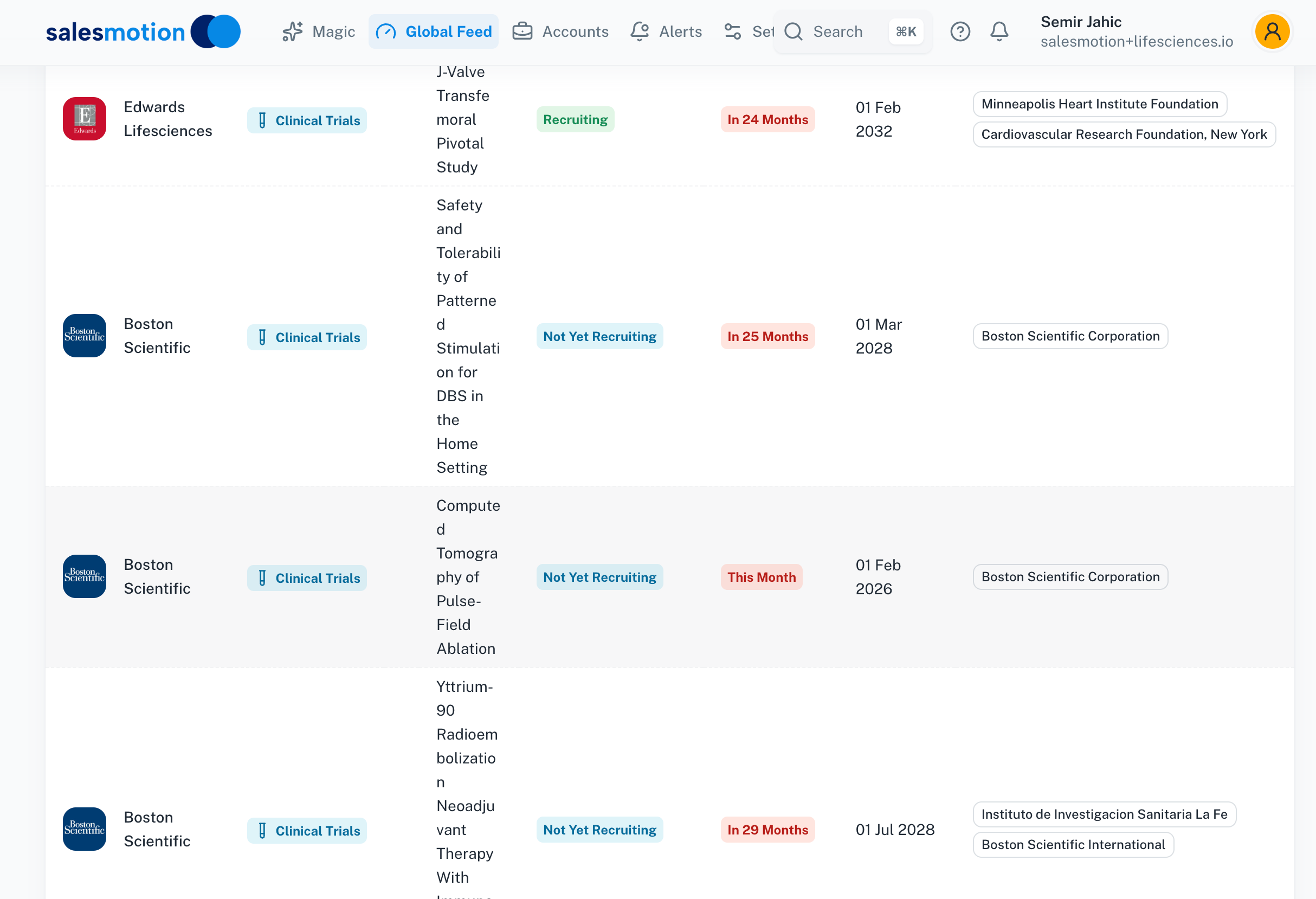 Salesmotion's Global Feed surfaces clinical trial activity in real time, showing trial status, expected timelines, and sponsoring organizations across your target accounts.
The key is watching these events in aggregate across your target accounts, not one trial at a time. A sponsor registering three new oncology trials in the same quarter is a different signal than a single Phase I filing.
Financial and Funding Events
Money creates opportunity. In life sciences, knowing where capital is flowing tells you exactly where pipeline development is about to accelerate.
- Series A/B funding for early-stage biotechs signals upcoming first-in-human trials and early clinical development needs. For practical outreach tactics, see our guide to cold outreach to biotechs
- IPO filings and secondary offerings indicate a company is capitalizing to fund late-stage trials or commercial launch
- Federal grants (SBIR, STTR, NIH) are particularly telling for smaller companies. These grants validate the science and fund the early work, often before any commercial partnerships exist
- Earnings call language from public pharma companies reveals pipeline priorities, trial timelines, and budget allocation. A CEO mentioning "accelerating enrollment" or "expanding our Phase III footprint" is a direct signal
For a deeper look at how to read these financial triggers, our guide to buying triggers in B2B sales covers 21 specific events and how to act on each one.
Leadership and Organizational Changes
New leadership almost always brings new vendor evaluations. In life sciences, watch for:
- New Chief Medical Officers who reshape clinical strategy and trial design priorities
- VP of Clinical Operations hires who evaluate existing CRO partnerships and site networks
- Head of Commercial / Chief Commercial Officer appointments who rethink go-to-market and vendor relationships
- Restructuring announcements that signal a company is consolidating, expanding, or pivoting therapeutic focus
As Cytel's CCO Jonathan Burr put it: "The platform gives our commercial team real-time visibility into key account movements, from leadership changes to clinical trial activity, and supports structured account planning at scale."
Strategic News and Press
Beyond trials and financials, strategic signals paint the bigger picture of where a company is headed:
- Partnership and licensing deals reveal which therapeutic areas are getting investment and which companies are actively building out their pipelines
- Conference presentations and publications show what science is progressing and which sponsors are generating data
- Regulatory submissions and approvals create downstream demand for manufacturing, commercial launch support, and post-market studies
- Competitive landscape shifts like a competitor's trial failure can open doors for sponsors working on similar therapies

“The AI templates were a surprise delight. We expected the data, but the pre-built email suggestions turned out to be much better than expected and a huge help, especially for newer reps.”
Sabina Malochleb-Bazaud
Senior Sales Operations Administrator, Cytel
From Signals to Pipeline: Building the Workflow
Catching signals is only valuable if you can act on them fast enough. Here's a practical framework for turning life sciences signals into qualified pipeline.
Step 1: Map Signals to Your Value Proposition
Start by identifying which signals are most relevant to what you sell. A CRO focused on oncology Phase II-III trials has a very different signal map than a company selling clinical data management software.
| Signal | What It Means | If You're a CRO | If You're a Vendor/Supplier |
|---|---|---|---|
| New Phase III registration | Sponsor scaling up | Site network and ops support needed | Data management, monitoring tools needed |
| Series B funding | First trials coming | Early-stage partnership opportunity | Long sales cycle, get in early |
| CMO appointment | Strategy shift likely | Existing CRO relationships under review | Technology stack re-evaluation |
| Protocol amendment | Trial complexity increasing | Offer specialized expertise | Offer tools to manage complexity |
| Positive Phase II results | Phase III planning begins | Proposal timing is now | Expand relationship from Phase II |
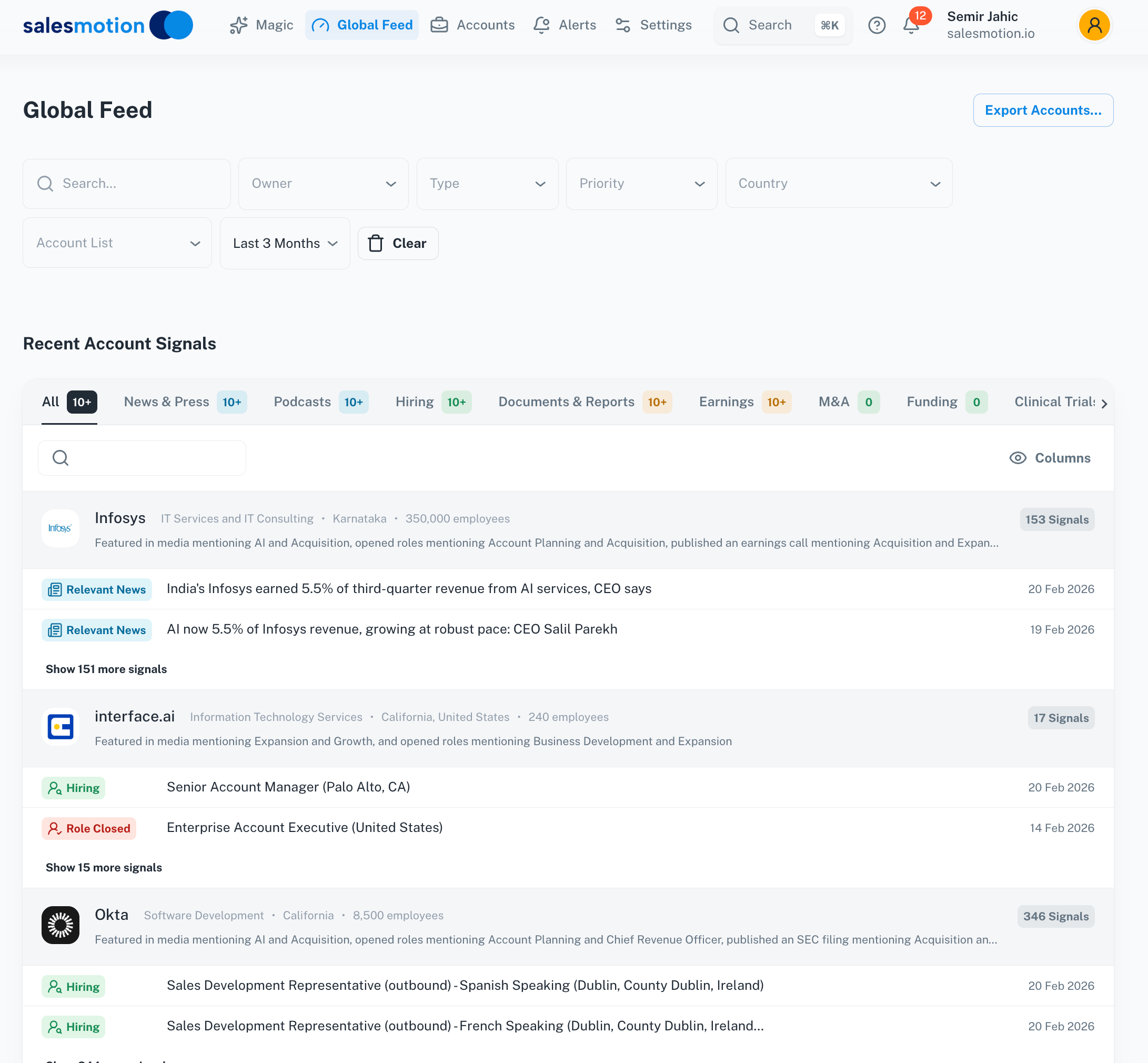 A centralized signal feed replaces five separate research tools, showing three months of buying signals across your entire territory in a single view.
Step 2: Centralize Your Signal Sources
The biggest productivity killer in life sciences prospecting is fragmentation. Teams waste hours every day toggling between ClinicalTrials.gov, LinkedIn, Google News, SEC EDGAR, PubMed, and industry databases.
Cytel found that consolidating from five separate research tools to a single account intelligence platform cut research time by 50% across their sales team. Their reps went from spending the first hour of each day on manual research to getting a prioritized view of what changed at their target accounts overnight.
As Lyndsay Thomson, Head of Sales Operations at Cytel, put it: "We had a variety of tools, and that was the pain. We had to go to multiple places to get streamlined data."
Step 3: Prioritize with Signal Stacking
Single signals are interesting. Stacked signals are actionable. Build a simple scoring model that weights combined triggers higher:
- High priority (act today): Positive trial results + leadership change + funding event at the same sponsor
- Medium priority (act this week): New trial registration + ICP fit, or funding announcement without other supporting signals
- Low priority (watch list): Job posting or single news mention without additional context
The best prospectors in life sciences treat signal monitoring like a daily briefing. Ten minutes reviewing stacked signals beats two hours of unfocused research.
Stacking only works if your tooling lets you combine dimensions. Filter on one dimension at a time and you cannot view funding plus a phase transition plus results activity together, which is the exact combination that flags a sponsor worth a call. And because results activity is only news for a short time, a busy week can mean missing the catalyst for good. Continuous monitoring beats reactive checking.
Step 4: Personalize Based on the Specific Trigger
The entire point of signal-based selling is relevance. Generic outreach fails in life sciences because sponsors receive hundreds of pitches. What works is referencing the specific event that prompted your outreach.
"I saw your Phase II readout for [compound] last week, congratulations. As you plan the Phase III expansion, our [specific capability] has supported similar programs at [therapeutic area]. Would it be helpful to share how?" That kind of message gets responses because it shows you understand their business, not just their email address.
CRO business development is sniper work, not machine-gun outbound. With contracts often in the millions, a few well-timed, signal-anchored conversations beat the spray-and-pray volume that leaves teams with burnt hands.
For more on matching signals to outreach, see our guide on the best signals for enterprise sales.
How Account Intelligence Platforms Accelerate This
Manual signal tracking doesn't scale. A team covering 200 target accounts across biopharma can't realistically monitor ClinicalTrials.gov, earnings transcripts, news, and LinkedIn for every account every day.
This is where the three-agent model changes the equation. The Signal Agent watches across 1,000+ sources for funding, IND filings, phase transitions, results activity, and clinical-ops hires, so nothing depends on a rep remembering to check. The Research Agent turns what would be three hours of reading the protocol, pipeline, and leadership team into a five-minute brief. The Outreach Agent drafts the first message anchored to the specific catalyst, not a template.
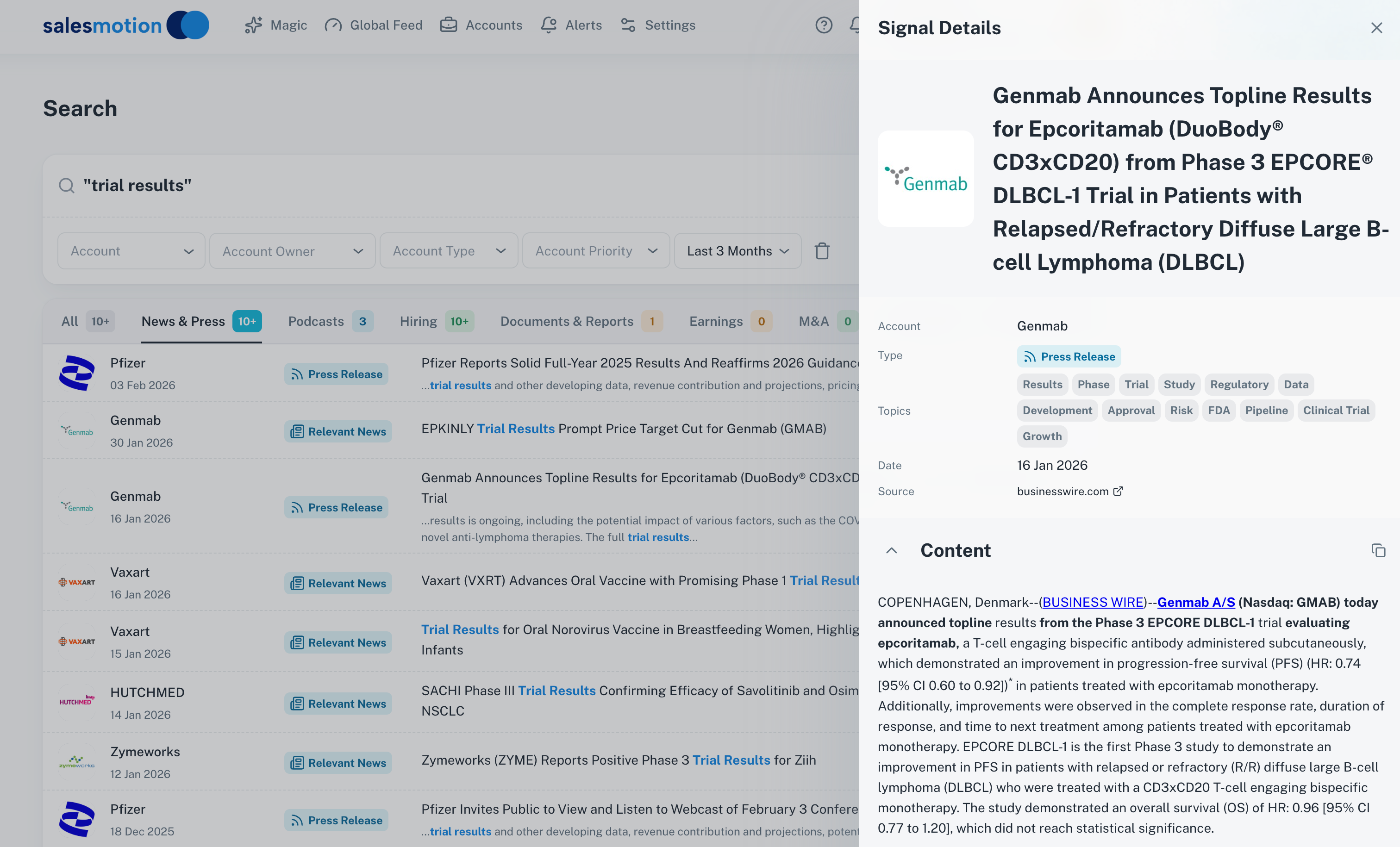 Searching for "trial results" in Salesmotion returns relevant press releases and news across your account list, with signal details showing tagged topics, source links, and full article content.
Cytel's experience is a practical example. After deploying Salesmotion, their commercial team had real-time visibility into executive changes, news mentions, strategic initiatives, and clinical trial activity across their entire target account list. New reps used the same platform as a learning tool, gaining industry context and crafting effective outreach without weeks of ramp time.
Jillian Cormier, VP of Business Development at Cytel, described it this way: "For newer reps, it functions as both a research tool and a learning tool. It helps them understand the account, the context, and how to message effectively without needing weeks of training."
That fast ramp matters more than it looks. The most common scar tissue among life sciences buyers is the tool that got bought and never used, a long list of licensed seats with a fraction logging in. Ease of use is what separates a tool reps actually open from shelfware.
For more on how to find clinical trials and turn milestones into pipeline, see our dedicated guide for pharmatech sales teams.

“All of the vendors that I've worked with, all of the onboarding that I have had to deal with, I will say, hands down, Salesmotion was the easiest that I have had.”
Lyndsay Thomson
Head of Sales Operations, Cytel
Key Takeaways
- Life sciences is the most signal-rich B2B sector. Clinical trials, funding, regulatory events, and leadership changes are all publicly available triggers that reveal buyer timing and intent
- Signal-based prospecting replaces manual scouring of ClinicalTrials.gov, SEC filings, and news sites with a systematic approach to catching opportunities early
- Stack multiple signals for higher confidence. A positive Phase II readout plus a new CMO plus a funding round is a stronger signal than any one event alone
- Centralize your sources. Toggling between five tools wastes hours. Teams that consolidate research into a single platform, like Cytel did, cut research time by 50%. For CRO and CDMO teams weighing up vertical tools, our life sciences alternatives guide compares the options
- Personalize every outreach around the specific trigger. In life sciences, generic pitches get ignored. Signal-referenced messages get meetings
- Use account intelligence as an onboarding accelerator. New reps in complex industries like life sciences ramp faster when they have context-rich account views from day one
Frequently Asked Questions
What is signal-based prospecting in life sciences?
Signal-based prospecting in life sciences is the practice of using real-time data triggers, such as clinical trial progressions, funding rounds, leadership appointments, and buying signals, to identify and prioritize accounts that are actively moving toward a purchasing decision. It replaces manual research with automated signal monitoring.
What are the best data sources for life sciences prospecting signals?
The most valuable sources include ClinicalTrials.gov for trial registrations and status changes, SEC EDGAR for financial filings and earnings transcripts, news and press release aggregators for strategic announcements, LinkedIn for leadership and hiring changes, and intent data providers for behavioral signals. Account intelligence platforms aggregate these into a single view.
How can CROs use clinical trial data for prospecting?
CROs can monitor trial registrations, phase progressions, protocol amendments, and results announcements to spot sponsors who need operational support, site networks, or specialized expertise. A positive Phase II readout, for example, signals that a Phase III trial is being planned, which is the ideal time to begin a relationship with the sponsor.
How much time does signal-based prospecting actually save?
Results vary, but Cytel's sales team cut account research time by 50% after centralizing their signal sources into a single account intelligence platform. Their reps went from using five or more separate tools to accessing everything they needed in one place, freeing up hours each week for actual selling.