You spent three weeks on the campaign. The messaging is sharp, the landing page converts, and the sequence fires exactly when it should. Then the pipeline review lands, and the same number stares back: most of the opportunities came from accounts that had no initiative, no budget and no reason to move, while two accounts actively replacing a competitor never got a single touch.
That isn't a campaign problem. It's a list problem. Target account selection decides where every research hour, every ad dollar and every rep conversation goes, and no amount of craft fixes a list that pointed at the wrong companies.
Teams often treat the list as an export from the CRM. It's better treated as a decision: one owner, one review date, and a verified reason behind every name on it. That's the difference between a list that generates pipeline and a list that generates activity reports.
Why Account Selection Comes Before Any Campaign
Say a marketing team ships its strongest campaign of the quarter to a list assembled from whatever leads arrived in the previous ninety days. Copy is tight, the offer is real, the sequence runs without a hitch. Six weeks later the story is familiar: opportunities from accounts with no initiative and no budget, silence from the three accounts that were shopping the category.
The list decided the outcome before the first email left.
Account-based marketing didn't invent that insight, but it named and systematized it. As Salesforce's account-based marketing guide traces the history, the discipline builds on Don Peppers and Martha Rogers' 1993 book The One to One Future, which argued that companies should move away from mass marketing and treat valuable customers as individual markets. The term itself is generally traced to ITSMA in 2003 and 2004, when enterprise sales and marketing practices around strategic accounts began to be named and systematized. What survived is the operating principle: account choice should precede campaign execution, and the accounts should reflect strategic value, revenue potential, fit and relationship context, not the volume of leads available.
That principle becomes a sequence. Define the ICP from customers you already keep. Score fit and momentum as two separate numbers. Verify the evidence and the buying-group access before an account earns coverage. Tier by fit and intent, then size each tier to the capacity you have. Test the result against a control, and refresh the whole universe on a quarterly clock.
The account list is the decision that shapes everything downstream. Give it the same scrutiny you give the pitch.
How to Build an ICP From Your Best Customers
Start with the customers you already keep. A profile assembled from a wish list of logos produces a list nobody can defend in a review, and it collapses the first time a rep asks why an account is on it. The accounts you win, retain and expand already contain the answer to fit.
A practical process combines three layers rather than leaning on company size or industry alone, as this targeted sales prospecting framework sets out: firmographic fit, technographic fit and active intent, applied in that order. Build the profile the same way.
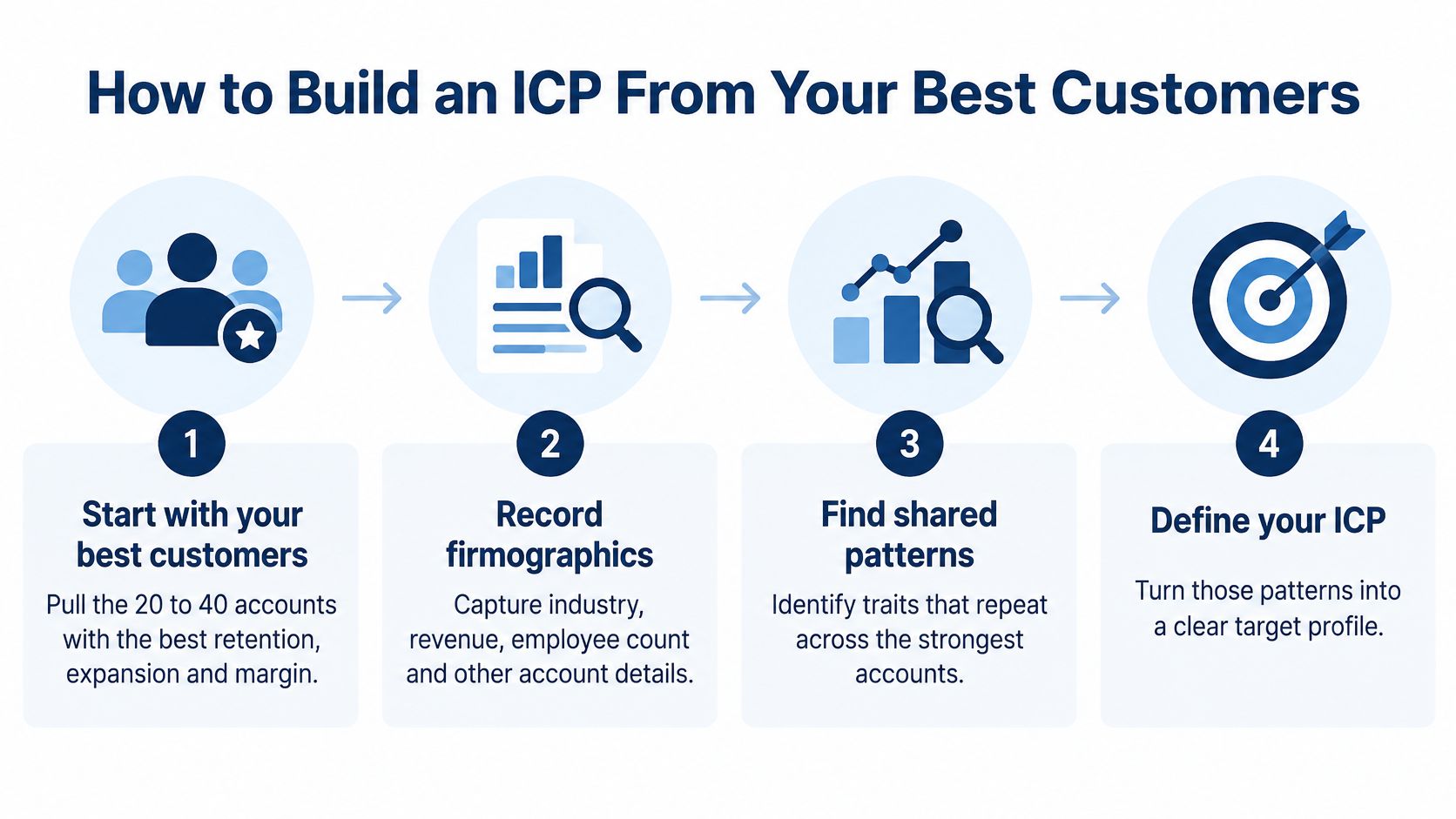
- Pull the 20 to 40 accounts with the best retention, expansion and margin. Rank on commercial outcomes, not on how good the logo looks in a board deck. This set is the evidence base for everything that follows, so a weak set here produces a weak profile.
- Record firmographics for each one. Industry, revenue, employee count, geography, growth stage and business model. Each variable has to earn its place by separating your best accounts from the rest. If nearly every customer sits in one industry, industry isn't a filter, it's a description.
- Add the technology stack. Note tools that create an integration, a replacement or a competitive situation. A payroll vendor cares which HR platform a prospect already runs; a security vendor cares which endpoint tool is deployed. Technographics are what turn a broad segment into a shortlist.
- Log the situational markers. Recent funding, a new executive, relevant hiring, a strategic announcement. These are the variables that turn a static profile into a live prioritization you can act on next week.
- Look for the pattern. Say a payroll software team runs this exercise and finds its strongest accounts are professional services firms with 150 to 600 employees that already run a specific HR system. That's narrow enough to search on, and narrow enough to reject accounts that don't match.
- Test the profile against closed deals. If it doesn't separate wins from losses, revise the variables before you score a single account. Many teams build lists from what sales already believes, so the closed-deal test is the check on that judgment. Skip it and you've automated an opinion.
Keep the output to a single page and pair it with a working ideal customer profile template so the profile and the scoring rules live in the same document. Get the whole revenue team to sign off on that page before it becomes the filter for the list, because every later argument about tiers is really an argument about this document.

“We're no longer fishing. We know who the right customers are, and we can qualify them quickly. Salesmotion has had a direct impact on pipeline quality.”
Andrew Giordano
VP of Global Commercial Operations, Analytic Partners
Score Fit and Intent as Two Separate Numbers
A single blended score hides the only distinction a rep cares about: whether the account belongs on the list at all, and whether it's moving right now. Keep the dimensions apart and rank on both.
Fit answers who belongs
Fit measures how closely an account matches the profile you just built. Use a short list of variables with fixed weights: employee range inside the ICP at 30 points, industry match at 20, a compatible technology stack at 15. That's a 65-point scale, deliberately compact. Every extra variable makes the score harder to explain and easier to argue with in a forecast call.
Intent answers who is moving
Intent measures observable momentum. Flowstrata's account-based marketing statistics make the case precisely: a firmographic-only list identifies companies that theoretically match an ideal customer profile but can't show whether they're changing vendors, expanding, hiring for relevant capabilities or evaluating a category. The framework flags hiring patterns, technology-stack changes, funding events, leadership transitions and geographic or headcount expansion as the active signals that raise priority, with leadership moves especially actionable since a new CRO, VP of Sales or CMO often triggers a reassessment of tools and vendors.
| Signal | Example points | Recency window | When it goes stale |
|---|---|---|---|
| Employee range inside ICP | 30 | Static attribute | Re-check at each quarterly refresh |
| Industry match to ICP | 20 | Static attribute | Re-check when the account changes segment |
| Compatible tech stack | 15 | Current state, re-checked quarterly | Drop points after a stack change or contract end |
| Competitor named on earnings call | 20 | One quarter | Expires after the next earnings cycle |
| New CRO, VP of Sales or CMO | 15 | Six months from announcement | Fades once the leader is settled and the initial review is over |
| Funding round announced | 15 | Two quarters | Expires when the round is older than two quarters or the budget is allocated |
| Job posting that maps to your product | 10 | Until the role is filled | Drop to zero once the role is filled |
| Office or headcount expansion | 5 | Two quarters | Expires once the announcement is older than two quarters |
The windows matter more than the points. Convert each dimension to a share of its maximum so both land on a 0 to 100 scale and can be compared directly. An account scoring 60 on fit and 20 on intent is a solid structural match with nothing happening. An account scoring 45 on fit and 70 on intent is a slightly weaker match in the middle of a decision. The second one usually deserves the earlier conversation, because current momentum beats a marginally better profile match.
That inversion is where most scoring models break. Teams build a beautiful fit model, then treat intent as a tiebreaker, and the reps spend the quarter on accounts that look right on paper.
Write the rules first: set the weights, the decay windows and the thresholds before you look at a single account. Weights chosen after the list exists always bend toward a favorite.
If intent data is new to your team, spend an hour on how intent data software actually works before you buy points from a provider. The scoring model is yours; the signal feed is a commodity you can change.
Verify Evidence and Map the Buying Group
A high score is only as good as the evidence under it. Before an account gets a tier, three questions decide: is the data current, is the source trustworthy, and can you reach the people who would decide?
- Date every signal and apply the decay windows. A leadership hire from eight months ago isn't a trigger, it's history. Intent points that never expire turn into a permanent Tier 1 for your favorite accounts.
- Confirm single-source claims before awarding points. A rumored funding round, an unverified reorg, a competitor mention pulled from a summary rather than the transcript: each needs a second source or a downgrade. Account and contact data remain among the highest-priority needs for BDR teams, and selection is still often driven by leadership assignment, territory coverage or rep judgment rather than systematic prioritization, as 6sense's research on BDR teams reports.
- Map verified contacts across economic, operational, technical and executive roles. Research on buyer behavior reports an average buying group of 10.1 people and finds that buyers complete roughly 70 percent of their evaluation before contacting a vendor, per 6sense's guide to how generative AI is changing B2B buyer research. The best target is rarely the loudest intent signal. It's the account where you can reach the right mix of decision makers early enough to shape the shortlist.
Consider two accounts. Account C shows a fresh CRO hire and a competitor mention in an earnings call, but the only verified contact is a junior analyst. It stays in Tier 2 until you find an economic buyer and a technical evaluator. Account D has modest intent on paper, yet it has a named CFO sponsor, a verified IT lead and a live integration project. It moves up. That's not a scoring change, it's an evidence judgment, and it has to be made by a person.
B2B teams still build lists from several inputs at once. In a 2021 survey of more than 300 B2B marketing executives and professionals, MarketingCharts reported these shares:
| Input | Share of respondents | Role in selection |
|---|---|---|
| Sales-team-selected data | 75% | Dominant input, needs evidence checks |
| Firmographic data | 65% | Core fit layer |
| Behavioral or intent signals | 57% | Momentum layer |
| Technographic data | 47% | Integration and replacement layer |
| Predictive data | 29% | 52% planned to adopt it later |
Sales judgment leading at 75 percent is exactly why the evidence checks matter. The same survey found only 46 percent had a clearly defined ideal customer profile, and 37 percent reported both alignment on that profile and strong coverage of target accounts. Human instinct plus a documented profile is strong. Human instinct alone is a list nobody can audit.
If buying-group mapping is new to your process, start with a repeatable method for finding decision makers inside a company rather than letting each rep invent their own.
“We have very limited bandwidth, but Salesmotion was up and running in days. The template made it easy to load our accounts and embedding it in Salesforce was simple. It was one of the easiest rollouts we've done.”
Andrew Giordano
VP of Global Commercial Operations, Analytic Partners
Tier Accounts With a Fit-by-Intent Matrix
The grid does the sorting, so reps stop relitigating every account in the weekly meeting. Fit on one axis, intent on the other, four cells, four treatments. Leadriver's guide to building an ABM account list makes the case for building selection as a measurable funnel rather than a static list: score structural fit and current intent separately, place accounts in a fit-by-intent matrix, then assign treatment tiers so the strongest cells get the most bespoke coverage, the weak-fit cells drop out, and top-fit accounts without momentum enter nurture.
| Fit | Intent | Tier and treatment | Coverage and response |
|---|---|---|---|
| High | High | Tier 1, bespoke coverage | Custom research, buying-committee map, response within one week |
| High | Low | Tier 2, nurture | Standard sequence, monthly signal review, promote on a new trigger |
| Low | High | Tier 3, light touch | Confirm the intent is real, document the fit gap, single-touch only |
| Low | Low | Excluded from the active list | Remove from coverage, recheck at the next quarterly refresh |
The low-fit, high-intent cell catches teams out. Genuine buying momentum in a company you can't serve well produces expensive, unwinnable deals. Confirm the signal is real, write down why the fit gap exists, then decide whether one light touch is worth it at all.
Governance keeps the grid honest. Name one owner for the list, require sales approval for any tier change, and set promotion and demotion criteria in advance: a Tier 2 account moves up when verified evidence meets the Tier 1 threshold, and a Tier 1 account drops after two quarters without a live signal. Acquisitions, leadership changes and budget cycles move accounts between cells, which is why the full universe gets re-scored at least quarterly.
The rule that keeps the list alive: every account carries an entry reason and an exit condition, and both are written down before the tier is assigned.
Then measure the list itself, not the activity around it. Track ICP-fit distribution, intent recency, buying-committee coverage, pipeline creation, opportunity conversion, win rate, sales-cycle length and revenue by tier. A dashboard full of emails sent tells you nothing about whether the selection was right.
Size Each Tier to the Coverage You Can Deliver
A list only works if your team can touch it. Research cited by the ABM Leadership Alliance puts average program sizes at approximately 6,221 accounts for one-to-many ABM, 177 for one-to-few and 39 for one-to-one, as summarized in this review of the ABM evidence base. Broader coverage supports lighter personalization; smaller sets justify deep research, stakeholder mapping and account-specific messaging.
Run the capacity arithmetic before you assign tiers. Say four reps each spend 10 of their 40 weekly hours on research, which is 40 hours a week across the team. A deep bespoke account takes about three hours, so that's roughly 13 accounts a week, about 58 a month, about 170 a quarter. A Tier 1 list of 300 would take almost two quarters to work once, which means it could never be refreshed quarterly.

The sizing rule that follows: cap Tier 1 at what one quarter of capacity can cover, and move the surplus into Tier 2, where the work is templated and signal-driven. Placing hundreds of accounts into a high-touch motion without the data or the people to support them produces a list that looks ambitious and performs like a backlog.
For a one-to-one strategic motion, keep the list selective enough that every account gets customized research and follow-up. At quarter end, count how many accounts received their planned touches. Resize from that number rather than from ambition.
Test Whether Your Selection Actually Works
Gut feel is hard to argue with, which is why you need a control. Tomba's analysis of account-based marketing benchmarks recommends testing selection quality with an in-ICP versus out-of-ICP control rather than relying on anecdotal rep feedback, which means recording the score components, inclusion reason, tier, mapped contacts, trigger date and eventual commercial outcome for every selected account.
With that data you can compare win rate, opportunity rate, average deal size and cycle time between in-profile accounts and excluded or lower-scoring ones. The published ICP benchmark in that analysis suggests in-profile accounts should close at least 1.5 times as often as out-of-profile accounts. If that separation doesn't show up in your own numbers, the profile isn't discriminating and the variables need reweighting or removal.
A benchmark you can't reproduce in your own pipeline is trivia, not a target.
Treat vendor benchmarks as directional. The stronger internal test is a rolling cohort comparison of your selected tiers against a holdout group across two or more sales cycles, because that test uses your buyers, your pricing and your sales motion.
Most selection failures show up as one of five symptoms. They're worth checking after your first two quarters of data.
| Symptom | Likely cause | Fix |
|---|---|---|
| Tier 1 wins no better than the rest | ICP variables do not discriminate | Reweight or remove weak variables and retest against closed deals |
| Long lists with few meetings | Committee-based list inflation | Require verified contacts across several roles before tiering an account |
| Famous logos stall in discovery | Selected for prestige rather than fit | Require a documented fit reason and a live initiative for each account |
| Reps call accounts dead | Stale contacts and no recent signal | Apply recency decay and move signal-less accounts to quarantine |
| Same accounts for a year | Static list with no refresh | Re-score the full account universe at least quarterly |
Two of those deserve a standing rule. First, quarantine accounts with no meaningful signal instead of deleting them: they come back when new evidence appears, and the history is useful. Second, require verified coverage of multiple roles before an account can reach Tier 1. List inflation usually starts when a team counts titles instead of people.
Move Your Tiers Into Your CRM This Week
A tiering framework that lives in a spreadsheet dies within a month. Move it where reps work.
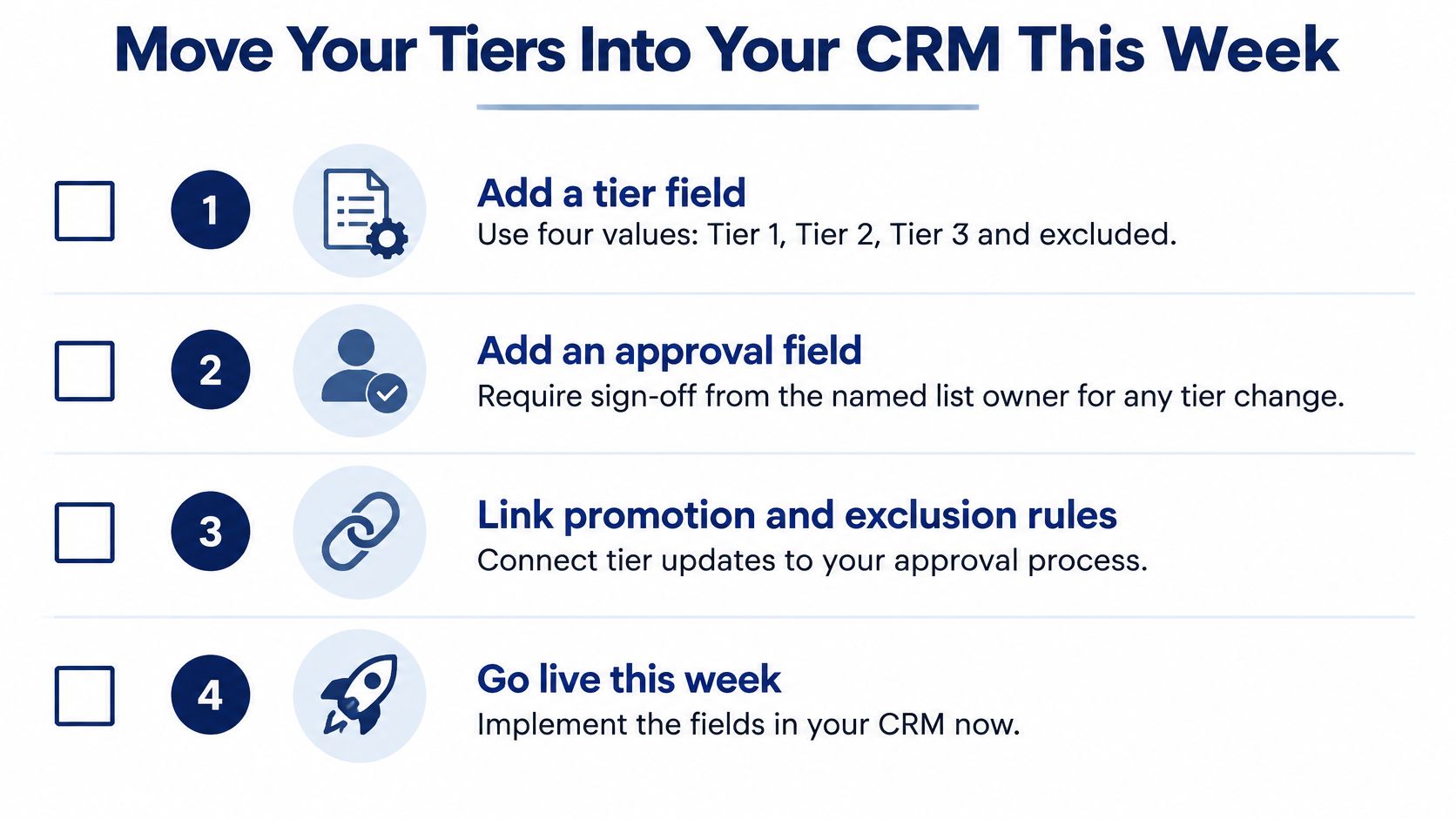
- Add a tier field with four values: Tier 1, Tier 2, Tier 3 and excluded. Picklist, not free text, so it can be reported on, and keep the rest of the company record clean enough to trust, following a few basic CRM hygiene rules.
- Add an approval field so any tier change needs sign-off from the named list owner, tied to the promotion and demotion rules you already wrote.
- Import the accounts in bulk, then pin the Tier 1 accounts so they lead the weekly pipeline review rather than getting buried under inbound.
- Configure signal preferences to the triggers you scored. Alerts should fire on the events in your model, not on every piece of company news.
- Route alerts into Slack, email or the CRM so a rep sees a trigger the day it fires, not in a monthly digest.
- Map verified contacts for every Tier 1 account across economic, operational, technical and executive roles, using the evidence checks above.
- Put the quarterly re-score on the calendar with a reminder to review promotions, demotions and quarantined accounts.
Signal monitoring is the part worth automating, since it's a coverage problem rather than a judgment problem. During onboarding, Salesmotion loads your target accounts, configures signal preferences to your ICP and integrates with your CRM. Accounts can be imported in bulk with favourites used to organize the view, and for each monitored account the platform scans news, filings, hiring activity and dozens of other sources, detects buying signals, updates research briefs and surfaces verified decision-maker contacts. Your team still owns the weights, the thresholds and the tier decisions.
The action that starts it today: create the tier field with its four values, enter the first assignments, and agree on the refresh date before the meeting ends.
Your target list is the most important document in your revenue plan, and it shouldn't go stale the week after you build it. Salesmotion keeps it alive: three AI agents research your accounts from more than 1,000 sources, watch for the triggers you scored, and draft outreach the moment something worth acting on happens, with every alert linked to its source. Add your first accounts, set your ICP signal preferences, and let your reps spend their time on the conversations that move pipeline at Salesmotion.