
A warm lead is a prospect with moderate awareness and real engagement, but not yet clear purchase readiness. They know the problem and your brand, and they have done something observable, such as downloading a guide, visiting the pricing page, or registering for a webinar.
TL;DR: Cold leads do not know you, warm leads have shown interest, and hot leads are asking for specifics. In B2B, warm leads come from company signals (funding, expansion, hiring), role signals (a new executive, a restructure), and direct intent (repeat visits to pricing or product pages). Hand a warm lead to sales when the team can explain both why this account and why now, then reach out with a message built on the signal.
A lot of sales teams are sitting on the same problem right now. The CRM looks full, marketing says lead volume is up, reps are busy, and pipeline still feels thin. Everyone has activity. Few people have clarity.
That’s where the question what is a warm lead stops being a glossary exercise and becomes an operating issue. If your team can’t tell the difference between mild curiosity and real buying momentum, they’ll default to generic outreach, slow follow-up, and bad prioritization. The result isn’t just lower conversion. It’s wasted rep time on people who were never likely to move.
A warm lead is useful because it gives sales and marketing a practical filter. Not perfect. Not final. But good enough to focus attention where interest, timing, and fit start to overlap.
The Problem with 'More Leads' Thinking
Most pipeline problems don’t come from having too few names. They come from treating every name like it deserves the same effort.
A rep logs in on Monday morning and sees a list of contacts: webinar attendees, form fills, old inbound leads, trade show scans, outbound replies, newsletter subscribers. Some of them are researching. Some were curious once and moved on. Some are in a buying cycle right now. If that rep can’t tell which is which, they usually do one of two things. They either spray the same message to everyone, or they cherry-pick based on instinct.
Both approaches waste time.
Where the waste shows up
The cost isn’t abstract. It shows up in very practical ways:
- Reps burn hours on low-intent contacts. They research accounts that haven’t shown meaningful signs of movement.
- Messaging gets flattened. A pricing-page visitor gets the same email as someone who only opened a newsletter.
- Good leads cool off. The people who were worth a quick, relevant follow-up wait too long.
- Forecast quality slips. Managers see “lead volume” and assume coverage, even when intent is weak.
The fix isn’t “work harder.” It’s to sort the funnel by actual engagement.
Evidence from industry benchmarks shows a sharp difference in outcomes. Search-driven warm leads show a 14.6% close rate versus 1.7% for cold leads, according to LiveAgent’s breakdown of warm leads vs cold leads. That gap is why serious revenue teams don’t obsess over lead counts alone. They focus on identifying which accounts have already moved from unknown to interested.
A full funnel can still be a weak funnel if reps can’t see where intent is forming.
Better question, better pipeline
Instead of asking, “How do we get more leads?” ask, “Which leads have earned follow-up?”
That shift changes everything. It moves the team away from volume-based thinking and toward signal-based selling. It also makes your tooling choices clearer. If your stack still treats all lead activity as equal, it’s worth reviewing practical options like these 12 Best B2B Lead Generation Tools, especially if your current setup creates more noise than prioritization.
A warm lead isn’t just a nicer label than “engaged lead.” It’s a way to allocate scarce selling time to prospects who have already shown they might care.
See Salesmotion in action
Take a self-guided interactive tour — no signup required.
The Lead Temperature Spectrum Explained
The easiest way to understand lead temperature is to think about a professional event.
A cold lead is someone across the room who doesn’t know you. A warm lead is someone you’ve been introduced to, and they’ve shown interest in continuing the conversation. A hot lead is the person asking when you can sit down and talk specifics.
That distinction matters because each stage needs a different motion.
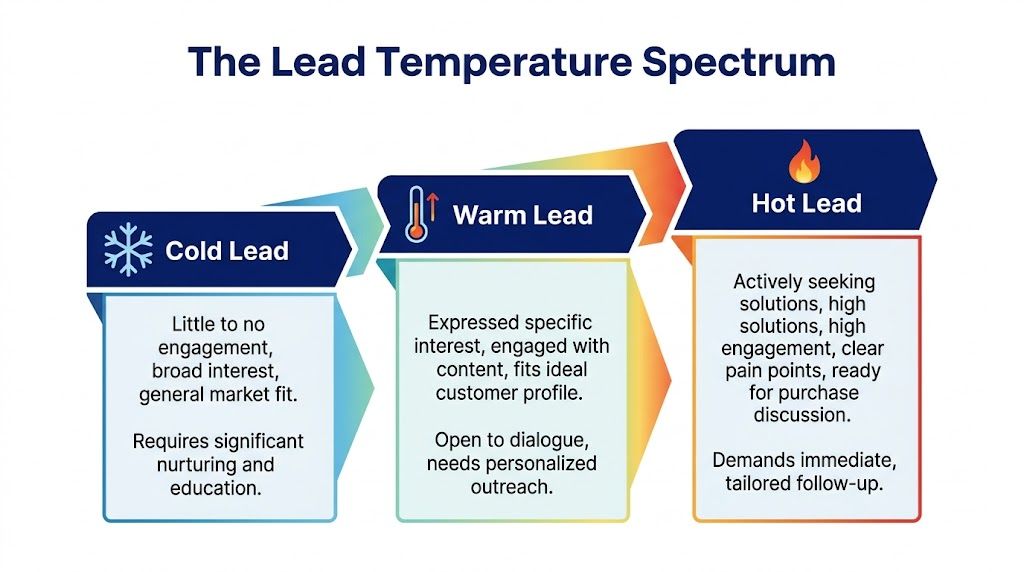
A warm lead is a prospect with moderate awareness and real engagement, but not yet clear purchase readiness.
That middle zone is where organizations often struggle. They either push too early, as if the lead were already sales-ready, or they leave the lead in automation too long and miss the window to start a useful conversation.
Cold, warm, and hot side by side
| Lead type | What they know | Typical behavior | Best sales move |
|---|---|---|---|
| Cold | Little or no familiarity | No meaningful engagement yet | Educate and test relevance |
| Warm | Aware of the problem and your brand | Downloads content, visits pricing, attends webinars, follows updates | Personalize outreach around context |
| Hot | Actively evaluating solutions | Requests specifics, asks direct questions, seeks next steps | Respond fast and move toward evaluation |
What makes a lead warm
Warm leads usually do something observable that shows more than passive awareness. They might download a buyer’s guide, return to the site, explore the pricing page, or register for an event. Those actions don’t mean they’re ready to buy. They do mean they’ve crossed a threshold from anonymous possibility to active interest.
According to Monday.com’s guide to warm leads, warm leads typically convert at 5% to 15%, compared with 1% to 3% for cold leads. That’s why reps should treat engagement history as more than marketing trivia. It’s a practical input for where to spend time.
The action should match the temperature
What hurts conversion is mismatch.
- Cold lead mistake. Pitching a demo before the buyer even understands the category.
- Warm lead mistake. Sending generic nurture content when the buyer has already signaled a specific area of interest.
- Hot lead mistake. Delaying response while trying to gather more internal data.
If your team needs a useful refresher on sequencing those middle-stage conversations, these lead nurturing best practices are worth reviewing. And if you want a deeper look at the signal side of this model, Salesmotion has a clear explainer on what buying signals are.
Warm isn’t a vibe. It’s a stage. The job is to recognize it early and respond with enough relevance that the lead keeps moving.

“Consolidation of prospect company information that I can use frequently to be way better informed when I'm doing my outbound, preparing for a meeting, or building relationships. Ease of use and Customer Support is excellent.”
Werner Schmidt
CEO & Co-Founder, Lative
Real B2B Signals That Create Warm Leads
Warm leads don’t appear out of nowhere. They’re usually created by a mix of company change, stakeholder movement, and direct engagement. Good reps notice those signals. Great teams systematize them.
The point isn’t to collect random activity. It’s to identify events that change the odds of a useful conversation.

Company-level signals
Some of the strongest warm-lead signals happen before an individual buyer ever fills out a form.
- New funding announcement. Fresh capital often means new priorities, team expansion, or pressure to execute faster. That doesn’t guarantee demand for your product, but it gives sales a credible reason to ask what changed.
- Market expansion. Opening a new region, launching a new business line, or increasing operational footprint usually creates process strain. That strain often reveals software, services, or operational gaps.
- Executive commentary. When leaders talk publicly about efficiency, growth, compliance, or transformation, they’re naming active initiatives. Those statements are useful because they frame the business issue in the company’s own language.
- Relevant hiring patterns. A cluster of jobs in RevOps, security, analytics, implementation, or enablement can signal new investment in a function your product supports.
Role-level signals
Warmth often becomes visible through people, not just accounts.
A new CRO, VP of Sales, CMO, or Head of Operations usually brings a different mandate. New leaders re-evaluate tools, challenge current workflows, and look for early wins. A promotion can matter too. Someone taking ownership of a function may suddenly care about issues they didn’t control before.
Watch for moments like these:
- New executive hire. The person is building credibility and setting priorities.
- Team restructuring. Changes in reporting lines often reveal a shift in process ownership.
- Public activity on LinkedIn. Posts, comments, or interviews can show what the leader cares about right now.
- Cross-functional hiring. If sales, ops, and analytics are all growing at once, that often points to coordinated change.
The best signal is the one that answers “why now?” without forcing the rep to invent urgency.
Intent signals
These are the direct behaviors already tracked, but often underused.
- Repeated visits to pricing or product pages. That usually means the buyer is comparing options or trying to understand scope.
- Webinar attendance or content downloads. Useful, especially when the content topic aligns with a live initiative.
- Demo-adjacent behavior. Someone may not request a meeting yet, but they’ll review integrations, implementation pages, or technical docs.
- Competitor references. Mentions in public discussions, analyst calls, or buyer conversations can indicate active evaluation.
One signal alone rarely tells the whole story. A pricing-page visit from a poor-fit student researcher means very little. The same visit from a director at a target account, after a webinar and a relevant executive hire, is a different situation entirely.
That’s the raw material of warm-lead generation in B2B. Not just activity, but activity with context.
How to Qualify Warm Leads for Handoff
A common mistake is treating “warm” as a synonym for “ready.” It isn’t.
Some prospects show interest because they’re curious. Some are doing research for a future initiative. Some want to benchmark vendors. Some are real buyers. If your team doesn’t separate those groups, sales gets flooded with leads that look active but go nowhere.
One useful way to think about this is context-fit misalignment. A lead can be engaged and still be wrong for your sales team right now. The use case may not match. The stakeholder may not own the problem. The timing may be off. Good qualification protects reps from chasing polite interest that won’t become pipeline.
A lightweight qualification screen
You don’t need a heavyweight framework for every inbound signal. You do need a few consistent questions.
Use a handoff screen like this:
- Problem relevance. Is the lead engaging with topics directly tied to your solution, or only broad educational content?
- Account fit. Does the company match your target segment, operating model, and likely buying environment?
- Stakeholder strength. Is the person a likely evaluator, influencer, or owner, or just an interested bystander?
- Timing clues. Is there evidence of an active project, internal change, or recent trigger that creates urgency?
- Engagement pattern. Are actions isolated, or do they show sustained momentum across channels?
Set rules for warm versus sales-ready
According to Bullseye’s warm lead glossary, modern lead scoring models often put warm leads in the 40 to 70 out of 100 range, with engagement velocity such as 3 or more interactions in a week acting as a strong indicator. The same source notes that properly nurtured warm leads can convert up to 3x faster than non-nurtured ones.
That matters because qualification should do two jobs at once. It should surface promising leads, and it should keep borderline leads in nurture until context improves.
Here’s a simple handoff model:
| Stage | What it means | Owner | Next action |
|---|---|---|---|
| MQL | Real engagement, decent fit, but buying readiness still unclear | Marketing or SDR | Nurture with targeted follow-up |
| SQL | Engagement plus fit plus a reason to believe a sales conversation is timely | Sales | Direct outreach and discovery |
Practical rule: A lead becomes sales-ready when the team can explain both why this account and why now.
For a deeper view on handoff criteria, Salesmotion has a useful post on what lead qualification means in practice.
The strongest teams aren’t afraid to disqualify. They know that saying “not yet” to a warm lead is often what protects rep capacity for the opportunities that are taking shape.

“This is my singular place that very simply summarizes a company's top initiatives, strategies and connects them to my solution. Something I would spend hours researching manually, now it's automated.”
Derek Rosen
Director, Strategic Accounts, Guild Education
A Modern Outreach Playbook for Warm Leads
Once a lead is warm, the outreach job changes. You’re no longer trying to create awareness from scratch. You’re trying to turn existing interest into a conversation with enough relevance that the buyer replies.
Too often, teams still miss this. They spot a signal, then send a generic email that ignores the reason the lead was worth contacting in the first place.

The email that wastes the signal
This is the kind of message buyers delete:
Hi Sarah, I came across your company and thought we might be able to help your team improve productivity and streamline growth. Would you be open to a quick call next week?
Nothing in that note tells the buyer why you reached out now, why you chose them, or why the message is relevant to their role.
Signal-based outreach that works better
A better email starts with a real trigger and a point of view.
Example one, new executive hire
Subject: New sales leadership and pipeline visibility
Hi Sarah, I saw your team recently brought in a new CRO. That usually comes with pressure to tighten pipeline visibility and improve rep focus quickly.
A lot of sales orgs hit a similar issue at that point. Reps know their accounts, but they don’t consistently catch the signals that show where momentum is building.
Worth comparing notes on how your team is prioritizing active accounts this quarter?
Why it works:
- It starts with a fact the buyer recognizes
- It connects that fact to a likely business issue
- It asks for a low-friction conversation, not a demo
Example two, hiring signal
Subject: Hiring often exposes process gaps
Hi Daniel, I noticed you’re hiring across RevOps and sales management. That usually means the team is trying to support more structure without slowing execution.
When that happens, one recurring problem is that reps still rely on manual account research, which makes prioritization inconsistent.
Open to a short conversation on how teams reduce that research burden while keeping outreach relevant?
Example three, repeated intent behavior
Subject: You’ve been looking at implementation detail
Hi Priya, You’ve spent time on our implementation and integration content, so I’m guessing your questions are less about category education and more about fit.
If you’re evaluating options, I can share the common blockers teams run into when they try to operationalize this across sales and RevOps.
Would that be useful?
What to avoid with warm leads
Warm outreach still fails when reps overcorrect.
- Don’t overpersonalize trivia. Referencing a hobby or college is not context.
- Don’t jump to pitch mode. A warm lead often wants insight first, not a calendar trap.
- Don’t ignore the stakeholder lens. The same signal should sound different to a CRO, RevOps lead, and frontline manager.
If your team is tightening sequence design, this collection of sales cadence templates is a practical starting point.
The best warm-lead emails feel like they were written by someone who understands the account, the moment, and the likely problem behind the activity. That’s the bar.
Key Metrics to Track Your Warm Lead Program
If you can’t measure your warm-lead program, you’ll fall back into anecdotes. One rep says the leads are strong. Another says they’re weak. Marketing says engagement is up. Sales says pipeline quality is down. Nobody is looking at the same scoreboard.
The fix is to track a small set of metrics that tell you whether your signal-to-pipeline system is working.
The metrics that matter most
- MQL to SQL conversion rate. This shows whether your qualification rules are realistic. If too few warm leads become sales-ready, your scoring may be too loose or your nurture weak. If almost everything becomes an SQL, handoff discipline is probably broken.
- Lead to opportunity conversion rate. Quality becomes visible here. It tells you whether warm leads are producing real pipeline, not just meetings.
- Speed to first meaningful follow-up. The issue isn’t just response time. It’s whether the first outreach uses the right context while the signal is still fresh.
- Sales cycle length by lead type. Warm leads should move with less friction than true cold starts. If they don’t, either qualification is off or outreach isn’t using the engagement context properly.
- Pipeline contribution from warm leads. Revenue leaders should know how much current pipeline started from warm, signal-based entry points versus broad outbound or low-intent inbound.
What good trends look like
You don’t need vanity metrics here. You need directional clarity.
| Metric | Healthy pattern | What a bad trend usually means |
|---|---|---|
| MQL to SQL | Steady, believable progression | Weak scoring or poor handoff rules |
| Lead to opportunity | More warm leads turn into active deals | Reps are contacting curiosity, not intent |
| Speed to follow-up | Faster, more contextual response | Signals are being noticed too late |
| Cycle length | Warm leads progress with fewer delays | The team still sells as if every lead were cold |
| Pipeline contribution | A growing share of pipeline starts from relevant signals | Prospecting is still too broad and untargeted |
If the program is working, reps should spend less time deciding who to contact and more time advancing the right conversations.
One caution. Don’t judge the system on opens, clicks, or raw lead volume alone. Those metrics can be useful diagnostics, but they don’t prove pipeline quality. Warm-lead strategy earns its keep when prioritization improves and qualified opportunities show up earlier and more consistently.
How AI Turns Signals into Timely Pipeline
Teams often understand the theory of warm leads. The breakdown happens in execution.
Reps can’t manually monitor every hiring change, press release, stakeholder move, earnings mention, job post, website visit, and content interaction across all target accounts. Even strong teams end up with patchy research, delayed follow-up, and inconsistent messaging because the work doesn’t scale cleanly by hand.
That’s where AI becomes operational, not cosmetic.

What AI should actually do
The useful AI pattern in sales has three parts.
First, it should build account context. That means pulling together public information, stakeholder changes, business priorities, and initiative clues into something a rep can use quickly.
Second, it should monitor for meaningful change. Not every event matters. Good systems separate noise from triggers that create a plausible outreach moment.
Third, it should turn context into action. A rep doesn’t need another dashboard full of alerts. They need a signal, an explanation of why it matters, and outreach that reflects the situation.
The system effect
When those steps are connected, warm-lead management stops being guesswork.
- Research becomes consistent instead of dependent on who had time.
- Prioritization gets sharper because accounts are ranked by live context, not static lists.
- Outreach quality improves because messaging starts from real triggers.
- Managers can coach from evidence instead of hoping reps found the right angle.
That’s also why AI lead scoring matters when it’s tied to actual signals, not just engagement points. Salesmotion has a helpful breakdown of how AI lead scoring works when the goal is prioritization rather than generic scoring theater.
Used well, AI doesn’t replace judgment. It clears the manual work that keeps teams from applying judgment in time. And that’s the true leap. A warm lead stops being a label in the CRM and becomes a live workflow: detect, qualify, act.
If your team is tired of manual research, weak “why now” outreach, and inconsistent lead prioritization, Salesmotion gives revenue teams a practical way to operationalize warm-lead selling. Its Research, Signal, and Outreach agents help you find the right triggers, understand the context behind them, and turn that context into timely outreach that creates pipeline.