AI lead scoring uses machine learning to predict which accounts are most likely to buy your product. It moves beyond simple, outdated metrics to analyze thousands of real-world buying signals, giving your sales team the clarity to focus only on accounts with genuine purchase intent.
Key Takeaways
- Traditional lead scoring is broken for complex B2B. Point systems based on email clicks and content downloads create MQLs that look ready but don't close.
- AI lead scoring uses signals, not actions. Hiring patterns, leadership changes, earnings-call mentions, tech-stack moves, and public commitments are the real predictors of purchase intent.
- Score at the account level, not the person. In multi-stakeholder deals, individual behaviour is misleading — account-level signals predict timing better than any single contact's engagement.
- Implementation is mostly data plumbing. Connect a signal source, define your ICP, validate against closed-won/lost accounts, and route hot scores to alerts your reps actually act on within hours.
See Salesmotion in action
Take a self-guided interactive tour — no signup required.
Stop Guessing Which Accounts Are Ready To Buy
For years, B2B sales teams have been stuck with traditional lead scoring—a system that often feels more like guesswork than science. It dutifully assigns points for vanity metrics like email clicks and content downloads, creating a flood of so-called marketing qualified leads (MQLs) that aren't actually ready to talk.
This old model is broken for complex B2B sales. Your reps end up paying a "manual research tax," wasting hours piecing together context instead of actually selling. It leaves them struggling to answer the one question that truly matters: "Why should this account buy from us, and why now?"
The Shift from Actions to Signals
AI lead scoring offers a practical fix by fundamentally changing the focus from static, individual actions to dynamic, account-level signals. Instead of just tracking what one person does on your website, it analyzes what's happening at the entire account in the real world.
Think of the difference:
- Traditional Scoring: A contact gets +5 points for downloading a whitepaper.
- AI Scoring: An entire account is prioritized because they just announced a new funding round, hired a key executive away from a competitor, or are reacting to new industry regulations.
This signal-driven approach is a game-changer in industries like SaaS, life sciences, and IT services, where timing is everything. A competitor's stumble or a customer's strategic pivot creates a perfect window of opportunity—one that old scoring systems would completely miss.
To give you a clearer picture of just how different these two approaches are, let's break them down side-by-side.
Traditional vs. AI Lead Scoring at a Glance
The table below highlights the core differences between outdated static lead scoring and a modern, dynamic AI-powered approach.
| Attribute | Traditional Lead Scoring | AI Lead Scoring |
|---|---|---|
| Focus | Individual actions (clicks, downloads) | Account-level signals (hiring, funding) |
| Data Source | Internal website/CRM activity | Thousands of public & private signals |
| Mechanism | Static, rule-based point system | Dynamic, predictive ML models |
| Output | List of "qualified" individuals (MQLs) | Prioritized list of "in-market" accounts |
| Rep Workflow | Chasing down contacts | Engaging high-value accounts |
| Core Question | "Who clicked our stuff?" | "Which accounts are ready to buy now?" |
As you can see, the shift is away from tracking isolated digital footprints and toward understanding an account's complete story. It's about finding the "why now" buried in real-world events.
AI lead scoring isn’t a futuristic concept; it’s an essential tool for any modern revenue team. It removes the burden of manual research and equips sellers to engage accounts with precision and relevance, backed by real-world context. You can learn more about the fundamentals of this process in our guide to lead qualification.
The market's rapid adoption of this technology underscores its immediate impact. The lead scoring software market is experiencing a massive surge, with a projected compound annual growth rate (CAGR) of 24.74%. This growth reflects a major shift as AI-powered platforms become central to account intelligence.
By identifying the true "why now," AI allows your team to stop guessing and start winning the deals that matter.

“There's been a big focus on hyper personalization and relevance in our outbounding efforts. Salesmotion has been a key partner in hitting our significantly increased meeting targets. What stands out is how simple it is. Reps can log in and get valuable account insights within 30 seconds to a minute.”
Joe DeFrance
VP of Sales, Incredible Health
How AI Lead Scoring Actually Finds Your Best Leads
Let's pull back the curtain on how AI lead scoring works. It’s easy to think of it as a mysterious black box, but the logic is surprisingly straightforward.
Imagine a seasoned sales director who’s seen thousands of deals—some won, some lost. Over time, they develop an almost sixth sense for which signals point to a real opportunity. An AI model does the exact same thing, just on a massive scale.
It analyzes huge amounts of your historical and real-time data to find the specific patterns that consistently lead to closed-won deals for your business. It’s not magic; it’s pattern recognition supercharged by machine learning. The AI synthesizes all those data points into a single, reliable score that predicts genuine buying intent, moving your team from chasing vague MQLs to engaging accounts that are actually in-market.
The Four Core Signal Categories
A smart AI model doesn't just look at one type of data. It pulls from four distinct categories to build a complete picture of an account's potential.
- Behavioral Signals: This is the data you own—the digital body language of an account. Think visits to your pricing page, webinar attendance, or repeat views of a specific case study. It’s all about how they interact directly with your brand.
- Firmographic Signals: These are the stable facts about a company. Things like industry, company size, annual revenue, and geographic location all fall into this bucket. Technographics (the tech they use) also fit here.
- Intent Signals: This is third-party data that shows what a company is researching across the wider web. If several people from a target account start Googling "cybersecurity compliance solutions," that's a powerful intent signal you can't see on your own.
- Account Signals: These are real-world business events that create a compelling reason to buy now. Think funding rounds, executive hires, M&A activity, or even bad news about one of their current vendors.
This is what moves scoring from speculative guesswork to data-driven precision.
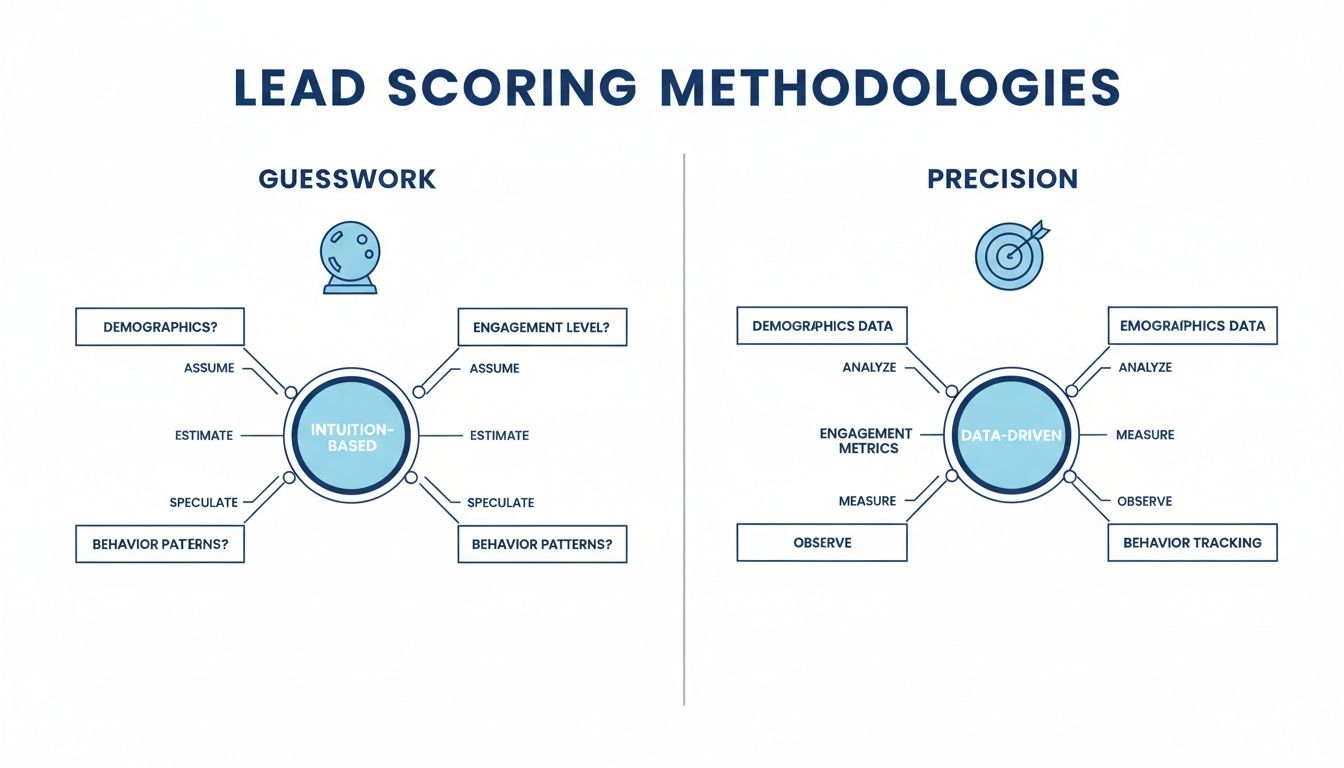
Ultimately, AI scoring replaces gut feel with intelligent, evidence-based prioritization.
Bringing The Signals Together
The real power of an AI model is its ability to connect these different signals into a single, cohesive story. A single data point rarely tells you everything, but together, they create a crystal-clear picture.
A lone behavioral signal, like a whitepaper download, is weak on its own. The magic happens when you combine it with other signals.
An AI model connects the dots automatically. It sees that a target account in the life sciences just hit a major clinical trial milestone (an Account Signal), and now multiple contacts from that account are browsing your "CRO Services" page (a Behavioral Signal). That combination is what triggers a high-priority score.
This is worlds away from old-school, rules-based scoring that can't weigh hundreds of dynamic signals at once.
An Example in Action
Let’s say you sell financial compliance software. Here’s how an AI model might process signals for a target fintech company:
- Account Signal: The company announces a $50 million Series C funding round to fuel its expansion into European markets.
- Intent Signal: The AI picks up a surge in searches from the company’s IP addresses for terms like "GDPR compliance tools" and "international payment regulations."
- Behavioral Signal: The new VP of Compliance, hired just two months ago, visits your pricing page and watches a demo on your GDPR features.
- Firmographic Signal: The model confirms the company is a perfect fit for your ICP—a B2B fintech with 200-500 employees.
Individually, each signal is just a hint. But when the AI combines them, they create an undeniable "why now." This account isn't just a good fit; it's an active buyer with a clear need, a fresh budget, and the right people engaging with your content. The AI flags the account with a high score and pushes it to the top of a rep's queue, complete with all the context needed to start a relevant conversation.
This is the essence of moving from guesswork to certainty. To dig deeper into this topic, learn more about account scoring in our comprehensive guide.
Turning AI Insights Into Daily Sales Wins
Theory is great, but a healthy pipeline is what pays the bills. A high score from an AI lead scoring model isn't just a number—it’s a green light. It’s a clear signal that cuts through the noise and plugs directly into your sales team's daily workflow, turning raw data into actual wins.

This operational intelligence solves two of the biggest headaches in B2B sales: the "manual research tax" and a weak outreach reason. Instead of reps losing hours digging for context, the AI serves it up on a platter, ensuring every outreach is timely and relevant.
Eliminating the Manual Research Tax
Imagine your rep has a huge meeting with a prospect tomorrow. The old way involved them spending two hours sifting through news articles, social media, and earnings reports. The new way? They get an automated meeting brief the night before. This isn't a generic summary; it's a strategic weapon.
This AI-powered brief includes:
- Ready-to-use talk tracks: Specific talking points tied directly to the account’s latest initiatives or pain points.
- Key stakeholder updates: Fresh intelligence on what decision-makers are talking about publicly.
- Critical account signals: A concise list of recent events, like a new product launch or a recent acquisition.
This simple step instantly frees up hours of a rep's time. They can now focus on strategy and conversation, not grunt work. Preparation goes from being a chore to a true competitive advantage.
Creating a Powerful "Why Now"
A high AI score means nothing without a compelling reason to reach out. This is where trigger-based selling shines. The AI doesn't just tell you who to call; it tells you why and when.
Let's say your team sells to the fintech industry. The AI detects a major regulatory change that impacts your top accounts. It doesn't just raise the score. It instantly pings the account owner in Slack with a pre-built messaging template that addresses that exact event.
That’s the "why now" in action. The rep can immediately reach out with a hyper-relevant message that shows they understand the prospect's world. This proactive move turns what would have been a cold call into a warm, consultative conversation.
By turning insights into actionable strategies, sales teams gain a significant advantage, especially when it comes to building a robust sales pipeline and stacking up daily wins.
From Insights to Measurable Pipeline
This level of intelligence fuels the entire sales motion, from the first prospecting email to long-term account management. It creates a continuous feedback loop that drives real, measurable results.
1. Always-On Account Monitoring Your AI platform becomes a 24/7 watchtower over your named accounts. The second a key signal pops—like a funding announcement or a competitor's bad press—it automatically alerts the right person on your team.
2. Strategic Account Planning Account plans are no longer static documents that gather digital dust. The AI keeps them alive and breathing, constantly refreshing them with new signals and context. This ensures your strategy always reflects what’s happening at the account right now. This proactive approach is fundamental, and you can see more of it in our guide on using AI for sales prospecting.
3. Trigger-Based Outreach A high-priority signal doesn’t just create an alert. It can automatically enroll an account into a specialized outreach sequence. The messaging is tailored to that specific trigger, guaranteeing maximum relevance and boosting response rates.
Ultimately, weaving AI lead scoring into your daily workflows flips the script, moving your team from reactive to proactive. It ensures every action is backed by data, every conversation is relevant, and every ounce of effort is aimed at the accounts most likely to convert. You stop guessing and start turning abstract insights into measurable pipeline growth.

“This is my singular place that very simply summarizes a company's top initiatives, strategies and connects them to my solution. Something I would spend hours researching manually, now it's automated.”
Derek Rosen
Director, Strategic Accounts, Guild Education
Real-World Impact In Complex Industries
The power of AI lead scoring isn't just a theory; it’s proven every day in the trenches of complex B2B sales. For any business with long sales cycles and multi-stakeholder deals, moving from guesswork to data-driven priorities is a fundamental shift in how you win.
Let's look at some real-world examples from industries where signal-based intelligence makes all the difference. These scenarios show how teams solve specific pain points—like inconsistent account planning or irrelevant outreach—and turn them into faster sales cycles and bigger deals.
B2B SaaS: Upsell Through Integration Signals
Imagine a mid-sized B2B SaaS company selling project management software. One of their enterprise customers, a fast-growing tech firm, announces a major product integration with a popular developer tool. To a customer success manager (CSM), this might be just interesting news. To an AI account intelligence platform, it's a critical account signal.
The AI model immediately flags this account as a high-priority opportunity. Here’s why:
- Context is Everything: The customer's new integration creates a direct need for the more advanced project tracking features found in the SaaS company's premium tier. The AI connects those dots automatically.
- The Perfect "Why Now": That announcement gives the CSM the perfect reason to reach out. They aren't just "checking in"; they’re calling with a specific, valuable insight that aligns with the customer’s brand-new public strategy.
- Automated Action: The platform alerts the CSM and even auto-generates talking points focused on how their premium features can help manage the complexity of this new integration, ensuring a smooth rollout.
Without that AI-driven alert, this opportunity might have been missed entirely or caught weeks too late. Instead, the CSM engages at the exact moment of need, turning a simple news item into a significant upsell conversation. This transforms account management from a defensive, churn-prevention team into a proactive revenue engine.
The AI didn't just find a "lead"; it identified a strategic moment. It connected a public event (the integration announcement) to a specific business need (managing new workflows), empowering the CSM to act with perfect timing and relevance.
Life Sciences: Win Through Competitive Intelligence
Now, picture a contract research organization (CRO) in the hyper-competitive life sciences world. They're trying to land a huge deal with a mid-sized biotech firm and are one of three vendors in the final running. The sales team is stuck in that familiar holding pattern, sending generic "just checking in" emails.
Then, their AI platform detects a crucial signal: one of their main competitors in the deal just announced disappointing Phase II clinical trial results for an unrelated drug. While not directly tied to the deal, this news creates a subtle but powerful perception risk around that competitor.
The AI model immediately elevates the biotech firm's priority score. It flags the competitor's negative news and alerts the account executive. The "so what" is crystal clear: the biotech firm might now be questioning that competitor's operational excellence and scientific rigor.
Armed with this insight, the CRO’s sales rep doesn't trash-talk the competition. Instead, they time their next outreach perfectly. They send a case study highlighting their own impeccable track record with similar trials and robust quality assurance processes. The message is confident and perfectly timed, reinforcing their core strength at a moment when their rival is likely facing internal questions. That timely, relevant move helps them win the deal.
IT Services: Accelerate Enterprise Deals
Finally, let’s look at an IT services firm that specializes in large-scale cloud migrations. For them, account planning was a massive time sink. Reps would spend days—sometimes weeks—manually researching a target company’s C-suite, strategic initiatives, and tech stack before making the first call. The process was slow, inconsistent, and painful.
By plugging in an AI lead scoring and account intelligence platform, they automated this entire discovery phase. The system continuously monitored their top 100 target accounts for signals like:
- A new CIO being hired from a company known for aggressive cloud adoption.
- Earnings call transcripts mentioning "digital transformation" and "legacy system modernization."
- A sudden spike in job postings for AWS or Azure-certified engineers.
The AI synthesized these scattered signals into living, breathing account plans. Instead of starting from a blank slate, reps received automated briefs that outlined the key players, their likely priorities, and credible "why now" triggers for outreach. The result? They cut their enterprise deal research time by more than half, freeing them to focus on high-value conversations. The improved targeting and relevance from these signal-driven insights directly led to a measurable increase in their meeting-to-pipeline conversion rate.
A Practical Blueprint for AI Lead Scoring
Ready to move from theory to action? Implementing AI lead scoring is no longer a massive, years-long data science project. Modern platforms are built for revenue leaders, not engineers, making the whole process surprisingly straightforward and fast.
This blueprint breaks down the setup into four manageable phases, designed to get you from zero to a fully operational scoring model that drives pipeline.
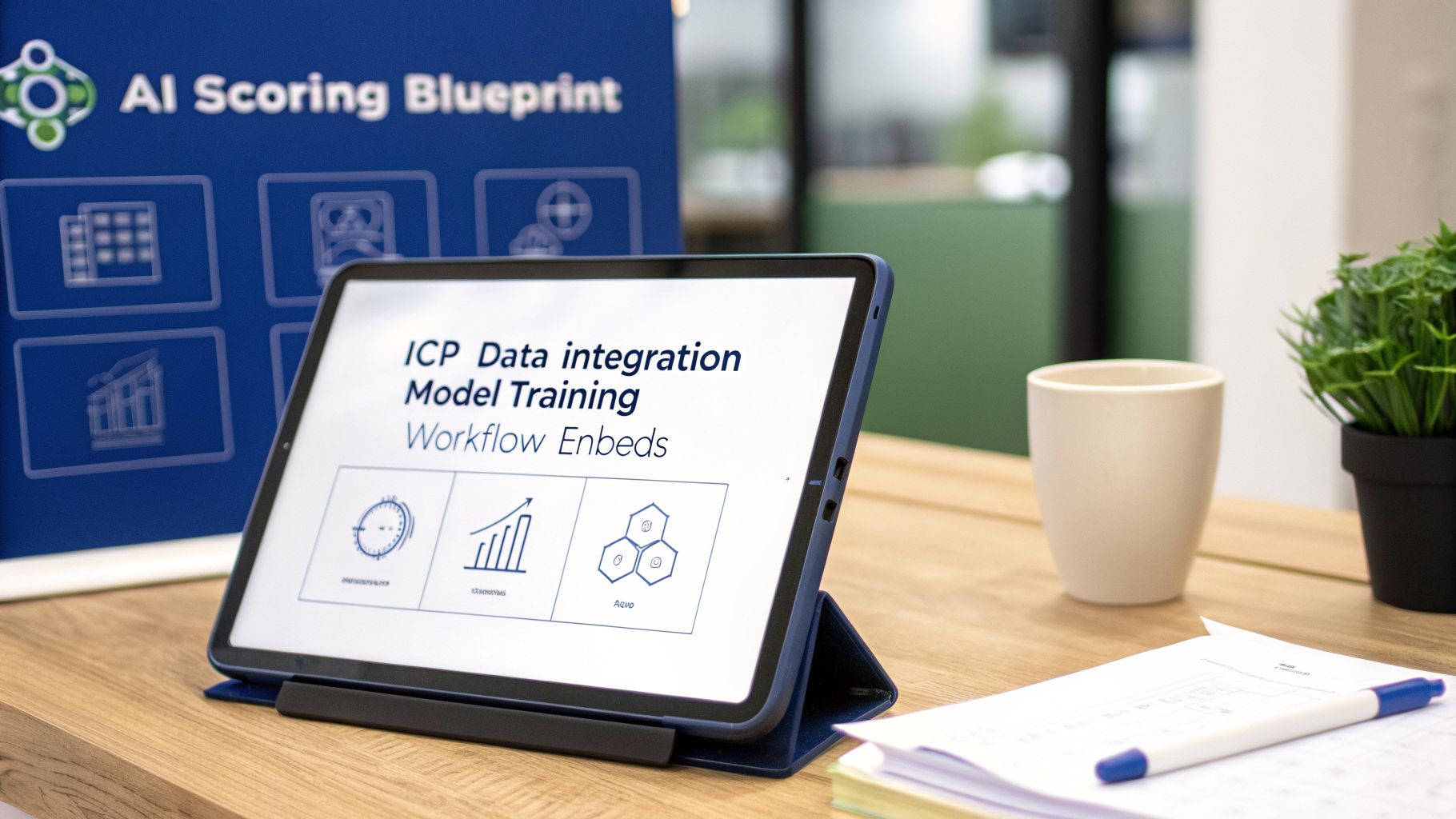
Think of it like assembling a high-performance engine. You don't need to forge the pistons yourself—you just need to connect the right parts and fuel it with good data.
Phase 1: Define Your Ideal Customer and Signals
The first step is strategic, not technical. Before a machine can score anything, you have to teach it what a great customer looks like for your business.
This means going beyond basic firmographics. You need to pinpoint the specific signals that show an account isn’t just a good fit, but is actively in-market right now.
Get your sales and marketing leaders in a room and answer these questions:
- What real-world events create a compelling reason for a company to buy our solution? (Think a new funding round, a key executive hire, or a regulatory change.)
- Which technographic signals matter most? (Maybe they use a complementary technology or are moving off a competitor's platform.)
- What firmographic attributes truly define our sweet spot? (Industry, company size, and growth trajectory are just the start.)
This initial definition is the foundation for your entire AI model. It’s how you teach the machine what patterns to look for.
Phase 2: Integrate Your Data Sources
With your strategy locked in, the next phase is connecting your data. This is the step that used to make teams nervous, but modern platforms have made it surprisingly simple.
The goal is to give the AI a complete, 360-degree view of your target universe.
This usually involves using pre-built, low-code connectors to sync a few key systems:
- Your CRM (like Salesforce or HubSpot): This is your historical source of truth. The AI will analyze past wins and losses to learn what success looks like.
- Your Marketing Automation Platform: This provides crucial behavioral data—how accounts are engaging with your content, emails, and website.
- Third-Party Data & Account Signals: The AI platform itself enriches your internal data with thousands of external signals, like buying intent, news, and company announcements.
This isn't a heavy engineering lift. It’s mostly about securely authorizing access so the AI can start connecting the dots between internal activities and external events.
Phase 3: Train and Calibrate the Model
Once the data is flowing, it's time to train the model. The AI platform gets to work, analyzing all those closed-won and closed-lost opportunities in your CRM to find the common threads among your best customers.
This process is a collaborative feedback loop, not a "set it and forget it" task. The sales team's real-world expertise is essential. They can help validate the model's findings and fine-tune which signals should be weighted more heavily, ensuring the scores reflect ground truth.
For example, the AI might find a strong correlation between deals won and accounts that recently hired a new VP of Operations. Your sales team can immediately confirm this, adding crucial human intelligence to the machine's findings. This collaborative calibration builds trust and ensures the scores are genuinely useful.
If you're looking for more ways to incorporate AI, explore how teams are using AI in sales to improve their entire process.
Phase 4: Embed Insights into Daily Workflows
This is the final and most important phase. A score is useless if it just lives in a dashboard. The whole point is to embed these insights directly into the tools your sales team uses every day.
This means delivering the "why" behind the score, right where your reps work:
- Slack/Teams Alerts: Get instant notifications when a target account's score spikes, complete with the specific signals that triggered the change.
- CRM Integration: Display scores and signal context directly on the account record in your CRM. No more toggling between systems.
- Automated Email Briefs: Send daily or weekly digests that summarize the most important movements across a rep's territory.
By pushing this intelligence directly into their flow of work, you make it effortless for reps to act. This seamless integration is what transforms an AI scoring system from a background analytics tool into a powerful engine for pipeline generation.
Common Mistakes To Avoid When Getting Started
Jumping into new technology always has a learning curve, and AI lead scoring is no different. The upside is huge, but a few common stumbles can slow you down and erode your team's confidence in the system.
Getting ahead of these issues is key to a smooth rollout and a faster path to seeing real results. The goal isn't just to install software; it's to build a system your team trusts and uses daily, turning AI insights into a reliable pipeline engine.
Over-Relying on a Single Signal Type
One of the first mistakes teams make is building a model with tunnel vision. It’s easy to get excited by flashy, real-time intent data and forget the foundational data that defines a good customer. An account searching for your solution is great, but not if they're the wrong size, in the wrong industry, or lack the budget.
The fix is to build a balanced model. A strong AI lead scoring system weighs multiple signal categories together, creating a more complete picture:
- Firmographic Data: The stable facts like company size, industry, and location. This is your foundation.
- Behavioral & Intent Data: The dynamic signals showing active research, website visits, and content engagement.
- Account Signals: Real-world business events like new funding rounds, key executive hires, or M&A activity.
This blended approach ensures you’re chasing accounts that are not only interested but also a perfect fit for what you sell.
Ignoring Negative Signals
It's natural to get caught up in good news—funding announcements, hiring sprees, and spikes in website traffic. But ignoring negative signals is just as risky. An account might look perfect on paper, but if they just went through a round of layoffs or had their budget slashed, they aren't a real opportunity right now.
A truly intelligent system acts as a co-pilot, not just a cheerleader. It should alert you to risk just as effectively as it flags opportunity. Signals like executive turnover, negative press, or financial distress are crucial for accurately qualifying an account's true potential.
Ignoring these red flags leads to reps wasting time in sales cycles that were never going to close. Factoring in negative signals gives you a more realistic, grounded score that your team can actually rely on.
Failing to Create a Sales Feedback Loop
This is the big one. The single biggest mistake is treating the AI like a black box and forgetting to bring your sales team into the process. If reps don't understand or trust the scores, they simply won't use them. The AI is a powerful tool, but it’s no substitute for the on-the-ground experience of your sellers.
To get this right, you have to make your sales team a core part of the process from day one. Involve them in defining which signals matter and set up a regular cadence to review high-scoring accounts together. When a rep closes a deal the AI flagged, celebrate it. When a high-scoring account fizzles out, use it as a coaching moment to refine the model.
This collaborative feedback loop is what builds trust and turns the AI into a true partner in hitting your number.
Frequently Asked Questions About AI Lead Scoring
Whenever teams start exploring AI-powered scoring, the same few questions always come up. Let's tackle them head-on so you know exactly how this approach works and what to expect.
How Is This Different from Traditional Lead Scoring?
Chances are, your marketing automation platform uses a rules-based system. You know the drill: you manually set points like "+5 for a webinar view" or "+10 for a pricing page visit." It’s a decent starting point, but it's fundamentally backward-looking and often a poor predictor of who is actually ready to buy.
AI lead scoring flips that model on its head. It’s dynamic and predictive. Instead of just tallying up past clicks, it analyzes thousands of data points—both your internal CRM data and real-world buying signals like funding announcements or new executive hires—to forecast which accounts will buy in the future.
What Is the Technical Lift to Get Started?
This is a common concern, but modern platforms are built to minimize the technical work on your end. You won't need to hire a team of data scientists to make this work.
The heavy lifting is handled by the platform itself. Your main task is securely connecting your CRM and other data sources through pre-built integrations. From there, your team can focus on strategy—like deciding which buying signals are most important—not on complex engineering.
Can This Work for New and Existing Customers?
Absolutely. This isn't just a tool for net-new acquisition. AI scoring adds value across the entire customer journey.
- For New Business: Its biggest strength is cutting through the noise. It pinpoints which accounts in your ICP are showing real buying intent right now, so your sales team can stop guessing and start engaging the right people at the right time.
- For Existing Customers: It’s an incredible tool for your customer success team to spot both risk and opportunity. A signal like an executive champion leaving could flag a churn risk, while a signal like a new funding round can highlight the perfect moment for an upsell or cross-sell conversation.
Ready to stop guessing and start targeting accounts with proven buying intent? Salesmotion is an AI-powered account intelligence platform that turns real-world signals into actionable sales plays. Discover how to focus your team on the deals that matter most at https://salesmotion.io.