B2B contact data is one of the largest line items in a modern sales tech stack, yet most teams have no idea what they're actually paying per contact. A Gartner study found that poor data quality costs organizations an average of $12.9 million per year. Meanwhile, B2B contact databases decay at roughly 2.1% per month, or about 22.5% annually, according to Marketing Sherpa research. That means nearly a quarter of the contacts you're paying for right now will be outdated before your next contract renewal.
TL;DR: B2B contact data costs range from a few cents per credit on self-serve platforms to custom, consumption-based contracts on enterprise providers like ZoomInfo, which does not publish pricing. Credit-based pricing obscures true costs, and hidden fees (overages, add-ons, auto-renewals) can inflate your bill by 30-50%. The right approach depends on your team's needs: a dedicated contact database for high-volume prospecting, an account intelligence platform that includes verified contacts for targeted outreach, or a combination of both.
How B2B Contact Data Pricing Works
B2B data providers use three primary pricing models, and understanding the differences is the first step to avoiding overpayment.
Per-Credit Pricing
Most mid-market providers sell credits. One credit typically reveals one email address or phone number. The catch: not all credits are equal. Apollo.io's Professional plan is $99 per seat on monthly billing with 4,000 credits per seat a month, and an email costs 1 credit, so each email works out to roughly $0.02. Lusha's Starter plan is $49.90 on monthly billing for 400 credits, roughly $0.12 per email, and a phone number costs 5 credits. That is about a 5x difference for what looks like the same thing on a feature comparison page.
Credit systems also create behavioral waste. Sales reps hoard credits early in the month, then burn through them at month-end to hit quotas. RevOps teams spend hours managing credit allocation across seats instead of optimizing pipeline.
Per-Seat (Unlimited Access) Pricing
ZoomInfo sells annual subscriptions and does not publish prices. Its pricing page describes consumption credits based on usage, with paid plans that include a minimum number of seats and scale with headcount. The appeal of a seat-based contract is obvious: less per-lookup math. The reality is more nuanced. Credits, export limits, and API access still shape what you can use, so ask how each is metered.
Cognism sells packages with seats included and a credit allocation per seat. One credit reveals one contact, there is no charge for viewing contacts you have already revealed, and additional credits can be purchased at any point.
Intelligence-First Platform Pricing
A newer category of platform leads with account intelligence rather than contact volume. These tools solve a different problem: not "how many contacts can I export?" but "which accounts should I prioritize, and what should I say when I reach out?"
Salesmotion, for example, starts at $85/month and scales by accounts monitored — not headcount — with unlimited users on team plans. Rather than replacing a dedicated contact database like ZoomInfo or Apollo, Salesmotion provides account intelligence, buying signal monitoring, and AI-generated outreach. For the accounts you're actively tracking, it also delivers verified contact data — phone numbers and emails — through a proprietary waterfall enrichment process that is GDPR-compliant and highly accurate. But it is not a standalone contact database and would not replace one for high-volume prospecting.
This model works best as a complement to your existing data stack. When data enrichment alone is not driving pipeline, adding an intelligence layer tells reps when to reach out and why — which is often the missing piece.
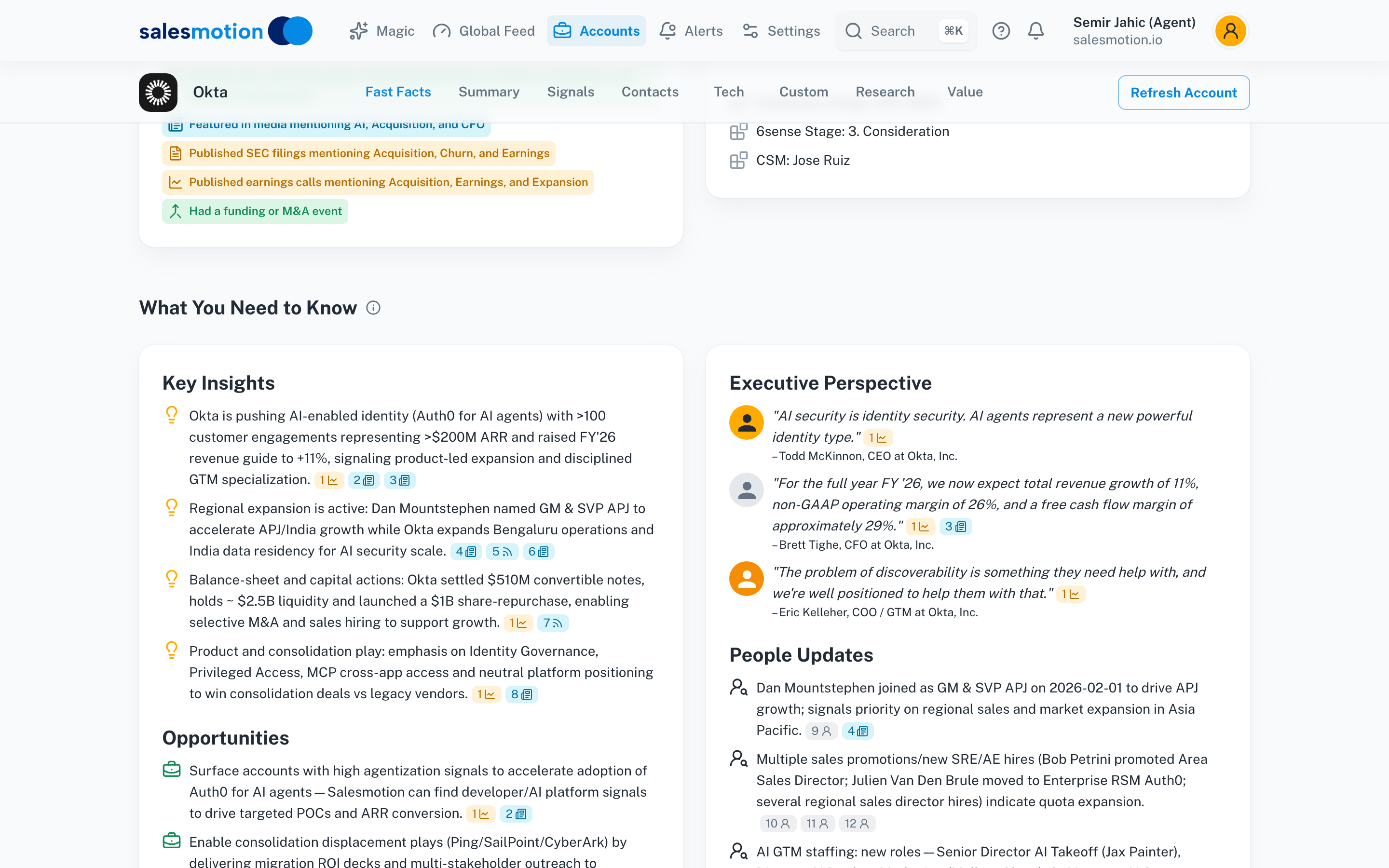 Salesmotion surfaces key insights, executive perspectives, people moves, and talking points for tracked accounts — so reps know exactly when and why to reach out.
See the product in action
Take a self-guided tour of the Salesmotion platform — no signup required.
Provider-by-Provider Pricing Comparison
Here is what each major provider publishes going into 2027. Where a vendor publishes no price, the table says so.
| Provider | Entry Price | Mid-Tier | Enterprise | Pricing Model | Database Size |
|---|---|---|---|---|---|
| ZoomInfo | Free (Lite, 10 credits/mo) | Custom, consumption-based | Custom, consumption-based | Consumption credits, annual | 500M+ contacts |
| Apollo.io | Free | $49–$79/user/mo (annual) | $119/user/mo (annual) | Credit-based | 240M contacts |
| Cognism | Custom, quote-only | Custom | Custom | Credits (1 credit = 1 revealed contact) | Not published |
| Lusha | Free (40 credits/mo) | $37.45–$69.90/mo | Custom | Credit-based | 515M+ contacts |
| RocketReach | $27/mo (annual) | $69/mo | $142/mo | Lookup and export caps | 700M professionals |
| Hunter.io | Free (50 credits/mo) | Starter 49€/mo, Growth 149€/mo, Scale 299€/mo, as shown on its pricing page | Custom | Credit-based | Not published |
| Seamless.AI | Free (limited) | Custom | Custom | Credit-based | Real-time search |
| UpLead | $99/mo ($74/mo annual) | $199/mo ($149/mo annual) | Custom (annual only) | Credit-based | Not published |
| Salesmotion | From $85/mo | Custom (Team) | Custom | Account-based (intelligence + on-demand contacts) | 200M+ profiles (waterfall-enriched) |
A few patterns stand out. ZoomInfo and Cognism publish no prices, so budget for a quoted contract. Apollo offers the best value on raw email volume. Cognism is the strongest choice for European and GDPR-compliant data. For teams that already have a contact database but struggle with knowing which contacts to prioritize and when to reach out, complementing your data stack with an account intelligence platform can fill that gap without replacing your existing tools.

“The Business Development team gets 80 to 90 percent of what they need in 15 minutes. That is a complete shift in how our reps work.”
Andrew Giordano
VP of Global Commercial Operations, Analytic Partners
What Does a Single B2B Contact Actually Cost?
The sticker price on a provider's website rarely reflects the true per-contact cost. Here is the math most buyers never do.
Calculating Effective Per-Contact Cost
Take your total annual spend (subscription + overages + add-ons), divide by the number of unique contacts your team actually used in outreach. Not exported. Not viewed. Used.
For a team of 10 reps on Apollo Professional ($99/user/month on monthly billing), the annual spend is $11,880. If each rep uses 500 contacts per month, you are touching 60,000 contacts per year. Effective cost: $0.20 per contact.
For the same team on a ZoomInfo contract at Vendr's reported median of $33,500 a year, touching the same 60,000 contacts, the effective cost is $0.56 per contact. A ZoomInfo contract may also bundle org charts, intent signals, and technographics, so compare what each price includes.
The cheapest per-contact cost is not always the best value. A $0.05 email that bounces wastes more than a $0.50 verified direct dial that connects.
Data Quality vs. Data Volume
According to Landbase research, high-quality B2B data providers delivering 97%+ accuracy achieve 66% higher conversion rates compared to budget alternatives averaging 50% accuracy. That accuracy gap means half the cheap contacts you buy may never reach a real inbox.
Cognism's data decay research shows that email addresses decay at 23-30% annually, and phone numbers change at 18% per year. If you bought 10,000 contacts in January, roughly 2,300 of those emails are invalid by December. Your effective per-contact cost just jumped by 30%.
Hidden Costs That Inflate Your Data Spend
The sticker price is where the conversation starts. These are the costs that show up later.
Auto-Renewal and Price Escalation
Vendr reports escalation clauses of typically 5–10% a year on ZoomInfo contracts. At 10%, a $33,500 contract passes $40,000 by year three without any additional seats or features. Several ZoomInfo alternatives now offer month-to-month or quarterly billing specifically to counter this lock-in.
Credit Overages
On credit-based platforms, running out mid-quarter forces a choice: stop prospecting or buy overage packs at premium rates. Apollo's unused credits expire at the end of each billing cycle and do not carry over. Lusha rolls unused credits over on monthly plans, up to twice the plan's limit, and resets them at the end of the cycle on annual plans.
Feature Gating
Intent data, technographics, org charts, and advanced filters are often sold as add-ons rather than included features. On ZoomInfo, Streaming Intent is sold as an add-on to base plans. On Apollo, intent topics are included on every plan: 1 on Free, 6 on Basic and Professional, 12 on Organization.
This is where the total cost of ownership diverges sharply from the list price. ZoomInfo's pricing page names Streaming Intent, sales engagement, international data, additional seats, and API and MCP access as add-ons, so ask for each as a separate line in the quote.
Integration and Onboarding
Most providers quote implementation as "included," but CRM sync configuration, field mapping, duplicate management, and training consume 20-40 hours of RevOps time. At an average RevOps salary, that is $2,000-4,000 in soft costs per implementation. Platforms with native CRM integration and pre-built Salesforce or HubSpot sync reduce this overhead to hours instead of weeks.

“The moment we turned on Salesmotion, it became essential. No more hours on LinkedIn or Google to figure out who we're talking to. It's just there, served up to you, so it's always 'go time.'”
Adam Wainwright
Head of Revenue, Cacheflow
When Contact Data Alone Isn't Enough
Raw contact data solves one problem: "Who should I call?" It does not answer the questions that actually close deals: "Why should I call them now?" and "What should I say?"
According to SMARTe research, companies using outdated contact data experienced a 45% decrease in conversion rates. The issue is not just data freshness — it is data context. A contact record tells you someone's title and email. Account intelligence tells you their company just posted a VP of Revenue Operations role, mentioned a "sales transformation initiative" on their last earnings call, and hired three new SDRs in the past month.
That context changes everything about how a rep approaches the conversation. Instead of a cold intro, the first call becomes consultative. Deal velocity increases because discovery is half-done before the meeting starts.
This is why many teams complement their contact database with an intelligence layer rather than simply buying more records. Analytic Partners grew qualified pipeline 40% year-over-year after adding intelligence-driven prospecting on top of their existing data stack, cutting account research from three hours to 15 minutes per account.
The takeaway: if your team has plenty of contacts but struggles with prioritization, timing, and personalization, the bottleneck is not data volume — it is data intelligence. Platforms like Salesmotion will not replace your ZoomInfo or Apollo subscription, but they can dramatically improve what your reps do with those contacts. And for the accounts you are actively tracking, Salesmotion's own verified contact data — waterfall-enriched and GDPR-compliant — can reduce your reliance on bulk databases for those high-priority targets.
How to Evaluate True ROI on Contact Data
Before signing any contract, run this calculation.
Step 1: Quantify your current cost per meeting booked. Total data spend (all tools) divided by meetings booked from outbound prospecting. If you spend $30,000/year across ZoomInfo, a data enrichment tool, and an intent provider, and your team books 600 outbound meetings, your cost per meeting is $50.
Step 2: Factor in rep time. Sales reps lose an estimated 500 hours annually validating and correcting contact information, according to PGM Solutions research. That is 62 working days, or nearly 25% of selling capacity wasted on data hygiene. At an average AE salary of $120,000, that is $30,000 per rep in lost productivity.
Step 3: Calculate the all-in cost. Add subscription fees, overage costs, rep time spent on data validation, RevOps time managing credits and integrations, and the revenue cost of missed opportunities from stale data. The true cost of your contact data stack is almost always 2-3x the subscription price.
Step 4: Compare against consolidated alternatives. If a single platform eliminates three separate subscriptions and saves each rep 6+ hours per week on research, the math often favors consolidation even at a higher sticker price. Guild Education's sales team saves 6+ hours per rep per week by replacing manual research across multiple tools with a single sales intelligence platform.
Key Takeaways
- B2B contact data costs vary widely by provider, plan tier, and data type (email vs. verified direct dial), so always calculate your effective per-contact cost based on actual usage rather than list price.
- Credit-based pricing creates hidden inflation through overages, unused credits, and behavioral waste. Track your team's credit utilization rate monthly.
- Data decays at 22-30% annually. A $0.20 contact that bounces costs more than a $0.50 verified contact that connects. Prioritize accuracy over volume.
- Hidden costs (auto-renewal escalation, feature gating, integration overhead) inflate the true cost of ownership by 30-50% beyond the sticker price for most enterprise providers.
- Complementing your contact database with account intelligence — signals, research, and AI outreach — can reduce reliance on multiple point solutions and refocus rep time on selling rather than data validation. Intelligence platforms like Salesmotion include verified, waterfall-enriched contacts for tracked accounts but are not standalone contact database replacements.
- Before renewing any data contract, calculate your all-in cost per meeting booked, including rep time spent on data hygiene, to understand the real ROI.
Frequently Asked Questions
How much does B2B contact data cost per contact?
On self-serve platforms the math is simple: Apollo.io's Professional plan works out to roughly $0.02 per email credit on monthly billing, and Lusha's Starter plan to roughly $0.12. Enterprise providers like ZoomInfo do not publish pricing, so the effective cost depends on your quote and how much of the contract you use. Budget platforms offer cheaper per-record costs, but data accuracy research from Landbase shows that providers with 97%+ accuracy achieve 66% higher conversion rates, making premium data more cost-effective over time.
What is the cheapest B2B contact data provider?
Apollo.io's free plan includes 900 credits per seat a year and two sequences, and Hunter.io's free plan includes 50 credits per month. Lusha's free plan gives 40 credits per month, with a phone number costing 5 credits. However, "cheapest" and "best value" are different metrics. Consider the total cost of your sales intelligence stack including data enrichment, intent signals, and research tools before optimizing on contact price alone.
How fast does B2B contact data decay?
B2B contact data decays at approximately 2.1% per month, or 22-30% annually, according to Marketing Sherpa and Cognism research. Email addresses degrade faster (23-30% per year) than phone numbers (18% per year). In high-growth sectors like technology and healthcare, decay rates reach 30-40% annually. This means roughly one in four contacts you purchased this year will be invalid within 12 months.
Is ZoomInfo worth the price for small teams?
ZoomInfo does not publish pricing; Vendr reports a median contract of $33,500 a year based on 1,576 purchases, which is a high per-seat cost for teams under 10 reps. ZoomInfo Lite is a permanent free tier with 10 credits a month. Apollo.io or Lusha publish self-serve plans that suit small teams needing basic contact data. However, if your team needs intent data, org charts, and technographics alongside contacts, compare ZoomInfo's bundled price against buying those capabilities separately. Some teams complement a lighter contact database with an account intelligence platform that provides verified contacts for tracked accounts plus the research and signal context that raw data providers lack.
What hidden fees should I watch for in data provider contracts?
The most common hidden costs are auto-renewal price escalation (10-20% annual increases), credit overages charged at premium rates, feature gating that puts intent data and advanced filters behind expensive add-on paywalls, and integration costs for CRM sync and field mapping. Always ask for a total cost of ownership breakdown including all add-ons before signing, and negotiate a price lock for multi-year terms.