Enterprise sales teams spend an average of 29% of their marketing budget on account-based selling programs, yet only 26% have a fully scaled ABM program in place. The gap between intent and execution comes down to tooling. The right account-based selling tools turn strategy into pipeline. The wrong ones add complexity without results.
TL;DR: The best account-based selling tools help enterprise teams identify high-value accounts, track buying signals, and personalize outreach at scale. This guide covers 10 tools across three categories: account intelligence platforms, ABM advertising platforms, and CRM-native ABM features. Your choice depends on whether you need research depth, ad orchestration, or CRM-native workflows.
Quick answer: Which account-based selling tool is right for you?
- If your reps spend hours researching accounts before meetings → Salesmotion ($85/mo) automates account research from 1,000+ sources, cutting prep time by 85%. Unlimited users on team plans (custom pricing).
- If you need targeted ABM advertising at scale → Demandbase (quote-only) has the strongest B2B DSP with native intent data.
- If you need predictive buying stage scoring → 6sense (quote-only) models account readiness across awareness-to-purchase stages.
- If you need the broadest contact database for ABS outreach → ZoomInfo (custom, consumption-based) has 500M+ contacts and 100M+ companies with org charts.
- If you want CRM-native ABM without additional tools → HubSpot ABM (included in Marketing Hub Enterprise) or Salesforce Account Engagement.
What Account-Based Selling Requires from Your Tech Stack
Account-based selling flips the traditional funnel. Instead of casting a wide net and qualifying inbound leads, your team selects target accounts first, then builds personalized engagement strategies for each. That approach demands a specific set of capabilities from your tools.
Account identification and prioritization. You need to know which accounts are worth pursuing right now, not just which ones fit your ICP on paper. That means intent data, hiring signals, leadership changes, and competitive moves feeding into a priority list that updates automatically.
Deep account research. Reps need context before every touchpoint: who the decision-makers are, what strategic initiatives the company is pursuing, recent earnings commentary, tech stack changes, and competitive dynamics. According to ITSMA research, 87% of marketers say ABM delivers higher ROI than other strategies, but that ROI depends on reps actually using account intelligence in conversations.
Signal monitoring. Only 5% of B2B accounts are actively looking to buy at any given time. Timing separates the deals you win from the ones you lose. Tools that monitor buying signals like leadership changes, funding events, earnings calls, and job postings help reps reach accounts during active buying windows.
Personalized outreach at scale. Generic templates fail in ABS. Every message needs to reference something specific about the account: a recent initiative, a leadership hire, a competitive threat. That requires either enormous manual effort or AI-generated messaging anchored to real research.
CRM integration and measurement. Account-based programs that live outside your CRM create data silos. The best tools sync intelligence directly into Salesforce or HubSpot so reps see signals where they already work.
Account-Based Selling Tools Comparison
Before reviewing each tool, here is a side-by-side comparison of the 10 platforms covered in this guide.
| Tool | Best For | Starting Price | Key Strength | Limitation |
|---|---|---|---|---|
| Salesmotion | Account intelligence + signals | From $85/mo | 1,000+ source account briefs | Not a full ABM ad platform |
| Demandbase | ABM advertising + engagement | Custom (platform fee + per-user fee) | Native B2B DSP for ads | Built for enterprise ABM teams |
| 6sense | Intent data + predictive ABM | Custom, quote-only | Buying stage predictions | Predictive scores need interpretation |
| ZoomInfo | Contact + company data | Custom, consumption-based | 500M+ contacts, 100M+ companies | Contact data first; research via Copilot |
| Terminus (now DemandScience) | ABM ads + engagement | Does not publish pricing | Multi-channel ad orchestration | Sold under the DemandScience brand |
| AdRoll ABM (formerly RollWorks) | Mid-market ABM | Does not publish ABM pricing | Accessible ABM for smaller teams | Advertising-led |
| Engagio (Demandbase) | Account engagement scoring | Included in Demandbase | Deep engagement analytics | Now part of Demandbase only |
| Triblio | ABM orchestration | Contact vendor | Multi-channel campaign orchestration | Standalone site no longer online |
| HubSpot ABM | CRM-native ABM | Included in Marketing Hub Enterprise | Tight CRM integration | First-party engagement focus |
| Salesforce Account Engagement | Enterprise ABM (Pardot) | See Salesforce pricing | Deep Salesforce ecosystem | Steep learning curve |

“We're no longer fishing. We know who the right customers are, and we can qualify them quickly. Salesmotion has had a direct impact on pipeline quality.”
Andrew Giordano
VP of Global Commercial Operations, Analytic Partners
Detailed Tool Reviews
1. Salesmotion: Account Intelligence and Signal-Based Selling
Salesmotion focuses on one problem most ABS tools overlook: giving reps the deep account context they need before every conversation. The platform aggregates intelligence from over 1,000 public and proprietary sources into one-click account briefs covering executive changes, strategic initiatives, earnings commentary, hiring patterns, and competitive moves.
What sets it apart from broader ABM platforms is signal-based timing. The platform monitors buying signals 24/7 and alerts reps when target accounts enter buying windows. When a target account posts a VP of Revenue Operations role, it flags the account, surfaces the context (new leadership change plus recent earnings call mentioning "sales transformation"), and generates AI-powered outreach anchored to that specific intelligence.
Analytic Partners, a marketing analytics firm, saw a 40% increase in qualified pipeline after deploying the platform. Their team cut account research time by 85%, from three hours to 15 minutes per account. That time savings alone translates to hundreds of recovered selling hours per quarter.
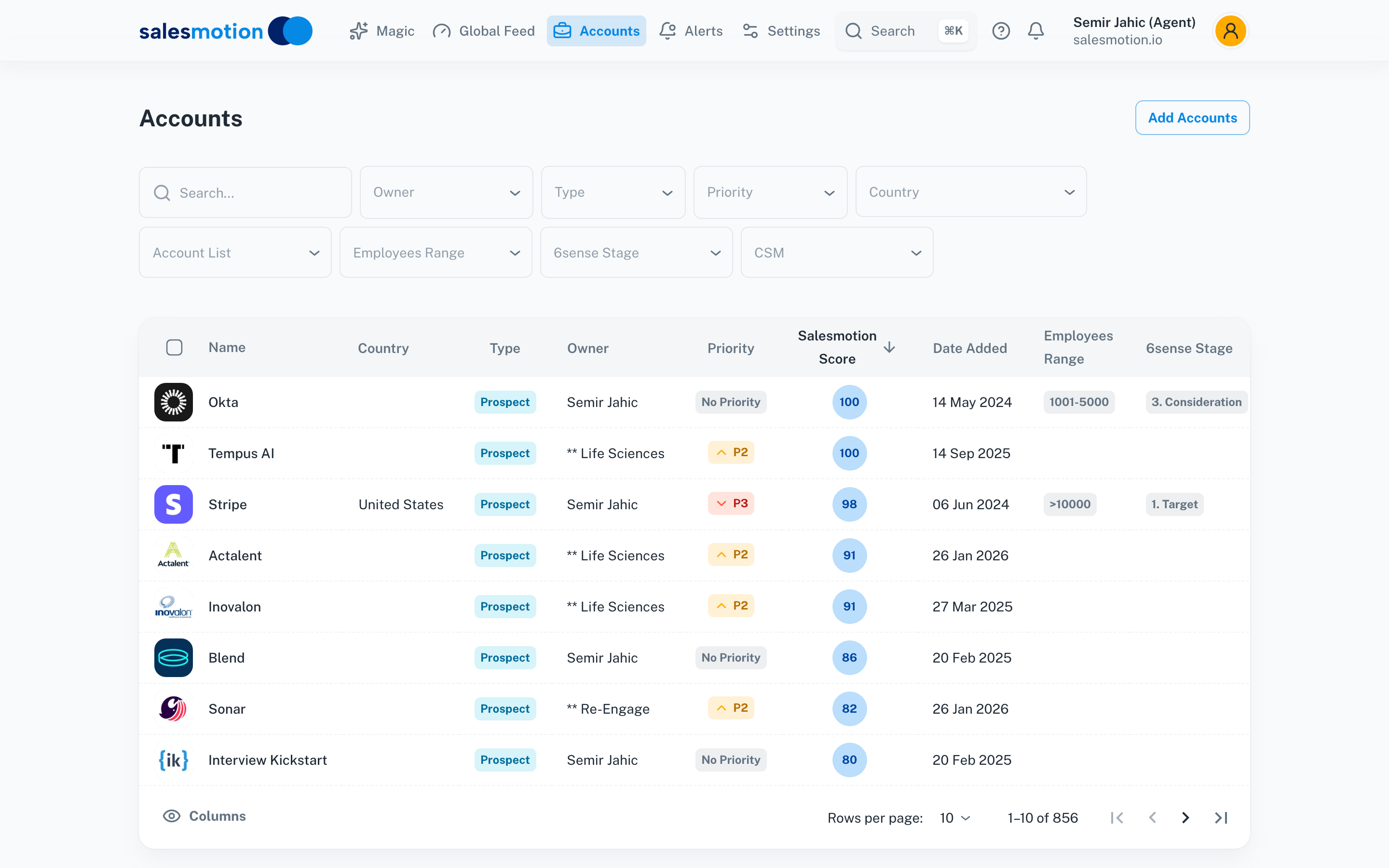 Salesmotion scores every account in your territory by signal activity, so reps focus on accounts showing the strongest buying signals right now.
Best for: Enterprise sales teams that need deep account research and signal-based timing, not just contact data or ad impressions.
Pricing: Flexible account-based pricing from $85/month — scales by accounts monitored, not headcount. Significantly less than full-stack ABM platforms while delivering the intelligence layer that makes outreach convert.
Limitation: Not an advertising platform. If your ABS strategy centers on display ads and retargeting, pair it with a tool like Demandbase or RollWorks for the ad layer.
2. Demandbase: Full-Stack ABM Platform
Demandbase is the incumbent in account-based marketing platforms, offering account identification, advertising, personalization, and analytics in a single suite. Its native B2B demand-side platform (DSP) is the strongest differentiator, letting teams run targeted display ads to specific accounts and buying groups.
Demandbase's account identification uses AI to match anonymous web traffic to target accounts, giving marketing teams visibility into which companies are researching your product before they fill out a form. The platform also includes Engagio's engagement scoring (acquired in 2020), which tracks how accounts interact across multiple channels.
Best for: Marketing-led ABM programs at enterprise companies with $50K+ annual contract values and dedicated ABM teams.
Pricing: Demandbase does not publish list pricing; its pricing page describes a platform fee plus a flat fee per user. Vendr reports a median annual contract value of $68,591 across 187 purchases, with a range of $24,000–$164,037.
Limitation: Demandbase is strongest for marketing-led ABM. Sales teams usually consume its intelligence through their CRM or sales engagement platform, so plan for that integration.
 Demandbase is the incumbent ABM platform with native B2B DSP for targeted account advertising.
3. 6sense: Intent Data and Predictive ABM
6sense built its reputation on predicting which accounts are in-market based on anonymous buying signals. The platform's predictive models analyze intent data from across the web to score accounts by buying stage, from awareness through decision. That predictive capability helps teams prioritize accounts that are actively evaluating solutions.
The platform also includes advertising, orchestration, and sales intelligence features. 6sense's "Dark Funnel" concept, capturing the 70%+ of the buying journey that happens before a prospect contacts you, resonates with enterprise teams frustrated by late-stage pipeline visibility.
Best for: Large enterprises with dedicated data teams who can interpret and act on predictive models. Works best when paired with strong sales execution processes.
Pricing: 6sense does not publish list pricing; contracts are quoted per organization. Vendr's marketplace data reports a median annual contract value of $62,220 across 386 purchases, with a range of $11,234–$176,511. Read our full 6sense pricing breakdown for details.
Limitation: Predictive scores need interpretation. Reps act on prioritization they understand, so plan enablement around how 6sense scores accounts.
 6sense predicts which accounts are in-market using anonymous buying signals and predictive AI.
4. ZoomInfo: Contact and Company Data
ZoomInfo is one of the largest B2B contact databases, offering verified emails, direct dials, org charts, and company firmographics. For ABS teams, ZoomInfo solves the "who do I contact?" question with 500M+ contacts and 100M+ companies.
ZoomInfo has expanded beyond contacts into intent data (via its Streaming Intent add-on), its Copilot AI sales agent, and workflow automation. Its core strength remains contact accuracy and coverage. Teams running account-based selling need reliable contact data to multi-thread into target accounts, and ZoomInfo delivers that consistently. See our ZoomInfo alternatives comparison for a detailed look at competitors.
Best for: Sales teams that need accurate contact data and direct dials for prospecting into target accounts.
Pricing: ZoomInfo does not publish list pricing; contracts are quoted per organization — its own pricing page states that no specific dollar amounts are published because pricing is consumption-based. Vendr reports a median contract of $33,500 a year based on 1,576 purchases, with a range of $7,233–$156,053. ZoomInfo Lite is a permanent free tier with 10 credits a month. See our ZoomInfo pricing breakdown.
Limitation: ZoomInfo's core strength is telling you who to call. Copilot adds buyer signals and account summaries on top of that data. Teams that want cited research from earnings calls, filings, and news pair ZoomInfo with an account intelligence layer.
 ZoomInfo is one of the largest B2B contact databases, with verified emails, direct dials, and org charts.
5. Terminus (Now DemandScience): ABM Advertising and Engagement
Terminus was one of the original ABM advertising platforms, specializing in serving targeted display ads to specific accounts across the web. The platform combines account-level ad targeting with email signatures, chat experiences, and web personalization into a multi-channel engagement hub.
Terminus merged into DemandScience in November 2024, and the combined company operates under the DemandScience brand. The terminus.com site now redirects to DemandScience.
Best for: Marketing teams that want an accessible ABM advertising platform without the complexity and cost of Demandbase.
Pricing: DemandScience does not publish pricing.
Limitation: Terminus is no longer sold as a standalone product. Ask DemandScience which former Terminus capabilities are in the package you are quoted.
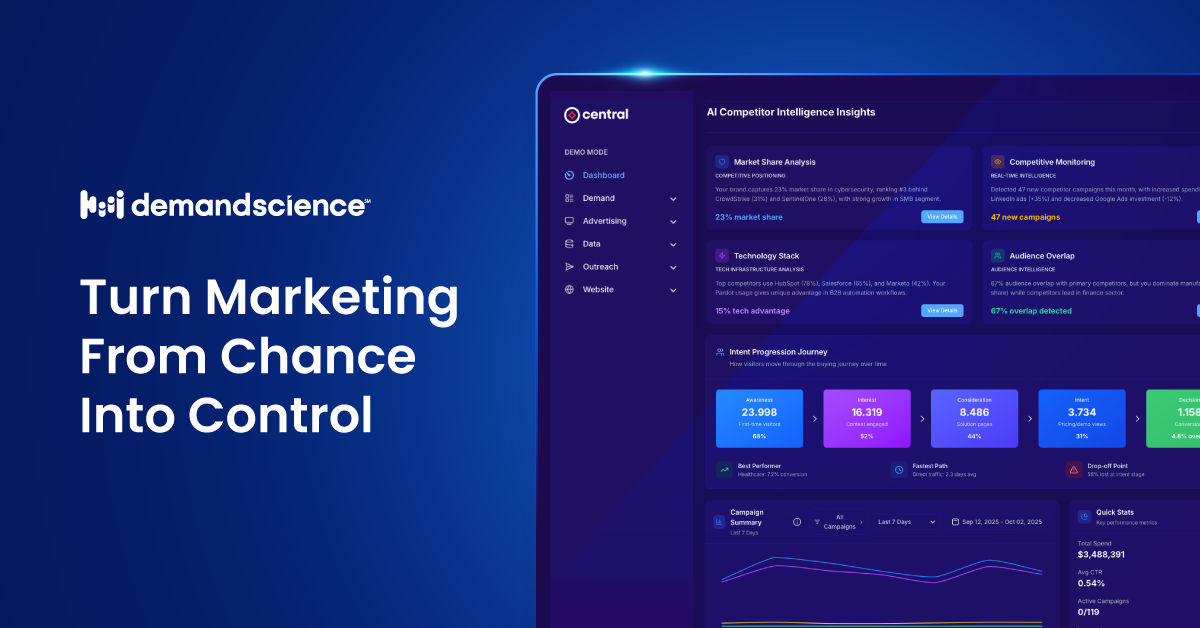 Terminus, now part of DemandScience, specialized in serving targeted display ads to specific accounts across the web.
6. RollWorks (Now AdRoll ABM): ABM for Mid-Market Teams
RollWorks, renamed AdRoll ABM in 2025 and sold under the AdRoll brand, brings ABM advertising to mid-market companies that lack the budget for Demandbase or 6sense. The platform offers account-based ads, retargeting, and lead scoring with a more accessible price point and simpler setup.
RollWorks' Machine Learning Scoring identifies accounts showing purchase intent and ranks them by fit and engagement. The platform integrates with HubSpot, Salesforce, and Marketo, making it a practical choice for teams already invested in those ecosystems.
Best for: Mid-market B2B companies ($5M to $100M revenue) running their first structured ABM program.
Pricing: AdRoll does not publish prices for its ABM packages. Account-Based Retargeting has no fee to get started and you pay only for media.
Limitation: Built around account-based advertising. Teams that need deep account research and sales signals usually pair it with an intelligence layer.
 RollWorks, now AdRoll ABM, brings ABM advertising to mid-market companies.
7. Engagio (Part of Demandbase): Account Engagement Scoring
Engagio pioneered the concept of account engagement scoring, measuring how target accounts interact with your brand across marketing and sales touches. After Demandbase acquired Engagio in 2020, its engagement analytics became part of the Demandbase platform.
Engagio's "engagement minutes" metric remains one of the better ways to quantify account-level interest. Instead of counting individual lead actions, it aggregates engagement across all contacts at an account into a single score that reflects true buying committee activity.
Best for: Teams already on Demandbase who want deeper visibility into which accounts are actively engaging.
Pricing: Included in Demandbase subscriptions. Not available as a standalone product.
Limitation: No longer independent. If you want engagement scoring without the full Demandbase platform, look at alternatives like RollWorks or HubSpot's native ABM features.
8. Triblio: ABM Orchestration
Triblio focuses on orchestrating multi-channel ABM campaigns. The platform coordinates targeted ads, web personalization, and sales activation into sequenced plays that move accounts through the buying journey.
Triblio's strength is campaign orchestration. You define account segments, set triggers, and the platform executes coordinated touches across advertising, email, web personalization, and sales alerts. For teams that struggle with executing multi-step ABM plays, Triblio provides the automation backbone.
Best for: Marketing operations teams that need to coordinate ABM campaigns across multiple channels with automated sequencing.
Pricing: Not published.
Limitation: The standalone Triblio site (triblio.com) is no longer online, so confirm current availability before shortlisting it.
 Triblio focuses on orchestrating multi-channel ABM campaigns with automated sequencing.
9. HubSpot ABM: CRM-Native Account-Based Tools
HubSpot added native ABM features to its Marketing Hub Enterprise tier, including target account dashboards, company scoring, and account-based reporting. For teams already running HubSpot as their CRM and marketing automation platform, these tools bring ABS capabilities without adding another vendor.
HubSpot's ABM features include: target account properties, ICP scoring, company-level workflows, account overview dashboards, and Slack notifications for account activity. The integration is seamless because everything lives in HubSpot.
Best for: Small to mid-market B2B teams already using HubSpot CRM who want basic ABM capabilities without additional platform costs.
Pricing: Included with Marketing Hub Enterprise (starts at $3,600/month). No additional charge for ABM features.
Limitation: HubSpot's ABM tools center on engagement with your own content (form fills, page views, email opens). For ABS programs that depend on earnings-call, filing, and news research, pair it with an intent or signal-based selling tool.
 HubSpot offers native ABM features including target account dashboards and company scoring.
10. Salesforce Account Engagement (Pardot): Enterprise ABM
Salesforce Account Engagement (formerly Pardot) provides B2B marketing automation tightly integrated with the Salesforce CRM. For enterprise teams that have standardized on Salesforce, Account Engagement offers lead scoring, account-based reporting, and engagement tracking within the Salesforce ecosystem.
The Einstein AI layer adds predictive lead and account scoring, and the platform's Engagement Studio lets marketers build complex nurture journeys. The tight Salesforce integration means every marketing touch is visible to sales reps inside their existing workflow.
Best for: Large enterprises committed to the Salesforce ecosystem who need marketing automation with account-level reporting.
Pricing: Sold in tiers through Salesforce; check Salesforce's pricing page for current rates.
Limitation: Pardot's reputation for a steep learning curve persists even after the rebrand. Implementation and customization typically require dedicated Salesforce admins. The platform is built for marketing automation rather than rep-facing account research.
 Salesforce Account Engagement provides B2B marketing automation tightly integrated with the Salesforce CRM.
How to Choose the Right Account-Based Selling Tool
Picking an ABS tool is not about finding the "best" platform. It is about matching capabilities to your team's actual workflow gaps. Here is a practical framework.
Start with the gap. If your reps spend hours researching accounts before meetings, you need an intelligence layer. If your marketing team cannot target ads to specific accounts, you need an ABM advertising platform. If your CRM has no account-level engagement data, you need scoring and measurement tools.
Consider your team size and budget. A 10-person sales team does not need an enterprise intent data platform. Start with tools that solve your most painful workflow bottleneck. Companies with tight budgets get more immediate ROI from account intelligence tools that save rep time than from advertising platforms that require additional ad spend.
Evaluate integration depth. The best tool is worthless if your reps never see the data. Prioritize tools with native CRM integration over those that require reps to log into a separate platform. According to WebFX research, 88% of ABM programs use CRM integration, making it table stakes.
Layer your stack strategically. Many enterprise teams combine two or three tools: an intelligence layer for account research and signals, an advertising platform (like Demandbase or RollWorks) for targeted campaigns, and their CRM's native features for measurement and workflows. This approach costs less than a single all-in-one platform and gives you best-of-breed capabilities in each category.
Here is a practical example of how the layers work together. A target account posts a VP of Revenue Operations role on LinkedIn. Your intelligence platform flags the signal and auto-updates the account brief with the leadership change, plus context from a recent earnings call mentioning a "sales transformation initiative." The rep opens their CRM, sees the alert, and sends a personalized message referencing the initiative. Meanwhile, the marketing team uses Demandbase to serve targeted ads to the account's buying committee. Within two weeks, the account requests a demo. That is the power of a layered ABS tech stack: intelligence for timing, advertising for awareness, and CRM for coordination.

“Automatic account profile detail I can use to manage my territory. Using Salesmotion AI to generate value statements per persona, account, etc. Using Salesmotion to give me a starting point based on new hires, or news alerts is critical.”
Adam Wainwright
Head of Revenue, Cacheflow
Frequently Asked Questions
What is the difference between account-based selling and account-based marketing?
Account-based selling (ABS) focuses on the sales team's execution: researching target accounts, personalizing outreach, and building relationships with buying committees. Account-based marketing (ABM) focuses on the marketing side: running targeted ads, creating personalized content, and scoring account engagement. The most effective programs align both under a unified account-based strategy. According to AdRoll research, companies that align ABS and ABM see 38% higher win rates.
How much do account-based selling tools cost?
Pricing ranges widely. CRM-native tools like HubSpot ABM come included with enterprise subscriptions ($3,600/month). Dedicated intelligence platforms start at $85/month with account-based pricing. Full-stack ABM platforms like Demandbase and intent data platforms like 6sense do not publish list pricing. Vendr reports a median annual contract value of $68,591 across 187 purchases for Demandbase and $62,220 across 386 purchases for 6sense.
Can I run account-based selling with just a CRM?
You can start, but CRMs alone lack three critical ABS capabilities: external buying signal detection, deep account research automation, and predictive prioritization. Teams running ABS with only a CRM spend significantly more time on manual research. A 2025 industry study found that companies using dedicated ABM tools see a 208% increase in marketing-generated revenue compared to CRM-only approaches.
What signals matter most for account-based selling?
The highest-value signals for ABS include leadership changes (especially in your buyer persona roles), earnings call language mentioning relevant initiatives, expansion hiring in departments you sell to, technology adoption or migration, funding events, and competitive displacement signals. The challenge is monitoring these signals across hundreds of accounts simultaneously, which requires automated signal monitoring tools rather than manual tracking.
How do I measure ROI from account-based selling tools?
Track three metrics: time saved on account research (hours per rep per week), pipeline generated from signal-qualified accounts versus cold outreach, and win rate differences between accounts where reps used intelligence versus those where they did not. Enterprise teams typically see 2 to 4 hours saved per rep per week and 20 to 40% higher win rates on signal-qualified opportunities. Compare those gains against your tool investment to calculate ROI. For a deeper dive into measurement, see our guide on ABM metrics that predict revenue.
What is the best ABS tool for a small sales team?
For small sales teams (under 10 people) running account-based selling, the best combination is an intelligence platform plus a contact enrichment tool. Salesmotion (custom team pricing for unlimited users) provides deep account research and signal monitoring that would otherwise require an enterprise ABM stack. Pair it with Apollo.io (from $49 per seat per month on annual billing) for contact data and sequencing. This setup costs a fraction of an enterprise ABM stack for a 10-person team; Vendr reports median annual contracts above $60,000 for both Demandbase and 6sense. Cacheflow used Salesmotion to cut prep time by 60% and triple average deal size.
Do I need an ABM platform or an account intelligence tool?
It depends on your biggest gap. If your challenge is reaching the right people at target accounts with ads and multi-channel campaigns, you need an ABM platform (Demandbase, 6sense, or RollWorks). If your challenge is that reps don't understand accounts well enough to have relevant conversations, you need account intelligence (Salesmotion, which generates cited account briefs from 1,000+ sources). Many enterprise teams benefit from both: Salesmotion for seller-facing intelligence and Demandbase or 6sense for marketing-facing orchestration. Start with the layer that addresses your most expensive problem — for most mid-market teams, that's research time, not ad targeting.
Key Takeaways
- Account-based selling tools fall into three categories: intelligence platforms (account research and signals), ABM advertising platforms (targeted ads and engagement), and CRM-native features (scoring and workflows). Most enterprise teams need at least two.
- For deep account research and signal-based timing, look for platforms that pull intelligence from 1,000+ sources and alert reps when accounts enter buying windows. Analytic Partners grew qualified pipeline 40% using this approach.
- Full-stack ABM platforms like Demandbase and 6sense excel at advertising and intent prediction. Neither publishes list pricing, and both are best suited to large enterprises with dedicated ABM teams.
- Start by identifying your team's biggest workflow gap: if reps spend hours on research, invest in intelligence first. If marketing cannot target specific accounts with ads, invest in an ABM ad platform.
- Layer your tech stack rather than buying an all-in-one solution. An intelligence layer plus an ad platform plus CRM-native features often costs less and delivers better results than a single enterprise platform.
- According to industry benchmarks, 71% of B2B organizations now run active ABM programs, but only 26% have fully scaled them. The right tools close that execution gap.