Most life sciences sales teams are still building prospect lists from conference badge scans and outdated CRM records. The result: emails that bounce, calls that reach the wrong department, and months wasted chasing contacts who changed roles two quarters ago. B2B contact data for life sciences is uniquely difficult because of the industry's complex org structures, regulatory layers, and rapid personnel movement between pharma, biotech, and CRO companies.
TL;DR: Life sciences contact data requires specialized sourcing because standard B2B databases miss key decision makers in clinical operations, medical affairs, and procurement. The best approach combines verified contact databases with real-time signal monitoring to catch role changes and organizational shifts as they happen.
Why Life Sciences Contact Data Is Different
Selling into pharma, biotech, and life sciences companies is not like selling into tech or financial services. Three structural differences make contact data harder to source and faster to decay.
Regulatory complexity creates hidden buying committees. A technology purchase at a biotech company might require sign-off from the VP of Clinical Operations, the Head of Medical Affairs, IT security, procurement, and a compliance officer. Standard B2B databases rarely map these regulatory-specific roles. They capture C-suite and IT contacts but miss the clinical and scientific leaders who actually drive purchasing decisions.
Personnel movement is constant. Life sciences professionals move between sponsors, CROs, and academic institutions frequently. A 2025 LinkedIn Workforce Report found that biotech and pharma had among the highest talent turnover rates across industries. Your contact list from six months ago is already significantly degraded.
Titles vary wildly between organizations. The person responsible for selecting a clinical trial management system might be called "VP of Clinical Operations" at one company, "Head of Clinical Development" at another, and "Senior Director of Trial Management" at a third. Keyword-based searches on standard databases miss these variations.
Key Decision Maker Roles in Life Sciences
Understanding the buying committee is the first step to building a useful contact list. These four roles appear in nearly every life sciences technology purchase.
VP of Clinical Operations
This role oversees trial execution, site management, and operational efficiency. They care about timelines, cost per patient, and site performance metrics. If your product touches clinical workflow, this is your primary buyer.
Head of Medical Affairs
Medical Affairs bridges the gap between clinical development and commercial operations. They influence decisions around medical information systems, KOL management platforms, and real-world evidence tools. Often overlooked by sales teams who focus exclusively on IT buyers.
Procurement Director
In large pharma, procurement controls vendor onboarding, contract negotiation, and compliance requirements. They are rarely the economic buyer for technology decisions, but they can block or delay any deal. Missing this contact means a deal that stalls in the final stages.
Chief Scientific Officer (CSO)
The CSO shapes the company's research direction and pipeline strategy. While they rarely evaluate individual tools, their strategic priorities determine which departments receive budget. Understanding their published research interests and public statements helps you align your outreach to what the company actually cares about.

“The AI templates were a surprise delight. We expected the data, but the pre-built email suggestions turned out to be much better than expected and a huge help, especially for newer reps.”
Sabina Malochleb-Bazaud
Senior Sales Operations Administrator, Cytel
Data Quality Challenges in Life Sciences
Three data quality problems hit life sciences harder than other industries.
Email deliverability is lower. Many pharma companies use aggressive email filtering, and some clinical organizations restrict external email entirely for compliance reasons. A Validity study found that average B2B email bounce rates hover around 2-3%, but life sciences-specific lists often see bounce rates of 8-12% due to stricter email infrastructure.
Direct dial availability is limited. Clinical operations leaders and medical affairs professionals are often based in labs, hospitals, or field offices rather than traditional corporate offices. Direct phone numbers are scarce, and mobile numbers require consent-based sourcing. Generic office numbers route through gatekeepers who screen sales calls aggressively.
Organizational restructuring is frequent. Mergers, acquisitions, and pipeline failures trigger regular reorganizations. When a pharma company acquires a biotech, the combined org chart can shift dramatically within weeks. Contacts who were decision makers before the merger may lose budget authority afterward.
Where to Find Life Sciences Contacts
No single source covers the full life sciences buying committee. The most effective approach layers multiple channels.
Industry-Specific Databases
Platforms like Definitive Healthcare and PharmaCircle specialize in healthcare and life sciences contacts. They map hospital systems, physician networks, and pharma org charts with more depth than general B2B databases. The trade-off: pricing is by quote, and direct contact details still benefit from verification.
Conference and Event Data
Life sciences runs on conferences. Events like JPM Healthcare Conference, BIO International, ASCO, and DIA draw thousands of decision makers. Attendee lists, speaker rosters, and exhibitor directories are high-quality contact sources. The challenge is timeliness. Post-conference data is most valuable within 30 days before contacts change roles or lose relevance.
Real-Time Signal Monitoring
The most reliable way to maintain accurate life sciences contacts is to monitor signals that indicate role changes, organizational shifts, and buying intent. Platforms like Salesmotion track leadership changes, hiring patterns, earnings call commentary, and strategic initiative announcements across 1,000+ sources. When a VP of Clinical Operations moves from Pfizer to a mid-size biotech, the signal fires within days, not months.
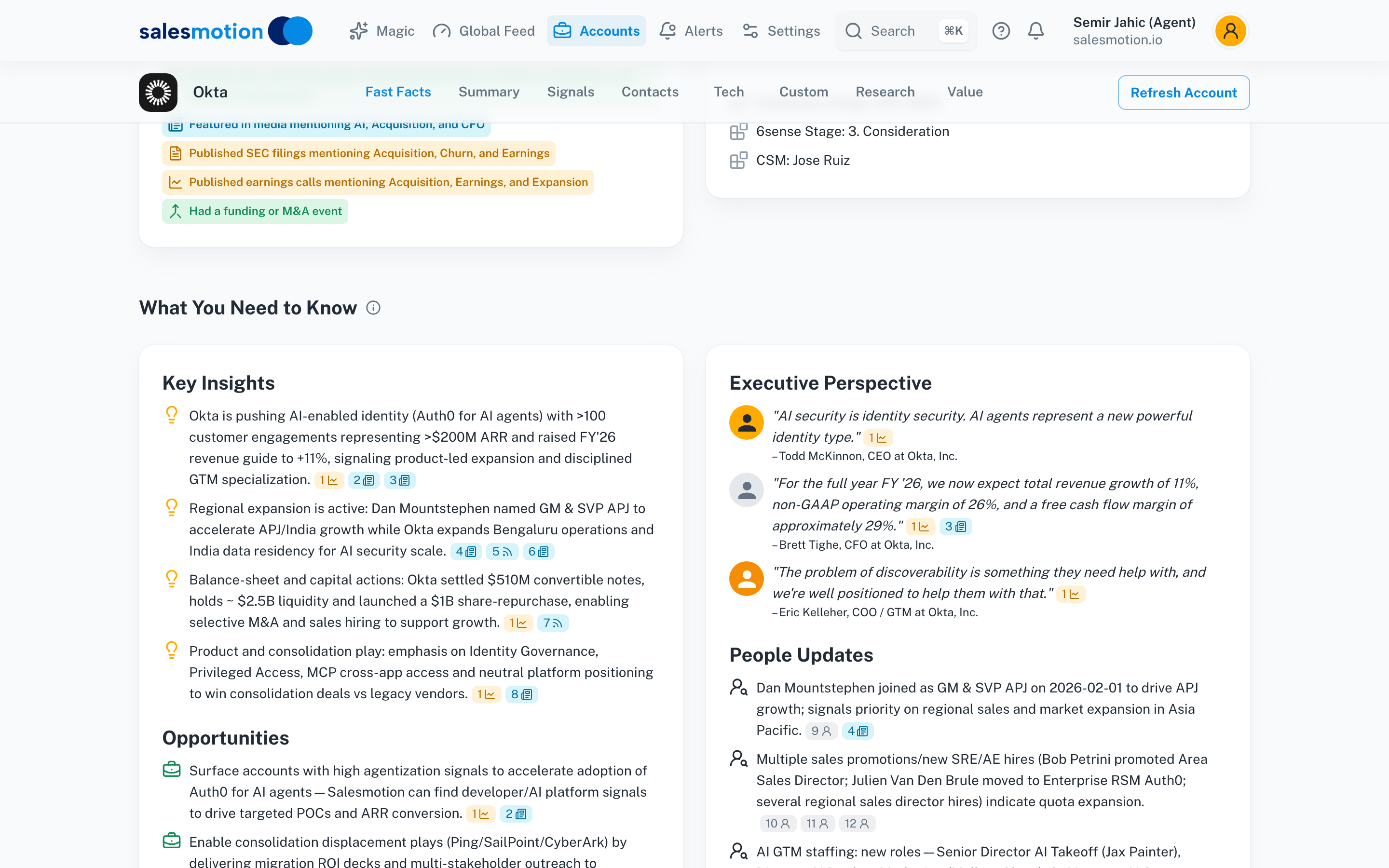 Salesmotion surfaces key insights, executive perspectives, people moves, and talking points — giving reps the context behind every contact.
LinkedIn and Professional Networks
LinkedIn remains the single largest source of life sciences professional data. But scraping profiles is against LinkedIn's terms of service, and the data degrades fast. The better approach: use LinkedIn for verification and relationship mapping, not as your primary contact database.

“All of the vendors that I've worked with, all of the onboarding that I have had to deal with, I will say, hands down, Salesmotion was the easiest that I have had.”
Lyndsay Thomson
Head of Sales Operations, Cytel
Life Sciences Contact Data: Source Comparison
| Source Type | Coverage | Accuracy | Cost | Best For |
|---|---|---|---|---|
| General B2B databases (ZoomInfo, Apollo) | Broad, built for general B2B roles | Varies by role and region | Apollo from $49/user/mo; ZoomInfo not published | Initial prospecting lists |
| Industry-specific databases (Definitive HC) | Deep on clinical/hospital | High (80-85% verified) | By quote | Hospital/health system targeting |
| Conference attendee lists | Narrow, highly targeted | High (recent, self-reported) | Varies by event | Post-event outreach campaigns |
| Signal-based platforms (Salesmotion) | Real-time, intent-enriched | High (verified + timestamped) | Mid-market pricing | Ongoing territory monitoring |
| LinkedIn Sales Navigator | Broad, self-reported | Moderate (titles current, emails missing) | $1,079.88-$1,799.88/yr per seat | Relationship mapping, verification |
Building a Life Sciences Prospecting Workflow
The highest-performing teams combine static contact data with dynamic signals. Here is what that looks like in practice.
A signal fires: a mid-size biotech posts three clinical project manager roles on LinkedIn in the same week. This hiring pattern suggests a new trial is ramping up. Salesmotion flags the account, surfaces the company's recent earnings commentary about their Phase III pipeline, and identifies the VP of Clinical Operations and Head of Procurement as key contacts.
The rep enters discovery already knowing the company's trial priorities, hiring velocity, and strategic direction. Instead of a generic "are you evaluating solutions?" opener, the conversation starts with specific knowledge about the company's current clinical pipeline expansion.
This approach works because the contact data is fresh (sourced within days of the signal), the context is relevant (tied to a real business event), and the timing is right (the company is actively building capability). Teams using signal-driven account research consistently report shorter sales cycles and higher conversion rates.
For more on building effective B2B contact databases, see our provider comparison. And if you sell into life sciences specifically, our guide to signal-based prospecting in life sciences covers the full playbook.
Key Takeaways
- Life sciences contact data decays faster than other industries due to frequent role changes, M&A activity, and organizational restructuring
- Standard B2B databases miss critical life sciences roles like VP of Clinical Operations, Head of Medical Affairs, and Chief Scientific Officer
- Layer multiple data sources: general databases for breadth, industry-specific tools for depth, and signal platforms for real-time accuracy
- Conference data is high-quality but time-sensitive; prioritize outreach within 30 days of an event
- Signal-based monitoring catches role changes, hiring patterns, and strategic shifts weeks before static databases update
- The best life sciences prospecting combines verified contacts with real-time buying signals to reach the right person at the right moment
Frequently Asked Questions
How often does life sciences contact data go stale?
Life sciences contact data degrades significantly within 6-12 months. High executive turnover, frequent M&A activity, and organizational restructuring mean that a contact list built in January may have 20-30% invalid entries by July. Signal-based platforms that monitor role changes in real time help maintain accuracy without manual re-verification.
What are the best sources for pharma decision maker contacts?
The most effective approach combines industry-specific databases like Definitive Healthcare for hospital and clinical contacts, general B2B databases like ZoomInfo for corporate contacts, and signal monitoring platforms for real-time updates. No single source covers the full life sciences buying committee, so layering sources is essential.
How do I identify the right buying committee at a life sciences company?
Start by mapping the four core roles: VP of Clinical Operations (operational decisions), Head of Medical Affairs (scientific influence), Procurement Director (vendor approval), and CSO (strategic budget authority). Then use account intelligence tools to identify the specific individuals in those roles at your target accounts and monitor for changes.
Is cold outreach effective in life sciences sales?
Cold outreach works in life sciences when it is highly personalized and timed to relevant business events. Generic batch emails perform poorly due to strict email filtering and busy schedules. Signal-anchored outreach that references a company's specific clinical pipeline, recent leadership change, or strategic initiative gets significantly higher response rates than templated prospecting.