SaaS companies are the most prospected segment in B2B sales. Every sales intelligence vendor, every SDR team, and every AI outreach tool is targeting the same pool of tech buyers. The result: SaaS decision makers are drowning in generic outreach, and the only way to break through is with contact data that is both accurate and contextually rich. B2B contact data for SaaS sales requires more than emails and phone numbers. It requires understanding who is buying, what they are building, and why they might be ready to evaluate your solution right now.
TL;DR: SaaS buyers are over-prospected and under-researched. The best SaaS contact data strategy combines verified contact databases with real-time signals like funding rounds, leadership changes, and hiring patterns to time your outreach to genuine buying windows.
Why SaaS Contact Data Is Different
Selling to SaaS companies presents unique data challenges that do not exist in other verticals.
Decision-making is distributed. In a typical SaaS company, technology purchases can be initiated by engineering, product, marketing, or revenue operations. A CTO might own infrastructure decisions while a VP of Product owns workflow tools and a Head of Growth owns the marketing stack. There is no single "IT department" to target. Your contact data must cover multiple functional leaders per account.
Titles change faster than databases update. SaaS companies create new roles constantly. "Head of Growth" barely existed five years ago. "VP of Revenue Operations" and "Chief Revenue Officer" are still emerging titles. Static databases that rely on standardized title taxonomies miss these evolving roles or categorize them incorrectly.
Company data changes rapidly. SaaS companies raise funding, pivot products, restructure teams, and get acquired at a much faster rate than companies in traditional industries. A Crunchbase analysis of venture-backed companies found that the average SaaS startup goes through a significant organizational change every 8-12 months. Contact data that was accurate last quarter may already be obsolete.
See Salesmotion on a real account
Book a 30-minute demo and see how your team saves hours on account research.
Key Decision Maker Roles at SaaS Companies
These five roles appear across nearly every SaaS buying committee for technology and infrastructure purchases.
Chief Technology Officer (CTO)
The CTO sets the technical architecture and engineering strategy. They evaluate tools that touch the development stack, infrastructure, security, and developer experience. In early-stage startups, the CTO often makes purchasing decisions unilaterally. In larger SaaS companies, they delegate evaluation but retain veto authority.
VP of Engineering
The VP of Engineering manages engineering execution and team productivity. They care about developer tools, CI/CD pipelines, monitoring, and anything that affects engineering velocity. They are often the day-to-day champion for technical purchases, even when the CTO has final sign-off.
VP of Product
The VP of Product owns the product roadmap and user experience decisions. They influence purchases related to analytics, user research, product management platforms, and experimentation tools. In product-led growth (PLG) companies, the VP of Product may have more budget authority than the CTO for user-facing tools.
Head of Growth / VP of Marketing
Growth leaders own demand generation, conversion optimization, and marketing technology. They evaluate tools across the marketing stack, from intent data platforms to ABM tools to content management systems. Their budgets have expanded significantly as SaaS companies invest more in efficient growth.
Revenue Operations (RevOps) Leader
RevOps owns the operational infrastructure across sales, marketing, and customer success. They evaluate CRM tools, sales engagement platforms, revenue intelligence solutions, and data enrichment providers. RevOps is increasingly the power center for technology purchases that span multiple revenue functions.

“The moment we turned on Salesmotion, it became essential. No more hours on LinkedIn or Google to figure out who we're talking to. It's just there, served up to you, so it's always 'go time.'”
Adam Wainwright
Head of Revenue, Cacheflow
Data Quality Challenges in SaaS Prospecting
Three data quality issues make SaaS prospecting particularly prone to wasted effort.
Job tenure is short. The average tenure at SaaS companies is significantly shorter than in other industries. A 2025 LinkedIn Economic Graph report showed that tech workers change roles every 2.2 years on average. For VP-level and above in high-growth SaaS, the number is even lower. Your contact list degrades faster in this vertical than almost any other.
Company-level data is unreliable. SaaS companies frequently change names, merge products, pivot markets, and restructure around new product lines. Firmographic data from six months ago may not reflect the current reality. A company that was a "Series B marketing tech startup" might now be a "post-acquisition enterprise data platform" with a completely different buying committee.
Over-prospecting makes accuracy critical. Because SaaS decision makers receive so much outreach, anything that signals inaccuracy, such as a wrong title, a reference to an old company name, or an email to someone who left months ago, destroys credibility instantly. In a market where first impressions matter this much, data quality is not just operational hygiene. It is a competitive advantage.
Where to Find SaaS Company Contacts
The most effective approach to SaaS contact data combines breadth, depth, and recency.
B2B Contact Databases
Platforms like ZoomInfo, Apollo, and Lusha provide broad coverage of SaaS company contacts. They work well for initial list building and are strongest on sales and marketing titles. Check coverage of engineering and product roles on your own account list, because coverage and freshness vary by role and company size. Enterprise SaaS companies are usually well-covered. Series A startups with 30 employees are harder.
Funding and Hiring Signals
Funding rounds and hiring surges are the strongest buying signals in SaaS. A company that just raised a Series B and is hiring five engineers is actively building. That is a buying window. Monitoring platforms like Salesmotion track funding announcements, job postings, and headcount changes in real time, connecting them to the specific contacts who are making purchasing decisions.
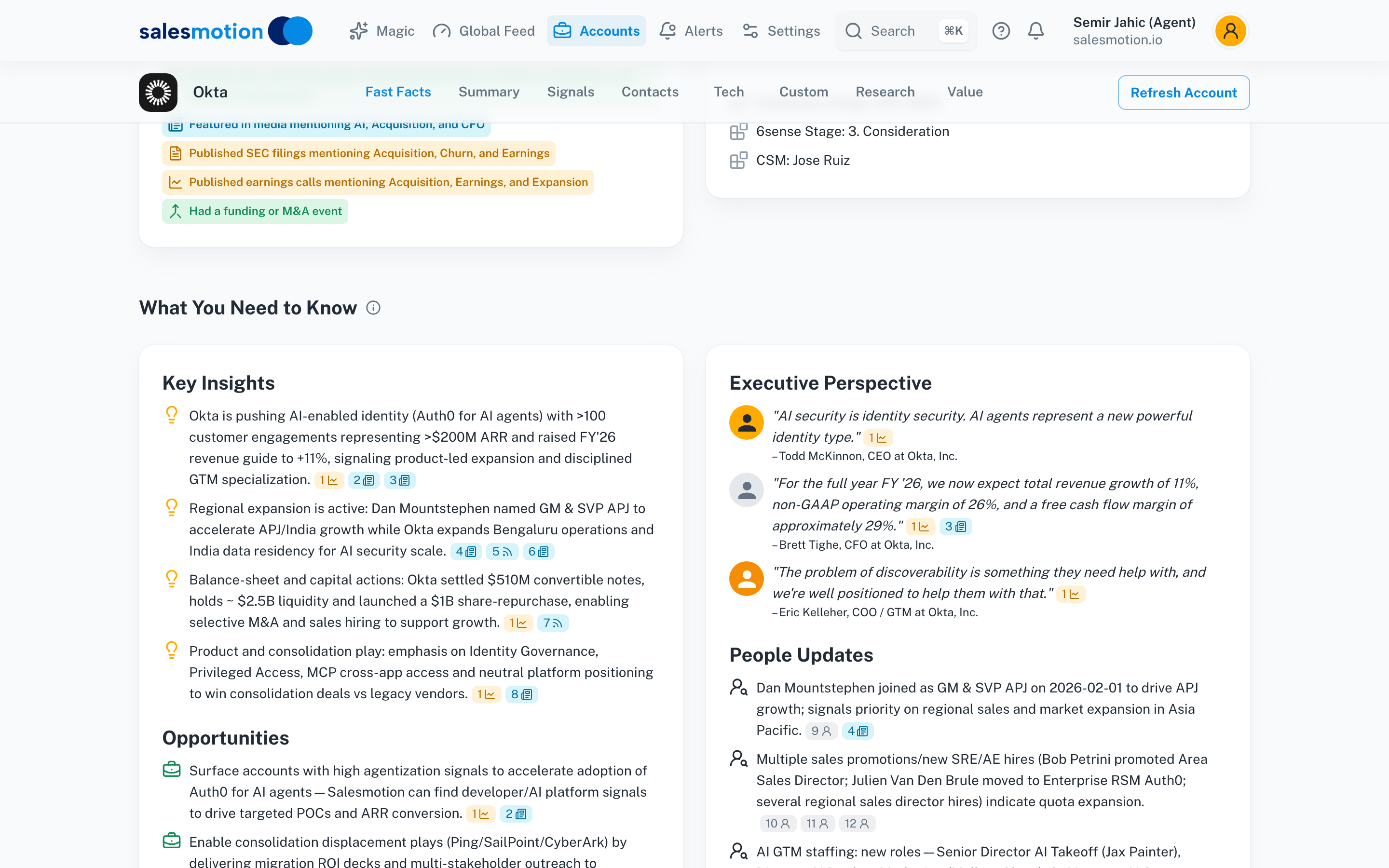 Salesmotion surfaces key insights, executive perspectives, people moves, and talking points — giving reps the context behind every contact.
LinkedIn and GitHub
For technical roles (CTO, VP Engineering, engineering managers), LinkedIn and GitHub provide the most current data. Engineering leaders maintain active profiles because their professional identity is tied to their technical contributions. The challenge is extracting structured contact data at scale without violating platform terms of service.
Technology Stack Data
Technographic data from providers like BuiltWith or Wappalyzer identifies what tools a SaaS company already uses. This helps you target companies that use complementary or competing products and avoids wasting outreach on companies that already have your category covered.
“Automatic account profile detail I can use to manage my territory. Using Salesmotion AI to generate value statements per persona, account, etc. Using Salesmotion to give me a starting point based on new hires, or news alerts is critical.”
Adam Wainwright
Head of Revenue, Cacheflow
SaaS Contact Data: Source Comparison
| Source Type | Coverage | Accuracy | Cost | Best For |
|---|---|---|---|---|
| General B2B databases | Broad, strong on sales/marketing | Moderate (65-75%) | Free plans to quote-only annual contracts | Initial list building |
| Funding/hiring signals | Narrow, high-intent | High (event-verified) | Varies | Timing outreach to buying windows |
| LinkedIn Sales Navigator | Broad, self-reported | Moderate to high | $1,079.88-$1,799.88/yr per seat | Technical role mapping |
| Technographic providers | Deep on tech stack | High (crawl-verified) | $10K-$30K/yr | Competitive displacement |
| Signal-based platforms | Real-time, multi-signal | High (verified + contextualized) | Mid-market pricing | Ongoing territory intelligence |
Building a SaaS Sales Prospecting Workflow
Here is what a signal-driven SaaS prospecting workflow looks like in practice.
A mid-market SaaS company raises a $40M Series C and announces plans to expand their enterprise sales team. Salesmotion detects the funding signal, cross-references it with recent job postings for VP of Sales and RevOps Manager, and surfaces the current CTO, VP of Engineering, and Head of Growth as key contacts.
The rep opens the account brief and sees that the company recently adopted Snowflake (suggesting a data infrastructure investment) and that their CTO published a blog post about scaling their analytics pipeline. The outreach references the funding round, the infrastructure investment, and the specific data challenge the CTO described.
This is what separates signal-driven SaaS prospecting from list-based blasting. The contact data is accurate, the timing is relevant, and the context is specific. Teams using this approach consistently report higher reply rates and shorter sales cycles compared to batch outreach from static prospect lists.
Key Takeaways
- SaaS buying committees are distributed across engineering, product, marketing, and RevOps, requiring broader contact coverage than single-department targeting
- Short job tenures (2.2 years average in tech) mean SaaS contact data decays faster than any other vertical
- Funding rounds and hiring surges are the strongest signals for identifying SaaS companies in a buying window
- Combine B2B databases for breadth with technographic data for targeting and signal platforms for timing
- Over-prospecting makes data accuracy a competitive differentiator, not just a hygiene issue
- Signal-driven outreach that references specific business events outperforms generic cadences by a wide margin
Frequently Asked Questions
What is the biggest challenge with SaaS contact data?
The biggest challenge is data decay. SaaS professionals change roles frequently, companies restructure after funding rounds, and new titles emerge that static databases do not track. A contact list built today will have 25-35% invalid entries within six months. Real-time monitoring of job changes, funding events, and organizational shifts is essential for maintaining accuracy.
How do I find the right buyer at a SaaS company?
Start by identifying the functional area your product serves: engineering tools target the CTO/VP Engineering, marketing tools target the Head of Growth/VP Marketing, and cross-functional tools target RevOps. Use account intelligence to map the specific individuals in those roles, then monitor for buying signals like funding rounds, leadership changes, and strategic hires that indicate a purchasing window.
Are B2B databases like ZoomInfo effective for SaaS prospecting?
B2B databases provide good coverage of sales, marketing, and executive contacts at mid-to-large SaaS companies. They are weaker on engineering and product roles, early-stage startups, and recently changed titles. The best approach uses databases for initial list building, then layers in signal data for timing and technographic data for targeting. See our comparison of B2B contact data providers for details.
What signals indicate a SaaS company is ready to buy?
The strongest signals include: recent funding rounds (new capital to deploy), leadership hires in your target function (new leaders bring new vendors), rapid headcount growth (scaling teams need new tools), and technology stack changes (infrastructure shifts create integration needs). Monitoring these signals in combination gives a much clearer picture than any single indicator.