Win-loss analysis is the practice of interviewing buyers after they decide, coding the reasons in a fixed way, and turning the patterns into three to five changes to how you qualify, message, price or build. It works when someone neutral asks the questions, when losses to "no decision" get interviewed like any other loss, and when the output is a short list of changes with owners rather than a slide of quotes.
TL;DR: Each quarter, interview every win, loss and no-decision above a size threshold, within 30 days of the decision, with someone who did not own the deal. Ask eight questions in 30 minutes. Code each decision to one primary reason from a fixed list and note the last stage before the loss. Before reading reasons, split losses that died of neglect from losses a competitor or the status quo actually won. Download the interview guide and coding sheet below.
What is win-loss analysis?
Win-loss analysis is a structured review of why buyers chose you, chose someone else, or chose nothing. It combines two sources: conversations with the buyers themselves, and the record in your CRM (stage reached, time in each stage, contacts involved, loss reason). Neither is enough alone. CRM loss reasons are written by the rep who lost, usually in a hurry, and "price" or "timing" in a drop-down rarely survives a conversation with the buyer.
The output is not a report. It is a short list of decisions: tighten qualification at a stage, change a message, fix an onboarding gap, adjust packaging.
Why do most win-loss programs fail?
Three reasons come up again and again:
- The account owner asks the questions. Buyers are polite to the person who sold to them. A neutral interviewer, from product marketing, RevOps or outside the company, hears the real reason.
- No-decisions are skipped. They are the most common outcome in many pipelines and the least examined. Matthew Dixon and Ted McKenna analyzed more than 2.5 million recorded sales conversations and found that between 40% and 60% of deals are lost to customers who say they intend to buy and then do not act (HBR, 2022).
- The codes change every quarter. If the categories drift, quarters cannot be compared and the program becomes anecdotes.
Who should you interview for win-loss analysis?
| Group | Sample per quarter | What you learn |
|---|---|---|
| Wins above your size threshold | All | What was different: the sponsor, the trigger, the proof that mattered |
| Losses above the threshold | All | Where and why you lost, and to whom |
| No-decisions above the threshold | All | Why a buyer with a stated need did nothing |
| Smaller deals | Five random wins and five random losses | Whether the large-deal pattern holds |
| Losses to your most frequent competitor | All | What that competitor is doing that you are not |
Ask within 30 days of the decision, while the buyer still remembers the sequence. Open with: "I'm not trying to sell you anything. We want to learn from how this went."
What questions should you ask in a win-loss interview?
Thirty minutes, eight questions, in this order. The buyer talks; the interviewer listens and codes afterwards.
| Minutes | Question | Listen for |
|---|---|---|
| 0 to 3 | Thanks, purpose, confidentiality, permission to take notes | Trust |
| 3 to 7 | What made you look for something new in the first place? What was happening in the business? | The real trigger |
| 7 to 10 | Why that moment, rather than half a year earlier or later? | A dated event, or none |
| 10 to 14 | Who had a say in the decision, and who could have blocked it? | The buying group; whether you met the person who signs |
| 14 to 18 | What else was on the table, including staying as you were or building it in-house? | The true competitive set |
| 18 to 22 | What tipped the choice? Which factor carried the most weight? | Product, price, value case, risk, relationship |
| 22 to 25 | Was there a point where it could have gone the other way? | Where the deal turned |
| 25 to 30 | How did the selling team come across, from first call to proposal? What should they stop doing? Can we check in again in six months? | Process and people; a future opening |
Two of these questions do most of the work. "What made you look in the first place?" tells you what triggered the project, which is the thing your prospecting should be watching for. "Was there a point where it could have gone the other way?" tells you where the deal was won or lost, which is rarely where the rep thinks.
Free Win-Loss Interview Guide and Coding Sheet
The 30-minute buyer question set, the eight-code frame, and a sheet to log stage at loss, competitor and buying-group coverage. PDF and Excel.
No email required. Includes the interview guide, coding frame and quarterly log.

“The talking points are gold. If they're in Salesmotion, I know they're being discussed inside that business. That makes it easy to spark a real conversation, which is 90 percent of the battle.”
Andrew Giordano
VP of Global Commercial Operations, Analytic Partners
How do you code win-loss reasons?
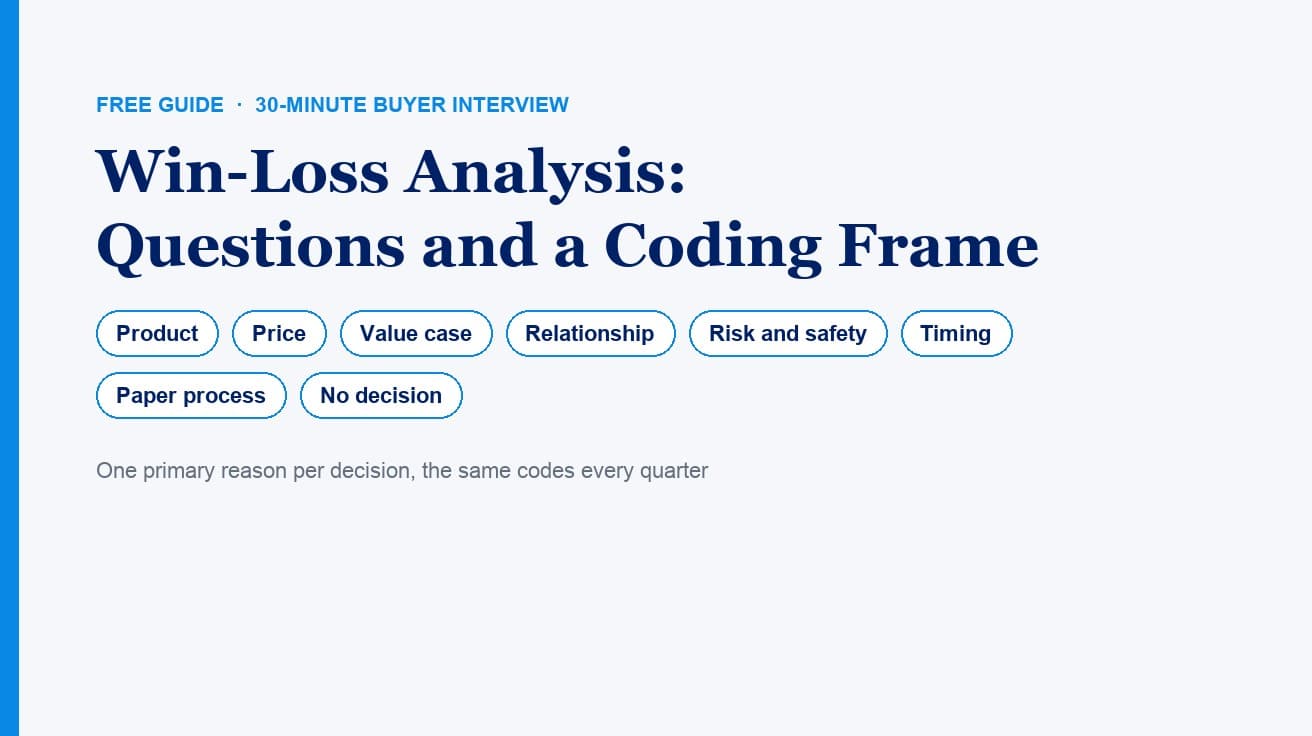
Give every decision one primary reason and at most two secondary ones, from a list that does not change:
| Code | Means |
|---|---|
| Product | A capability you lacked, or one they valued more elsewhere |
| Price | Price or packaging, after the value was accepted |
| Value case | The business case was never made, or not believed |
| Relationship | Trust, speed of response, access to executives |
| Risk and safety | The buyer went with what felt safer: the incumbent, a larger vendor, or no change |
| Timing | Budget cycle, reorganization, priorities moved |
| Paper process | Legal, security or procurement slowed or stopped it |
| No decision | Nothing happened; record why |
Also log: the stage the deal reached, the competitor if any, whether you met the economic buyer, and the days from first meeting to decision. Those four fields turn reasons into patterns.
Is "no decision" really one reason?
No. It is usually two problems wearing one label, and they need opposite fixes.
Neglect and process deaths. Opportunities with no amount ever entered, stuck in the first stages despite several meetings, or closed by a cleanup rule rather than by a buyer decision. These are pipeline hygiene problems. The buyer may never have been qualified at all.
Contested no-decisions. Deals that reached a real evaluation with a named decision maker, then stalled. These are discovery problems: the buyer never had a reason to act by a date, or nobody quantified the cost of doing nothing.
Split your closed-lost list into these two groups before reading any reasons. If most of your "no decision" losses are the first kind, you have a qualification and hygiene problem, not a market problem. If most are the second kind, the fix is upstream: a compelling event tested before the demo, and a mutual action plan the buyer agrees to.
How do you read win-loss patterns?
Pair each loss reason with the stage the deal reached. The combination tells you where to act:
- Losses concentrated early point at targeting and qualification. Research from Forrester's Seth Marrs, cited by Salesloft, found that 60% of deals are lost in the first two stages and that lost deals stay open about 2.4 times longer than won ones (Salesloft, 2023). Early losses that linger also inflate your pipeline.
- Early losses in one team only point at enablement or coaching, not the market.
- Late losses point at the business case, the economic buyer conversation, or the paper process.
- Winning the evaluation but losing the deal is usually a risk problem: the buyer believed you could do it, but chose the safer option.
- Wins that started from the same kind of event (a new executive, a funding round, a regulation, an acquisition) tell you which buying signals to watch across the rest of your territory.
That last point is where win-loss analysis feeds prospecting. If eight of your last ten wins began within months of a leadership change or a cost program announced on an earnings call, those are the events to monitor on every target account.
Watch your accounts for the events your wins started with
Salesmotion's agents track leadership changes, earnings language, hiring and news across 1,000+ sources, so the next deal starts when the trigger fires. See it in a 30-minute demo.
What should a quarterly win-loss review produce?
One 60-minute meeting in the first week of the quarter, with sales, marketing, product and customer success leaders:
- RevOps shows this quarter's coded results next to last quarter's, split by the stage where each deal ended.
- The group reads the patterns using the rules above.
- The group agrees three to five changes, each with an owner and a date: a qualification rule, a message, an enablement session, a pricing or packaging tweak, a product request with evidence.
- A two-paragraph summary goes to the whole sales team.
Then check, two quarters later, whether the top loss reason shrank. If it did not, the change did not work.
Salesmotion's Take
Reps remember losses as price. Buyers remember them as risk, timing or a business case nobody believed. The gap between those two stories is where win-loss analysis earns its keep, and you only find it if someone other than the rep asks the buyer.

Semir Jahic
CEO & Co-Founder, Salesmotion
Key takeaways
- Interview wins, losses and no-decisions above a size threshold each quarter, within 30 days, with a neutral interviewer.
- Use one fixed coding frame so quarters compare, and log stage at loss, competitor, economic-buyer contact and cycle length.
- Split "no decision" into neglect deaths and contested stalls before reading reasons; they need opposite fixes.
- Read reasons together with the stage reached: early losses are a qualification problem, late losses a business-case or risk problem.
- Use the triggers behind your wins to choose which signals to watch on target accounts.
Frequently Asked Questions
What is win-loss analysis in sales?
Win-loss analysis is a structured review of why buyers chose you, a competitor or nothing. It combines short interviews with buyers after the decision and CRM data such as the stage reached and the loss reason. The goal is a small set of changes to qualification, messaging, pricing or product.
Who should conduct win-loss interviews?
Someone neutral, never the rep who owned the deal. Product marketing, RevOps or an outside interviewer hears more honest answers, because buyers soften criticism when they speak to the person who sold to them.
How many win-loss interviews do you need?
Interview every decision above your deal-size threshold, plus a random sample of five smaller wins and five smaller losses per quarter. Set the threshold so the volume is something one person can run alongside their day job.
What are the most common reasons for losing a deal?
The eight codes above cover the reasons buyers give: product, price, value case, relationship, risk, timing, paper process and no decision. Which one dominates varies by company and by stage, and the CRM field is a poor guide because the rep who lost writes it. That is why the buyer interview matters.
How do you reduce no-decision losses?
Split them first. Losses that died of neglect need better qualification and pipeline hygiene. Contested stalls need a dated compelling event before the demo, a quantified cost of doing nothing, and a mutual action plan the buyer agrees to.