Most advice on marketing lead qualification is stuck in a different market. It assumes that if someone downloads a guide, attends a webinar, or hits an arbitrary score in HubSpot or Marketo, they deserve a fast handoff to sales. That playbook created a generation of bloated MQL dashboards and annoyed account executives.
The problem isn't lead volume. It's timing, context, and discipline.
A contact can look active in your marketing automation system and still be a terrible sales conversation. A company can barely touch your website and still be a perfect account to call today because they just hired a new CRO, raised funding, announced expansion, or changed strategy in a public filing. If your qualification model can't tell the difference, it's outdated.
Modern marketing lead qualification has to answer two questions at the same time. Is this account a fit? And why now? If you can't answer both, you're not qualifying leads. You're sorting clicks.
Your MQLs Are Costing You Money
The standard MQL model rewards activity that feels measurable, not activity that predicts revenue. That's why so many teams keep generating leads, keep reporting progress, and keep hearing from sales that the leads are junk.
The data is brutal. The MQL-to-SQL conversion rate averages just 13% across industries, which means 87% of leads marketing passes to sales are rejected or stalled. Worse, 67% of lost sales result from inadequate lead qualification before the handoff according to Landbase's lead qualification statistics.
That isn't a minor optimization issue. That's a system failure.
Why the old model breaks
Most legacy qualification programs make three bad assumptions:
- Engagement equals readiness. It doesn't. A whitepaper download often signals curiosity, not urgency.
- Lead score equals quality. It usually reflects how much a person interacted with your content machine, not whether the account can buy.
- Sales can sort it out later. They can, but they shouldn't have to. Every bad handoff burns rep time and trust.
Practical rule: If sales consistently re-qualifies what marketing already called qualified, your model is broken.
A rep doesn't need more names. A rep needs a reason to act.
What to replace it with
Start by killing the idea that an MQL is the finish line. It isn't. At best, it's an early signal. At worst, it's a vanity metric disguised as pipeline creation.
A better model treats qualification as a shared revenue process, not a marketing status field. It combines fit, actual intent, and business context before the lead ever reaches an AE. If you're still debating whether downloads or form fills should add more points, you're solving the wrong problem. A more useful starting point is this practical guide on how to qualify a lead.
The old MQL playbook optimizes for handoffs. Revenue teams should optimize for accepted pipeline.
See Salesmotion in action
Take a self-guided interactive tour — no signup required.
Redefining Qualification with Fit and Intent
A qualified lead isn't someone who engaged. A qualified lead is someone from the right account, showing the right level of intent, at the right moment.
That requires a simpler mental model than is typically used. Forget the bloated lead score for a minute. Think in a fit and intent matrix.

Fit tells you who matters
Fit is account quality. It's the answer to: should we care about this company at all?
Your fit criteria usually includes:
- Firmographics such as industry, company size, geography, and business model
- Technographics such as CRM, data stack, cloud environment, or installed tools
- Commercial fit like average contract potential, sales motion, and serviceability
- Strategic fit such as whether the account maps to your ideal use case or expansion thesis
If your ICP is fuzzy, fix that first. Teams that need a reset on audience definition can use this guide to identifying target audience as a practical reference.
Fit should be hard-edged. Not every company that can buy should enter your funnel. Strong qualification depends on excluding accounts that drain time, even if they look active.
Intent tells you when to act
Intent is not just website activity. That's a common pitfall.
Intent includes classic engagement signals, but it also includes evidence that a business issue is active. A target account exploring pricing pages matters. A target account posting jobs tied to your category matters more. A target account bringing in a new executive who owns your problem space often matters most.
Here is the matrix I use with revenue teams:
| Fit | Intent | What to do |
|---|---|---|
| High fit | High intent | Prioritize now. Fast routing, tailored outreach, clear owner. |
| High fit | Low intent | Nurture patiently. Keep the account warm and monitor for change. |
| Low fit | High intent | Treat carefully. Demand stricter qualification before sales spends time. |
| Low fit | Low intent | Ignore or disqualify. Don't let noise into the pipeline. |
The practical definition of qualified
A modern definition of marketing lead qualification should be simple enough for both sales and marketing to use without interpretation.
Use a definition like this:
A lead is qualified when the account matches our ICP, the buying context is credible, and the next sales action is clear.
That last part matters. If nobody can state the next action, the lead isn't qualified. It's just interesting.
What good teams change immediately
They stop asking, "Did this person engage enough?" and start asking:
- Is this account worth winning?
- Is there evidence of a real initiative or pain?
- Do we know who should own the next move?
- Can sales personalize outreach with specifics, not guesses?
That's how marketing lead qualification becomes useful again. It stops being a threshold and becomes a decision.

“Salesmotion helps you spot signals from prospect accounts, news items / job hiring alerts etc that indicate that now is a good time to reach out with a well-crafted message.”
Rob Douglas
Director of Sales, icit business intelligence
Choosing Your Qualification Framework
Once you've defined fit and intent, you need a common operating language. That's what frameworks are for. They don't replace judgment. They force consistency.
The core options are familiar for a reason. BANT, GPCTBA, and MEDDIC all create structure around qualification, and MEDDIC is especially important in complex B2B sales because reps need to identify the economic buyer and decision criteria. That matters even more when lead-to-MQL conversion averages 31% across industries, which means qualification has to begin at the first touch, not after a lead score crosses a threshold, as noted by Headley Media's guide to lead qualification.
Don't pick a framework because it's popular
Pick one because it matches the way you sell.
Here's the clean comparison:
| Framework | Best fit | What it focuses on | Where it breaks |
|---|---|---|---|
| BANT | Simpler deals, faster cycles | Budget, authority, need, timeline | Too shallow for multi-stakeholder deals |
| GPCTBA | Consultative mid-market sales | Goals, plans, challenges, timeline, budget, authority | Can become verbose if reps aren't disciplined |
| MEDDIC | Complex enterprise deals | Metrics, economic buyer, decision criteria, decision process, pain, champion | Heavy for transactional motions |
When BANT is enough
BANT still works when your product is relatively straightforward, your buyer is obvious, and your team needs speed. If you're selling into a narrower use case with a shorter cycle, forcing reps through a heavyweight discovery structure is unnecessary.
Use BANT when sales needs to answer a simple question fast: is this worth a real conversation?
That said, don't let reps reduce BANT to a checklist. "No budget yet" isn't always a disqualifier if a triggering event just changed priorities. Frameworks should guide conversations, not end them.
When GPCTBA gives you better discovery
GPCTBA is stronger when your buyer has a problem but hasn't shaped the purchase process yet. It helps reps qualify around business outcomes instead of just procurement readiness.
That's useful in marketing lead qualification because many leads are early. They have a challenge, maybe a sponsor, but not a clean buying committee. A goals-first approach gives both SDRs and AEs a better way to assess whether the opportunity can mature.
Use it if your team sells change, not just software.
Why MEDDIC matters in enterprise
MEDDIC is the framework serious enterprise teams eventually end up using, whether they admit it or not. If a deal involves multiple stakeholders, internal politics, procurement, security review, and competing priorities, you need more than budget and timeline.
You need answers to questions like:
- Economic buyer. Who controls spend?
- Decision criteria. What standards will the solution be judged against?
- Decision process. How does the purchase get approved?
- Champion. Who will push this internally when you're not in the room?
Most stalled enterprise deals aren't lost because the account lacked interest. They're lost because the team never mapped how the decision would get made.
My recommendation
Most companies shouldn't force one framework across every segment.
Use a tiered model:
- BANT for fast inbound and lower-complexity opportunities
- GPCTBA for consultative mid-market motions
- MEDDIC for enterprise accounts and strategic deals
That lets marketing, SDRs, and AEs qualify to the level the deal deserves.
If you need a practical operating model for rolling this out, this lead qualification framework guide is a useful reference point.
What leadership should standardize
Framework selection is only half the work. Leaders need to standardize the mechanics.
Make these essential:
- Shared definitions. Sales and marketing should agree on what fields or evidence prove each qualification element.
- CRM discipline. If reps can skip required context, your framework turns into theater.
- Exit criteria. Every stage needs a clear reason a lead advances, stays in nurture, or gets disqualified.
- Feedback loops. Marketing should hear exactly why sales accepts, rejects, or stalls leads.
A framework doesn't create alignment by itself. Operators do. The framework just makes their decisions visible.
Discovering High-Value Buying Signals
Static qualification data tells you whether an account belongs in your market. Behavioral data tells you whether someone touched your brand. Neither one reliably tells you why a buying conversation should happen today.
That's why signal-driven qualification matters. It brings real-world business context into marketing lead qualification.

Most qualification guides still focus on ICP fit and basic behavior while ignoring real-time signals from sources like earnings calls, SEC filings, and LinkedIn. That's the gap. According to Highspot's discussion of lead qualification, AI-driven signal monitoring is enabling teams to detect these "why now" triggers, and that trend can boost pipeline by 30-50%.
The three data layers that matter
I look at qualification through three layers.
Static fit data
This is your baseline. Industry, size, region, stack, segment, ownership model. It's necessary, but it doesn't create urgency.
A software company in your ICP is still just an eligible account until something changes.
Behavioral data
These are the familiar signals in systems like HubSpot, Pardot, or Marketo. Page visits, content downloads, webinar attendance, repeat sessions, form fills.
Useful? Yes. Sufficient? No.
Behavioral signals often tell you that a person is researching. They rarely tell you whether the company has an active initiative, budget pressure, executive mandate, or strategic reason to act.
Dynamic signal data
Modern qualification gets sharper. These dynamic signals include changes in the business itself:
- Executive hires such as a new CRO, CMO, CFO, or head of operations
- Funding events that often trigger hiring, tooling, and process change
- Earnings commentary that reveals new priorities, risks, or cost pressure
- Org changes like expansion into a new region or a restructuring effort
- Hiring patterns that map to a capability your product supports
- Public interviews and posts where leaders describe current initiatives
These signals answer the question most lead scoring models can't answer. Why would this account care right now?
Which signals are strongest
Not all signals deserve the same weight. A pricing page visit may indicate curiosity. A newly hired executive with a mandate usually signals accountability, urgency, and willingness to change.
Here's a practical hierarchy:
| Signal type | What it usually means | Priority |
|---|---|---|
| Executive change | New leader evaluating team, tooling, process, vendors | Highest |
| Funding or investor update | Resources and strategic pressure are changing | High |
| Strategic hiring | A capability is being built or fixed | High |
| Earnings or filing language | Publicly stated initiative or problem | High |
| Website engagement | Research behavior | Medium |
| Content download | Topical interest | Lower |
The best outreach doesn't start with "I saw you downloaded our guide." It starts with "You just hired a new revenue leader and posted roles that suggest a team redesign."
How teams can use this now
You don't need to wait for a complete systems overhaul.
Start with a short signal set tied to your product category. If you sell revenue software, monitor leadership hires, GTM hiring, expansion moves, and public statements about pipeline or efficiency. If you sell finance tools, watch funding, cost programs, CFO changes, and reporting complexity.
For teams building this muscle with tooling, platforms such as buyer intent data systems can help combine traditional engagement with account-level business signals so reps act on context, not noise.
The point is simple. Stop treating all intent as equal. The market doesn't move because someone clicked. It moves because businesses change.

“Automatic account profile detail I can use to manage my territory. Using Salesmotion AI to generate value statements per persona, account, etc. Using Salesmotion to give me a starting point based on new hires, or news alerts is critical.”
Adam Wainwright
Head of Revenue, Cacheflow
Building Your Signal-Driven Qualification Process
Signal-driven marketing lead qualification isn't a philosophy exercise. It's an operating system. If marketing captures signals but sales still receives a generic lead record with no context, nothing changes.
The process has to be explicit, owned, and enforced.
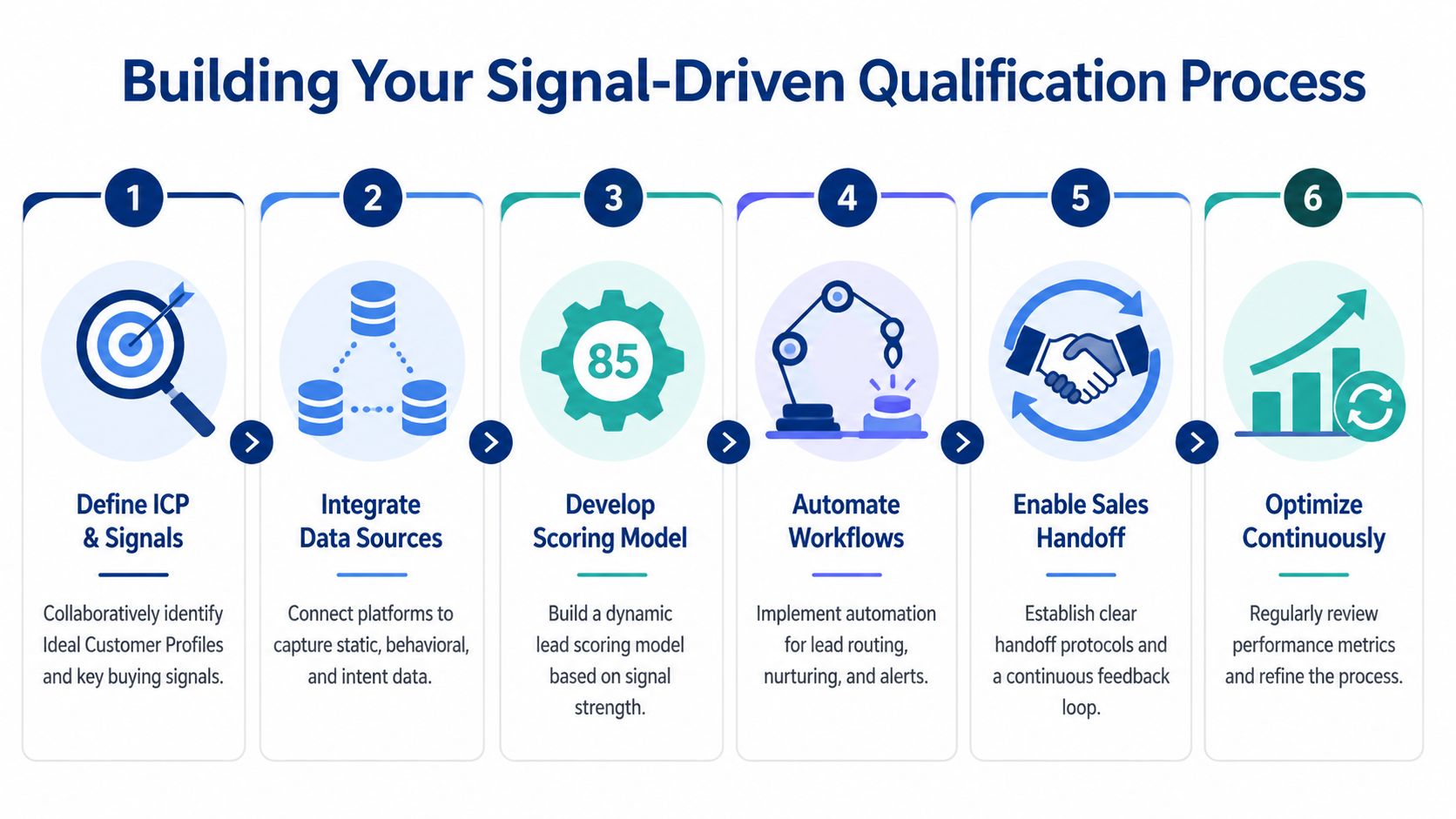
One reason to fix this fast is the downstream payoff. Companies that excel at lead nurturing generate up to 50% more sales-ready leads at a 33% lower cost, and nurtured leads make 47% larger purchases, according to Salesgenie's marketing qualified lead statistics. A systematic process beats ad hoc follow-up every time.
Define a new stage called signal-qualified
Many teams don't need another scoring tweak. They need a new qualification category.
Call it what you want. I like Signal-Qualified Lead because it forces precision. This stage should sit between early engagement and sales acceptance.
A lead enters this stage only when three things are true:
- The account fits your ICP.
- A meaningful trigger suggests active change or urgency.
- The team has enough context for relevant outreach.
That immediately filters out a huge amount of false-positive activity. It also gives marketing a better job than just passing names.
Reweight your scoring model
If your current score gives the same kind of credit to a webinar attendee and a company that just hired a new executive aligned to your use case, the model is upside down.
A modern scoring model should rank evidence in this order:
- Account fit first
- Dynamic business signals second
- Behavioral engagement third
- Contact-level enrichment and recency as modifiers
That means a mediocre-fit account with lots of clicks still won't outrank a prime-fit account with a credible trigger.
Use a rules table that looks something like this:
| Input | Weighting principle |
|---|---|
| ICP match | Must be present or near-present |
| Executive or strategic signal | High influence on routing |
| Behavioral engagement | Supports context, doesn't drive qualification alone |
| Negative indicators | Can block or downgrade the lead |
Negative indicators matter. If the account is outside your service model, too small for your economics, tied to a bad-fit use case, or showing irrelevant research behavior, disqualify early.
Route signals into the systems reps already use
Here, many programs falter. The signal gets detected, then dies in a dashboard no one checks.
Your routing model should push qualified signals into the tools people already live in:
- CRM for account history, ownership, and reporting
- Slack for real-time alerts to SDRs, AEs, and managers
- Marketing automation for nurture branches when the signal is promising but not yet ready
- Sales engagement tools for immediate, context-rich sequences
The alert itself should include four things:
- What happened
- Why it matters
- Who should act
- What the recommended next move is
That last point is often missing. Raw signal feeds create more work. Interpreted signals create action.
Build the handoff with an SLA
If your team finally surfaces a strong buying signal and sales responds whenever they get around to it, you've wasted the advantage.
Create a service-level agreement around signal-qualified leads. Keep it simple:
- Marketing or RevOps confirms the account meets fit criteria.
- The signal is attached to the record with source context.
- Sales gets routed the account with a clear task.
- Sales must accept, reject, or return feedback quickly.
- Rejections require a reason code.
This keeps the system honest. It also creates the feedback data needed to improve your model.
Fast follow-up matters less than relevant follow-up. But if you have both, you'll beat teams still arguing over MQL definitions.
Give reps context, not just alerts
A good signal without context still produces mediocre outreach.
Reps need a short account brief that explains the account's initiative, likely stakeholders, and likely angle. That's where research automation helps. Salesmotion is one example of a platform that monitors public sources, builds account briefs, and routes signal alerts into Slack, email, or CRM so reps can work from account context rather than isolated events.
Even if you use different tooling, the standard should be the same. No alert should reach a rep without enough background to write a sharp first message.
Review the model every cycle
Signal-driven qualification gets better when leadership treats it like a live system.
Run a recurring review and look at:
- Accepted versus rejected signal-qualified leads
- Signals that produce meetings
- Signals that create opportunities
- Common reasons for disqualification
- Gaps in routing, enrichment, or ownership
You don't need a giant committee. You need operational honesty.
The teams that get this right stop debating whether marketing or sales owns qualification. They build a process where both teams own different parts of the same decision.
For organizations refining automated prioritization, this AI lead scoring overview is a useful companion to the process above.
Measuring the Impact of Better Qualification
If your dashboard still starts with MQL volume, you're measuring activity, not progress. Better marketing lead qualification should change business outcomes, not just funnel labels.
The first metric to watch is still the handoff quality metric, which is often misused.

According to Cubeo's lead qualification metrics benchmark, the MQL-to-SQL conversion rate is foundational, with a typical B2B benchmark of 16-20%. Cubeo also notes a broader spectrum of 12-38% depending on how companies define MQLs. That variance is the point. If your definition is loose, the metric becomes meaningless. Cubeo also reports that 79% of marketing leads never convert to sales, often because of weak nurturing and poor initial qualification.
Metrics that deserve executive attention
Track a compact set of metrics tied to pipeline quality.
- MQL-to-SQL conversion rate. This tells you whether marketing's qualification logic matches what sales will accept.
- Lead-to-opportunity velocity. Watch how quickly accepted leads become real pipeline. Faster movement usually means stronger timing and better context.
- Pipeline contribution by source and signal type. You want to know whether webinars, outbound prospecting, executive-change triggers, or hiring signals create opportunities that progress.
- Sales acceptance reasons and rejection reasons. The truth lives here.
- Win rate from qualified opportunities. A lead model is only good if it improves the quality of deals that reach later stages.
How to read the numbers correctly
Not every drop in volume is a bad sign.
If MQL count falls while acceptance rises, that's progress. If sales gets fewer leads but more relevant ones, that reduces wasted effort and tightens forecasting. Leaders should reward that.
Use this simple interpretation table:
| Metric movement | What it usually means |
|---|---|
| Lower MQL volume, higher acceptance | Qualification is getting tighter |
| High MQL volume, flat acceptance | Marketing is still optimizing for output |
| Faster velocity after handoff | Timing and context are improving |
| High rejection from one source | Source quality or scoring logic is off |
What to put on the weekly dashboard
Don't overload the team. Put only the metrics that drive action:
- Accepted lead rate
- Time from qualification to first sales action
- Opportunity creation from accepted leads
- Top-performing signal categories
- Top rejection causes
A metric is useful only if someone can change behavior because of it.
That rule eliminates half the dashboards I see.
The real standard
The goal isn't to generate more "qualified" leads on paper. The goal is to create more pipeline that sales believes in and can move.
If your qualification engine is working, three things become obvious. Sales accepts more of what marketing sends. Reps personalize faster because the context is already there. Pipeline moves with less friction.
That's the outcome worth measuring.
From Volume to Velocity: Winning with Qualification
The old model said marketing should deliver more leads and sales should sort the rest out. That model produced bloated funnels, noisy dashboards, and predictable conflict.
A modern approach to marketing lead qualification is stricter and smarter. Start with fit. Add real intent. Prioritize dynamic business signals over shallow engagement. Route only the accounts that have both relevance and reason to act now.
That changes the job of both teams. Marketing stops optimizing for handoffs. Sales stops wasting time re-qualifying weak leads. RevOps stops defending scoring models nobody trusts.
The best revenue teams don't ask how to produce more MQLs. They ask how to create more pipeline velocity from the right accounts at the right time.
Audit your current model. Look at what sales rejects. Look at which triggers create conversations. Then rebuild qualification around evidence, not tradition.
Frequently Asked Questions
What should we do first if we want to improve marketing lead qualification
Audit rejected leads from the last few months. Don't start with software. Start with evidence. Look for patterns in what sales rejected, what converted, and what signals existed before the opportunity was created.
Then rewrite your definition of qualified around account fit, buying context, and next action.
How do we get sales buy-in for a new qualification model
Involve sales before you change scoring or stages. Ask AEs and SDRs which lead traits they trust, which signals they act on, and which sources waste time.
Then make sales feedback part of the process. If they can reject a lead with a reason code and see that marketing updates the model, buy-in rises fast.
Should we eliminate MQLs entirely
Not necessarily. But you should demote the MQL from a success metric to an early indicator. MQLs can still be useful for tracking engagement. They shouldn't be treated as proof of sales readiness.
Use them as one input, not the handoff standard.
How does this fit with our CRM and marketing automation stack
You don't need to rip out Salesforce, HubSpot, Marketo, Pardot, or your sales engagement platform. You need to change what gets passed through them.
Keep your systems. Upgrade your logic. Feed account fit, dynamic signals, and contextual notes into the workflows your reps already use.
What if our team doesn't have enough signal data yet
Start small. Pick a narrow set of triggers tied directly to your product and buyer. Executive hires, relevant job postings, funding updates, and public strategy statements are good starting points because they create clear outreach angles.
Depth beats breadth at the beginning.
How do we know the new model is working
You'll know quickly. Sales will accept more leads, reject fewer for vague reasons, and respond with better outreach because they have context. The pipeline will look smaller on paper in some teams, but cleaner and more believable.
That's an improvement, not a problem.
If your team is still qualifying leads with static scores and vague handoffs, it's time to fix the operating model. Salesmotion helps revenue teams monitor account signals, turn public-source changes into actionable context, and route that intelligence into the systems reps already use so qualification becomes faster, sharper, and more useful.