Your reps are busy. Your pipeline looks active. Meetings are getting booked.
And still, too much of that activity goes nowhere.
That often means the team is not struggling with effort. It is struggling with qualification. In B2B, bad qualification wastes seller time, muddies forecasts, and creates fake momentum that falls apart in discovery or after the demo.
If you are asking how do you qualify a lead, the modern answer is not just “use BANT” or “score form fills.” Those still help. But they are no longer enough on their own. Strong teams qualify at two levels at once: the person and the account. They look for fit, pain, authority, and timing. Then they layer in real-world signals that explain why this account may be ready to change now.
TL;DR: You qualify a B2B lead by checking six things: fit, intent, authority, timeline, budget and pain. Run one framework consistently (BANT, CHAMP or MEDDICC), then add account-level signals such as leadership changes, funding and hiring to confirm the timing is real. A qualified lead is one where the rep can explain fit, pain, decision path and timing without guessing.
Key Takeaways
- Modern qualification works at two levels. The person (fit, pain, authority) and the account (ICP match, signals, timing). Most teams only score the first and end up with leads that look good and never close.
- Frameworks still matter: pick one and run it consistently. BANT for transactional, MEDDICC for complex enterprise, CHAMP for relationship-led. The framework matters less than the discipline of using it the same way every cycle.
- Signals are the "why now" that scoring misses. Earnings call mentions, leadership changes, hiring patterns, and tech adoption tell you which qualified accounts are also ready right now, not in six months.
- Bad qualification compounds. Wasted seller time, inflated forecasts, and a pipeline you can't trust are all symptoms of a missing qualification system, not a sales effort problem.
Stop Wasting Time on Leads Who Won't Buy
Many teams know they have a qualification problem before they admit it.
You see it in the pipeline review. Reps defend deals with vague language. Marketing says the lead engaged. Sales says the contact liked the demo. Nobody can clearly explain why the account is likely to buy, who will drive the decision, or what changed recently that makes the timing real.
That gap is expensive. When teams pursue leads without real intent, budget, or authority, cycles drag and revenue slips.
Qualification is not a gate
A lot of teams treat qualification like admin work. Fill in fields. tag the record. move the lead to the next stage.
That mindset creates bloated pipelines. Good qualification does the opposite. It acts as a focusing lens. It helps a rep answer a much sharper question:
Why should we engage this account now, and what evidence supports that?
Many legacy processes fall short at that point. They judge one contact in one moment. They do not tell you whether the account itself is changing, prioritizing a new initiative, or opening a real buying window.
The cost shows up in operations
When qualification is weak, every downstream process gets worse:
- Lead routing breaks down: the wrong reps get the wrong accounts at the wrong time.
- Discovery becomes repetitive: reps ask basic questions they should already know.
- Forecasting gets noisy: pipeline stages reflect hope, not evidence.
- Morale drops: sellers spend time chasing deals that never had a path.
A cleaner qualification process also improves handoffs and prioritization. Routing logic is essential here. If your team is tightening qualification, your lead distribution rules should tighten with it. Sales leaders working through that issue should also review how lead routing affects speed, ownership, and follow-up quality.
The point of qualification is not to say “no” faster. It is to say “yes” with better evidence.

“Salesmotion empowers me to cultivate a great buyer experience. I'm able to challenge prospects' thinking and be a trusted consultative seller. A major part of this is Salesmotion insights.”
Austin Friesen
Account Executive, FY25 #1 President's Club, Clari
The Building Blocks of a Qualified Lead
Before choosing a framework, define what “qualified” means in your business.
A qualified lead is not just someone who downloaded content or asked for a demo. In practice, strong qualification combines company fit, buying context, and current momentum. If one of those is missing, reps often end up forcing a deal that should have stayed in nurture.
Six pillars that matter
I use six core pillars.
Fit comes first. Is this the kind of company you can help? Industry, company size, operating model, maturity, and team structure matter. A highly engaged account outside your ideal customer profile still creates friction later. Data quality matters here, which is why strong teams invest in B2B data enrichment before they ever score a lead.
Intent tells you whether the account is leaning in. Repeat visits to high-intent pages, content tied to evaluation, direct replies, or product usage all suggest movement. But intent is not enough by itself. Plenty of curious buyers never buy.
Authority answers who can move a deal forward. Sometimes the person you speak with owns the problem but not the budget. Sometimes they can influence the process but cannot sponsor a purchase. You do not need immediate access to the top executive on day one, but you do need a path to decision-makers.
Timeline separates active projects from nice-to-have interest. Good reps do not just ask when the buyer wants to implement. They ask what event, initiative, or risk is driving that timing.
Budget matters, but not in the simplistic sense of “Do you have money?” The better question is whether the account has capacity and willingness to fund a solution if the problem is important enough.
Pain is the anchor. If the problem is mild, everything else becomes harder. If the problem is visible, costly, or strategic, urgency becomes easier to establish.
Discovery Questions by Qualification Pillar
| Pillar | Sample Discovery Question |
|---|---|
| Fit | “How is your team structured today, and where does this problem sit inside the business?” |
| Intent | “What made this worth looking at now instead of later?” |
| Authority | “Who else will weigh in if this moves forward?” |
| Timeline | “Is there a deadline, initiative, or change that makes this time-sensitive?” |
| Budget | “How do you usually fund projects like this when they become a priority?” |
| Pain | “What is breaking in the current process, and what happens if it stays that way?” |
What good reps do differently
Weak qualification sounds like a checklist. Strong qualification sounds like a diagnosis.
A good rep listens for specifics:
- an executive initiative
- a workflow bottleneck
- a headcount gap
- a missed target
- a recent org change
- a tool that is failing unnoticed
Then they test whether those facts connect to a real buying process.
A lead becomes qualified when the rep can explain fit, pain, decision path, and timing in plain English without guessing.
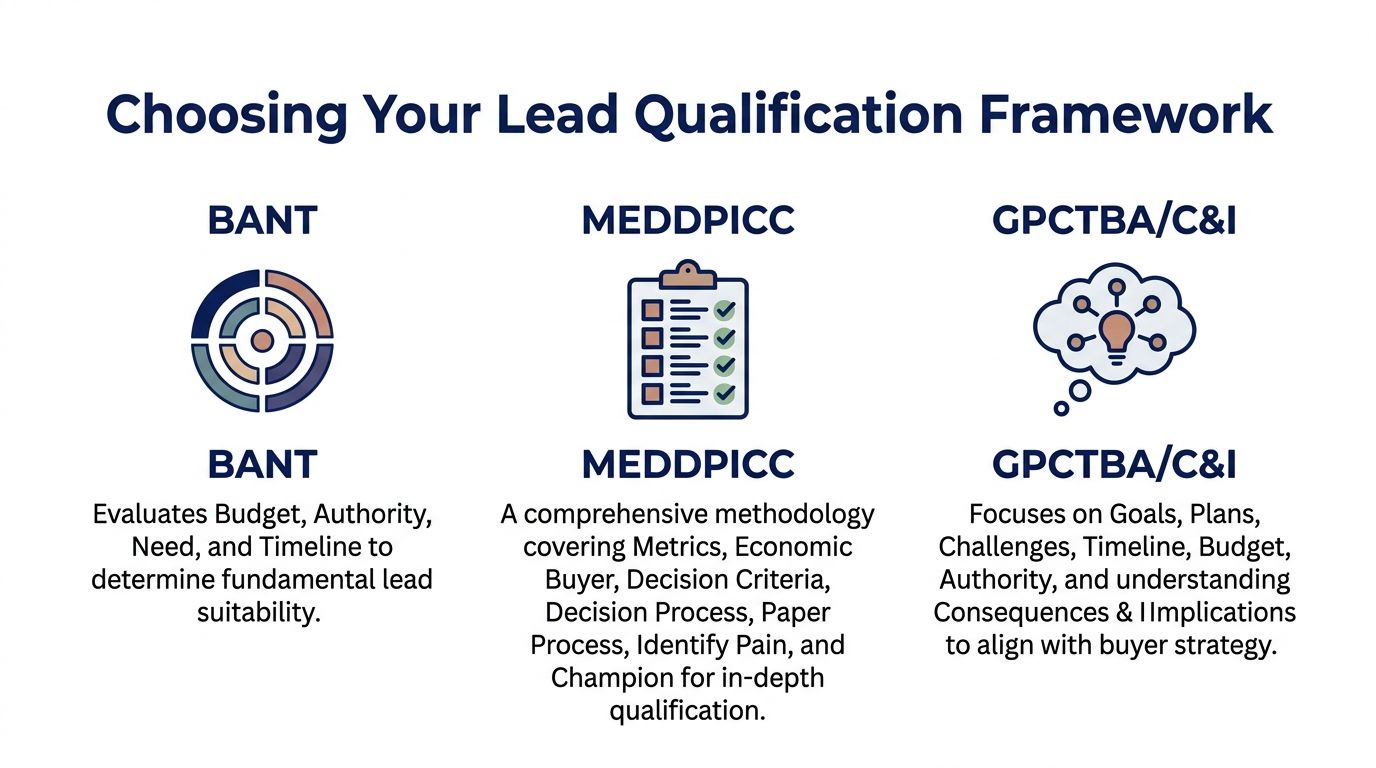
Choosing Your Lead Qualification Framework
Frameworks help reps structure discovery. They are useful because they prevent lazy conversations and force consistency across the team.
They are not useful when leaders treat them like religion.
When BANT works
BANT is still practical. It covers Budget, Authority, Need, and Timeline. For transactional deals, fast-moving mid-market cycles, or teams that need a simple standard, BANT is a solid starting point.
It works because it asks the obvious questions early and prevents reps from mistaking curiosity for pipeline.
The catch is just as important: over-relying on a lead’s self-reported budget can disqualify deals late, after the demo, because the financial picture was incomplete. Check budget against what the company has said publicly about spending priorities.
So use BANT, but do not ask budget like a procurement form. Ask how projects get approved, what trade-offs exist, and what makes this problem expensive enough to fund.
When CHAMP is better
CHAMP starts with Challenges, Authority, Money, and Prioritization.
That shift matters. Many deals begin with pain, not budget. Buyers often cannot define budget until they believe the problem deserves attention. CHAMP is better for consultative selling because it lets reps build the case before forcing financial detail too early.
Use CHAMP when:
- your category needs education
- buyers are still shaping the problem
- priorities compete internally
- the first contact is not the final approver
When MEDDICC earns its keep
MEDDICC goes deeper. It is built for complex deals where multiple stakeholders, procurement, internal champions, and formal decision criteria all matter.
If your team sells enterprise software or large services contracts, MEDDICC often gives a more realistic view of deal health than a lighter framework. It also surfaces risk early. No champion. unclear paper process. no economic buyer. weak metrics. Those are not small issues.
The trade-off is speed. MEDDICC takes more discipline and better coaching. For smaller deals, it can feel heavy.
What to choose
The best framework is the one your team will apply consistently.
Consider this simple approach:
- Use BANT for shorter cycles and faster triage
- Use CHAMP when you need problem-led discovery
- Use MEDDICC for larger, multi-threaded deals
Do not expect any framework to tell you whether an account is heating up right now. Frameworks qualify conversations. They do not monitor markets, hiring patterns, investor updates, or leadership changes.
That is the gap modern teams need to close.

“We have very limited bandwidth, but Salesmotion was up and running in days. The template made it easy to load our accounts and embedding it in Salesforce was simple. It was one of the easiest rollouts we've done.”
Andrew Giordano
VP of Global Commercial Operations, Analytic Partners
Find Your 'Why Now' with Real-Time Signals
Much qualification advice still focuses on the contact. Did they fill out a form? Attend a webinar? Open an email?
That is useful. It is also incomplete.
Accounts buy. Not isolated leads.
Contact signals miss the bigger story
A single contact can look qualified on paper and still go nowhere because the account has no urgency. The reverse also happens. One contact may appear cold while the company itself is clearly entering a buying window.
That is why account-level qualification matters. Automating external signal monitoring across an account cuts the manual research behind that view. Analytic Partners, a Salesmotion customer, cut research time by 85% and grew qualified pipeline 40% after doing it.
That should change how teams think about how do you qualify a lead. You are not just evaluating one person. You are reading the account’s context.
If your team is still relying on email opens and form fills, it helps to build a shared language around buying signals so reps know what to look for and why each signal matters.
Signals that usually mean something
Not every trigger deserves action. The useful ones create a plausible reason to change.
Here are the signals I would want in front of a rep:
- Leadership changes: a new CRO, CMO, COO, or VP often brings new priorities, new vendors, and fresh scrutiny of existing systems.
- Funding or investor activity: new capital can fund hiring, tooling, expansion, and urgency around execution.
- Hiring patterns: if an account posts roles that map directly to your category, they may be trying to solve the problem manually first or preparing to invest.
- Earnings calls and strategic updates: public statements often reveal initiatives, risks, or operational pressure points.
- Office expansion or market entry: growth creates process strain and frequently exposes gaps in systems.
- Competitor mentions or category shifts: if the company is reacting to market pressure, priorities can change quickly.
How reps should use signals
A signal is not an excuse to send a generic “saw your news” email.
It should shape three things:
-
The account thesis What likely changed inside the business?
-
The stakeholder map Who probably cares most?
-
The outreach angle What point of view is relevant right now?
A new CRO, for example, can mean a lot of things. Maybe they are inheriting a weak pipeline model. Maybe they are standardizing process across regions. Maybe they are under pressure to improve forecast quality. The signal itself is not the message. The implication is.
The best outbound messages do not mention news for the sake of personalization. They connect the news to a business consequence.
Static scoring creates blind spots
Traditional lead scoring assumes the world is stable. Add points for a title. Add points for a webinar. deduct points for inactivity.
Real markets do not work that way. Accounts change direction fast. New leaders arrive. budgets move. priorities snap into place after an event the scoring model never saw.
That is why the strongest qualification systems combine old-school discovery with live account monitoring. One tells you whether the lead fits. The other tells you whether the timing is real.
Build Your Qualification Machine with Tech
Good qualification should not depend on a heroic rep doing everything manually.
If the process only works when your best seller remembers every account, checks every source, writes every note, and interprets every trigger, it is not a process. It is improvisation.

Start with a scoring model that reflects reality
Modern scoring should blend three layers:
-
Firmographic fit Industry, company profile, team structure, geography, and role relevance.
-
Behavioral activity Site visits, replies, downloads, product usage, meeting engagement.
-
Account-level signals Leadership changes, funding, hiring, strategic announcements, expansion, market pressure.
In this regard, predictive systems beat static spreadsheets when they have enough history to learn from. Business.com's guide to building a lead scoring system explains how predictive scoring uses machine learning on your historical deal data. Our guide to AI lead scoring covers where it helps and where it misleads.
For teams evaluating that shift, this overview of AI lead scoring is a useful complement to the operational side.
Build the workflow around rep action
The scoring model matters. The workflow matters more.
A clean qualification machine usually follows this pattern:
-
Capture the account and contact data in CRM Standard fields should show ICP fit, ownership, stage, and key stakeholders.
-
Pull in enrichment and activity data Your CRM, marketing automation, product analytics, and engagement tools should feed one view.
-
Monitor external account signals continuously Teams frequently fail at this stage. Manual research is too slow and too inconsistent.
-
Score and route based on combined evidence Fit alone should not trigger sales action. Neither should raw activity with poor fit.
-
Deliver context to the rep in the workflow they already use CRM tasks, Slack alerts, and sales engagement tools are better than another dashboard no one checks.
A practical example
Say one of your target accounts announces a funding round.
A basic system does little. Maybe RevOps updates the account. Maybe a rep notices the news a week later.
A better system does this:
- detects the event
- checks whether the account matches ICP
- updates the account score
- compiles a short brief on likely implications
- identifies relevant leaders
- drafts outreach tied to the new business context
- alerts the owner where they already work
That is the difference between “interesting news” and a qualified opportunity.
One option in this category is Salesmotion, which uses a Research Agent, Signal Agent, and Outreach Agent to monitor target accounts, compile account context from public sources, and route actionable alerts into Slack, email, or CRM.
Where teams usually get it wrong
The most common mistakes are operational, not theoretical:
- Too many weak signals: reps stop trusting alerts when everything looks urgent.
- No “so what” context: a trigger without interpretation still leaves the rep doing the hard part.
- No decay logic: old activity should not carry the same weight as recent movement.
- No feedback loop: if won deals and lost deals do not reshape the model, the model gets stale.
Build for relevance, not volume. Ten useful alerts beat a flood of noise every time.
From Qualification to Meaningful Conversation
Lead qualification is not about protecting sales from bad leads. It is about helping reps show up with relevance.
The old model asked whether a person fit a checklist. The better model asks whether the account has a reason to act, whether the contact can help guide the decision, and whether the timing is grounded in something real.
That shift changes the quality of the conversation.
Instead of opening with generic discovery, reps can say what they are seeing in the business, why it may matter, and where they think the friction sits. Buyers respond better to that because it respects their time and reflects actual homework.
If you want a healthier pipeline, qualify harder on fit, qualify smarter on timing, and qualify wider across the full account. That is how you stop filling the funnel with names and start building pipeline with intent.
Frequently Asked Questions
How often should we update lead qualification criteria?
More frequently than many organizations manage.
"Why now" events such as funding rounds or executive hires often change a deal's timing, which is why live signals belong next to static qualification criteria.
If your scoring model is mostly static, review it regularly and reweight recent signals more heavily than older activity.
What if I cannot get budget information early?
Do not force the budget question too soon.
Instead, qualify for economic seriousness. Ask how similar projects get approved, what happens if the problem stays unresolved, and who would need to support a purchase. That often reveals more than a direct budget question.
Should marketing and sales use the same definition of a qualified lead?
They should use the same core language, but not necessarily the same threshold.
Marketing can identify engaged leads. Sales should decide when the evidence supports active pursuit. The handoff gets cleaner when both teams agree on fit, intent, and required next-step evidence.
Can a lead be qualified even if the contact is junior?
Yes, if the account is right and the contact can give you access, context, or a path to power.
Junior contacts often surface real pain early. The mistake is treating them as the whole deal instead of the start of stakeholder mapping.
Sales teams that qualify well do three things consistently: they define fit clearly, watch for real account change, and route action fast. If you want to operationalize that with automated account research, live signal monitoring, and outreach tied to actual business context, take a look at Salesmotion.