Your calendar says "Discovery call: Brightline Logistics" in twenty minutes. One browser tab holds the company homepage, another holds the prospect's LinkedIn profile, and somewhere in the back of your mind is a note that they announced something last quarter. Nothing on screen tells you why this company would buy anything this year, let alone from you.
Public companies are the one segment of your book where that excuse runs out. They publish a steady stream of dated, checkable evidence about their priorities, their risks and their spending, and most of it arrives on a legal schedule whether they feel like talking or not. The problem isn't scarcity. It's ranking what you find so you spend your hour on the document that can prove something.
Why Public Company Research Pays Off in Sales
The call goes fine in the way that calls with no point of view always go. You ask about priorities, the prospect gives you a polished version of the answer they gave the last three vendors, and your follow-up email dies in a queue. The pitch wasn't wrong. It was generic, and it landed early or late by luck rather than by design.
Public companies give you a way out, because disclosure rules force them to keep publishing facts about what they're doing. Annual reports, quarterly reports, current reports, insider filings and earnings calls all arrive with dates attached. That stream is where the reason to call lives.
Timing is a research question, not a gut feel. In 2024, more than 70% of investors identified technological change as the most important factor compelling public companies to change how they create, deliver, and capture value, according to PwC's Global Investor Survey. When that's the pressure executives are under, budgets move toward whatever the change demands: new systems, new roles, new partners. Those moves get disclosed before the RFP exists.
For this guide, public company research means finding dated, checkable evidence about what a company is doing, what's changing, and who is likely to act on it. You will walk away with:
- A ranked source list, so you know what each document can prove before you quote it.
- A five-step workflow that turns filings into a decision instead of a folder of notes.
- A signal table that tells you which accounts to work this week and how fast to move.
- A one-page brief template you can fill in before a call.
- An alert setup for your first ten accounts.
Which Public Sources to Check First
A CRO leaves on a Thursday. By Monday you may have an 8-K, a press release, and a LinkedIn post. Only the filing is a statement someone made under securities law, and it had to land within four business days. Open that one first.
One rule governs the rest of the stack: a document filed under securities regulation outranks anything the company writes about itself, which outranks anything a journalist writes about the company. Rank by who is accountable for the statement and by how soon it has to appear, not by how readable it is.
EDGAR is the starting point. It offers full-text search across SEC filings and exposes standardized XBRL financial data, which makes revenue, operating income, assets, liabilities and cash flow comparable across reporting periods. That comparability is the point. Read the trend across eight quarters instead of one number on its own.
Here is the order I use, with the clock that tells you when each source is worth opening.
| Source | What it reveals | Typical timing | Reliability |
|---|---|---|---|
| Form 10-K annual report | Strategy, risk factors, segments, headcount | Due 60 days after fiscal year-end for large accelerated filers, 75 for accelerated, 90 for non-accelerated | Primary, audited |
| Form 10-Q quarterly report | Quarterly revenue, cost trends, risk updates | Due 40 days after quarter-end for large accelerated and accelerated filers, 45 for non-accelerated | Primary, reviewed |
| Form 8-K current report | Executive changes, acquisitions, material events | Within 4 business days of the event | Primary, time-stamped |
| Form 4 insider transactions | Insider buys and sells, with price per share | Within 2 business days of the trade | Primary, factual |
| Earnings call transcript | Guidance, priorities, executive tone | Same day as quarterly results | Management-framed |
| Press release | Launches, partnerships, funding | As announced | Company-authored |
| Investor presentation | Targets, strategic priorities | With earnings or investor events | Company-authored |
| Job postings | Which functions are hiring and for what | Continuous, check weekly | Strong signal, not proof |
| LinkedIn activity | Leadership moves, team growth, executive posts | Continuous | Verify before citing |
| Reputable news | Context, competitor moves, controversy | Daily | Secondary, verify against filings |
Know what each row cannot do. A transcript shows how management frames a quarter. The answers are scripted and the questions are pre-briefed, so tone is context, not evidence of a budget. Job postings show where hiring is pointed. They do not prove the budget is committed. A LinkedIn title change is a lead until a filing or a press release confirms it.
Two items in this table get over-read. A Form 4 is primary and factual, and it is still a weak reason to call. The SEC's investor bulletin on insider transactions explains what the form discloses: the amount bought or sold and the transaction price per share, nothing about why. A purchase can be a compensation plan, a tax event, or a small personal trade. I do not treat it as a buying signal. A news mention that a company is "investing in AI" sits even lower. It is secondary until a 10-K, 10-Q, 8-K, or earnings release states the spend, the program, or the risk.
Foreign issuers follow the same logic in different forms. Companies that list in the United States but are domiciled elsewhere file a 20-F annually and 6-K reports for current developments. Swap the form names and keep the hierarchy: regulated filing, then company materials, then news.
Set EDGAR alerts for every account on your list, then spend twenty minutes each Monday opening whatever landed since Friday. Researching SEC filings for sales prospecting gets easier once you know where the segment tables sit. Salesmotion's agents monitor more than 1,000 public sources, including earnings calls, SEC filings, news, job postings and funding announcements, which is the volume a diligent rep would otherwise read to keep ten accounts current. The ranking above still decides what you act on.

“There's been a big focus on hyper personalization and relevance in our outbounding efforts. Salesmotion has been a key partner in hitting our significantly increased meeting targets. What stands out is how simple it is. Reps can log in and get valuable account insights within 30 seconds to a minute.”
Joe DeFrance
VP of Sales, Incredible Health
Run the Five-Step Research Workflow
Most research fails before the first document opens, because the rep never decided what question they were answering. "Learn about the company" produces a stack of tabs. A decision question produces a sentence you can act on.
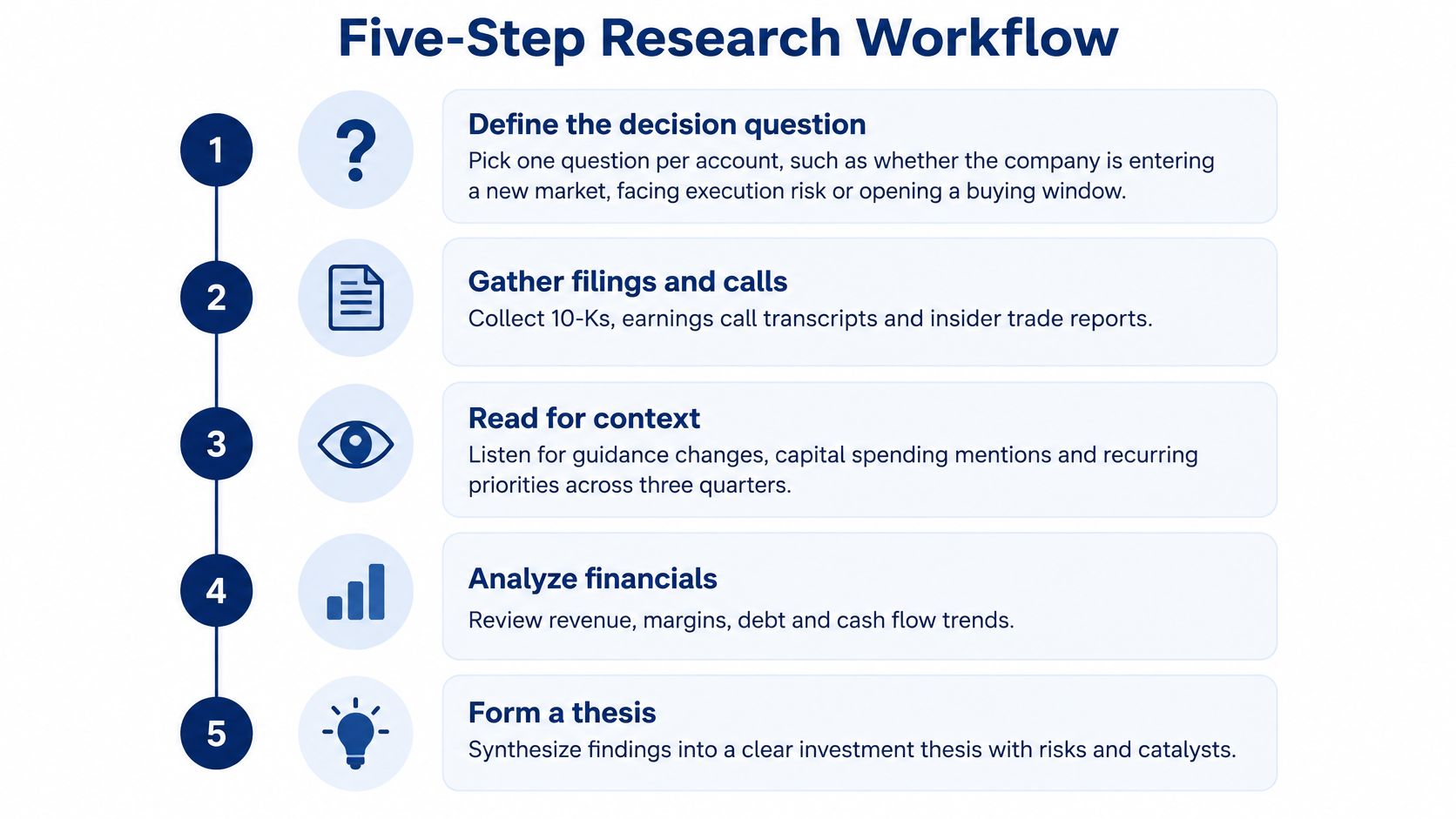
Five steps that survive a real account
-
Define one decision question per account. Something like: is this company entering a new market, carrying execution risk, or opening a buying window? The question sets what counts as evidence and what you're allowed to ignore.
-
Fix your evidence hierarchy before you start reading. Regulatory filings and exhibits first, then earnings releases and call transcripts, then investor presentations and official careers pages, then independent coverage. Without a fixed order, a well-written news article can outrank an audited filing in your head.
-
Normalize before you compare. Align periods, currency, segment names, accounting definitions and document dates. A non-GAAP revenue figure from one quarter doesn't sit next to a GAAP figure from another without adjustment, and a fiscal year that ends in January doesn't line up with a calendar year.
-
Triangulate every material claim across at least two independent disclosures. If the CEO says the company is growing in a region, check segment revenue, headcount trends, capital spending and new role postings. Two sources agreeing is evidence. One source repeating itself is marketing.
-
Record each finding with four fields. Source date, quoted metric, confidence level, and a "so what" sentence that says why it matters to your deal. A finding without a so-what is trivia.
A worked example from a freight account
Say your question is whether a freight company is expanding its warehouse network. The 10-K property section lists a new facility. Segment revenue for logistics is up while the other segments are flat. The careers page shows four warehouse-systems roles posted in six weeks. You anchor the note on the 10-K because it's audited, use the postings as corroboration, and write the so-what: warehouse tooling is being bought now, and the operations analytics team is probably the champion. That's a talk track built from three documents in about twenty-five minutes.
The 10-K is the spine of the brief. Everything else either confirms it or tells you what changed since it was filed.
Where structured data lies to you
The one mistake that fakes a trend is treating machine-readable financial data as automatically comparable. Restatements, changes in segment reporting, redefined non-GAAP measures, shifted fiscal calendars and inconsistent XBRL tagging can all manufacture a growth curve that never happened. The SEC's Data Library is useful precisely because it publishes structured datasets extracted from filings, but treat it as an acceleration layer rather than the source of truth.
Keep the original filing as your audit trail. When a number looks surprising, open the document and find the table it came from. That single habit catches most of the errors that make a rep sound confident and wrong.
Read Calls, Filings and Insider Trades for Context
An executive tells analysts that AI is a strategic priority. It's in the prepared remarks, it's in the business section of the annual report, and your competitor's emails are already citing it. None of that makes it a buying signal. The test isn't whether the company says AI. It's whether the money and the people moved.
The language is now near-universal. Approximately 41% of large companies discussed AI in the Business section of their 2025 Form 10-Ks, up from 35% in 2024, according to O'Melveny's public company advisory review of 2025 filings, which also notes that disclosures remain inconsistent and that SEC comment letters have pressed companies on the basis for AI performance claims. When almost half of large filers use the same phrase, the phrase stops carrying information.
Test the AI claim against hiring and capital
Run three checks. Are there AI roles posted, and are they implementation, governance, security or product roles? Is there a capital line or an infrastructure commitment that only makes sense if the program is funded? Did the product roadmap or the pricing model change in a way a customer would notice?
If the answer is no on all three, you're looking at positioning, often written for investors or regulators rather than for a buying committee. If two of the three come back yes, you have a real thread. If the roles are governance and risk, that points to compliance spend. If they're implementation and data engineering, that points to tooling.
A company that mentions AI is managing a narrative. A company that hires for AI is managing a budget.
Listen for repetition, not enthusiasm
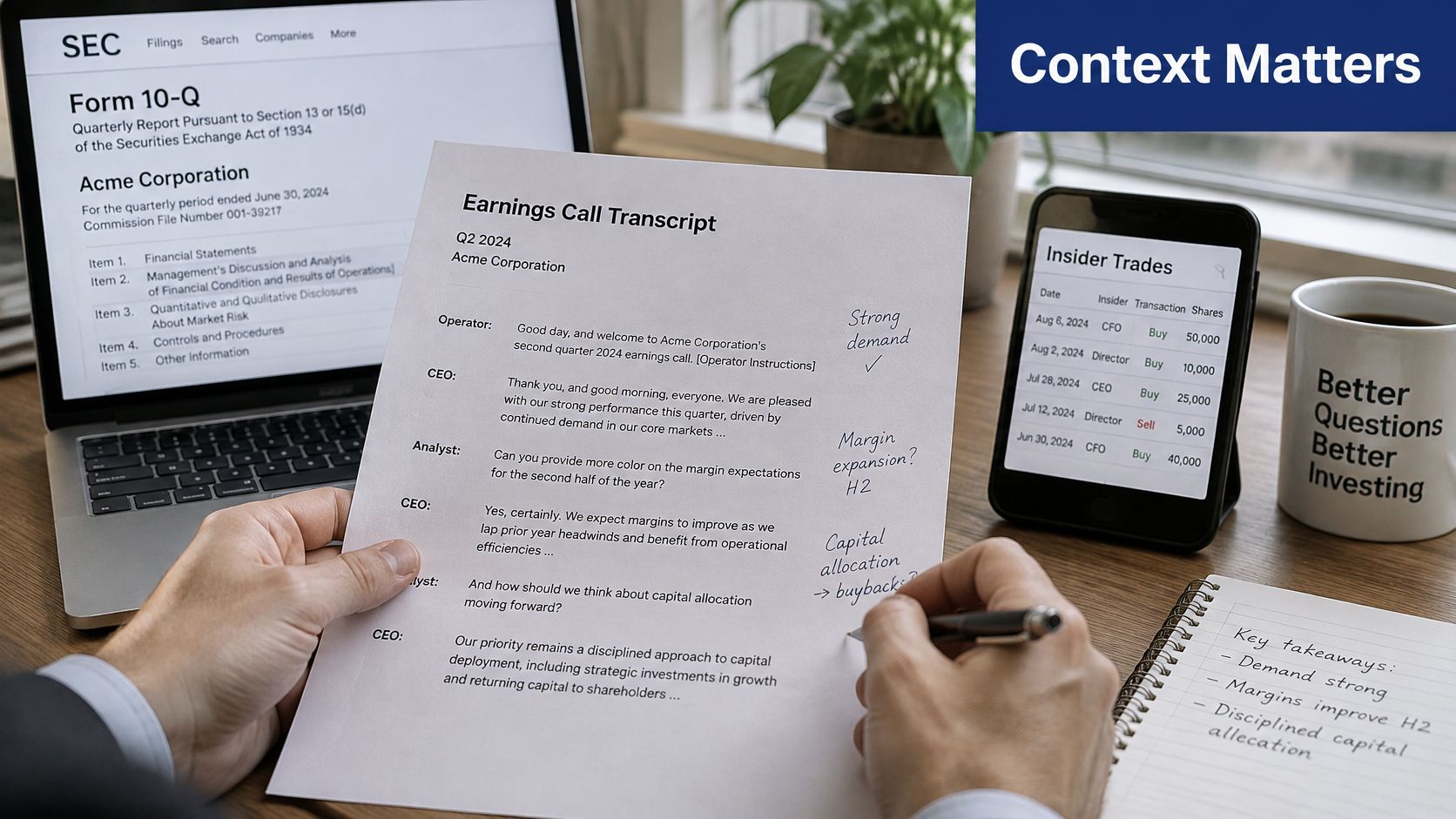
On the earnings call, the reliable signal isn't the strongest adjective, it's the theme that survives three quarters. Management teams repeat what they're funding and drop what they aren't. Track whether the same priority shows up in consecutive calls, whether capital spending moves in the same direction, and whether the language shifts from "exploring" to "investing" to a number. Reviewing earnings call transcripts side by side across three quarters takes less time than reading one press release carefully.
Read the insider trade before you read intent
Form 4 filings look like a confidence signal and often aren't one. The trade date tells you when ownership changed. The filing date tells you when the market learned about it, and they aren't the same day. Check the transaction type: an open-market purchase, an option exercise, a gift and a planned sale under a pre-arranged trading plan tell four different stories, and only one of them is a bet on the future.
Add context before you cite anything. A first-time CFO buying shares a month into the job carries different weight than a ten-year director exercising options on a schedule. A single trade is a prompt to look further. An insight becomes usable when at least two independent sources point the same way.

“This is my singular place that very simply summarizes a company's top initiatives, strategies and connects them to my solution. Something I would spend hours researching manually, now it's automated.”
Derek Rosen
Director, Strategic Accounts, Guild Education
Signals That Matter for Sales and How to Rank Them
A signal earns its place when it gives you a reason to talk now, and its value decays fast. Rank by that decay rate, not by how interesting the news is. A merger announced this morning is worth a call this week and worth nothing in six weeks.
Filing rules give you the clock. Companies must file or furnish a Form 8-K within four business days after most reportable events, and if the event lands on a weekend or SEC holiday the window opens on the next business day, as the SEC's Form 8-K filing guide explains. A chief executive change announced on a Monday is generally due by Friday. That's your detection window, and it's also why filing-date monitoring beats keyword monitoring: a new 8-K is a recent event, while a news article may be describing something from last quarter.
Eight signals, ranked by what they change
| Signal | Where to find it | Why it matters for sales | Act within |
|---|---|---|---|
| New CRO or CFO appointed | Form 8-K, press release, LinkedIn | Often triggers a vendor and tooling review | 48 hours |
| Acquisition or merger | Form 8-K, press release | Integration creates process and tooling gaps | 1 week |
| Funding round | Press release, reputable news | Fresh capital often funds growth roles and new tools | 1 week |
| Cybersecurity incident | Form 8-K Item 1.05 | Remediation and governance spending usually follows | 48 hours |
| Hiring spike in one function | Job postings | Shows where budget is moving | 2 weeks |
| Insider open-market purchase | Form 4 | Can signal confidence; check context before using | 1 week |
| Guidance raised or cut | Earnings release, call transcript | Priorities reset and budgets shift | 48 hours |
| AI investment discussed | 10-K business section, call, job posts | Useful only when backed by hiring or capital spending | Verify before acting |
The cybersecurity row deserves a closer look because the timing mechanism is unusual. The SEC's guidance on Form 8-K Item 1.05 ties the four-business-day deadline to the company's materiality determination, not to the day the incident began. So the filing tells you something a breach report doesn't: management has formally assessed the incident as significant. For anyone selling security, resilience, cloud or compliance work, that's a dated trigger with a named impact and a stated remediation path.
Executive changes come first because a new CRO or CFO arrives with a mandate and a review habit. New leaders re-examine the tool stack they inherited, and the first ninety days is when that scrutiny happens. If you have something to say, say it before the org chart settles.
Guidance changes come second because they reset budgets mid-year. When a company cuts guidance, cost conversations open and discretionary spend closes. When it raises, expansion conversations open. Either direction is a reason to reach out, and the framing differs completely.
The two signals that look better than they are
An AI mention in a filing is a narrative signal until hiring or capital spending confirms it, so keep it in a verify-first bucket rather than a call-today bucket. An insider purchase is a factual signal with an unknown motive, so check the transaction type and whether other insiders acted in the same window.
Response rule: executive, cybersecurity and guidance signals get a response within 48 hours. Most other signals can wait one to two weeks without losing value.
The practical constraint is volume. A territory of fifty accounts generates more signal than any rep can track manually, which is why Salesmotion's Signal Agent watches every account in a territory for 50+ signal types across 1,000+ sources, around the clock, and alerts the user when something changes.
Turn Research Into a One-Page Account Brief
The output of all this reading should be one page a rep can absorb in five minutes before a call, with every claim traceable to a source. Not a research document. A decision aid with an audit trail.
The test of a good brief is simple: if a claim can't be traced to a document and a date, it gets labeled as inference or it gets cut. That single constraint separates a brief from a summary.
| Brief section | What to write | Example entry |
|---|---|---|
| Snapshot | Revenue, headcount, segments, last reported quarter | $2.4B revenue last fiscal year, about 9,000 employees, three segments: freight, warehousing, last-mile |
| What changed | Two or three events with dates and sources | New CFO announced in an 8-K filed March 3 |
| Strategic priorities | Quotes from calls, with the call date | Q2 call: "cutting cost-to-serve by 12% over two years" |
| Risks | Risk factors that changed since the last 10-K | New disclosure on customer concentration in one region |
| Stakeholders | Likely buyer, champion and blocker | New CFO as buyer, VP Operations as champion |
| Talk track | One opener tied to a verified fact | Your Q2 call committed to cutting cost-to-serve; how is that tracking? |
| Confidence | Verified, inferred or unverified, per claim | Verified: CFO change (8-K). Inferred: analytics hiring points to cost work |
Row by row on a freight account
Brightline Logistics, a fictional mid-sized operator, is a useful walkthrough. Three facts do the work. The company filed an 8-K in early March announcing a new CFO. The Q2 call committed publicly to cutting cost-to-serve by a stated percentage. Job postings in the same period cluster around operations analytics roles.
The snapshot sets the stage in one line, so the rep isn't guessing at scale. The "what changed" row carries the 8-K date, which matters because a six-week-old executive change is still actionable and a two-year-old one is not. The priorities row quotes the call rather than paraphrasing it, so the rep can reference the commitment without misquoting it.
Then the talk track falls out almost automatically. "Your Q2 call committed to cutting cost-to-serve; how is that tracking across the three segments?" is a question only someone who read the transcript could ask. It doesn't pitch anything. It opens a conversation about a number the CFO already owns.
Confidence labels: "Verified" means a filing or transcript says it. "Inferred" means two sources point that way. "Unverified" means someone said it once and you haven't checked.
The confidence row is what keeps a rep out of trouble. Say a hiring cluster suggests a cost program but no document confirms it. The brief should say inferred, so the rep opens with curiosity instead of asserting a fact the prospect will correct.
Refresh on filing dates, not on a calendar
A brief decays the moment a new 8-K or earnings release lands, so the trigger to rebuild is the document, not the first of the month. Salesmotion's Research Agent produces briefs of this kind from 1,000+ sources, and building an account brief by hand the first few times is worth the effort, because you learn which rows change your opener.
Set Up Alerts and Start Outreach This Week
The gap between reading this and getting value from it is a setup afternoon. Work through these five steps in order.
-
Pick ten target accounts and weight the ones where a signal from the table has already appeared. Ten is enough to prove the process and small enough to keep current.
-
Set alerts for the four fastest-moving signal types: executive appointments, cybersecurity disclosures, funding rounds and guidance changes. Route them into Slack or your CRM with a link to the source document, not just a headline.
-
Assign an owner and a response window to each alert type. A 48-hour executive alert that sits in a shared inbox for a week is a dead alert, and the owner is the person who notices it first, not the whole team.
-
Build one brief using the template, then draft outreach that cites a single verified fact and asks one question. One fact, one question. Resist the urge to demonstrate how much you read.
-
Review every Friday which signals produced replies and which produced noise, then tighten the list. Two weeks of that review will tell you more than any best-practice list.
If you'd rather not wire the alerts yourself, setting up Google Alerts for sales covers the free version of the same discipline. Either way, the review habit is the part that matters.
Practical rules: never present an inferred claim as if it came from a filing. Check the filing date before you reference an event, because "just announced" in a document published five weeks ago damages your credibility. And retire any alert that hasn't produced a conversation in a quarter.
Then pick your first ten accounts today and build the first brief before next Monday. The brief will be rough, the talk track will need editing, and the second one will take half the time. Salesmotion scans news, filings, hiring activity and dozens of other sources for each monitored account, detects buying signals, updates research briefs and surfaces verified decision-maker contacts, so the Monday routine can run without you being the one opening every tab. Research stops being a tax on selling and becomes the reason the call got booked in the first place.
If you'd rather spend your hour on the conversation than on the tab collection, Salesmotion does the reading for you: three agents research each account, watch for the signals that change the conversation, and hand your reps a cited brief with a talk track attached. Add ten accounts, and you'll see the filings, calls, hiring moves and leadership changes that give you a reason to reach out this week. Start at Salesmotion and build your first brief before your next Monday review.