The number of activities required to book a single outbound meeting has quadrupled since 2020, and deal cycles have stretched 66% longer in that same window, according to UserGems' analysis of 4.2 million accounts. The old playbook — build a list, blast a sequence, pray for replies — is not just underperforming. It is mathematically broken.
Meanwhile, teams running signal-based plays are booking meetings at 25-40% reply rates while the rest of the market scrapes by at 1-5%, per Autobound's research. That is not a marginal improvement. It is a different game entirely.
This post is a complete signal-based sales playbook. Not theory. Not a vendor pitch. A step-by-step system for turning real-time alerts into booked meetings, built from the data that actually matters.
What a Signal Play Actually Is (And What It Is Not)
Most teams confuse "having signal data" with "running signal plays." They are not the same thing.
A signal play, as defined by Pocus, is the combination of a signal and a specific action. The signal is the trigger — a leadership change, a funding round, a technology adoption. The action is your prescribed response — who reaches out, through which channel, with what message, within what timeframe.
Without the action layer, signals are just noise in a dashboard. You are paying for data nobody acts on.
Here is the distinction that separates high-performing teams from everyone else:
| Approach | What It Looks Like | Typical Result |
|---|---|---|
| Signal data without plays | Reps see alerts in a feed, decide individually what to do | Inconsistent follow-up, most signals ignored |
| Signal plays | Every signal type has a defined owner, channel, message template, and SLA | Repeatable pipeline generation at scale |
The second approach works because it removes decision fatigue. When a new VP of Sales is hired at a target account, your team does not debate whether to reach out. The play dictates: AE owns it, LinkedIn + email, reference the transition, respond within 48 hours.
For a broader look at the types of events that should trigger plays, see our guide to B2B buying triggers.

“The account and contact signals are key for reaching out at important times, and the value-add messaging it creates unique to every contact helps save time and efficiency.”
Daniel Pitman
Mid-Market Account Executive, Black Swan Data
The 5 Highest-Converting Signal Plays
Not all signals convert equally. The data is clear on which ones deserve your attention first.
1. Past Champion Job Change
This is the single highest-converting signal in B2B sales. When someone who previously bought your product moves to a new company, they already trust you. Champify's 2025 Impact Report found that known contacts deliver a 37% win rate compared to 19% for cold outreach. UserGems' data shows past champions convert at 3x the rate of cold prospects, with 114% higher win rates, 12% shorter sales cycles, and 54% higher deal sizes when past contacts are involved.
The play:
- Signal: Former customer or champion starts a new role
- Owner: The AE who held the original relationship
- Channel: LinkedIn connection request + personal email
- Timing: Within 72 hours of the role change going live
- Message framework: Congratulate the move, reference their past success with your product, offer to help them replicate results at the new company. No pitch. Just an open door.
2. New Executive Hire (First 100 Days)
New executives are under pressure to make their mark fast. UserGems reports that new execs spend 70% of their budget in the first 100 days, and these hires convert at 2.5x higher rates in the first three months versus after their first year. The window is short but the conversion rates are enormous.
The play:
- Signal: VP+ hire at a target account in your ICP
- Owner: AE assigned to the account (or round-robin if unassigned)
- Channel: Email first, LinkedIn second
- Timing: Week 2-4 of their tenure (let them settle, but catch them before they commit budget elsewhere)
- Message framework: Reference a challenge their predecessor likely faced, share a relevant case study from their industry, propose a 20-minute intro. The key is showing you understand the problems they inherited, not just pitching features.
3. Leadership Change at Existing Pipeline Account
When your prospect's boss changes, your deal is in danger — or in luck. A leadership change at an account already in your pipeline means priorities will shift. The seller who contacts first after a trigger event is 5x more likely to win the deal, per Forrester data cited by QuotaPath.
The play:
- Signal: C-suite or VP change at an account with an open opportunity
- Owner: Current opportunity owner
- Channel: Direct call to existing contact + separate outreach to new leader
- Timing: Same day as detection
- Message framework: To your existing contact: "Saw the leadership change — how does this affect your priorities? I want to make sure we're aligned." To the new leader: Reference the initiative already in progress, position yourself as a resource to help them understand what their team has evaluated so far.
4. Funding Round or IPO Filing
Companies that just raised capital have money to spend and growth targets to hit. This signal is especially powerful when combined with hiring surges in your buyer's department.
The play:
- Signal: Series B+ funding, IPO filing, or significant debt raise
- Owner: AE covering the account's segment
- Channel: Email with specific reference to growth plans mentioned in the announcement
- Timing: Within 1 week of announcement (before every other vendor floods their inbox)
- Message framework: Connect their announced growth goals to a specific problem your product solves. "You just raised $50M to expand into EMEA — here's how [similar company] solved the data quality problem that typically slows international expansion."
5. Technology Stack Change
When a company drops a competitor's tool or adopts a technology that integrates with yours, they are actively reshaping their workflow. This is a buying window.
The play:
- Signal: Competitor technology removal, new complementary tech adoption, or contract renewal timing
- Owner: AE or SDR assigned to competitive displacement plays
- Channel: Email referencing the specific technology change
- Timing: Within 48 hours of detection
- Message framework: Acknowledge the change without being presumptuous. "Noticed you moved off [competitor]. Teams that make that switch usually run into [specific problem] — happy to share how others have navigated it."
For deeper coverage of the software that surfaces these signals, see our buying signals software guide.
See Salesmotion on a real account
Book a 15-minute demo and see how your team saves hours on account research.
Signal Stacking: Why Compound Signals Crush Single Signals
A single signal tells you something might be happening. Multiple signals stacked together tell you something is happening.
Autobound's research found that multi-signal stacked outreach achieves 25-40% reply rates compared to 1-5% for generic cold outreach. That is not a typo. Stacking turns lukewarm interest into unmistakable buying intent.
Here is how stacking works in practice:
Single signal (weak): A target account visits your pricing page. Stacked signals (strong): The same account visits your pricing page + their VP of Sales just changed + they posted a job for a Revenue Operations Manager + their competitor just raised a Series C.
Each signal alone might not warrant a call. Together, they paint a picture of a company in transition, actively evaluating solutions, with budget authority shifting. That is your cue.
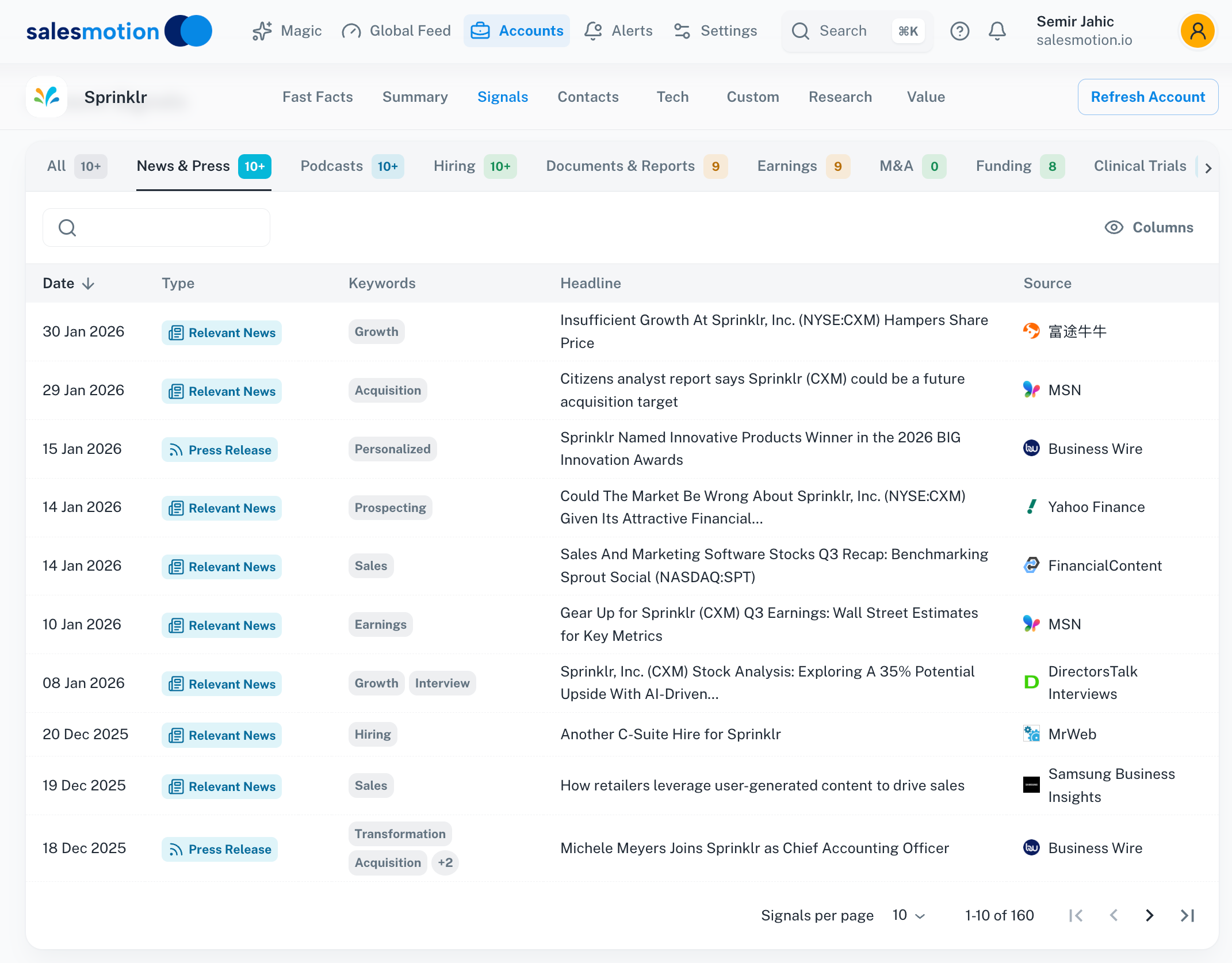 Multiple signals stacking on a single account — each one adds context, and together they reveal buying intent that no single alert could capture.
Building a Signal Scoring Model
Not every combination carries equal weight. Assign points to each signal type and set thresholds for different response urgency:
| Signal Type | Points | Example |
|---|---|---|
| Past champion job change | 10 | Former buyer starts at new company |
| New exec hire (ICP title) | 8 | VP of Sales hired at target account |
| Funding/IPO | 7 | Series C announcement |
| Competitor tech removal | 7 | Dropped a rival tool |
| Hiring surge in buyer dept | 5 | 3+ open roles in sales/rev ops |
| Website visit (high-intent page) | 4 | Pricing or comparison page |
| Content engagement | 2 | Downloaded whitepaper |
Threshold guidelines:
- 15+ points: Immediate outreach (AE-led, personalized)
- 10-14 points: Priority outreach within 48 hours
- 5-9 points: Add to nurture sequence with signal-specific messaging
- Below 5: Monitor, do not act yet
This framework keeps your team focused on the accounts that are genuinely ready to engage, rather than chasing every blip in the data. For a deeper look at how to rank and sort accounts by signal strength, see our account prioritization framework.
Building Your Playbook: The Crawl-Walk-Run Model
You do not need to operationalize every signal type on day one. Pocus recommends a crawl-walk-run approach that prevents the most common failure mode: building a system so complex that nobody uses it.
Crawl: Tiger Team (Weeks 1-4)
Start with a small group — two or three of your best reps — and one signal type. Pick the signal with the clearest ROI: past champion job changes, since the data on conversion rates is overwhelming.
What to set up:
- One signal source feeding alerts to a shared Slack channel or dashboard
- A single play with a defined owner, channel, timing, and message template
- A tracking spreadsheet (yes, a spreadsheet — do not over-engineer this)
- Weekly review to measure response rates and iterate on messaging
The goal is not scale. It is proof of concept. You need data that shows leadership this approach works before you invest in automation.
Walk: Expand Coverage (Months 2-3)
Once your tiger team has proven the model with one signal type, expand in two directions:
- Add signal types: Layer in new exec hires and funding rounds. Each gets its own play with defined actions.
- Add reps: Train the next cohort using the plays your tiger team validated. The messaging templates and timing guidelines are already tested.
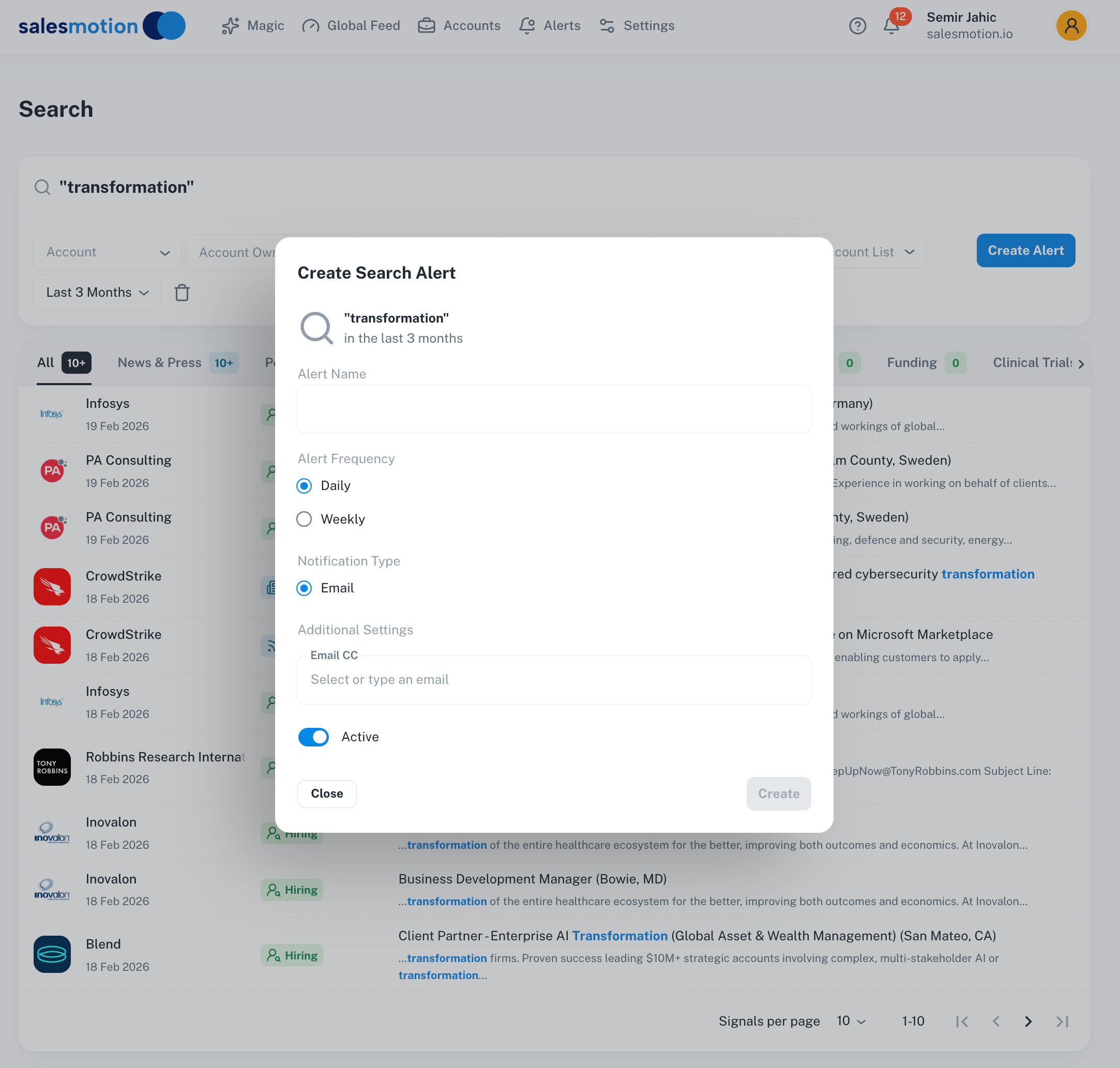 Setting up targeted signal alerts ensures your team catches high-converting triggers the moment they fire — not days later when competitors have already reached out.
At this stage, you should also start tracking leading indicators beyond reply rates: meetings booked per signal type, pipeline generated per play, and conversion rate from signal-to-opportunity.
Run: Automate and Scale (Months 4-6)
With validated plays and enough data to know what works, start automating the lower-value steps:
- Auto-routing: Signals automatically assigned to the right rep based on account ownership and signal type
- Draft messaging: Pre-populated outreach templates that reps personalize in 60 seconds instead of writing from scratch
- Sequencing: Multi-touch plays that fire across channels without manual scheduling
- Reporting: Dashboards that show signal-to-revenue attribution so you can double down on what converts
The critical principle: automate the process, never the personalization. The moment your signal-based outreach reads like a mass sequence, you lose the entire advantage.
For teams evaluating tools to help automate these workflows, our comparison of AI SDR tools covers the landscape.

“There's been a big focus on hyper personalization and relevance in our outbounding efforts. Salesmotion has been a key partner in hitting our significantly increased meeting targets. What stands out is how simple it is. Reps can log in and get valuable account insights within 30 seconds to a minute.”
Joe DeFrance
VP of Sales, Incredible Health
End-to-End Example: From Signal to Booked Meeting
Theory is useful. Watching it work is better. Here is a real-world scenario showing how a signal-based play converts.
The Setup
Your company sells revenue intelligence software to mid-market SaaS companies (100-1,000 employees). Your ICP is VP of Sales or CRO at companies between $10M-$100M ARR.
Day 0: The Signal Fires
Monday morning. Your signal monitoring tool surfaces three alerts on Meridian Analytics, a $45M ARR data platform company:
- New VP of Sales hired — Sarah Chen, previously VP of Sales at a company that used your product two years ago (past champion signal: +10 points)
- Series B extension closed — $28M raised, announced last week (funding signal: +7 points)
- Two SDR Manager roles posted — listed on their careers page in the last 5 days (hiring surge signal: +5 points)
Total signal score: 22 points. Well above the 15-point threshold for immediate AE-led outreach.
Day 0: Research (15 Minutes)
Before any outreach, the AE spends 15 minutes building context:
- Sarah's background: Led a 12-person sales team at her previous company. Used your product there to reduce ramp time for new hires. Left after 18 months when the company was acquired.
- Meridian's situation: Series B extension suggests they are scaling aggressively but ran into headwinds (extensions often signal a pivot or acceleration). Two SDR Manager roles confirm they are building out the outbound function.
- The likely pain: Sarah walked into a growing team without the infrastructure she had at her previous company. She knows what good looks like and will want to rebuild it fast.
Day 1: First Touch (LinkedIn)
The AE sends a LinkedIn connection request with a note:
"Sarah — congrats on the move to Meridian. Loved working with your team at [previous company]. Sounds like you're building something big over there. Would love to catch up when you're settled in."
No pitch. No product mention. Just a warm reconnection with a former champion.
Day 3: Sarah Accepts and Responds
Sarah replies: "Thanks! Yes, lots to build here. Would be great to reconnect."
Day 4: Second Touch (Email)
The AE sends a brief email:
Subject: Scaling the outbound team at Meridian
Sarah — saw you're hiring two SDR Managers. When you were building out the team at [previous company], you mentioned that the biggest bottleneck was getting new reps productive in the first 60 days.
I imagine that challenge is 10x at Meridian's growth stage. Happy to share what we've seen work for teams scaling from 8 to 30+ reps — no strings attached.
Would 20 minutes next Tuesday or Thursday work?
The email references a specific pain point from the previous relationship, connects it to a visible signal (the job postings), and makes a low-commitment ask.
Day 5: Meeting Booked
Sarah replies and books a 20-minute slot for the following Tuesday.
Why This Worked
Every step in this sequence was driven by compounding signals, not guesswork:
- Past champion relationship made the LinkedIn touch warm, not cold
- Funding signal confirmed the company has budget to invest
- Hiring signal revealed the specific pain point (scaling the team)
- Research connected these signals to a conversation Sarah actually wants to have
- Timing caught her in the first 30 days of the new role — the exact window where new executives are most open to vendors they already trust
This is what signal-based selling looks like in practice. Not a single step relied on a cold list, a generic template, or hope.
The Speed Imperative
One data point should haunt every sales leader: 84% of B2B buyers have already selected a preferred vendor before they ever talk to a sales rep, according to 6sense's 2025 Buyer Experience Report. The first seller to reach a buyer after a trigger event is 5x more likely to win the deal.
This means your signal-to-action speed is not a nice-to-have. It is a competitive moat.
The teams that win are not the ones with the most signals. They are the ones that act on signals fastest with the most relevant message. Linear's team, for example, increased deal size by 30%, hit a 50% response rate on outbound, and saved roughly 20 hours per week on prospecting by building signal plays into their core workflow.
That kind of result does not come from adding another data source to a dashboard. It comes from pairing signals with plays and executing them relentlessly.
Common Mistakes That Kill Signal Playbooks
Before wrapping up, here are the failure modes that derail most teams:
Drowning in signals without prioritization. If every alert gets the same urgency, nothing is urgent. Use the scoring model above to triage ruthlessly.
Writing generic outreach that ignores the signal. If your message does not reference the specific event that triggered it, you have wasted the signal's value. "I noticed you recently joined Meridian" is not enough. "You're hiring two SDR Managers, which tells me you're scaling outbound fast" is.
Skipping the research step. Signals tell you when to reach out. Research tells you what to say. The 15-minute research investment in the example above is what turned a warm lead into a booked meeting.
Automating too early. The crawl phase exists for a reason. If you automate plays before you have validated them manually, you will scale bad outreach instead of good outreach.
Treating signals as a solo sport. The best signal playbooks are shared systems, not individual rep habits. If your top performer is the only one who knows how to act on a past champion alert, you have a people dependency, not a playbook. For more on the tools that help standardize prospecting workflows, see our roundup of the best sales prospecting tools.
Key Takeaways
- A signal play is the combination of a trigger event and a prescribed action — data alone does not generate pipeline
- Past champion job changes are the highest-converting signal, delivering 37% win rates versus 19% for cold outreach and 3x conversion rates
- New executives spend 70% of their budget in the first 100 days, making the first three months the critical outreach window
- Stacking multiple signals on the same account drives 25-40% reply rates, compared to 1-5% for generic cold outreach
- The first seller to reach a buyer after a trigger event is 5x more likely to win the deal — speed is a competitive moat
- Start with a tiger team and one signal type (crawl), expand to more signals and reps (walk), then automate the process while keeping personalization manual (run)
- Never automate the research and personalization steps — those are what make signal-based outreach different from another mass sequence
- 91% of revenue leaders are already using or planning to use signals — if you are not running plays against them, your competitors are
Frequently Asked Questions
How many signal types should we start with?
Start with one. Specifically, start with past champion job changes because the conversion data is strongest (3x cold outreach, 37% win rate) and the play is straightforward to execute. Once your tiger team has run that play for 3-4 weeks and you have baseline metrics, add a second signal type — typically new exec hires. Expanding too quickly is the most common reason signal playbooks fail. Teams that try to operationalize five signal types on day one end up with five mediocre plays instead of one great one.
What is the difference between signal-based selling and intent data?
Intent data is one category of signal. It typically refers to third-party data about topics a company is researching online — anonymous web browsing behavior aggregated by providers like Bombora or 6sense. Signal-based selling is broader. It encompasses intent data but also includes first-party signals (your own website visits, content downloads), relationship signals (past champions, existing contacts), and event signals (funding rounds, leadership changes, hiring surges). The playbook in this post uses all of these signal types because relying on intent data alone misses the highest-converting triggers — particularly job changes and relationship signals, which consistently outperform anonymous browsing data.
How do we measure ROI on a signal-based playbook?
Track three tiers of metrics. First, activity metrics: signal-to-outreach speed (how fast you act on alerts) and signal coverage rate (what percentage of relevant signals get a response). Second, engagement metrics: reply rates per signal type, meetings booked per signal type, and meeting-to-opportunity conversion rate. Third, revenue metrics: pipeline generated from signal-sourced outreach, average deal size for signal-sourced versus cold-sourced opportunities, and win rates by signal type. Compare these against your cold outbound baseline. Most teams see reply rates climb from the 1-5% range to 15-30% within the first quarter, with pipeline per rep increasing proportionally. The signal scoring model also lets you calculate which signal types deliver the highest revenue per dollar invested, so you can reallocate budget toward what converts.
How quickly should we respond to a signal?
Speed matters more than perfection. The data from QuotaPath and Forrester shows the first seller to contact after a trigger event is 5x more likely to win. As a general framework: past champion job changes and leadership changes at pipeline accounts warrant same-day or next-day outreach. New exec hires have a wider window — the sweet spot is weeks 2-4 of their tenure, after they have context but before they have committed budget. Funding announcements should get a response within one week, before the flood of vendor outreach buries your message. The worst response time is "whenever the rep gets around to it." Build SLAs into every play.