The best account research tool for a B2B sales team is Salesmotion if the job is knowing what changed at a target account and why it matters, with every claim cited to its source, from $85/month. Choose ZoomInfo if the research has to sit on top of a large contact and company database, and LinkedIn Sales Navigator if it starts with people and relationships. The other nine tools in this guide each win a narrower job: enterprise account planning, market and filings research, custom research workflows, prospecting, intent data, European contact data, private-company data and general-purpose AI research.
Need to scale account research?
3 hours of account research, done in 5 minutes. That's the Salesmotion promise.
Cited account briefs, SWOT analyses, talking points — built from 1,000+ public sources. From $85/mo.
TL;DR: The top three account research tools for 2027 are Salesmotion (cited account briefs and live buying signals for B2B sales teams, from $85/month on a monthly contract), ZoomInfo (teams that want contact data, org charts and AI account research in one platform, quoted per organization) and LinkedIn Sales Navigator (sellers who research people and relationships, Core at $119.99/month). Contact databases answer who to call. Account intelligence answers why and when. Most teams end up with one of each.
Top picks
| Tool | Best for | Starting price |
|---|---|---|
| Salesmotion | Cited account briefs and live buying signals | From $85/mo |
| ZoomInfo | Contact and company data with AI account research | Custom, consumption-based |
| LinkedIn Sales Navigator | People and relationship research | Core $119.99/mo; Advanced $159.99/mo |
Why Trust This Guide?
Salesmotion publishes this guide, and Salesmotion is ranked first in it. Account research is the category Salesmotion is built for, so that placement is the one you should test hardest. The entry below says exactly what it does, what it costs and where it sits alongside the other tools here.
Every price and product fact in this guide was checked against the vendor's own website on 10 October 2026. Where a vendor does not publish a price, the guide says so and does not estimate. Third-party figures are named where they appear: the contract medians quoted for ZoomInfo and 6sense come from Vendr's marketplace data, with the number of purchases behind each one.
I'm Semir Jahic, CEO of Salesmotion. I built an account research platform after years of doing the research by hand at Salesforce and watching the same problem persist at Clari: three hours on a single enterprise account, spread across LinkedIn, Crunchbase, SEC.gov, Google News and the company's investor relations page.
The ranking also reflects what buyers told us. We sat in 55 sales and customer calls between August and October 2026. In 25 of them buyers pressed on whether the data was current and relevant, not on how much of it there was.
"I'm not impressed by pulling a lot of data these days because any tool can do that. The question is relevant data."
Commercial lead, life sciences software
"it's a whole lot of Frankensteining ... having to go to multiple sources just to confirm each step of the way"
Business development rep, CRO
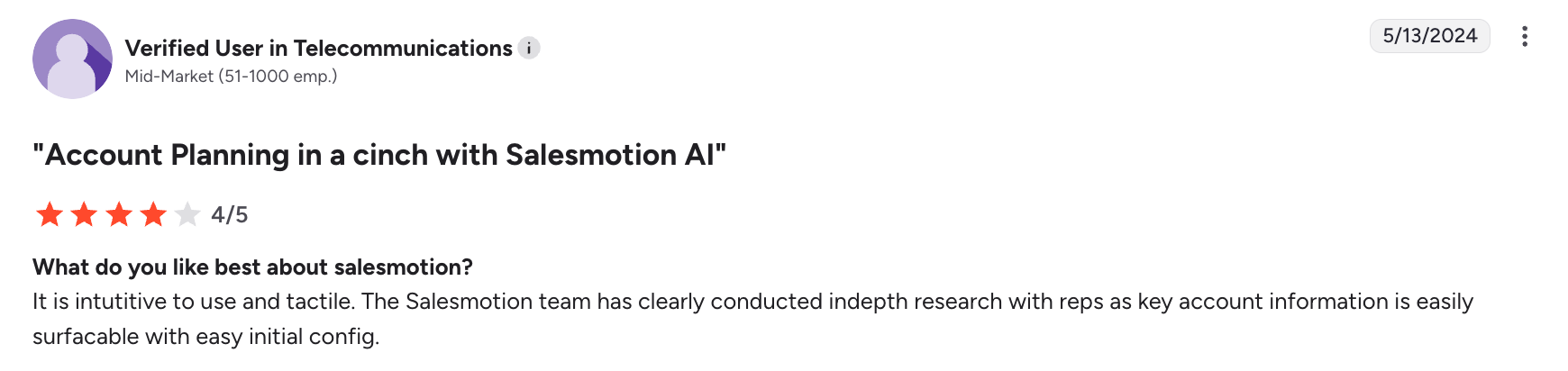 Real G2 review of Salesmotion.
Quick Comparison Table
Pricing is each vendor's published wording as of 10 October 2026. The order is explained under the table.
| Tool | Best for | Standout capability | Pricing | Free plan or trial |
|---|---|---|---|---|
| Salesmotion | Cited account briefs and live buying signals | 1,000+ public sources, 50+ signal types | From $85/mo | Interactive demo |
| ZoomInfo | Contact and company data with AI account research | 500M+ contacts and 100M+ companies | Custom, consumption-based | ZoomInfo Lite free tier |
| LinkedIn Sales Navigator | People and relationship research | Account IQ and Lead IQ on LinkedIn data | Core $119.99/mo; Advanced $159.99/mo | Trial on Core and Advanced |
| Databook | Enterprise account plans and executive points of view | Account intelligence joined with CRM and call data | Custom; outcome-based, 90-day proof of value | 90-day proof of value |
| Draup | Research agents across a large enterprise book | 50+ sales agents with always-on monitoring | Custom, demo-gated | Demo on request |
| AlphaSense | Market, filings and analyst research | 500+ million documents | Custom; annual subscriptions | Free trial |
| Clay | Custom research workflows built by RevOps | 150+ data providers in one table | Free; Launch $185/mo, Growth $495/mo | Free plan |
| Apollo.io | Prospecting with research built in | 240M contacts with sequences and dialer | Free; $49–$119/user/mo (annual) | Free plan |
| 6sense | Intent-led account prioritization | Signalverse intent network | Custom, quote-only | Demo on request |
| Cognism | European contact data with company research | Phone-verified mobiles | Custom, quote-only | Free data sample |
| Crunchbase | Private-company and funding research | Private company profiles and forecasts | Pro $49/mo (first year, annual) | Free trial on Pro |
| ChatGPT | General-purpose AI research | Deep research and scheduled monitoring tasks | Free; Business $20/user/mo (annual), $25 monthly | Free plan |
What the order is based on. The list is ordered by fit for one buyer: a B2B sales team that needs to understand a named account before a meeting or an outreach. Tools that deliver finished, account-level research come first. Tools where research is one part of a contact database, an intent platform or a workflow builder follow. Research tools built for a narrower subject or a general audience close the list. A lower position is not a lower quality score. Each tool is the right pick for the buyer named in its entry.

“We're saving about 6 hours per week per seller on account research alone. That's time they can reinvest in actually selling.”
Derek Rosen
Director, Strategic Accounts, Guild Education
The 12 Best Account Research Tools for 2027
1. Salesmotion
What it is. Salesmotion is an AI account intelligence platform built for account research. Three AI agents do the work: the Research Agent builds cited account briefs, the Signal Agent watches your accounts for changes, and the Outreach Agent drafts messages from that research for a rep to review.
Best for. B2B sales teams selling into mid-market and enterprise accounts, where the context of a deal matters more than the volume of contacts.
What it is strong at.
- Cited account briefs. The Research Agent draws on 1,000+ public sources and returns a brief in which each point links back to where it came from, so a rep can check a claim before repeating it to a buyer.
- Live buying signals. The Signal Agent tracks 50+ signal types across your account list, including leadership changes, earnings call commentary, funding, hiring and M&A activity.
- Research inside the tools a team already uses. A native Salesforce integration (managed package, one-way or bi-directional sync), a HubSpot integration, outreach drafts pushed to lemlist, a REST API, and an MCP server that works with Claude, ChatGPT and other assistants.
- A contract you can leave. The Individual plan is a monthly contract with no annual commitment.
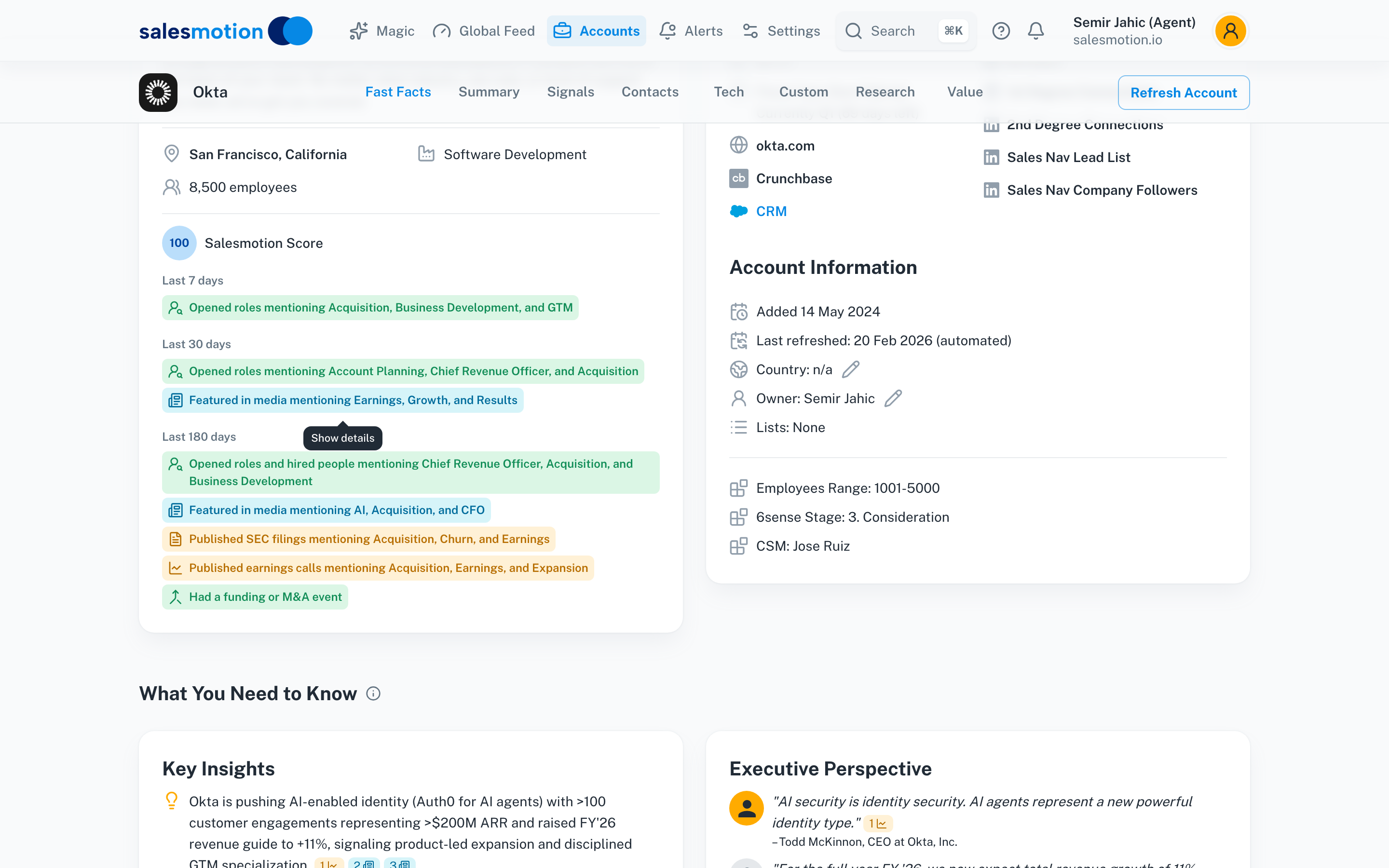 A Salesmotion account brief: key insights, executive quotes, opportunities, challenges and talking points, each sourced.
Customer results. Guild Education saved 30 minutes per account and 6 hours per rep per week. Cytel cut research time by 50% and went from five tools to one. Incredible Health increased meetings booked by 50% after a three-day implementation. Analytic Partners reduced research time by 85%.
Pricing. $85/month for individuals on a monthly contract, covering up to 100 accounts and 200 contact credits a month for verified email and phone. Custom pricing for teams and enterprise. Rated 4.8/5 on G2 (26 reviews) (reviews on G2) and named a High Performer in the G2 Spring 2026 reports.
Choose it if your reps already know who to call and lose their time working out what to say and when. Salesmotion is the account intelligence and signal layer that sits alongside a contact database or a sequencer. Teams whose first need is bulk emails and phone numbers usually pair it with ZoomInfo or Apollo.io.
Salesmotion's Take
I built Salesmotion after watching AEs at Salesforce and Clari spend 3+ hours per account before every meeting. Where we're strong is proactive, always-on research that monitors 1,000+ sources so reps never start from scratch. If you need a contact database, ZoomInfo or Apollo will serve you better. If you need your reps to walk into every meeting with a real point of view on what the account cares about — that's what we built for.

Semir Jahic
CEO & Co-Founder, Salesmotion
2. ZoomInfo
What it is. ZoomInfo is a go-to-market data platform. Its site states verified data on 500M+ contacts and 100M+ companies, with 300+ human researchers behind the data. For a detailed breakdown, see our ZoomInfo pricing review.
Best for. Sales and marketing teams that want contact data, org charts and AI account research in one platform.
What it is strong at.
- Scale of people and company data. Verified business emails, direct-dial phone numbers and org charts across 500M+ contacts and 100M+ companies.
- ZoomInfo Copilot. ZoomInfo describes Copilot as an AI sales agent that assembles contacts, org charts, account history and company updates, produces deal briefs and generates personalized messaging. It connects to Salesforce, HubSpot, Outreach, Salesloft and Gong.
- Research agents. GTM Workspace includes agents for account research, meeting prep and deal prioritization, and ZoomInfo offers an MCP server.
- Intent as an option. Streaming Intent is available as an add-on to base plans.
Pricing. ZoomInfo does not publish list pricing; contracts are quoted per organization; its own pricing page states that no specific dollar amounts are published because pricing is consumption-based. Vendr reports a median contract of $33,500 a year based on 1,576 purchases, with a range of $7,233–$156,053. ZoomInfo Lite is a permanent free tier with 10 credits a month. ZoomInfo's pricing page also states that paid plans are annual subscriptions. For other options, see our ZoomInfo alternatives comparison.
Choose it if your first bottleneck is finding and reaching the right people at scale, and you want account research in the same place as the contact record.
3. LinkedIn Sales Navigator
What it is. LinkedIn Sales Navigator is LinkedIn's sales product, built on a network of 1+ billion members and, by LinkedIn's count, trusted by 1.5M+ sellers.
Best for. Individual sellers and teams whose research starts with people: who holds the role, who just moved, and who in your company already knows them.
What it is strong at.
- Search and alerts on first-party professional data. 50+ advanced search filters, plus alerts when saved leads have updates such as a job or role change. Those alerts work as buying signals for timing outreach.
- Account IQ and Lead IQ. AI summaries of target accounts and of a lead's experience, interests and recent activity. LinkedIn positions the Advanced plan for teams that need AI-powered lead and account research.
- Relationship mapping. TeamLink, Relationship Explorer and Relationship Map show warm paths into an account.
- CRM connections. Sales Navigator integrates with Salesforce, HubSpot, Microsoft Dynamics and Oracle. Lead IQ inside the CRM is part of Advanced Plus.
Pricing. LinkedIn publishes Sales Navigator pricing: Core at $119.99/month or $1,079.88/year, Advanced at $159.99/month or $1,799.88/year, and Advanced Plus on request. All three plans include 50 InMail credits a month. A trial is available on Core and Advanced for eligible members.
Choose it if relationships drive your deals and you need the most direct view of who works where. Many teams keep it alongside an account intelligence tool that covers earnings calls, filings and news.
4. Databook
What it is. Databook sells the GTM Decision System, which it describes as an AI-native operating system for revenue execution. It connects account intelligence with a company's own CRM notes, deal activity and relationship context.
Best for. Enterprise revenue organizations that run formal account planning and executive-level selling.
What it is strong at.
- Provenance. Databook describes licensed, proprietary and human-verified third-party data joined with your CRM, calls and planning, with every fact carrying source, date and provenance.
- Finished planning documents. Outputs include account plans and executive points of view as custom PowerPoint or Word files.
- Delivery where sellers work. Databook runs inside Salesforce, Slack and Microsoft Teams, and every workflow is available as a REST endpoint and through an MCP server.
- Enterprise references. Customers named on its site include Salesforce, Microsoft, Databricks and Schneider Electric.
Pricing. Databook does not publish list pricing; contracts are quoted per organization. Since September 2026 it sells the GTM Decision System on what it calls an outcome-based commercial model, starting with a 90-day proof of value.
Choose it if you lead a large enterprise sales organization, account plans and executive briefings are a formal part of how you sell, and you want the vendor's commercial terms tied to measured results.
5. Draup
What it is. Draup sells Draup Sales Agents, which it calls an AI-native GTM operating system with 50+ agents across five revenue functions.
Best for. Enterprise teams that want research agents running across a large book of accounts.
What it is strong at.
- Deep account research at scale. Draup's stated aim is to automate deep account research, capture priority signals earlier and return next-best moves.
- Always-on monitoring. Draup describes every account on a book monitored around the clock, tracking what changed across leadership, budget, hiring and competitive movement.
- Distinct data assets. Its site lists 1.7M+ companies and 8M+ buyer profiles, with data on tech stack footprint, outsourcing and workload mapping, and talent flow and hiring.
- Open integration. Model Context Protocol, Agent2Agent, a sales data API and CRM integration.
Pricing. Draup does not publish list pricing; contracts are quoted per organization; its site is demo-gated with no pricing page and no self-serve plan.
Choose it if you sell technology or services into large enterprises and want workforce, tech stack and outsourcing data behind your account plans.
6. AlphaSense
What it is. AlphaSense is an AI platform for market intelligence. It states that it aggregates 500+ million documents from premium private and public sources and serves 7,000+ enterprise customers.
Best for. Competitive intelligence, corporate strategy and corporate development teams, and account teams that work with them on research into public companies and markets.
What it is strong at.
- Depth of source material. Regulatory filings, earnings call transcripts, company presentations, news and trade journals, equity research from 1,000+ sell-side and independent firms, and expert call transcripts.
- AI research on top. Generative Search, a Deep Research agent, Monitoring and Workflow Agents.
- Internal content. Enterprise Intelligence brings a company's own documents into the same search.
Pricing. AlphaSense does not publish list pricing; contracts are quoted per organization; its pricing page says it sells annual subscriptions ranging from enterprise packages to per-seat options, and offers a free trial.
Choose it if your research questions are about markets, competitors and what public companies and analysts have said, and the work is closer to analysis than to daily prospecting.
7. Clay
What it is. Clay is a data enrichment and workflow platform that brings 150+ data providers into a spreadsheet-style table, alongside its own company and people database. For detailed cost analysis, see our Clay pricing review.
Best for. RevOps teams and GTM engineers who want to design their own research and enrichment workflows.
What it is strong at.
- Waterfall enrichment. Clay queries providers in sequence, and if an enrichment returns no result you are not charged Data Credits or Actions.
- AI research agents. Claygent runs research tasks on the web. Account Agents reason over what you know about an account and track what changed.
- Account research on a schedule. Clay's account research use case refreshes research on a schedule and notifies reps when signals such as website intent or job changes occur.
- Reach beyond the table. A native sequencer, CRM integrations, and Clay MCP for ChatGPT, Claude and Codex.
Pricing. Clay publishes its pricing: a free tier, Launch from $185/month and Growth from $495/month (about $167 and $446 on annual billing), then custom Enterprise on an annual commitment. Paid plans start with a 14-day trial, include unlimited seats, and meter usage in Actions and Data Credits. Clay introduced these plans in spring 2026; customers on the legacy Starter, Explorer and Pro plans can stay on them.
Choose it if you have an operations owner who wants full control over which sources feed each research field and is ready to build and maintain the workflow.
8. Apollo.io
What it is. Apollo.io combines a database of 240M contacts and 30M companies with sequencing, a dialer and AI features. Check our Apollo alternatives guide for a broader comparison.
Best for. Startups, SDR teams and small to mid-market sales teams that want data, research and outreach in one product.
What it is strong at.
- One tool from list to send. Contact data, sequences, a US dialer and a Chrome extension in one product.
- Research inside the workflow. AI Research and pre-meeting AI insights are listed on the free plan, and AI lead scoring on Professional.
- Intent on every tier. One intent topic on Free, six on Basic and Professional, twelve on Organization.
- A permanent free plan. Apollo states its free plan stays free with no time limit, and Basic and Professional start with a 14-day trial.
Pricing. Apollo publishes its pricing: a free tier, then Basic at $49, Professional at $79 and Organization at $119 per seat per month on annual billing (3-seat minimum on Organization). Monthly billing is $65 and $99 on Basic and Professional; Organization is annual only. Usage is metered in credits: an email costs 1 credit and a phone number 8. See our Apollo pricing breakdown for full details.
Choose it if you run high-volume prospecting and want account research in the same tool your reps use to send.
9. 6sense
What it is. 6sense is a revenue intelligence platform built on its Signalverse intent network, which 6sense says captures one trillion signals every day. It is one of the best-known tools for intent data-driven account prioritization. Read our 6sense pricing breakdown for cost details.
Best for. Enterprise marketing and sales organizations that prioritize accounts by buying intent.
What it is strong at.
- Intent and prediction. Intent Data, Web Deanonymization and Predictive Modeling are core parts of the platform, with Account Prioritization and Sales Alerts for sellers.
- Research for sellers. RevvyAI offers account research, meeting prep and sales strategy, with insights and talking points grounded in account activity.
- Buyer data. 6sense states 750M+ B2B buyer profiles and 111M+ verified business email addresses.
- Reach into the rep's tools. Buyer context in a Chrome browser, CRM or sales engagement platform, plus an MCP server.
Pricing. 6sense does not publish list pricing; contracts are quoted per organization. Vendr's marketplace data reports a median annual contract value of $62,220 across 386 purchases, with a range of $11,234–$176,511.
Choose it if marketing and sales run a shared account-based program and you want research layered on an intent model.
10. Cognism
What it is. Cognism is a B2B data provider that positions itself as built for growth in Europe. For pricing details, read our Cognism pricing review.
Best for. Sales teams with large European territories that depend on phone outreach.
What it is strong at.
- Phone-verified mobiles. Cognism cites up to 3x higher connect rates and decision-maker data refreshed every 30 days.
- Compliance. Extensive Do-Not-Call coverage across Europe and a compliance-first posture.
- Research and signals. AI company research, AI search, and contextual signals covering hiring, funding and M&A, and job changes.
- Intent on Pro. The Pro package uses Bombora's Company Surge data to show accounts researching relevant topics. MCP and API access are part of the Standard package.
Pricing. Cognism does not publish list pricing; contracts are quoted per organization; it sells Standard and Pro packages, each listed with 5 seats included, on a credit system where one credit reveals one contact.
Choose it if your reps call into Europe and you need mobile numbers and compliance first, with AI company research and signals in the same product.
11. Crunchbase
What it is. Crunchbase is a private-market data platform. Its homepage leads with being first to know about private market opportunities through predictive intelligence.
Best for. Reps and founders who sell to startups and venture-backed companies, where a funding event is a common reason to reach out.
What it is strong at.
- Private-company depth. Crunchbase Pro includes full private company profiles, private company forecasts, AI Search, saved lists and exports.
- Works with AI assistants. MCP usage is included with Pro and Business, with ChatGPT and Claude listed as integrations.
- Team workflows. Business lists CRM integrations with Salesforce, HubSpot, Zapier and Outreach.
Pricing. Crunchbase publishes its pricing: Pro at $49 per month billed annually for the first year (against a $79 list rate), or $99 per month billed monthly, with a free trial on both. Business for teams starts at $199 per month billed annually. Custom Data Solutions are priced on request.
Choose it if your ideal customer is a funded private company and funding history, investors and growth forecasts are the research you need most.
12. ChatGPT
What it is. ChatGPT is OpenAI's general-purpose AI assistant. It is on this list because so many sellers now start their research in it.
Best for. Individual reps who want an assistant for one-off research questions on any company or topic.
What it is strong at.
- Open-ended research. ChatGPT's plans list Search and Deep research, so a rep can ask a question in plain language and get a written answer.
- Scheduled and monitoring tasks. ChatGPT can run one-time or recurring tasks, and monitoring tasks check for changes and send a notification when a relevant update occurs.
- Connections to company tools. Full MCP support is rolling out in beta to ChatGPT Business, Enterprise and Edu plans, so ChatGPT can work with a company's own tools and systems.
Pricing. OpenAI publishes ChatGPT pricing: Free, Go, Plus and Pro for individuals, and ChatGPT Business at $25 per user per month, or $20 per user per month billed annually, with a two-seat minimum. Enterprise is quoted by sales.
Choose it if you want a flexible assistant for ad hoc questions. Teams that want the same account data in every answer often connect a sales data source to it. Salesmotion's MCP server, for example, works with ChatGPT and Claude.
Changes from earlier editions. Clearbit is now part of HubSpot and ships as HubSpot data enrichment, so it no longer holds a slot of its own. Owler, part of Meltwater, is also in this space for company profiles and news.
How to Choose the Right Account Research Tool
Start with the situation you are in, not the feature list.
Your reps have contacts but walk into meetings unprepared. You need finished account research, not more records. Look at an account intelligence platform first: Salesmotion for cited briefs and signals on a monthly contract, Databook or Draup if you run a large enterprise organization with formal account planning. Guild Education documented 6 hours saved per rep per week. Cytel reported 30% faster account planning.
Your pipeline problem is missing people to call. Start with a contact database. ZoomInfo states 500M+ contacts and 100M+ companies, Apollo.io adds sequencing and a free plan, and Cognism leads with European mobile data. For a broader sweep of the category, including enrichment and ABM platforms, see our guide to the best company research tools.
Your deals run on relationships. LinkedIn Sales Navigator gives the most direct view of who holds which role and who can introduce you. Teams usually keep it alongside whichever research tool they choose.
You have a RevOps builder and specific requirements. Clay lets you decide which sources feed each field and how research is refreshed. Budget for the time to build and maintain it.
Your research is about markets and competitors. AlphaSense is built on filings, transcripts and analyst research. Crunchbase covers private companies and funding.
You are a small team or a single rep. Tools with a free plan or a low monthly entry price let you start without a procurement cycle: Apollo.io and Clay have free plans, ChatGPT has a free plan, and Salesmotion starts at $85/month on a monthly contract.
You need to make a budget case. Separate the vendors that publish prices (Salesmotion, LinkedIn Sales Navigator, Apollo.io, Clay, Crunchbase, ChatGPT) from those that quote per organization (ZoomInfo, 6sense, Cognism, Databook, Draup, AlphaSense). For ZoomInfo and 6sense, Vendr reports median annual contracts of $33,500 and $62,220.
The strongest stacks pair a contact data provider with an account intelligence layer. Contact data tells you who is at the company. Account intelligence tells you what is happening at the company and whether now is the right time to engage.

“All of the vendors that I've worked with, all of the onboarding that I have had to deal with, I will say, hands down, Salesmotion was the easiest that I have had.”
Lyndsay Thomson
Head of Sales Operations, Cytel
Salesmotion's Take
"Account research is the most time-consuming, least automated part of B2B sales. Reps spend 3+ hours per account toggling between tabs, and most of that work is never reused. We built Salesmotion to compress that into minutes — not by cutting corners, but by aggregating 1,000+ sources into a single SWOT-style brief with live buying signals. If your team is still doing research manually, that's the gap."
— Semir Jahic, CEO & Co-Founder, Salesmotion
Key Takeaways
- Account research tools fall into four groups: account intelligence platforms (Salesmotion, Databook, Draup), contact databases with research features (ZoomInfo, Apollo.io, Cognism), people and intent platforms (LinkedIn Sales Navigator, 6sense), and research tools for a specific subject or a general audience (AlphaSense, Crunchbase, Clay, ChatGPT).
- Contact databases answer who to call. Account intelligence platforms answer why and when to call. Most teams use both layers.
- Salesmotion ranks first for B2B sales teams because it delivers cited account briefs from 1,000+ public sources and 50+ signal types, from $85/month on a monthly contract. Cytel cut research time by 50% and Guild Education saved 6 hours per rep per week.
- LinkedIn Sales Navigator remains the reference tool for relationship-based selling, and most teams keep it alongside their research tool.
- Six of the twelve vendors publish prices and six quote per organization. Where a price is not published, this guide says so and names any third-party figure it uses.
- Buyers in our calls asked about relevance and freshness more than volume. Test any tool on your own accounts before you commit.
Frequently Asked Questions
What is the best account research tool for 2027?
For a B2B sales team that needs to understand named accounts, Salesmotion is the best fit: cited account briefs from 1,000+ public sources, 50+ signal types and a monthly contract from $85/month. ZoomInfo is the better pick if contact data is your first need, and LinkedIn Sales Navigator if your research starts with people and relationships. Enterprise teams with formal account planning should also look at Databook and Draup.
What is account research software?
Account research software gathers and organizes information about a target company so a seller can prepare for outreach or a meeting. Account research tools pull from sources such as earnings calls, filings, news, job postings and leadership announcements, then present what changed and why it matters. The category overlaps with company research tools and sales intelligence, which also cover contact data and intent data.
What is the difference between account research tools and contact databases?
Contact databases such as ZoomInfo and Apollo.io provide contact information: verified emails, phone numbers, job titles and company firmographics. Account research tools monitor companies for changes such as leadership moves, earnings commentary, funding events and strategic initiatives. Contact data tells you who works at a company. Account research tells you what is happening there and whether it points to a buying opportunity. Most enterprise sales teams benefit from having both.
How much do account research tools cost?
Prices range from free plans to quoted enterprise contracts. Apollo.io, Clay and ChatGPT have free plans. Salesmotion is $85/month for individuals on a monthly contract. LinkedIn Sales Navigator Core is $119.99/month or $1,079.88/year. Crunchbase Pro is $49 per month billed annually for the first year. ZoomInfo and 6sense do not publish list pricing; Vendr reports a median contract of $33,500 a year for ZoomInfo based on 1,576 purchases, and a median of $62,220 for 6sense across 386 purchases. Cognism, Databook, Draup and AlphaSense quote per organization.
Are there free account research tools?
Yes. Apollo.io has a permanent free plan that lists AI Research and pre-meeting AI insights. Clay has a free tier with 100 Data Credits a month. ZoomInfo Lite is a permanent free tier with 10 credits a month. ChatGPT has a free plan. Crunchbase Pro and AlphaSense offer free trials. Free plans are a sensible way to test a workflow before paying for depth.
Can ChatGPT do account research?
Yes, for one-off questions. ChatGPT lists Search and Deep research, and it can run scheduled and monitoring tasks that notify you when something changes. In 22 of the 55 calls we sat in between August and October 2026, buyers asked how a dedicated tool differs from doing the research themselves in an AI assistant. A dedicated account research tool is built around a defined account list, a fixed set of sources and one brief format for the whole team. The two also work together: Salesmotion, for example, offers an MCP server that brings its account data into ChatGPT and Claude.
Which account research tool is best for small teams?
Small teams should start with tools that publish a low entry price or a free plan. Apollo.io's free plan covers prospecting on a budget. Salesmotion is $85/month for individuals on a monthly contract, with no annual commitment on that plan. Crunchbase Pro suits teams selling to venture-backed companies. LinkedIn Sales Navigator Core, at $119.99/month, is worth adding once reps work accounts where relationship mapping matters.
How do I evaluate account research tools for my team?
Start with your main bottleneck: contact data, account context, signal coverage or outreach. Then run a two-week pilot in which three to five reps use the tool on their own active accounts. Measure research time per account before and after, the quality of meeting preparation, and whether reps keep using it. Ask each vendor how fresh the data is, whether every data point can be traced to its source, how it fits inside your CRM, and whether the research arrives finished or needs interpretation.