Manufacturing companies are some of the hardest accounts to prospect. Decision makers work on plant floors, not behind laptops. Org charts span corporate headquarters, regional offices, and individual facilities. And the people who actually choose technology solutions, plant managers, operations directors, and procurement leads, are among the least digitally visible professionals in B2B. Finding accurate contact data for manufacturing sales requires a fundamentally different approach than selling into tech or financial services.
TL;DR: Manufacturing contact data is hard to source because decision makers are distributed across facilities, use inconsistent titles, and have limited digital presence. The best approach combines industry databases with signal monitoring for hiring surges, capex announcements, and leadership changes that indicate buying windows.
Why Manufacturing Contact Data Is Different
Manufacturing presents three structural challenges that make contact data uniquely difficult to build and maintain.
Decision makers are distributed across facilities. A single manufacturing company may operate dozens of plants, each with its own management team. The plant manager at a facility in Ohio makes different purchasing decisions than the VP of Operations at corporate headquarters in Texas. Your contact data must identify not just who to reach, but where they sit in the organization, both geographically and functionally.
Digital presence is minimal. Manufacturing executives are less likely to maintain active LinkedIn profiles than their counterparts in tech or financial services. Many plant managers and operations directors do not have public email addresses, rarely attend digital-first conferences, and are not indexed in standard B2B databases. A Deloitte manufacturing study found that over 60% of manufacturing workforce roles involve limited digital communication tools, making these contacts harder to source through traditional channels.
Titles vary across companies and facilities. The person responsible for selecting manufacturing execution systems might be called "Plant Manager" at one company, "Director of Manufacturing Operations" at another, and "VP of Production" at a third. Corporate titles do not always map to facility-level titles either. A "VP of Engineering" at headquarters may oversee design, while a "VP of Engineering" at a plant may oversee maintenance and process improvement.
See Salesmotion on a real account
Book a 15-minute demo and see how your team saves hours on account research.
Key Decision Maker Roles in Manufacturing
Four roles consistently appear in manufacturing technology buying committees.
Plant Manager
The plant manager runs the day-to-day operations of a manufacturing facility. They care about uptime, throughput, safety, and cost per unit. For products that touch the shop floor, such as MES, IoT sensors, predictive maintenance, or quality management systems, the plant manager is often the initiating buyer. They may not control the full budget, but they control the use case.
VP of Operations
The VP of Operations oversees manufacturing operations across multiple facilities. They are the economic buyer for enterprise-wide technology decisions and set the operational strategy that plant managers execute. Reaching them requires understanding the company's operational priorities, such as lean manufacturing, digital transformation, or supply chain resilience.
Procurement Director
Manufacturing procurement teams manage large vendor portfolios and negotiate contracts for everything from raw materials to enterprise software. They enforce compliance with preferred vendor lists and GPO agreements. Missing this contact typically means your deal stalls in the contracting phase even after the business sponsor has approved the purchase.
VP of Engineering
The VP of Engineering owns product design, process engineering, and manufacturing technology. They evaluate CAD/CAM systems, simulation tools, and engineering collaboration platforms. In companies where engineering and operations are separate functions, the VP of Engineering may control a distinct technology budget.

“We're saving about 6 hours per week per seller on account research alone. That's time they can reinvest in actually selling.”
Derek Rosen
Director, Strategic Accounts, Guild Education
Data Quality Challenges in Manufacturing
Manufacturing contact data faces quality problems that are distinct from other industries.
Job function is ambiguous from title alone. A "Director of Operations" at a manufacturing company might manage supply chain, factory operations, or business operations, three entirely different functions with different technology needs. Title-based filtering in standard databases frequently groups these dissimilar roles together, leading to irrelevant outreach.
Email infrastructure varies by facility. Some manufacturing companies use a single corporate email domain. Others use facility-specific or legacy email domains, especially after acquisitions. A company that acquired three manufacturers may have four different email domains in active use. Batch email verification tools sometimes reject valid facility-level addresses.
Contact information is concentrated at HQ. B2B databases tend to index contacts at corporate headquarters but underrepresent facility-level leadership. The plant managers and operations directors who drive technology adoption on the shop floor are often missing entirely. This creates a sourcing gap where the contacts you can find (corporate executives) are not the contacts who drive evaluation, and the contacts who drive evaluation (plant leaders) are not in your database.
Workforce restructuring follows economic cycles. Manufacturing companies expand and contract workforces in response to demand cycles, tariff changes, and supply chain disruptions. Restructurings can eliminate entire management layers at facilities, making contact lists obsolete quickly during economic shifts.
Where to Find Manufacturing Contacts
Building a comprehensive manufacturing contact list requires layering specialized sources.
Industry-Specific Databases
Platforms like ThomasNet and Dun & Bradstreet provide manufacturer-specific data including facility locations, employee counts, and industry classifications (NAICS/SIC codes). BuiltWith and similar technographic providers can identify manufacturers using specific software platforms, helping you target competitive displacement opportunities.
Trade Shows and Industry Events
Manufacturing trade shows like IMTS, Hannover Messe, Automate, and Pack Expo attract decision makers from across the industry. Attendee lists and exhibitor contacts are high-quality data sources. Speaker rosters are particularly valuable because speakers tend to be active technology evaluators and influencers.
Signal-Based Monitoring
Capital expenditure announcements, facility expansions, and hiring surges are the strongest buying signals in manufacturing. Salesmotion monitors these events across manufacturers, connecting them to the specific contacts responsible for technology decisions. When a manufacturer announces a $50M plant expansion, that signal links to both the corporate VP of Operations and the facility-level contacts who will evaluate and implement new systems.
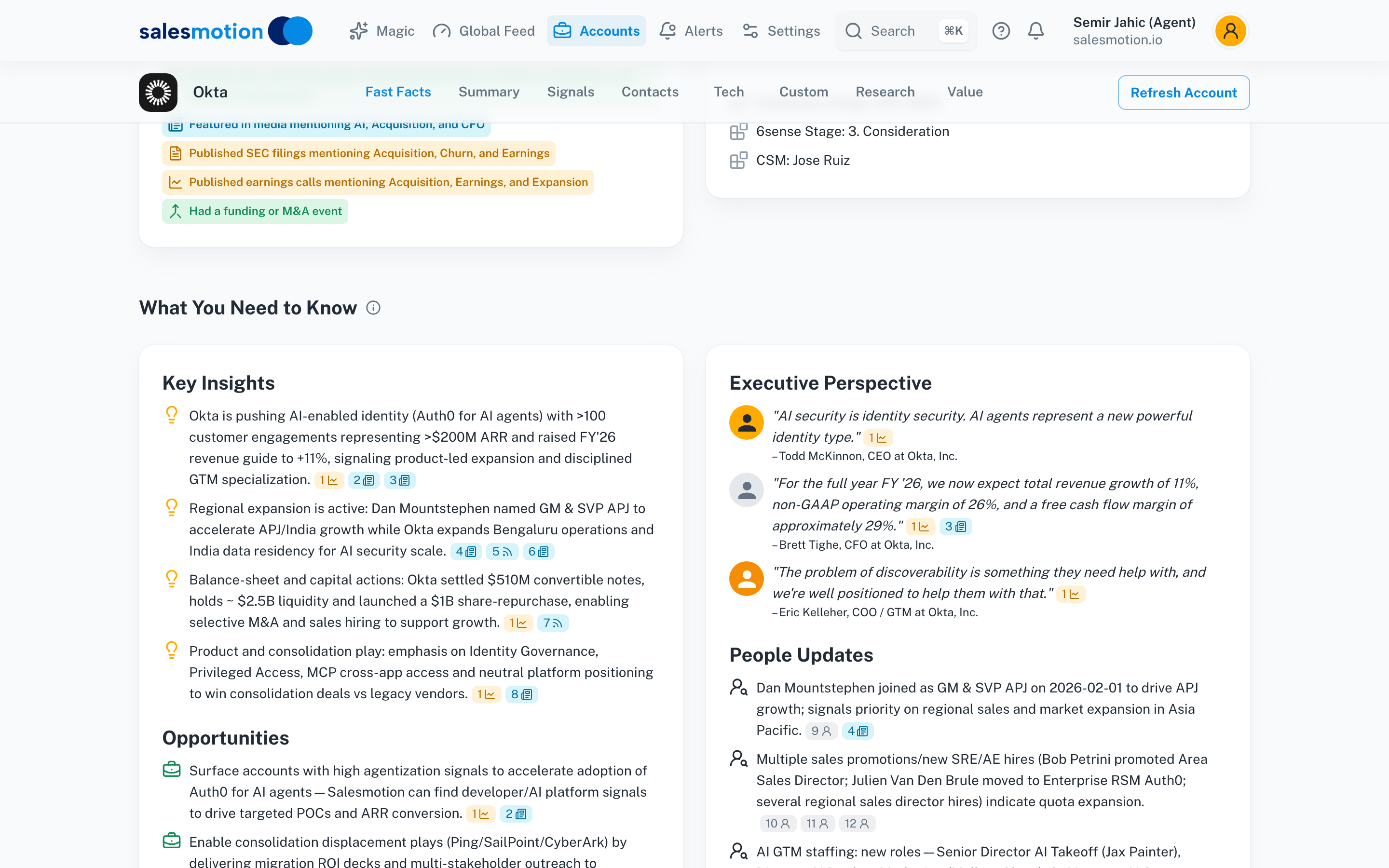 Salesmotion surfaces key insights, executive perspectives, people moves, and talking points — giving reps the context behind every contact.
Government and Regulatory Sources
Manufacturers file permits for facility construction and expansion that are public record. EPA environmental permits, local building permits, and OSHA inspection records can reveal facility-level activity that signals growth and investment. These are unconventional but valuable sources for identifying manufacturing accounts in expansion mode.

“The Business Development team gets 80 to 90 percent of what they need in 15 minutes. That is a complete shift in how our reps work.”
Andrew Giordano
VP of Global Commercial Operations, Analytic Partners
Manufacturing Contact Data: Source Comparison
| Source Type | Coverage | Accuracy | Cost | Best For |
|---|---|---|---|---|
| General B2B databases | Corporate HQ contacts | Moderate (60-65%) | $15K-$60K/yr | Initial list building |
| Industry databases (ThomasNet, D&B) | Deep on facility data | Moderate to high | $10K-$50K/yr | Facility-level targeting |
| Trade show attendee lists | Narrow, high-intent | High (self-reported) | Varies by event | Post-event campaigns |
| Signal-based platforms | Real-time, capex-enriched | High (event-verified) | Mid-market pricing | Expansion and hiring signals |
| Government permit filings | Narrow, facility-specific | Very high (public record) | Free | Identifying growth accounts |
Building a Manufacturing Sales Prospecting Workflow
Here is how a signal-driven manufacturing prospecting workflow operates in practice.
A mid-size industrial manufacturer posts four job listings for automation engineers and one for a Director of Smart Manufacturing within the same two-week period. This hiring pattern signals a digital manufacturing initiative. Salesmotion flags the account, surfaces the company's recent earnings commentary about capex investments in Industry 4.0 technologies, and identifies the VP of Operations and VP of Engineering as key contacts.
The rep reviews the account brief and builds outreach that references the company's automation investment and connects it to their solution's specific manufacturing use case. Instead of asking "are you looking at smart manufacturing solutions?" the message acknowledges the initiative already underway and positions the product as relevant to their timeline.
This approach works because manufacturing buyers are practical and time-constrained. They respond to outreach that demonstrates specific knowledge of their operations, not generic "digital transformation" messaging. Teams using signal-driven prospecting in manufacturing report significantly higher response rates from plant-level and operations contacts.
For a full comparison of B2B contact data providers, see our guide. For more on using signals to time your outreach, see our post on buying signals in B2B sales.
Key Takeaways
- Manufacturing decision makers are distributed across facilities, making contact data harder to source than single-HQ companies
- Plant managers and operations directors drive technology evaluation but are underrepresented in standard B2B databases
- Title ambiguity is a major challenge: filter by function (operations, engineering, procurement) rather than exact title match
- Facility expansion, capex announcements, and automation hiring surges are the strongest buying signals in manufacturing
- Combine industry databases for facility data with signal platforms for real-time buying intent
- Government permit filings are an unconventional but high-accuracy source for identifying manufacturers in expansion mode
Frequently Asked Questions
How do I find plant-level contacts at manufacturing companies?
Plant-level contacts are rarely indexed in standard B2B databases. The most effective sources are industry databases like ThomasNet (which maps facilities), trade show attendee lists, LinkedIn searches filtered by facility location, and signal monitoring for facility-level hiring that reveals management team members. Combining these sources gives better coverage than any single database.
What are the best buying signals for manufacturing sales?
The strongest signals are capital expenditure announcements (facility expansion, new lines), automation and smart manufacturing job postings, leadership hires in operations and engineering, and earnings call commentary about operational investment priorities. These signals indicate both budget availability and a specific need that your product can address.
How fast does manufacturing contact data decay?
Manufacturing contact data decays at moderate rates during stable periods (15-20% annually) but can degrade much faster during economic shifts or industry-specific disruptions. Facility closures, workforce restructurings, and M&A activity can invalidate large portions of a contact list within months. Signal monitoring catches these changes as they happen.
Should I target corporate headquarters or individual facilities?
Target both, but tailor your approach. Corporate contacts (VP Operations, VP Engineering) control enterprise-wide budgets and strategy. Facility contacts (Plant Manager, Operations Director) drive evaluation and adoption for facility-level implementations. The ideal multi-threading strategy engages both levels simultaneously.