A solid pipeline generation plan is what separates predictable revenue from random acts of selling. It’s your strategic playbook that answers three critical questions: which accounts to target, why you should target them now, and how your team will engage them to build a pipeline of real, high-quality sales opportunities.
Why Your Pipeline Generation Plan Needs a Reboot
Let’s get straight to the point: the old B2B sales playbook is broken. For years, revenue teams chased a simple mantra: “more is more.” The goal was to cram the top of the funnel with as many leads as possible, assuming a small percentage would eventually trickle down into closed deals.
This volume-based approach has created a huge problem for modern revenue teams: pipeline inflation. It's that frustrating situation where your lead volume is soaring, but revenue growth is stubbornly flat. Your dashboards might look great, but the business isn't actually moving forward.
The Real Cost of a Bloated Pipeline
Pipeline inflation isn’t just a vanity metric; it has real, negative consequences that burn out your best people and stretch resources dangerously thin.
The data tells a clear story. In 2025, many B2B organizations celebrated a 20-30% growth in marketing qualified leads (MQLs). But this surge came at a huge cost: deal close rates fell by an average of 15%, and enterprise sales cycles got 25% longer. The culprit was a bloated pipeline filled with low-quality leads, with a shocking 79% of marketing leads never converting because they lacked a clear "why now" trigger. This forced SDRs to waste 40-60% of their time filtering noise instead of talking to high-potential accounts. You can dive deeper into these execution fixes and learn why more pipeline can lead to less revenue.
This inefficiency creates a vicious cycle of frustration:
- Sales Development Reps (SDRs) are buried under thousands of low-intent "leads" from webinar lists and content downloads, most of which go nowhere.
- Account Executives (AEs) get stuck on discovery calls with poorly qualified prospects, wasting time on opportunities that were doomed from the start.
- Marketing teams, under pressure to hit their numbers, feel forced to generate even more MQLs, which only feeds the cycle of low-quality volume.
The old model rewarded activity over outcome. A modern pipeline generation plan must reverse this, focusing teams on signals that indicate a genuine opportunity to solve a problem now.
The Shift to Signal-Based Pipeline Generation
The solution is a fundamental pivot from a volume-obsessed mindset to one centered on quality and timing. This means building your entire pipeline generation plan around clear, actionable buying signals—real-world events that give a prospect a compelling reason to engage.
Instead of asking, "Who can we sell to?" the much better question is, "Who has a problem we can solve right now, and how do we know?" This is the bedrock of a signal-based approach.
To build a plan that truly competes, business leaders need to stay informed with actionable business intelligence for executives. This new framework requires a complete shift in how we measure success and direct our team's effort.
This table breaks down the shift from the old, volume-based model to a modern, signal-based framework.
| Focus Area | Old Model (Volume-Based) | New Model (Signal-Based) |
|---|---|---|
| Primary Goal | Fill the funnel with MQLs | Identify accounts with active buying intent |
| Key Metric | Lead volume, MQL count | Intent density, signal-to-opportunity rate |
| SDR Activity | High-volume, generic outreach | Trigger-driven, personalized plays |
| Sales/Marketing Alignment | Focused on lead handoffs | Aligned around target accounts and signals |
| Outcomes | Pipeline inflation, low conversion, burnout | Predictable pipeline, higher win rates, efficiency |
The focus moves away from MQLs and toward a metric we call intent density—the concentration of high-quality buying signals within a target account. An account with high intent density is one where multiple triggers are firing at once, signaling that a window of opportunity is wide open.
By reorienting your plan around these signals, you transform your go-to-market engine from a blunt instrument into a precision tool. Every action becomes purposeful, ensuring your efforts are directly tied to predictable revenue growth.
See Salesmotion in action
Take a self-guided interactive tour — no signup required.
Defining Your Goals and Ideal Customer Profile
A winning pipeline plan starts with a rock-solid foundation. Forget chasing a generic, top-line revenue number. To get real traction, you need to set precise, meaningful goals that get your team focused on the right accounts for the right reasons.
It all begins by admitting that not all accounts are created equal. Once you segment them by their strategic purpose, you can create focused goals that give your team genuine clarity.
Setting Goals for Strategic Account Segments
Instead of one big revenue target, break it down into three core categories. Each one has its own mission, which helps you prioritize resources and tailor your team's efforts where they'll have the most impact.
- Land Accounts: These are your prime, net-new logos that perfectly match your Ideal Customer Profile. The goal is simple: acquisition. Your team’s objective is to break in, secure that first deal, and start proving your value.
- Expand Accounts: These are existing customers with a clear runway for growth. Here, the goal is driving expansion revenue, whether that's through upselling, cross-selling, or rolling out new use cases. Success is all about growing ARR and deepening your footprint.
- Protect Accounts: These are your most strategic customers. Maybe they're at risk of churning, or maybe they're just too critical to your market position to ever lose. The objective here is retention and turning them into raving fans. Your goal is to lock in the renewal, fend off competitors, and make them vocal advocates.
This simple segmentation turns a vague revenue target into a clear set of directives. It lets you build specific plays and measure what actually matters for each part of your pipeline generation strategy.
Building Your Ideal Customer Profile on Real-Time Signals
With your strategic goals defined, the next question is which accounts to actually focus on. A static Ideal Customer Profile (ICP) based only on firmographics like industry, company size, and location just doesn’t cut it anymore. To build a pipeline that actually works, your ICP needs to be dynamic, incorporating the real-time buying signals that show an account is ready to talk.
An ICP built on signals helps you answer the most important question in sales: "Why now?"
An ICP is not just a description of who you sell to; it's a living profile of an organization that has a problem you can solve right now. It combines who they are with what they are doing.
Take an Enterprise SaaS company, for example. A traditional ICP might point you to software companies with over 1,000 employees. A modern, signal-based ICP would zero in on those same companies that are also hiring dozens of new sales reps, just announced a key product integration, or had an executive mention "improving sales efficiency" on an earnings call. You can find a deeper dive on this approach in our comprehensive guide to creating a powerful Ideal Customer Profile template.
Prioritizing Accounts with Dynamic Tiers
The final piece of the foundation is prioritization. Because even among signal-fit accounts, not all are created equal. Signal-based pipeline generation is rapidly changing how B2B revenue teams operate. High-performing teams—with 79% rating their data handling as 'excellent'—build their plans around triggers like funding rounds, leadership changes, and intent data, which leads to much higher close rates. In verticals like Energy and Manufacturing, macro events like plant expansions are key timing drivers, and teams tracking these signals see research time slashed by 40-60% through smarter prioritization. You can read the full research on modern lead generation to see how this is changing the game.
This is where dynamic account tiers come into play.
- Tier 1 Accounts: These are a perfect ICP fit and are lighting up with multiple, high-value buying signals all at once. For a Life Sciences company, this might be a biotech firm that just closed a Series B funding round and announced positive clinical trial results. These accounts demand immediate, multi-threaded outreach from your best reps.
- Tier 2 Accounts: These accounts are a strong ICP fit but are showing fewer or lower-intent signals. Maybe they’re hiring for a relevant role but have no other major triggers. They are perfect candidates for automated nurturing and consistent monitoring until another signal pops.
- Tier 3 Accounts: These are accounts that fit your ICP but are currently "quiet," showing no active buying signals. They should be on your radar, but they get minimal direct sales resources until a trigger event puts them in motion.
By defining goals, building a signal-based ICP, and creating dynamic tiers, you build a powerful foundation. This ensures your team is always focusing its energy on the accounts most likely to buy, turning your pipeline generation plan into a predictable engine for growth.

“Salesmotion empowers me to cultivate a great buyer experience. I'm able to challenge prospects' thinking and be a trusted consultative seller. A major part of this is Salesmotion insights.”
Austin Friesen
Account Executive, FY25 #1 President's Club, Clari
Building a Playbook That Turns Signals into Sales
A great strategy is nothing without solid execution. This is where your pipeline generation plan moves off the whiteboard and becomes a concrete set of actions your sales team can use. The goal is to turn buying signals into real conversations and, ultimately, opportunities.
The key to achieving this is creating a trigger-driven playbook.
This playbook takes the guesswork out of outreach. It maps specific, real-world events—like a funding announcement, a new executive hire, or a competitor's project win—to a pre-defined sequence of actions. This ensures every touchpoint is timely, relevant, and impactful.
From Signal Detection to Sales Action
Instead of reps spending hours digging for a reason to call, a well-designed playbook empowers them to act with speed and precision. The moment a key signal is detected, the right "play" is activated. This is how you shift your team from being reactive to truly proactive.
Of course, your plays need a solid foundation. Integrating top lead generation strategies for businesses is crucial for making sure your playbook has a real impact. The good news is that modern AI-powered platforms can automate this entire process, detecting signals in real-time and freeing your team from hours of manual research.
You'll also need different plays depending on where you are with an account—whether you're trying to land a new logo, expand your footprint, or protect an existing relationship.
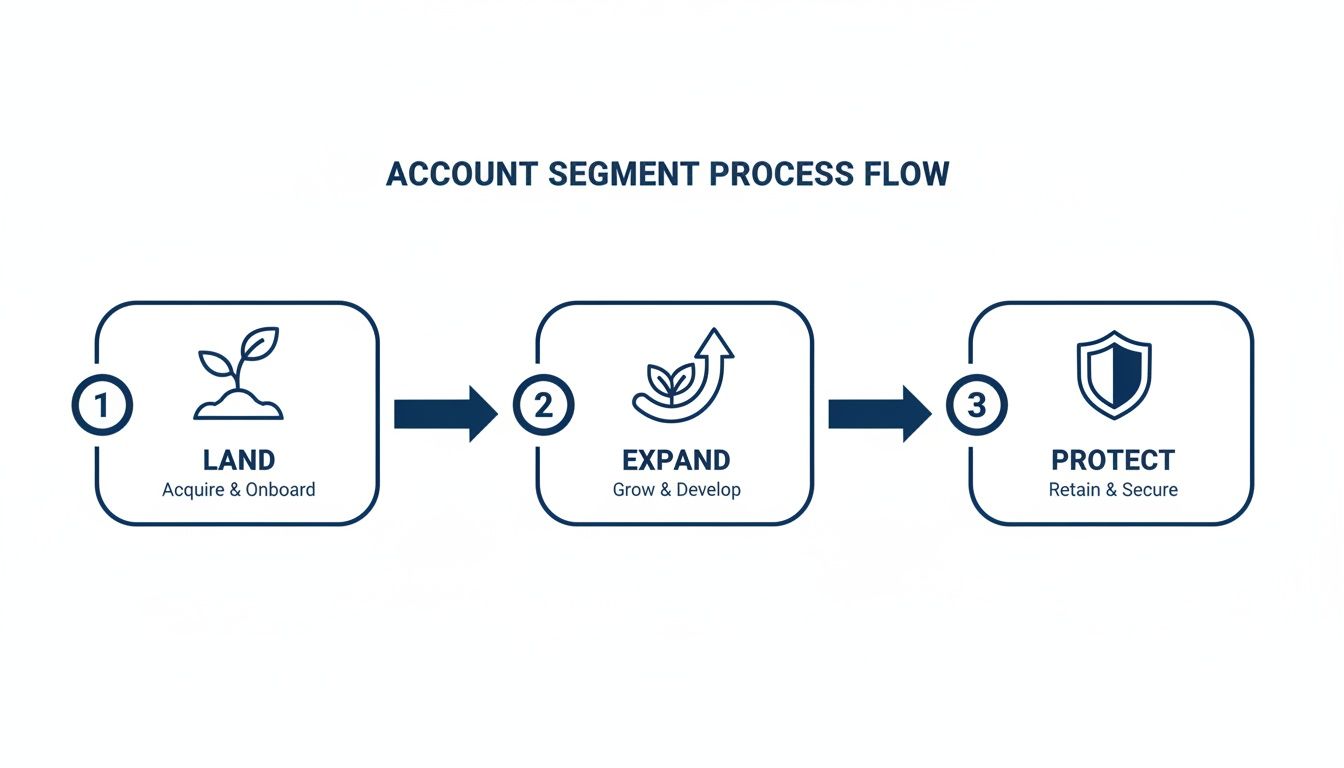
As you can see, the strategy shifts based on the account's stage. You wouldn't use the same approach to land a new deal as you would to protect a strategic customer.
Designing Your Trigger-Driven Sales Plays
The magic of a great playbook is its specificity. Generic templates don't cut it. Your plays must be tailored to the signal, the industry, and the specific stakeholder you're trying to reach.
Here are a few real-world examples of how this works in practice:
- The 'Funding Round Play' (SaaS): A target SaaS account closes a major funding round. The trigger is the public announcement. The play kicks off a multi-threaded outreach sequence targeting the CEO, CRO, and VP of Operations. The messaging is all about how your solution helps them scale efficiently, handle new operational headaches, and get the most out of their fresh capital.
- The 'Clinical Milestone Play' (Biotech): A biotech prospect announces positive Phase II clinical trial results. This signal triggers a play aimed at the Chief Medical Officer and Head of Commercialization. The outreach is hyper-focused on supporting their next phase—perhaps preparing for a commercial launch or scaling up manufacturing.
- The 'Executive Hire Play' (Enterprise): A Tier 1 target hires a new CIO from a company you know is a happy customer. This is a warm outreach play waiting to happen. The AE can reference the new CIO’s past experience and frame your solution in a context they already understand, creating an instant, credible connection.
A well-crafted play doesn’t just tell a rep who to contact; it tells them why to contact them now and what to say. It connects a real-world event to a specific business pain you can solve.
Automating Intelligence for Timely Outreach
The biggest historical challenge with signal-based selling has been the manual effort. Reps simply don't have the time to monitor hundreds of accounts across news sites, financial filings, and social media. This is where AI-powered platforms like Salesmotion become a complete game-changer.
These platforms act as an always-on intelligence layer, doing the heavy lifting so your team can focus on selling.
- Automated Signal Detection: The AI constantly scans your target accounts for dozens of different trigger events.
- Real-Time Alerts: Reps get instant notifications right where they work (like Slack or their CRM) the moment a relevant signal pops up.
- Actionable Context: The alert doesn't just deliver the news; it provides the "so what"—the crucial context that helps a rep immediately see the opportunity and launch the right play.
This level of automation ensures no opportunity slips through the cracks. It closes the gap between signal and action, empowering every rep to engage with the relevance and speed of a top performer.
If you're building out your own plays, our guide on crafting a signal-based sales playbook offers even more templates and ideas to get you started.
Mastering Your Channels for Maximum Impact
A brilliant message paired with a perfect buying signal is useless if it never reaches the right person. After you've built your trigger-driven playbooks, the next mission-critical step is executing those plays across the right channels. This is where you move beyond single-threaded outreach and create a cohesive, multi-channel approach that surrounds your target accounts with value.
Think about it. When a strong signal hits, you don't just send one email and hope for the best. That’s a recipe for getting lost in the noise. Instead, you launch a thoughtful sequence that engages multiple stakeholders across different platforms, dramatically increasing your chances of starting a real conversation.
Leading with LinkedIn: The B2B Powerhouse
When it comes to B2B pipeline generation, one channel stands head and shoulders above the rest: LinkedIn. It’s no longer just a place for professional networking; it's the primary battlefield for B2B engagement and intelligence gathering.
The research is clear on this. LinkedIn has proven to be 277% more effective for B2B pipeline generation than other social platforms. The magic happens when you pair it with personalization. When your outreach is informed by clear buying signals, message response rates can jump to an impressive 10-15%. The most sophisticated plans often layer in visitor ID technology to capture valuable anonymous traffic from high-value accounts, turning unseen interest into real, actionable leads.
But just having a LinkedIn profile isn't enough. Success comes from using it strategically as part of a larger play.
Example Scenario: A Signal in Action
Imagine a signal alert informs you that a Tier 1 target account just announced a new strategic initiative to expand into Europe. A multi-channel play could look like this:
- LinkedIn Connection: Send a personalized connection request to the newly appointed Project Lead for the European expansion. Your message references the announcement and offers a specific insight related to overcoming common cross-border compliance challenges.
- Targeted Email: At the same time, send a hyper-targeted email to the VP of Operations (the likely budget holder). This email includes a short case study of how you helped a similar company streamline their international launch.
- Content & Ads: Launch a small, targeted ad campaign on LinkedIn aimed at the known members of the buying committee, promoting a whitepaper on "The 5 Hidden Costs of European Market Entry."
This coordinated approach ensures your message is seen by multiple key players in different formats, reinforcing your value proposition from several angles.
Beyond LinkedIn: High-Impact Channel Integration
While LinkedIn is a crucial starting point, the most effective pipeline generation plans are multi-channel. Relying on a single platform creates a single point of failure. You need to weave in other high-touch and high-tech channels to build a resilient outreach strategy. For more ideas on how to diversify, check out our guide on modern outbound lead generation.
Here are other powerful channels to weave into your plays:
-
Hyper-Targeted Email: Still a workhorse for B2B communication, email lets you deliver detailed, valuable content directly to a stakeholder's inbox. The key is extreme personalization driven by your buying signals. No generic templates allowed.
-
Strategic Content: Use your blog posts, whitepapers, and webinars as precision tools in your sales plays, not just broad marketing assets. Send a link to a relevant article as a follow-up or use it to warm up an account before direct outreach.
-
High-Touch Referrals: This remains the highest-converting strategy by a wide margin. Referrals can close at 50-70% rates, a massive jump from the 20-30% you might see from cold leads. Your pipeline plan must include plays for activating your network, asking for introductions, and leveraging connections from happy customers.
The goal isn't just to be on multiple channels; it's to create a multi-threaded conversation where each touchpoint builds on the last. The channel is just the delivery mechanism—the real power comes from the consistent, relevant message you deliver across them.
By mastering your channels, you ensure your well-crafted plays get delivered with maximum impact. You avoid the generic, single-channel outreach that gets ignored and instead create a surround-sound effect of value that is impossible for your target accounts to miss.

“We have very limited bandwidth, but Salesmotion was up and running in days. The template made it easy to load our accounts and embedding it in Salesforce was simple. It was one of the easiest rollouts we've done.”
Andrew Giordano
VP of Global Commercial Operations, Analytic Partners
Measuring Success and Creating a Feedback Loop

Here's a hard truth: a pipeline generation plan isn't a "set it and forget it" document. It’s a living, breathing system that needs constant attention. To make sure your plan is actually driving revenue, you have to look past the usual vanity metrics and get real about what indicates a healthy, high-quality pipeline.
This means building a solid, closed-loop feedback system that connects Sales, Marketing, and RevOps. It's the only way to make sure your strategy adapts to what’s really working in the market, making your team more efficient and your efforts more effective over time.
Moving Beyond Vanity Metrics
Let's get one thing straight: MQL counts might look great on a dashboard, but they rarely predict actual revenue. Top-performing revenue teams know this. They track a handful of key indicators that directly reflect pipeline quality and momentum.
These are the core metrics that give you an honest view of how well your signal-based strategy is performing.
- Pipeline Velocity: How fast are opportunities moving through your sales stages? A speedy velocity means your team is hitting the right accounts with the right message at the right time.
- Deal Conversion Rates by Signal: Which triggers—like funding rounds or new executive hires—are actually producing opportunities that close? This data is pure gold for refining your playbooks.
- Average Deal Size: Are your signal-driven plays leading to bigger, more strategic deals? This metric helps prove the value of targeting accounts that have clear, high-intent triggers.
- Sales Cycle Length: Is your plan helping to shrink the time from first touch to closed-won? A shorter sales cycle is a massive sign of increased efficiency and relevance.
Tracking these numbers gives you an objective foundation for every decision you make. You can dig deeper into how to calculate and improve this crucial metric in our guide to understanding pipeline velocity.
The Pipeline Review Cadence
Data by itself isn't enough. You have to pair those quantitative insights with real-world feedback from the front lines. This is where a regular pipeline review cadence becomes your secret weapon, creating a formal channel for reps to share what they're seeing and hearing.
And no, this is not your typical deal-by-deal forecast call. The entire point is to dissect the pipeline generation plan itself.
The most valuable insights for improving your plan come from the people executing it every single day. Your reps know which signals are sparking real conversations and which ones are just falling flat.
During these sessions, the conversation needs to revolve around a few key questions:
- Which sales plays are getting the best responses, and why?
- Are the signals we’re tracking actually leading to meaningful conversations about business pain?
- Is the context we provide with signal alerts enough for reps to act on quickly?
- What objections or roadblocks are popping up most often?
This direct feedback from sales is critical for marketing and RevOps. It’s what allows them to fine-tune messaging, adjust targeting criteria, and improve the quality of the signals you’re surfacing in the first place.
Closing the Loop for Continuous Improvement
The final piece of the puzzle is turning all these insights into action. The feedback you gather during pipeline reviews has to flow directly back into your strategy, creating a virtuous cycle of improvement. This is how your plan evolves based on real-world results, not just assumptions.
For instance, let's say reps report that the "New Product Launch" signal consistently leads to high-quality meetings. You can immediately double down on that trigger. This might involve:
- Refining the Playbook: Marketing can create more targeted content that directly supports that specific play.
- Prioritizing the Signal: RevOps can tweak scoring models to give more weight to this trigger.
- Enabling the Team: Sales leadership can share best practices and winning talk tracks for this play across the entire team.
On the flip side, if a signal is consistently producing dead-end conversations, you can figure out why. Maybe the messaging is off, or maybe the signal itself isn't a strong indicator of intent for your particular solution. This feedback gives you the power to either fix the play or de-prioritize the signal, saving your team a ton of valuable time.
By building this tight feedback loop, you turn your pipeline generation plan into a dynamic, intelligent system that gets smarter and more productive over time. You stop wasting effort on what isn’t working and start systematically scaling what does.
Frequently Asked Questions
Even the most seasoned revenue leaders have questions when shifting to a modern, signal-driven pipeline plan. Moving your team away from pure volume is a big change, so let's tackle some of the most common questions that pop up during the transition.
How Long Does It Take to See Results?
This is always the first question, and the answer comes in a few stages. You should expect to see early wins within 30 to 60 days. These aren't closed deals, but crucial leading indicators like higher reply rates on your outreach or more meetings booked from those first few signal-based plays.
The real revenue impact—seeing those deals actually close and recognizing the ARR—starts to show up over two to four quarters. This timeframe accounts for setting up the right tech, defining your signals, building out the initial playbooks, and getting the team comfortable with a new way of working.
Getting to a fully mature, predictable pipeline from signals can take 12 to 18 months. That might sound like a long time, but the trade-off is huge. The opportunities you generate this way are almost always bigger, close faster, and have much higher win rates than anything coming out of a traditional volume-based funnel.
My Team Is Already Overwhelmed. How Can We Possibly Implement This?
This is a completely fair point. The goal of a signal-based plan isn't to pile on more work. It’s to replace low-value, manual tasks with high-impact, automated workflows. It’s about working smarter, not harder.
Think about how many hours your reps burn every day just trying to find a decent reason to reach out to an account. An account intelligence platform that automates signal detection can cut that daily research grind by 40% to 60%.
A signal-based plan doesn't add work. It reallocates your team's effort from fruitless manual research to timely, high-value conversations that actually generate pipeline.
The secret is to start small and prove the value internally. Don't try to boil the ocean.
- Pick one or two high-value signals that are easy to track, like a funding announcement or a key executive hire.
- Build one simple playbook for just those triggers.
- Give it to a small group of reps to run the plays and obsessively track the results.
Once the team starts feeling the wins—getting meetings with prospects who are genuinely interested—they’ll be pulling for more, not pushing back on the change.
What’s the Difference Between Intent Data and Buying Signals?
This is a critical distinction that’s at the very heart of a modern pipeline generation plan. People use these terms interchangeably, but they are not the same thing.
Traditional intent data is usually broad and anonymous, based on third-party web activity. It tells you that someone from a company (or, more accurately, an IP address associated with that company) is researching topics related to what you sell. It hints at interest, but it's not a concrete event.
The "buying signals" we're focused on are specific, verifiable events happening at the company itself. These are real-world triggers you can point to directly in your outreach, which gives you a much more credible "why you, why now."
Here’s a simple way to think about it:
| Factor | Traditional Intent Data | Actionable Buying Signals |
|---|---|---|
| Origin | Anonymous web browsing activity | Public announcements, company actions |
| Specificity | General topic interest (e.g., "cybersecurity") | Concrete event (e.g., "Hired a new CISO") |
| "Why Now" | Inferred and weak | Clear and verifiable |
| Example | Someone read an article about sales efficiency | Company is actively hiring 50 new sales reps |
Knowing an account is hiring 50 new SDRs is a concrete signal that they have a pressing need for sales tools and training. That’s far more actionable—and gives you a much stronger reason to reach out—than knowing someone from that company browsed a blog post three weeks ago.
Salesmotion is the AI-powered account intelligence platform that automates this entire process. We track the real-world signals that matter across your target accounts and turn them into actionable insights, so your team can stop guessing and start selling with a clear "why now." Discover how you can build a better pipeline by visiting https://salesmotion.io.