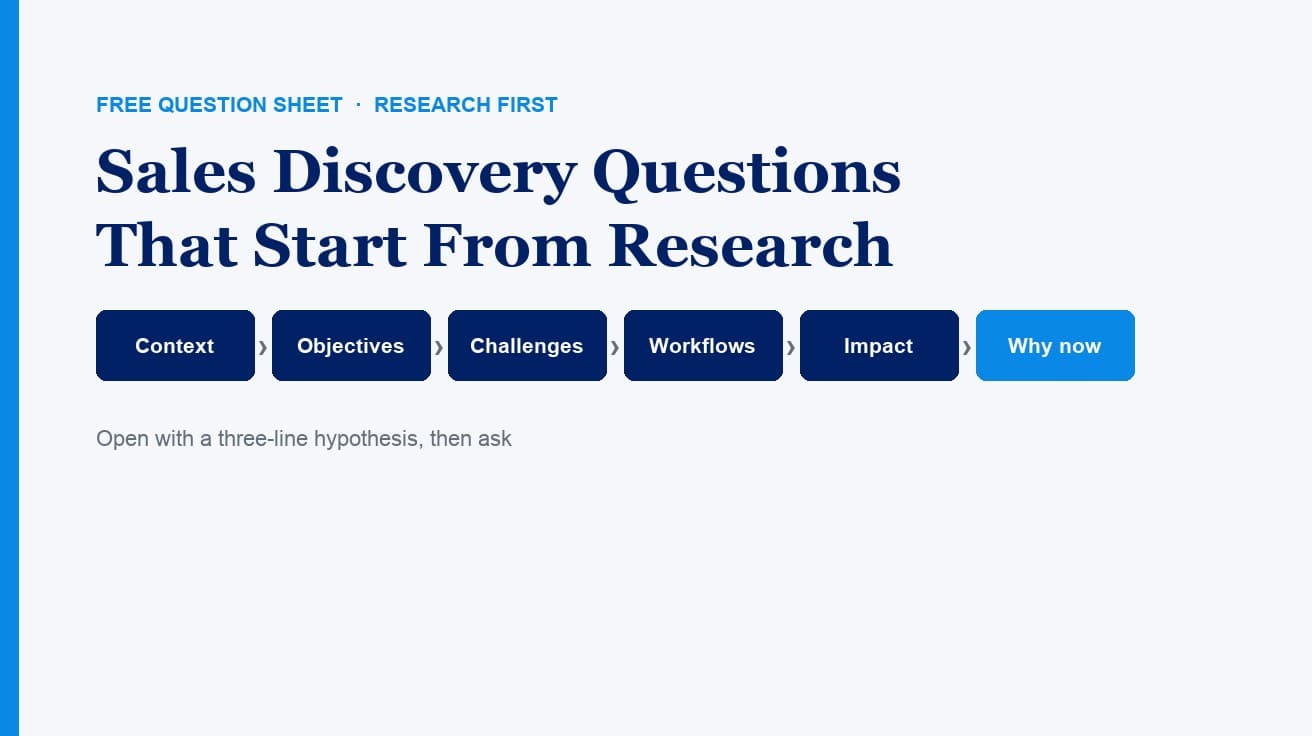
Good sales discovery questions move from broad to specific: the buyer's business and goals first, then the challenges in the way, then how the work is done today, and finally what the problem costs and why it has to be solved now. The best discovery calls start before the call, with a researched hypothesis the rep opens with and lets the buyer correct. Questions without research sound like an interview. Research without questions sounds like a pitch.
TL;DR: Spend 15 minutes on outside-in research and write a three-line hypothesis: what is likely going on at the account, what it likely costs them, and why now. Open the call by sharing it and asking what you got wrong. Then work through five groups of questions in order (context, objectives, challenges, workflows, impact) and finish with urgency, decision process and next step. Do not demo during discovery. Download the question sheet below.
What is a sales discovery call?
A discovery call is the conversation where the seller learns what the buyer is trying to achieve, what stands in the way, what it costs, and how they will decide. It is not qualification, although the two overlap. Qualification asks whether there is a project at all: need, budget, authority, timing. Discovery goes deeper into objectives, workflows and impact, so that the solution and the business case fit this buyer and not a generic one.
The order matters. Discovery on an account with no need, budget or timeline is wasted effort, so a short qualification check comes first. Discovery that skips to product is a demo with questions attached.
How do you prepare for a discovery call?
Write a hypothesis before you write questions. Fifteen minutes on the account is usually enough:
- What management said in public: the annual report, the latest earnings call, investor presentations.
- What changed recently: leadership moves, acquisitions, reorganizations, funding.
- Where they are investing: open roles in the team you sell to, new initiatives in press releases.
- How the meeting arrived: which signal or inbound action triggered it.
Then write three lines: what is likely going on, what it likely costs them, and why now. A wrong hypothesis is still useful. When the buyer corrects it, you get their real view and they see that you did the work. The pre-call research checklist covers the sources in more detail.

“If we have five net-new meetings a day, we can't do an hour of research before each call. Salesmotion surfaces everything we need to build credibility in five minutes.”
Adam Wainwright
Head of Revenue, Cacheflow
Example: from an earnings release to a hypothesis
Example built from public filings, 22 October 2026. Pfizer published its second-quarter 2026 results on 4 August 2026, filed with the SEC as an 8-K exhibit. Four items a seller of commercial or sales-productivity software would note:
- More cost savings: Pfizer announced $1.0 billion of additional anticipated net cost savings, expected to "further reduce costs in SI&A" (selling, informational and administrative expenses) from 2027 through 2029.
- A bigger program: total net cost savings from its cost realignment program are now expected to reach about $6.7 billion.
- Finance leadership change: the CFO was to leave on 15 August, with a senior finance executive named interim CFO from 16 August while Pfizer searches for a permanent one.
- AI expectations: the release's forward-looking statements refer to scaling AI initiatives and to cost savings expected from "AI, automation and digital enablement efforts."
The three-line hypothesis a seller could write from that:
- What is likely going on: Pfizer is taking cost out of selling and administrative spend over the next three years, and expects AI and automation to carry part of it.
- What it likely costs them: every commercial tool and process will be judged on productivity, and anything that adds work for reps or cost to SI&A will struggle.
- Why now: new savings targets for 2027 to 2029 and a change in finance leadership mean spending decisions are being re-examined this year.
And the opening it produces: "In August, Pfizer added a billion dollars of savings in selling and administrative costs for 2027 to 2029 and talked about AI and automation carrying part of it. I assumed that means every commercial investment now needs a productivity case. How close is that to what you are seeing?"
That one question does more than ten generic ones. The rest of this post is what to ask next.
What are the best sales discovery questions?
Pick from each group; never read the list out. The questions marked ★ matter most.
1. Context and business model
- ★ Can I check I have this right: what you sell, who buys it, and how they buy?
- How is the team set up, and what has changed over the past year?
- How do you win, renew and grow customers today?
- Which outside partners or agencies are involved in this area?
2. Objectives
- ★ Which goals matter most to the company this year, and how will anyone know they were hit?
- ★ What does your team have to deliver for those goals?
- Which projects are already under way, and who sponsors them?
- What would a great year look like for you personally?
3. Challenges
- ★ What has to be overcome to hit those goals? Why is it hard today?
- How long has this been a problem, and what have you tried?
- Is this the challenge, or are others more pressing?
- What would you regret not having fixed six months from now?
4. How the work is done today
- ★ Walk me through how this happens today: who is involved, which tools, which data, how often, how long.
- Where does the data come from, and what is missing?
- What happens when the person who runs this is away?
- What would the ideal version look like?
5. Impact
- ★ What is this costing today, in hours, money, risk or revenue you miss? Even a rough estimate helps.
- Who else is affected, and how?
- Which number would move most if this were solved, and what is that worth?
- How would you make the case for this spend to your manager and to finance?
6. Urgency
- ★ Why now? What makes this a priority this quarter rather than next year?
- What happens on [their date] if nothing has changed?
- Has money or headcount already gone into this problem without fixing it?
7. Decision process and paper process
- ★ What has to happen between now and a firm yes or no, who takes part in each step, and what will they judge on?
- ★ Where would the money come from, and whose signature does it need?
- Think of the last purchase like this: how long did it take, and what did legal, security and procurement ask for?
- What could derail this?
8. People and alternatives
- Who is pushing for this, and who would be happier if it went away?
- Who above you will challenge this? Could the three of us talk?
- What else are you considering, including building it yourselves or doing nothing?
- What do you like about how you do it today? What would you keep?
Free Discovery Question Sheet
All eight question groups on one printable page, with the three-line hypothesis box and a post-call checklist.
No email required. One page, print or keep it open on the call.
How do you uncover urgency without creating it?
You cannot manufacture a reason to buy. You can find one the buyer already has and connect it to the problem. Ask the person in the meeting how they would defend the spend to their manager. "It would save us some copy-pasting" is not a reason to act. A regulation with a date, a board commitment, a contract renewal or a failed project is.
MEDDICC founder Andy Whyte puts the test well: a real compelling event "exists whether or not you're in the room" (MEDDICC). If the urgency disappears when you stop pushing, it was yours, not theirs. The compelling event guide has 14 examples and where each shows up publicly.
How do you read where the buyer is?
Buyers arrive at discovery in one of four states, and the right next move differs:
| Buyer state | What you hear | What to do |
|---|---|---|
| Not looking | "Interesting, we haven't really thought about it." | Educate with a point of view. Do not forecast it. |
| Admits the problem | "Yes, that's painful, but we don't know how to fix it." | The best moment for discovery: quantify, shape the solution. |
| Has a vision | "We think the answer looks like X." | Validate value, build the business case, meet more people. |
| Evaluating | "We have requirements and a shortlist." | Reshape the criteria if you can, and be crisp on differences. |
A deal in the first state sitting in your forecast is the most common reason a pipeline looks bigger than it is.
Open every discovery call with a researched hypothesis
Salesmotion's Research Agent reads earnings calls, filings, news and hiring for your accounts and drafts the brief you prepare from. See it in a 30-minute demo.
What separates a strong discovery call from a weak one?
Score your own recorded calls against this list. Managers can use it for coaching.
- Research is visible in the first two minutes
- An agenda is stated, with the outcome you both want from the call
- "Why now?" is asked
- At least one pain is quantified with the buyer's own numbers
- The decision process is explored, including who signs
- No product shown before the problem is framed
- The buyer talks more than you do, especially in the first 15 minutes
- A second stakeholder is named
- The call ends with a dated next step the buyer agreed to
The last one is the easiest to skip and the most expensive. "By when will you have an update? Fine, I'll reach out then" turns a pleasant conversation into a next step you can hold the buyer to.
Salesmotion's Take
Too much credit goes to great demos and too little to great discovery. The rep who arrives knowing what the CEO said last quarter, and asks one sharp question about it, has earned the next meeting before the demo is even booked.

Semir Jahic
CEO & Co-Founder, Salesmotion
Key takeaways
- Discovery moves broad to specific: context, objectives, challenges, workflows, impact, then urgency and decision process.
- Research first. A three-line hypothesis (what is happening, what it costs, why now) beats ten generic questions.
- Earnings calls and filings give you management's own words to open with.
- Uncover urgency the buyer already has; a compelling event exists whether or not you are in the room.
- End every call with a dated next step the buyer agreed to.
Frequently Asked Questions
What are good discovery questions in sales?
Good discovery questions are open, specific to the buyer and asked in order from broad to narrow: the company's goals, the challenges in the way, how the work is done today, what the problem costs and why it matters now. The strongest single question is usually a researched one, such as asking the buyer to react to something management said on the last earnings call.
How many questions should you ask on a discovery call?
Enough to cover each group, usually one or two starred questions from each, plus the follow-ups they lead to. Follow-up questions matter more than the list. Never read questions out in sequence; pick the ones that fit what the buyer just said.
What is the difference between discovery and qualification?
Qualification checks whether there is a real project: need, budget, authority and timing. Discovery goes deeper into objectives, workflows, cost and decision process so the solution and business case fit the buyer. Qualify first, because discovery on an account with no project is wasted.
Should you demo on a discovery call?
No. Showing product before the problem is framed turns the call into a feature tour and teaches you nothing about the buyer. If the buyer insists, show one short example tied to the problem they described and return to questions.
How do you research an account before a discovery call?
Read what management said publicly (annual report, earnings call), what changed recently (leadership, acquisitions, funding), where they are hiring, and what triggered the meeting. Write a three-line hypothesis from it. Account intelligence tools like Salesmotion collect those sources per account so the brief takes minutes, not an hour.