Account-based lead generation isn't about casting a wide net; it’s precision spear fishing. It's a strategy that focuses all your resources on a handpicked list of high-value accounts—the ones that are a perfect fit for your business. This isn't just a minor tweak; it’s a total shift from a volume game to a quality game.
A Strategic Shift to Quality Over Quantity
Let's be honest, traditional lead generation often feels like a relentless numbers game. You pump out hundreds or thousands of leads, push them through a funnel, and hope a tiny fraction converts. While that approach can work, it’s notoriously inefficient, leading to wasted effort and a constant tug-of-war between marketing and sales.
Account-based lead generation flips that entire model on its head.

It all starts with a simple but powerful idea: identify the companies you actually want to do business with first. Instead of marketing to a faceless audience, your sales and marketing teams collaborate to build a target account list (TAL) of businesses that perfectly match your ideal customer profile (ICP). From there, every single marketing and sales action is coordinated to engage those specific accounts.
Traditional Lead Generation vs. Account-Based Lead Generation
This difference in philosophy leads to completely different workflows and outcomes. Looking at them side-by-side makes it crystal clear why so many B2B revenue teams are making the switch.
| Aspect | Traditional Lead Generation | Account-Based Lead Generation |
|---|---|---|
| Focus | Volume of individual leads | Quality of target accounts |
| Targeting | Broad, persona-based | Narrow, specific companies |
| Sales & Marketing | Often operate in separate funnels | Tightly aligned on the same accounts |
| Primary Metric | Cost per lead (CPL), MQLs | Account engagement, pipeline velocity |
| Communication | General, one-to-many messaging | Personalized, one-to-one outreach |
It's this laser-focused approach that explains why 87% of marketers report that ABM delivers a higher ROI than other marketing strategies. When you treat each target account as a market of one, you create relevant, meaningful interactions that resonate with key decision-makers.
Why It Matters Now More Than Ever
In today's crowded market, generic outreach is just noise. Decision-makers are drowning in templated emails and irrelevant ads. To break through, you need context and relevance. Account-based lead generation gives you the framework to deliver exactly that. And if you're selling in a B2B world, mastering modern outreach channels is critical, like those covered in these LinkedIn lead generation strategies.
The core principle is simple: stop waiting for good-fit customers to find you. Instead, identify them proactively and build a thoughtful, multi-threaded plan to win their business.
This strategy isn't just about sending better emails. It's an operational shift that gets your entire revenue team pulling in the same direction. While this guide zeros in on lead generation, you can dive deeper into the overarching strategy in our guide to account-based marketing.
Now, let's get into how to turn this concept into a scalable revenue engine.
See Salesmotion in action
Take a self-guided interactive tour — no signup required.
Using Signals to Know When to Engage Accounts
Knowing who to target is only half the battle. The real advantage in account-based lead generation comes from knowing when to engage. Static data like revenue, industry, and employee count can help you build a target account list, but it tells you nothing about an account’s immediate needs or willingness to buy.
This is where buying signals come in. These are real-time events indicating an account is actively changing, making them far more receptive to your message. Think of it like this: a "perfect fit" account sitting quietly is a closed door. An account actively signaling change is a door that just swung wide open.
The Power of "Signal Density"
The most effective account-based strategies prioritize accounts based on their level of activity, not just their firmographic profile. It's a fundamental shift in mindset that has a huge impact on your pipeline.
We prioritize "signal density" over firmographic fit. Instead of ranking accounts purely by revenue or industry match, we score them by how many buying signals they've triggered in a rolling 90-day window. This flips the typical approach on its head—instead of starting with "who should we sell to" and then finding reasons to reach out, you start with "who is actively changing" and reach out with real context.
This focus on timing ensures your team connects with prospects at the exact moment they’re most open to new solutions. As a result, pipeline velocity improves noticeably because you're catching companies in motion rather than trying to create momentum from a standstill.
From Manual Drudgery to Automated Insight
In the past, uncovering these signals was a grueling, manual task. Reps would spend hours each day scouring LinkedIn and Google News, trying to piece together a reason to reach out. The process was slow, inconsistent, and often turned up stale information.
Before using automated intelligence, one of our customer's BDR teams spent roughly 45 minutes per account on manual research. They were stuck researching about 10 accounts per day, and the insights they found were often outdated.
After switching to automated signal monitoring, that research time plummeted to under 5 minutes per account. This created a powerful compounding effect.
- Increased Volume: The team went from researching ~10 accounts a day to 40+, a 4x increase in activity.
- Higher Quality: The automated signals were fresher and more relevant, giving reps a stronger "why now" for every interaction.
The result? Their opportunity creation rate per outreach sequence doubled. This is the core benefit of modern intelligence: it allows your team to do more volume with significantly higher quality context.
Turning Signals into Conversations
So, what does this look like in practice? Imagine an enterprise SaaS company selling to mid-market businesses. They identified that a new VP of Sales or CRO hire was a critical buying signal, since new leaders are prime candidates for shaking up their tech stack.
Using automated monitoring, their sales reps received alerts within 48 hours of a leadership change. They immediately sent personalized outreach that referenced the new hire and the strategic shifts that usually follow.
The outcome was stunning. Compared to their generic outreach to the same ideal customer profile, their reply rates jumped from ~3% to over 12%. That’s a 4x uplift in engagement, driven entirely by timing and context.
To learn more about identifying these crucial triggers, explore our guide on what buying signals are and how to use them. The "why now" isn't just a nice-to-have; it's a critical component of a successful account-based strategy.

“Salesmotion is instrumental in helping me prioritize net-new accounts, understand their strategic initiatives, and cover more ground. With a lot of green-field accounts, I'm heavily leaning on the AI insights to tier my accounts and focus my time. The platform is incredibly intuitive and easy to use.”
Rob Webster
Enterprise Account Executive, Synthesia
A 3-Step Playbook for Signal-Based Outreach
Knowing that signal-driven outreach is powerful is one thing. Putting it into practice is another. The process is a simple, repeatable system once you break it down. This isn't about piling more work onto your reps; it's about swapping low-value manual research for a high-impact, automated workflow.
What used to take a rep two to three hours of digging per account can now be done in minutes, freeing them up to sell.
The whole process boils down to three core steps.
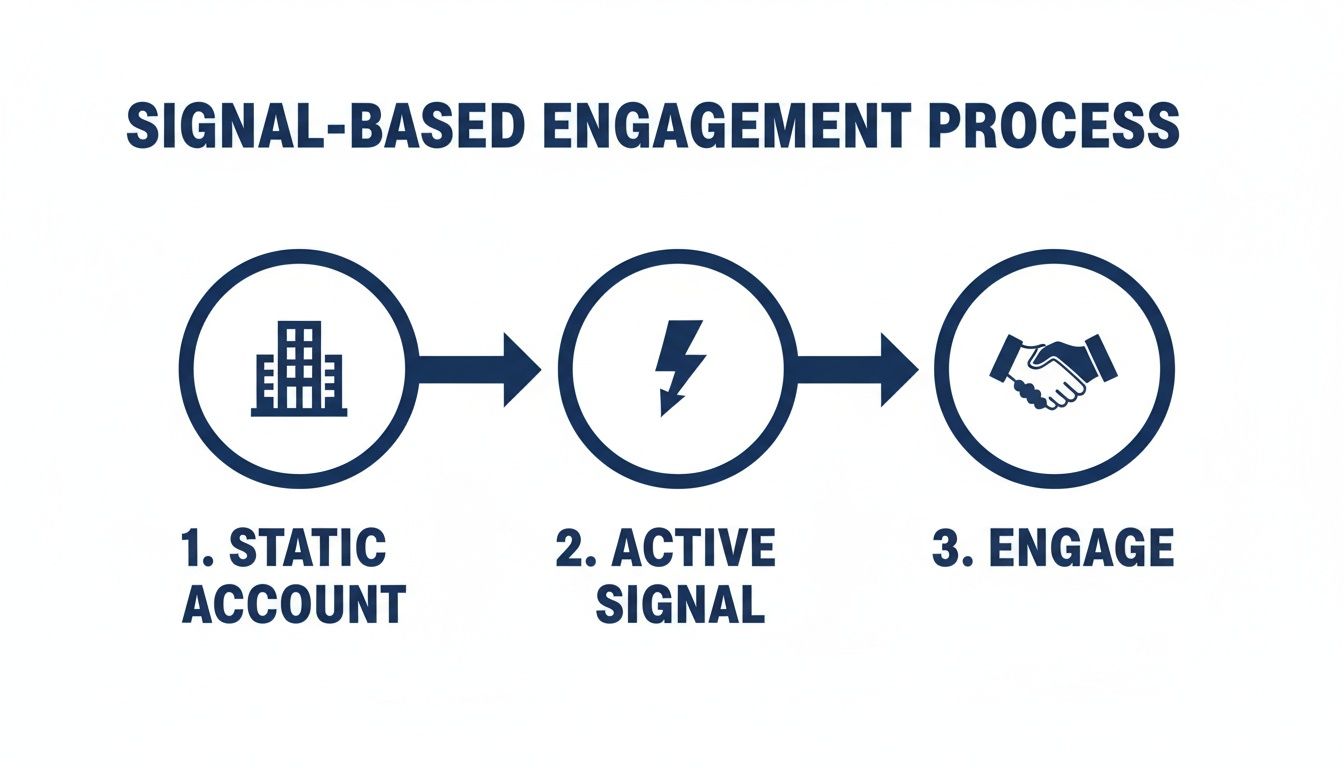
As the image shows, a static target account only becomes a hot opportunity when an active buying signal goes off, triggering timely engagement.
Step 1: Signal Configuration (30 mins)
First, define which buying signals actually matter to your business. This isn't about tracking every piece of company news. It's about pinpointing the specific events that tell you a prospect is entering a buying window.
Start by asking: "What events create an urgent need for our solution?"
Common high-value signals include:
- Leadership Changes: A new CRO, VP of Sales, or CMO is hired.
- Funding Events: The company announces a Series B, C, or a later round.
- Strategic Shifts: They're expanding into a new market or launching a product line.
- Hiring Trends: They post multiple jobs for roles your product supports, like "Payments Specialist" or "Data Scientist."
Once you've defined these, you map them to your target account list. This ensures you're only tracking relevant activity from the companies you want to sell to.
Step 2: Automated Monitoring (Continuous)
This is where you trade manual drudgery for automated precision. Instead of reps wasting hours on LinkedIn and Google News, an intelligent system monitors your target accounts for you 24/7. This is always on, so your team works with the freshest intel.
When a configured signal is detected—like a press release announcing a key executive hire—it gets flagged immediately, often within hours of going public. No manual research is needed. Your team instantly shifts from reactive to proactive.
This step removes the "manual research tax" that bogs down your team's workflow, guaranteeing that opportunities are never missed. You can learn more about structuring these workflows in our signal-based sales playbook.
Step 3: Outreach Activation (15–30 mins per batch)
With a fresh, relevant signal in hand, the final step is to launch personalized outreach. This activation stage is remarkably fast.
The rep simply reviews the signal's context provided by the monitoring system. They can then pull that specific detail—like the name of the new CRO or the funding amount—directly into their outreach sequence. Modern platforms can even use AI to draft a hyper-relevant message based on the signal, which the rep can quickly review and send.
This creates a powerful, compounding effect. Your team isn't just sending more emails; they're sending better, more contextual messages at the perfect time. This seamless workflow is how you turn account intelligence into real pipeline.
How AI-Driven Intelligence Creates Compounding Returns
The old-school approach to account-based lead generation is crushed by a heavy “manual research tax.” Sales teams waste hours every day digging through LinkedIn and news sites for stale insights, which means they can only research a handful of accounts. This manual slog is slow, inconsistent, and almost never uncovers the timely triggers needed for outreach that actually works.
AI-driven intelligence completely eliminates this tax. When you automate the research and monitoring process, you fundamentally change your team’s capacity and effectiveness. This isn't just about working a bit faster; it’s about creating compounding returns that grow your pipeline.
The Before-and-After of Manual Research
The difference between manual and automated intelligence is night and day. Before using Salesmotion, one of our customer's BDR teams spent roughly 45 minutes per account on manual research—scanning LinkedIn, Google News, and press releases—before crafting outreach.
After switching to automated signal monitoring, that dropped to under 5 minutes per account. The result: their team went from researching ~10 accounts/day to 40+, and because the signals were fresher and more relevant, their opportunity creation rate per outreach sequence doubled. They were doing more volume with higher quality context — that's the compounding effect.
This shift proves that the biggest bottleneck in account-based lead generation isn't a lack of motivation, but a lack of operational efficiency. Removing the manual research burden unlocks your team’s true potential.
By automating the "what's happening" and "why now," you free up reps to focus on the truly human part of selling: building relationships and having meaningful conversations.
Amplifying Volume and Quality Simultaneously
The real magic of AI-driven intelligence is its ability to boost both the quantity and quality of your outreach at the same time. Typically, you have to trade one for the other—to increase volume, you sacrifice personalization, and vice versa. Automation breaks this trade-off.
- More Volume: With research time cut by over 85%, reps can engage four, five, or even ten times the number of accounts each day.
- Higher Quality: The AI surfaces real-time buying signals, giving every piece of outreach a specific, relevant hook. Reps no longer fall back on generic templates.
This dual improvement is what drives exponential growth. You’re not just making small, incremental gains; you're fundamentally changing the math behind your pipeline generation. If you want to explore how artificial intelligence can specifically improve your lead qualification, it's worth digging into the concept of AI Powered Lead Scoring.
This is the strategic advantage that separates high-growth companies from everyone else. To dive deeper into how this works, check out our guide on using AI for lead scoring. Ultimately, AI-driven intelligence lets you scale personalization, turning what was once a manual art form into a repeatable science.

“The Business Development team gets 80 to 90 percent of what they need in 15 minutes. That is a complete shift in how our reps work.”
Andrew Giordano
VP of Global Commercial Operations, Analytic Partners
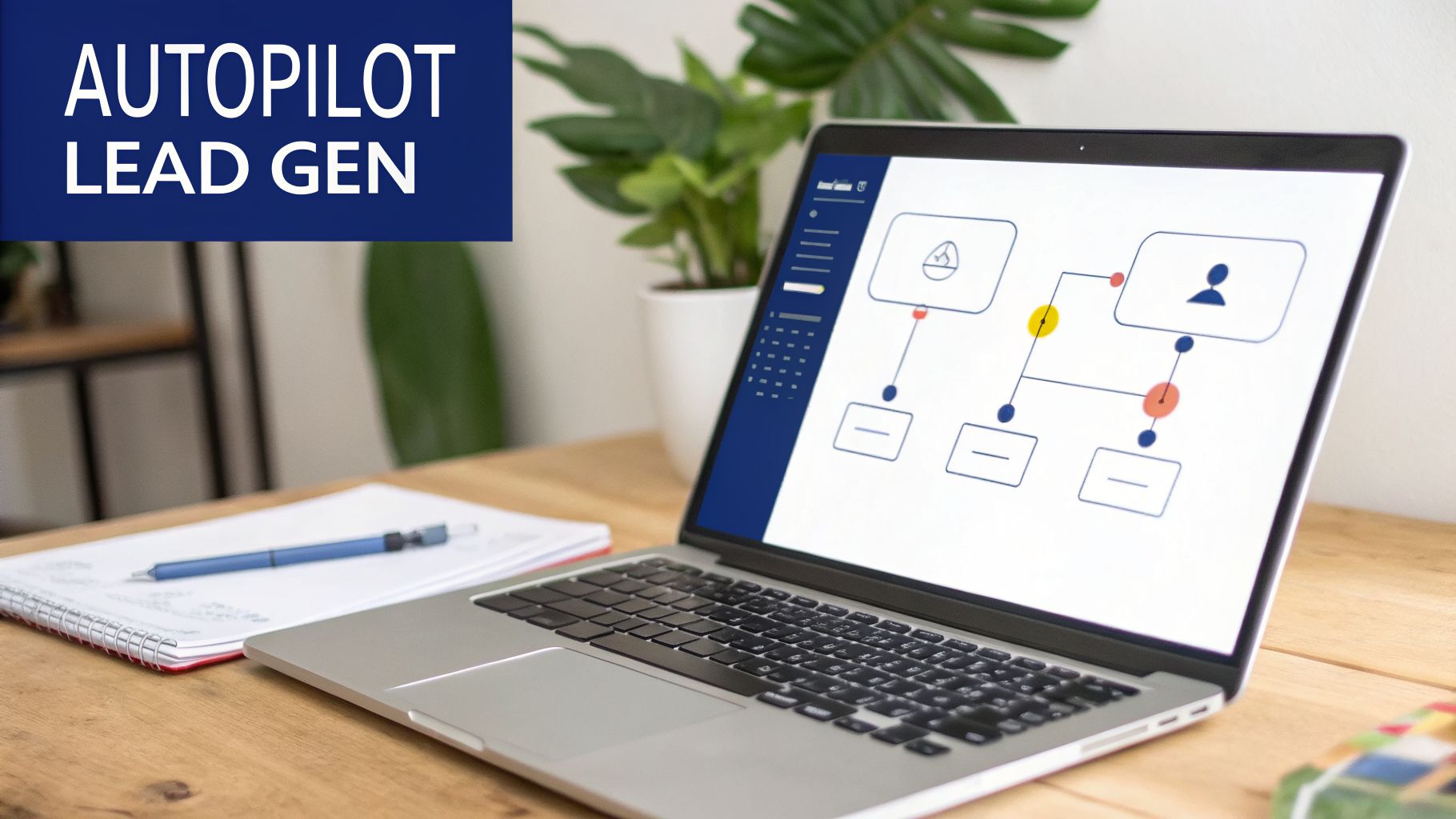
Putting Your ABLG Strategy on Autopilot
So, how do you actually execute a signal-driven account-based lead generation strategy without hiring an army of researchers?
The key isn't to work harder. It's to build an automated system into your sales motion that does the heavy lifting for you. This is how you put your ABLG strategy on autopilot, freeing up your sales reps to have great conversations and close deals.
This all happens through a set of specialized AI agents. Think of them as new members of your team, each tackling a specific job that your reps are probably doing manually today.
Introducing Your Autonomous ABLG Team
Imagine a specialized team working 24/7 to find your next big opportunity. That's what these agents do. They’re built to solve the biggest headaches in modern sales: the endless manual research, the flood of irrelevant signals, and the generic outreach that falls flat.
-
The Research Agent: This agent completely gets rid of the "manual research tax." It works on its own to build deep, structured profiles on your target accounts, pulling insights from thousands of public sources—earnings calls, SEC filings, new job postings, and executive interviews. The output is a strategic brief packed with initiatives, risks, and even talk tracks, giving your reps prep work in minutes that would normally take them hours.
-
The Signal Agent: This is your lookout, on duty around the clock. It monitors every one of your target accounts and alerts your team the second a buying trigger happens. Did they just hire a new CRO? Announce a Series C funding round? The agent doesn't just flag the event—it tells you why it matters and suggests what to do next.
-
The Outreach Agent: This is where intelligence becomes action. This agent takes the insights from the Research and Signal Agents and automatically drafts personalized, multi-step outreach sequences for the right people at the account. Every message is tied to something real—a specific signal or a stakeholder’s known priority.
Together, these agents create a seamless workflow. You set the target accounts, the Research Agent builds the intelligence, the Signal Agent watches for buying triggers, and the Outreach Agent drafts the outreach the moment an opportunity appears.
From Manual Process to Operational Framework
This isn't just a collection of cool tools; it's an operational framework that embeds the best practices of ABLG directly into your team's day-to-day workflow. It's what turns your account-based lead generation strategy from a theoretical plan into a practical, automated reality.
When you deploy these autonomous agents, you solve the core problems that hold most sales teams back:
- A Weak "Why Now": The agents surface timely, actionable triggers for every outreach.
- Signal Overload: They cut through the noise, prioritize what's actually important, and explain the "so what."
- Low-Relevance Messaging: The context generated by the agents gives your reps a real point of view, not just another bland template.
This shift gives your team the power to finally scale personalization and turn all that rich account intelligence into a predictable pipeline. That's how you turn real-world account activity into measurable, repeatable revenue.
Frequently Asked Questions
When you're thinking about building an account-based lead generation program, a few common questions always pop up. Here are some straightforward answers to help turn this strategy into a pipeline-building machine.
How does this approach handle triggers like new hires or funding?
This is where signal-driven ABLG really separates itself from the pack. It's all about timing. One of our customers, an enterprise SaaS company selling to mid-market, was targeting accounts that posted new VP of Sales or CRO hires.
Within 48 hours of the leadership change signal firing, their SDRs sent personalized outreach referencing the new hire and the strategic shift it typically signals.
Compared to their generic outreach to the same ICP, reply rates jumped from ~3% to over 12% — roughly a 4x uplift. The key was timing: reaching out in the window when a new leader is actively evaluating their stack and open to conversations.
It just goes to show that hitting the right person with the right message at the right time is what drives real pipeline.
What does the signal-to-outreach workflow actually look like?
Getting from a signal to a live outreach sequence can be boiled down to a quick, three-step process that cuts out hours of manual research.
- Signal Configuration (30 mins): We define which signals matter for a given campaign — e.g. leadership hires in payments roles, Series C+ funding, or expansion into new markets — and map them to a target account list.
- Monitoring and Surfacing (Continuous, Automated): Salesmotion monitors accounts 24/7 and surfaces triggered signals as they happen, typically within hours of a public event. No manual research needed.
- Outreach Activation (15–30 mins per batch): The rep reviews the signal context, pulls it into their sequence tool or uses our API to feed it into an AI-drafted message, and launches. End to end, what used to take an SDR 2–3 hours of manual research per account now takes minutes.
How does this compare to old-school B2B marketing?
In the B2B world, account-based strategies are no longer a niche tactic; they've become the dominant play. In fact, 70% of marketers are already running active account-based programs.
This shift isn't happening by accident. The results speak for themselves. Teams are reporting significant lifts in pipeline conversion when they get this right. If you want to dig into the numbers, you can discover more insights about account-based marketing stats.
Ready to put your account-based lead generation strategy on autopilot? Salesmotion uses three specialized AI agents to autonomously track what matters across your target accounts, surface buying signals, and draft personalized outreach. Stop the manual research tax and start building a predictable pipeline. See how Salesmotion works.