The days of manually tracking accounts through Google News alerts, LinkedIn searches, and quarterly earnings calls are over. B2B sales teams managing 500+ accounts face an impossible task: staying on top of buying signals across their entire book of business while also researching prospects and drafting personalized outreach.
AI sales agents have evolved from simple automation tools into sophisticated systems that autonomously monitor accounts for compelling events, synthesize account intelligence from dozens of sources, and draft contextually relevant outreach within minutes of detecting a signal. The result? Sales teams are catching high-intent opportunities 3-6 months earlier, cutting account research time by 80%, and seeing reply rates jump from 1-5% to 25-40% when outreach is anchored to specific buying signals.
Comparing AI sales agents?
Most 'AI sales agents' are just templated email senders. Salesmotion is three agents that actually do the work.
Signal Agent + Research Agent + Outreach Agent — every account, every day. From $85/mo, monthly contract.
TL;DR: The best AI sales agents combine real-time signal monitoring with research-grounded outreach. This guide covers 10 platforms that excel at detecting buying signals and generating personalized messages, from purpose-built account intelligence agents to autonomous AI BDRs and enterprise revenue platforms.
Best AI sales agent by use case (2026):
| Use Case | Best AI Agent | Starting Price | Key Strength |
|---|---|---|---|
| Account intelligence + signal-anchored outreach | Salesmotion | $85/mo | 3 agents (Signal, Research, Outreach), 1,000+ sources, cited data |
| Enterprise revenue workflow automation | Outreach AI | Custom | Sequencing, deal inspection, forecasting |
| Signal-based lead identification | Coldreach.ai | Custom | Custom signal detection with auto-messaging |
| Data enrichment + custom AI workflows | Clay | Free; $185/mo | 150+ data providers, workflow builder |
| Autonomous AI SDR/BDR | 11x.ai | Custom | Fully autonomous outbound agent |
| Intent-driven outreach orchestration | Regie.ai | $180/user/mo | Persona sequences driven by intent signals |
This guide covers the top AI sales agents that excel at two critical capabilities: monitoring accounts for buying signals in real-time and generating personalized outreach based on deep account intelligence. Each platform brings distinct strengths, from all-in-one autonomous agents to specialized signal detection and research systems.
1. Salesmotion: Purpose-Built Account Intelligence Agents
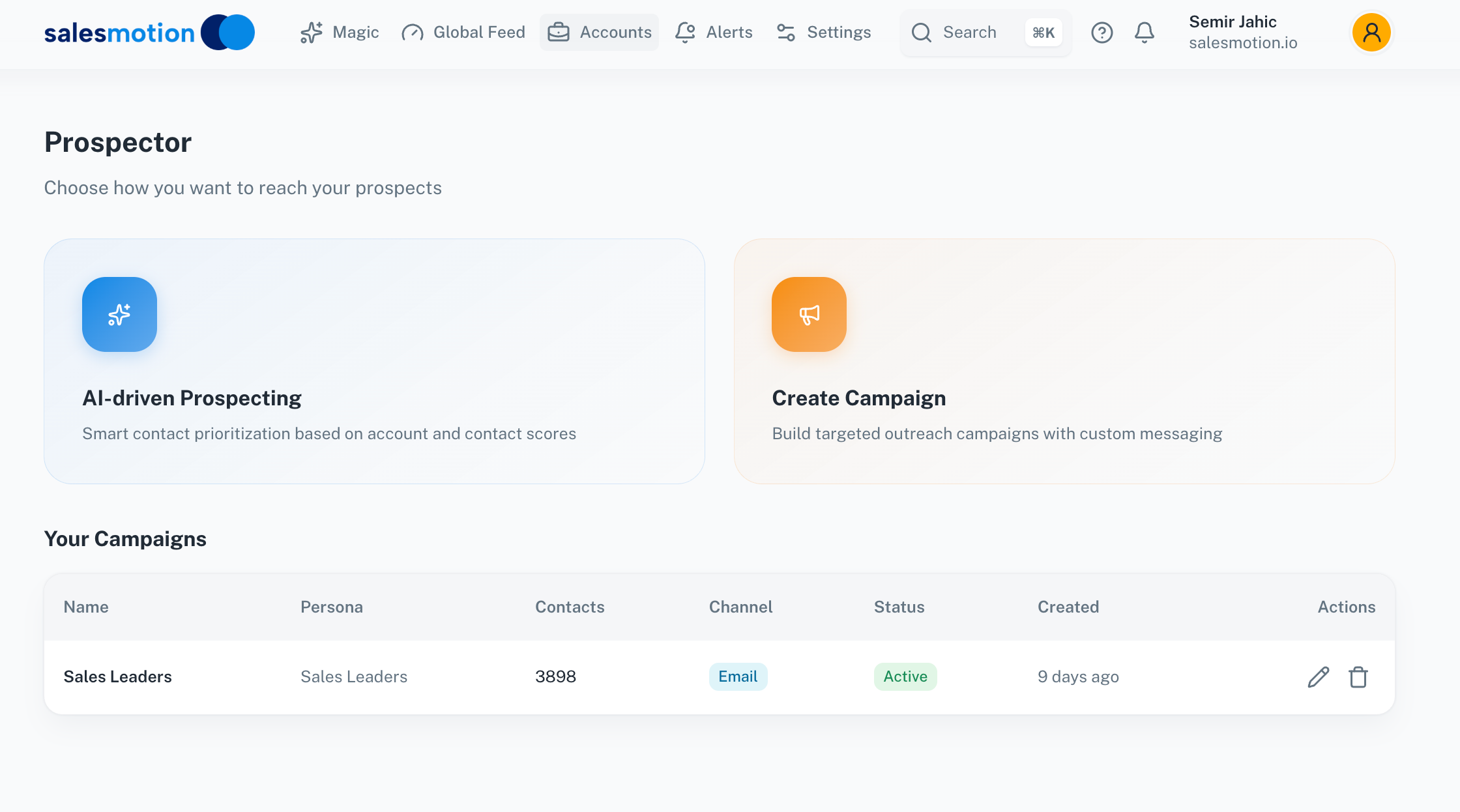 Salesmotion's Outreach Agent drafts personalized emails grounded in real account intelligence and live buying signals.
Salesmotion operates as a system of three specialized AI agents designed specifically for account-based sales teams that need continuous monitoring across their full portfolio. The Signal Agent monitors 1,000+ sources, including earnings calls, SEC filings, news, hiring patterns, leadership changes, funding rounds, M&A activity, podcasts, and industry publications, to detect buying signals in near real-time.
When a signal fires on one of your accounts, the Research Agent immediately assembles an account brief that synthesizes intelligence from 42+ sources, providing the "why now" context that turns a cold outreach into a relevant conversation. The Outreach Agent then drafts personalized emails and LinkedIn messages anchored to the specific trigger, whether that's a new CRO hire, a strategic initiative mentioned in an earnings call, or a geographic expansion.
Best for: B2B sales teams managing large account portfolios (100-1,000+ accounts) who need always-on signal monitoring paired with instant, research-backed outreach. Particularly effective for AEs and SDRs who previously spent hours manually researching accounts.
Key capabilities:
- 24/7 monitoring of public and proprietary signals across 1,000+ sources
- Live Signal Feed that surfaces compelling events matched to your ICP
- Account Briefs generated in seconds with full source citations
- AI-drafted outreach that references specific triggers and strategic context
- Native integration with Salesforce and HubSpot
- Team-based access with unlimited users on team plans
Pricing: Monthly contracts with fast deployment (live in hours). See pricing.
See Salesmotion on a real account
Book a 15-minute demo and see how your team saves hours on account research.
2. Outreach AI Agents: Enterprise Revenue Workflow Platform
 Outreach's AI agent ecosystem includes dedicated agents for research, prospecting, and deal management.
Outreach has evolved from a sales engagement platform into a full AI agent ecosystem featuring dedicated agents for Research, Revenue (Prospecting), and Deal Management. The platform's agents autonomously perceive customer signals across all connected systems, reason about optimal actions, and execute tasks like researching accounts, updating CRM records, and orchestrating multi-channel sequences.
Outreach's Research Agent can summarize account activity and extract insights from conversation transcripts, while the Revenue Agent handles prospecting workflows including contact sourcing and initial outreach generation. The platform excels at reducing manual data entry, with agents automatically updating Salesforce based on conversation intelligence and flagging deal risks in real-time.
Best for: Enterprise sales organizations (100+ sellers) already using Salesforce who need a unified platform that combines signal detection, conversation intelligence, and execution across the full revenue cycle.
Key capabilities:
- Purpose-built agents for research, prospecting, and deal management
- Conversation intelligence that detects pricing objections and competitor mentions
- Automated CRM updates and deal stage progression
- Multi-channel sequence orchestration across email, phone, and social
- Real-time alerts for deal risks based on sentiment shifts
Pricing: Outreach does not publish dollar figures. It sells four tiers — Amplify Essentials, Core, Plus, and Pro — differentiated by AI credit allotments, described as per-user pricing with no platform fees.

“The moment we turned on Salesmotion, it became essential. No more hours on LinkedIn or Google to figure out who we're talking to. It's just there, served up to you, so it's always 'go time.'”
Adam Wainwright
Head of Revenue, Cacheflow
3. Coldreach.ai: Signal-Based Lead Identification
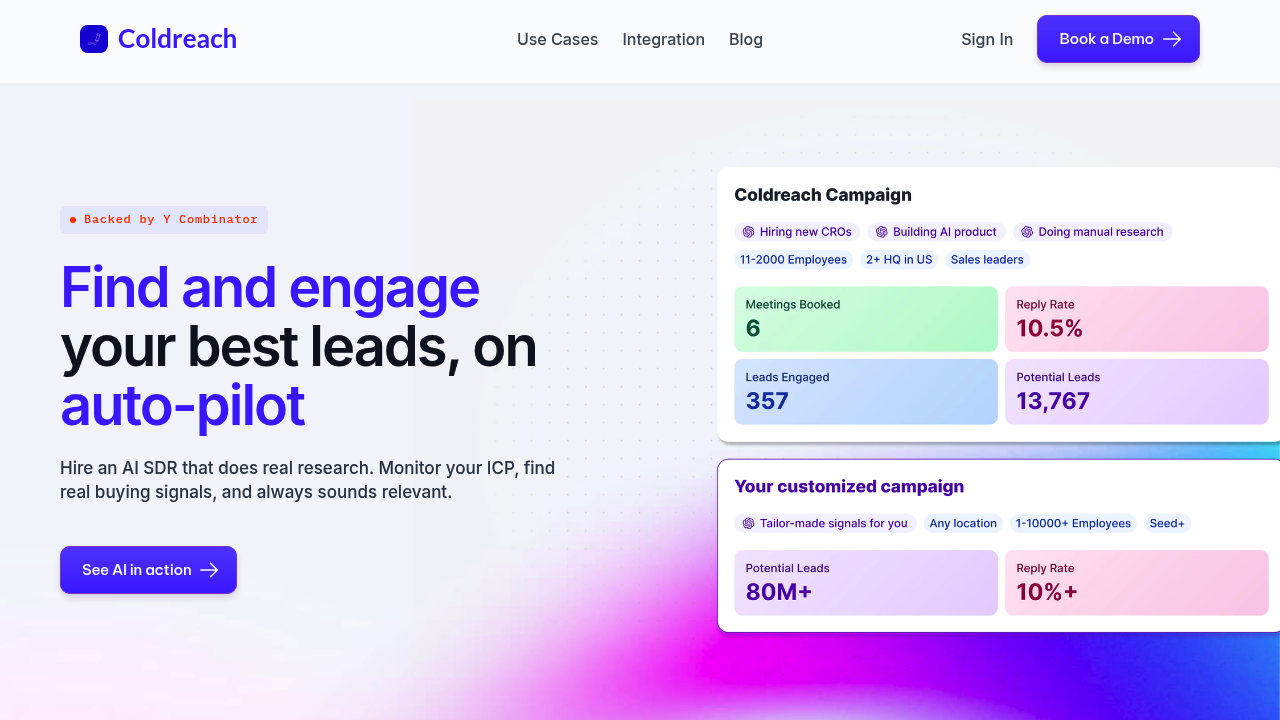 Coldreach monitors hiring patterns, tech stack changes, and funding announcements to identify accounts showing buying intent.
Coldreach specializes in signal-based selling, monitoring hiring patterns, tech stack changes, job postings, and funding announcements to automatically identify accounts showing buying intent. The platform then enriches those signals with contact data and drafts personalized emails that reference the specific trigger.
What sets Coldreach apart is its focus on finding leads you didn't know existed by detecting patterns across thousands of companies. When a company matching your ICP starts hiring for roles that indicate a need for your solution (for example, hiring a Head of Revenue Operations when you sell RevOps tools), Coldreach surfaces that account with context and suggested messaging angles.
Best for: Outbound teams that want to build pipeline from signal-based prospecting rather than static lists. Particularly effective for identifying early-stage buying cycles before they show up in traditional intent data.
Key capabilities:
- Real-time monitoring of job postings and hiring signals
- Technographic change detection (software adoption/removal)
- Funding and M&A event tracking
- Automated lead enrichment with decision-maker contacts
- AI-generated outreach templates based on detected signals
Pricing: Subscription-based with tiered plans based on signal volume.
4. Clay: AI Agents for Data Enrichment and Workflow Automation
 Clay's Claygent AI agents build detailed prospect profiles from 150+ data sources with customizable workflow logic.
Clay operates as a data enrichment and workflow automation platform powered by "Claygent" AI agents that can visit websites, scrape information, aggregate data from 150+ sources, and build detailed prospect profiles. While not exclusively focused on signal monitoring, Clay excels at creating sophisticated research workflows that trigger personalized outreach based on specific conditions.
Sales teams use Clay to build "personalization waterfalls," layered enrichment logic that pulls the most relevant context for each prospect from multiple data sources, then generates unique outreach based on what's discovered. For example, a workflow might check for recent funding, then leadership changes, then hiring patterns, and tailor messaging based on which signal is present.
Best for: Revenue operations teams and sophisticated outbound practitioners who want full control over their data enrichment and personalization logic. Best suited for teams comfortable building custom workflows.
Key capabilities:
- AI agents (Claygent) that can navigate websites and extract specific data
- 150+ data source integrations for comprehensive enrichment
- Advanced workflow builder for conditional personalization logic
- Custom AI prompts for generating tailored outreach
- Bulk enrichment for large prospect lists
Pricing: A free tier, then Launch at $185/month and Growth at $495/month (roughly $167 and $446 on annual billing), with Enterprise custom. Usage draws on two pools: Data Credits for marketplace enrichments and Actions for workflow operations.

“The Business Development team gets 80 to 90 percent of what they need in 15 minutes. That is a complete shift in how our reps work.”
Andrew Giordano
VP of Global Commercial Operations, Analytic Partners
5. Persana AI: Autonomous Agent "Nia" with 75+ Data Sources
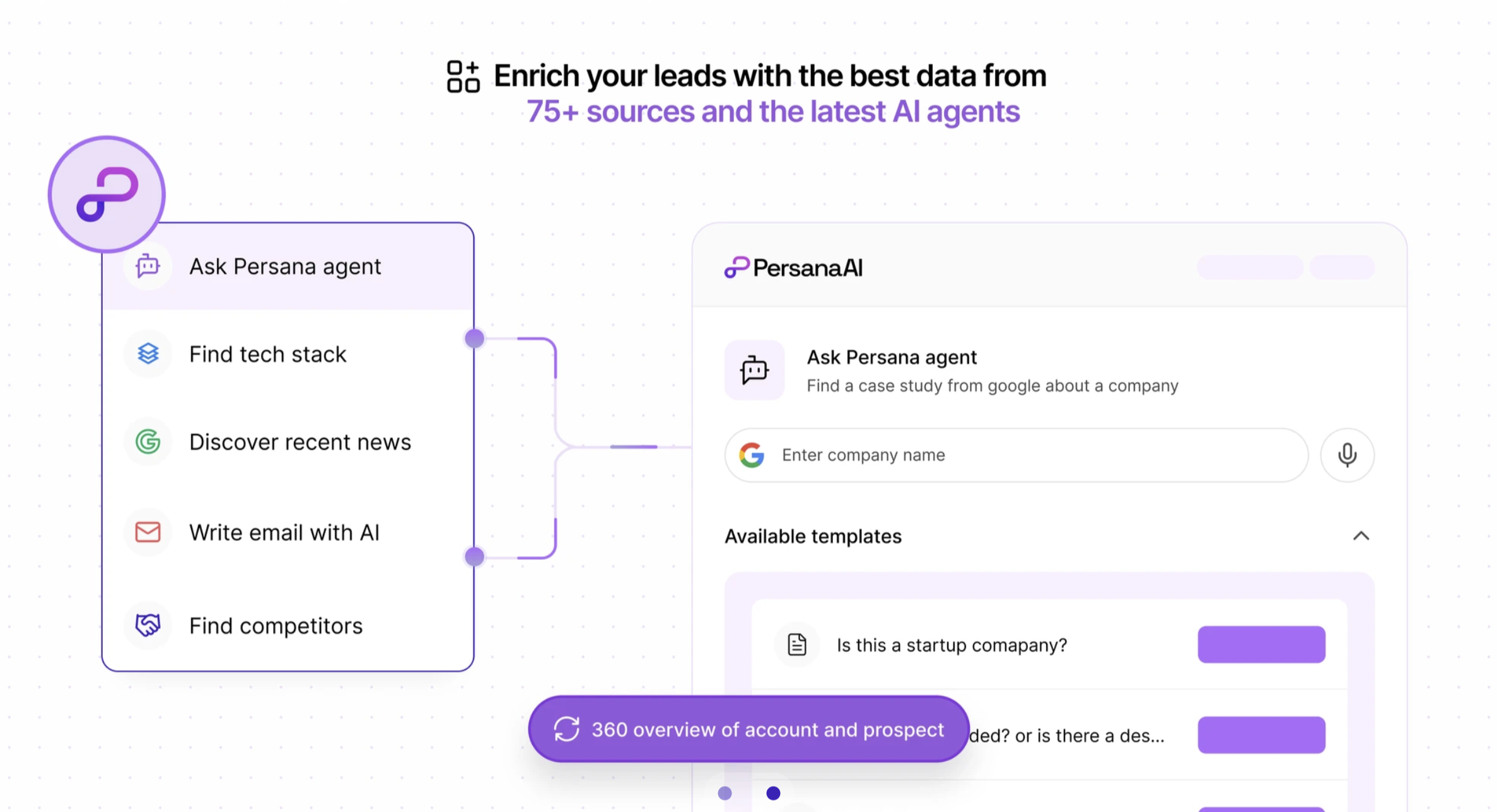 Persana's AI agent Nia autonomously monitors accounts and executes personalized outreach sequences based on real-time triggers.
Persana AI features an AI agent called "Nia" that autonomously aggregates data from over 75 sources, monitors accounts for real-time triggers like funding events and leadership changes, and executes personalized outreach sequences when intent signals reach optimal levels. The platform combines lead generation, enrichment, and signal-based outreach in a single system.
Nia continuously monitors your target accounts and scores them based on 300+ data points, automatically moving high-intent accounts into outreach sequences. The agent can identify when multiple signals align, for example, a company that just raised Series B funding and is hiring a VP of Sales, and trigger highly contextual outreach referencing both events.
Best for: Mid-market and growth-stage B2B companies that want an all-in-one system combining prospecting, signal detection, and automated outreach without building complex workflows.
Key capabilities:
- Autonomous agent (Nia) that monitors 75+ data sources continuously
- 300+ data point personalization for hyper-relevant messaging
- Real-time trigger detection (funding, hiring, tech changes)
- Automated lead scoring based on signal strength
- Multi-channel sequence execution across email and LinkedIn
Pricing: Subscription plans based on contact volume and feature access.
6. Regie.ai: Intent-Based Prospecting Orchestration
 Regie.ai orchestrates multi-touch sequences that automatically adjust based on detected buying intent signals.
Regie.ai positions itself as a "generative AI platform for sales prospecting," focusing on persona-based sequences and intent-driven outreach. The platform listens for real buying intent signals across multiple channels, including website visits, content downloads, and third-party intent data, then orchestrates multi-touch sequences that reference those specific signals.
Regie's strength lies in its "Signals" feature, which surfaces the most relevant buying signals for each account and automatically adjusts outreach timing and messaging based on signal strength. The platform helps teams cut through the noise by prioritizing accounts showing genuine intent rather than blasting entire lists.
Best for: Sales development teams that run account-based campaigns and need to orchestrate outreach based on multiple signal types (first-party intent, third-party signals, and technographic data).
Key capabilities:
- Multi-source signal aggregation (1st and 3rd party intent)
- Persona-based email sequence generation
- AI-powered message personalization at scale
- Signal-triggered sequence enrollment
- A/B testing framework for optimizing messaging
Pricing: Regie.ai publishes per-user pricing: AI SEP at $180 per user per month on an annual contract with a 10-seat minimum, Force Multiplier Rep at $499 per user per month with a 5-seat minimum, then custom Enterprise. The parallel dialer is $1,800 per user per year.
7. 6sense: Predictive Account Intelligence and Intent Data
 6sense uses AI to predict which accounts are in-market based on anonymous website behavior and third-party intent signals.
6sense uses AI to predict which accounts are in-market based on anonymous website behavior, content consumption patterns, and third-party intent signals. The platform's "Signalverse" aggregates billions of buying signals to identify accounts actively researching solutions in your category, then scores them based on their stage in the buying journey.
While 6sense is primarily an account intelligence and advertising platform rather than a direct outreach tool, its AI agents analyze buying behavior to recommend optimal engagement strategies. Sales teams use 6sense to prioritize which accounts warrant immediate outreach versus nurture campaigns, dramatically improving efficiency by focusing effort on accounts showing genuine purchase intent.
Best for: Enterprise marketing and sales teams (1,000+ employees) running account-based strategies who need predictive intelligence to identify in-market accounts before they enter active evaluation.
Key capabilities:
- Anonymous buyer intent detection across web properties
- Predictive AI that identifies accounts entering buying cycles
- Account-level intent scoring and buying stage prediction
- Recommended engagement strategies based on intent level
- Integration with MAP and CRM for workflow automation
Pricing: 6sense does not publish pricing. Vendr's marketplace data reports a median annual contract value of $62,440 across 381 purchases, with a range of $11,566 to $175,022.
8. Artisan (Ava): Autonomous AI BDR
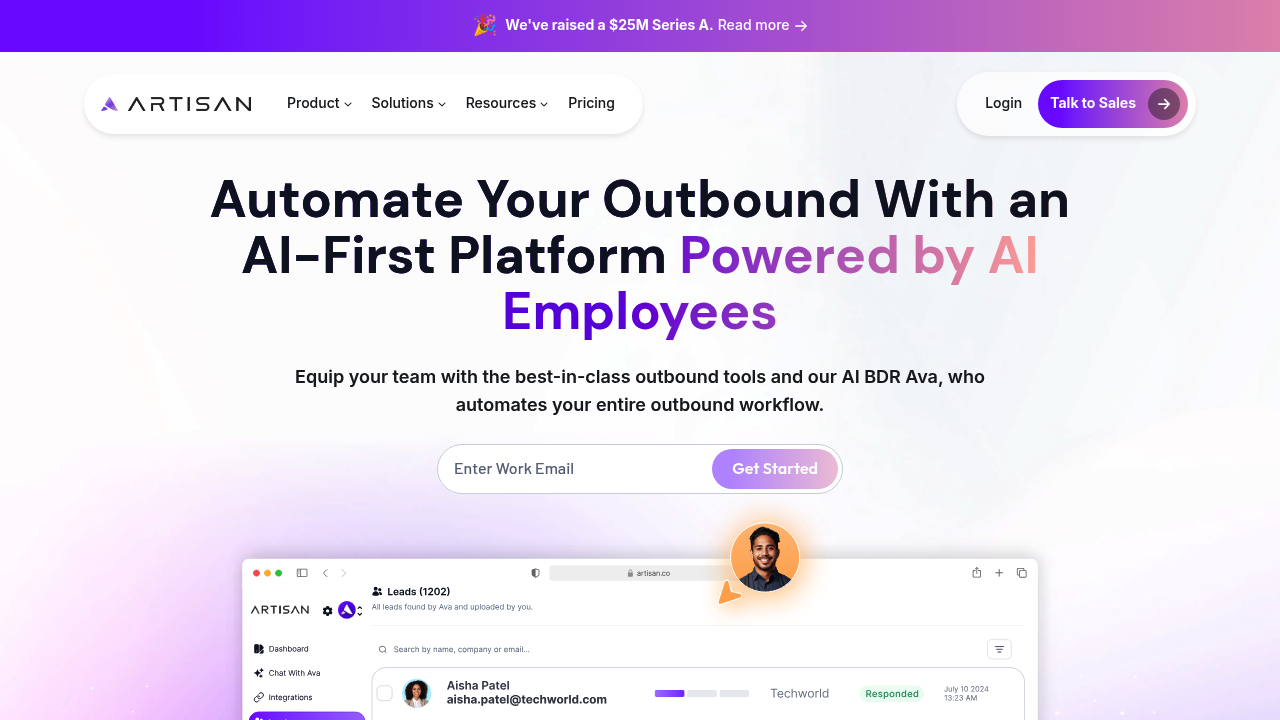 Artisan's AI agent Ava operates as a fully autonomous BDR, handling the entire prospecting cycle from research to outreach.
Artisan features an AI agent called "Ava" that operates as a fully autonomous BDR (Business Development Representative) that handles the entire prospecting cycle: finding prospects, researching accounts, crafting personalized messages, and sending outreach. Ava manages 15,000+ companies continuously, monitoring for signals and executing outbound campaigns without requiring external integrations.
Ava's research capabilities include analyzing company websites, news mentions, social media activity, and publicly available data to build comprehensive prospect profiles. The agent then uses this intelligence to craft highly personalized cold emails that reference specific company initiatives, recent achievements, or challenges relevant to your solution.
Best for: Small to mid-sized sales teams (5-50 people) that want to augment their SDR capacity with an autonomous agent that requires minimal oversight. Particularly effective for teams selling to high-volume target segments.
Key capabilities:
- Autonomous prospecting across 15,000+ monitored accounts
- Multi-source account research and profile building
- AI-generated personalized outreach at scale
- Built-in email deliverability optimization
- Self-contained system requiring no external integrations
Pricing: Subscription-based with per-agent pricing model.
For teams evaluating autonomous agents, this AI SDR tools comparison breaks down what actually works for B2B pipeline generation.
9. ZoomInfo Copilot: Data-Enriched Signal Detection
 ZoomInfo Copilot layers AI-powered signal detection on top of its extensive B2B contact and company database.
ZoomInfo Copilot layers AI-powered workflow automation on top of ZoomInfo's extensive B2B contact and company database. The platform monitors account activity, including website visits, technographic changes, and business events, then surfaces timely outreach recommendations anchored to ZoomInfo's proprietary data.
Copilot's strength is combining high-quality contact data with real-time buying signals. When an account shows intent, Copilot automatically enriches contact records with direct dials, email addresses, and org chart relationships, then recommends who to contact and suggests messaging angles based on the detected signal.
Best for: Mid-market and enterprise teams that prioritize data quality and need both signal detection and contact enrichment in a single platform. Particularly valuable for teams selling into complex structures requiring multi-threading.
Key capabilities:
- Real-time intent signal detection across ZoomInfo's data network
- Automatic contact enrichment with direct dials and verified emails
- Organizational mapping and buyer group identification
- AI-generated outreach recommendations based on signals
- Native CRM integration for automated workflow triggers
Pricing: ZoomInfo does not publish list pricing; its own pricing page explains that amounts vary because pricing is consumption-based. Vendr shows an average contract value of $33,500 across 1,012 anonymized deals.
To understand the full landscape of account intelligence tools, explore detailed comparisons of leading platforms. For teams evaluating Copilot specifically, see our ZoomInfo Copilot alternatives guide.
10. Apollo.io: All-in-One Prospecting and Engagement
 Apollo.io combines a B2B contact database with engagement automation and AI-powered outreach features.
Apollo.io combines a B2B contact database with engagement automation and AI-powered outreach features. While not exclusively focused on signal monitoring, Apollo's platform includes intent data, technographic tracking, and automated enrichment that surfaces accounts showing buying signals.
The platform's AI writing assistant generates personalized email copy based on prospect data pulled from Apollo's database, including company news, technologies used, and hiring patterns. Sales teams can build multi-channel sequences that automatically adjust based on prospect engagement and detected signals, creating a scalable outbound engine. Apollo recently acquired Pocus to add signal intelligence and revenue orchestration capabilities to its platform.
Best for: SMB and mid-market sales teams (10-200 reps) that need an affordable all-in-one solution combining prospecting data, engagement automation, and basic signal detection.
Key capabilities:
- B2B database with 230M+ people and 30M+ companies
- Intent data and technographic change tracking
- AI email writing assistant for personalized outreach
- Multi-channel sequence builder (email, phone, LinkedIn)
- Built-in email deliverability tools and inbox rotation
Pricing: A free plan with 900 credits a year, then Basic at $49, Professional at $79, and Organization at $119 per user per month on annual billing (3-user minimum on Organization).
What to Look for in AI Sales Agents for Signal Monitoring
When evaluating AI sales agents for your team, prioritize these capabilities:
Signal breadth and depth: The best platforms monitor 1,000+ sources including earnings calls, SEC filings, news, hiring patterns, leadership changes, funding events, M&A activity, podcast mentions, and industry publications. Broader coverage means fewer missed opportunities.
Signal-to-outreach speed: Time kills deals. Look for platforms that detect signals in near real-time and can generate contextual outreach within minutes, not days. This speed advantage often determines who gets the meeting.
Research quality and citations: AI-drafted outreach is only valuable if it's grounded in accurate intelligence. The best platforms provide source citations for every insight, allowing reps to verify claims and dig deeper when needed.
Personalization without AI smell: Generic AI-written emails get deleted. Effective platforms generate outreach that references specific account triggers and strategic context, making messages feel human-written and relevant rather than obviously automated.
Integration with existing workflows: Standalone tools create workflow friction. Prioritize platforms with native CRM integrations (Salesforce, HubSpot) and the ability to push signals, research, and drafted outreach into the tools your team already uses.
Human-in-the-loop options: Full autonomy isn't always desirable. The best platforms offer configurable approval workflows, from fully autonomous sending to "draft for review" modes that let reps maintain control over what goes out under their name.
For comprehensive guidance on account research best practices, explore proven frameworks used by top enterprise sales teams.
Making the Choice: Match Your Use Case to Platform Strengths
The right AI sales agent depends on your specific bottleneck:
If your challenge is monitoring large account portfolios without missing buying signals, platforms like Salesmotion and 6sense excel at always-on monitoring across hundreds or thousands of accounts, surfacing high-intent opportunities the moment they emerge.
If you need autonomous end-to-end prospecting with minimal oversight, agents like Artisan (Ava) and Persana (Nia) handle the full cycle from research through outreach execution, functioning as digital SDRs.
If you want maximum control and customization over enrichment logic, Clay provides the flexibility to build sophisticated workflows tailored to your exact ICP and messaging strategy.
If you're an enterprise team requiring a unified platform across the full revenue cycle, Outreach and ZoomInfo Copilot integrate signal detection with conversation intelligence, forecasting, and deal management.
If you prioritize signal-based lead discovery over static list prospecting, Coldreach and Regie.ai focus on identifying accounts showing buying intent through hiring, tech stack changes, and other trigger events.
The most effective approach often combines multiple tools: a data/enrichment platform (Clay, ZoomInfo) paired with a specialized signal monitoring or outreach agent (Salesmotion, Artisan, Persana). This stack ensures both data accuracy and high-quality, contextual engagement.
The Future: From Outreach Automation to Intelligent Account Management
AI sales agents are evolving beyond simple automation toward genuine account intelligence. The best systems now understand not just what happened ("Company X hired a new CTO") but why it matters ("New CTO has a track record of modernizing tech stacks at previous companies, creating a 6-month window for infrastructure deals").
This shift from activity automation to intelligence-driven action represents a fundamental change in how B2B sales teams operate. Instead of reps manually tracking accounts through fragmented tools and hoping to notice important signals, AI agents create an always-on intelligence layer that continuously monitors, interprets, and acts on buying signals across entire portfolios.
The teams winning today aren't choosing between human reps and AI agents. They're strategically pairing them. AI handles the high-volume, repeatable work (monitoring 500+ accounts, synthesizing intelligence from dozens of sources, drafting initial outreach), while human reps focus on relationship-building, complex objection handling, and closing strategic deals. For more on AI adoption strategies that actually work, explore practical implementation frameworks.
The result? Sales teams are catching opportunities earlier, having more relevant conversations, and converting pipeline at higher rates, all while managing larger account portfolios than was previously possible with manual processes alone.
Key Takeaways
- AI sales agents have evolved from simple automation to sophisticated systems that monitor signals, synthesize research, and draft contextual outreach within minutes of detecting a buying trigger.
- The best platforms monitor 1,000+ sources (earnings calls, SEC filings, hiring patterns, news, funding) and convert those signals into personalized outreach, not generic templates.
- Signal-to-outreach speed is a critical differentiator. Teams using signal-anchored outreach see reply rates of 25-40% compared to 1-5% for generic cold outreach.
- Enterprise teams should prioritize platforms with native CRM integrations and human-in-the-loop workflows that give reps control over what goes out under their name.
- The most effective stack often pairs a signal monitoring agent with an enrichment platform, ensuring both intelligence depth and data accuracy.
- Match your choice to your biggest bottleneck: portfolio monitoring, autonomous prospecting, custom workflow control, or unified enterprise revenue management.
- For vendor-specific comparisons, see our Poggio alternatives and Rox alternatives guides.
Frequently Asked Questions
What are AI sales agents for signal monitoring?
AI sales agents for signal monitoring are software platforms that autonomously track buying signals across hundreds or thousands of data sources, including earnings calls, SEC filings, news, hiring patterns, leadership changes, funding rounds, and industry publications. When a relevant signal is detected on a target account, these agents synthesize the context and either alert the rep or automatically draft personalized outreach anchored to that specific trigger. The best platforms combine signal detection with account research and outreach generation in a single workflow.
How do signal-triggered AI sales agents differ from traditional sales automation?
Traditional sales automation (sequencers, email blasters) sends pre-written messages on a schedule regardless of what's happening at the account. Signal-triggered agents only activate when something meaningful occurs, like a leadership change, a funding round, or a strategic initiative mentioned on an earnings call. This means every outreach has a specific "why now" reason, which is why signal-anchored messages see dramatically higher reply rates (25-40%) compared to generic automated sequences (1-5%).
Which AI sales agent is best for large account portfolios?
For teams managing 100-1,000+ accounts that need continuous monitoring, Salesmotion and 6sense are purpose-built for portfolio-scale signal detection. Salesmotion monitors 1,000+ sources and pairs signals with instant account briefs and AI-drafted outreach. 6sense excels at predictive intent scoring and identifying anonymous buyers. The right choice depends on whether you prioritize outreach automation (Salesmotion) or predictive analytics and advertising (6sense).
Can AI sales agents replace human SDRs?
AI sales agents augment human SDRs rather than replacing them. Platforms like Artisan (Ava) and Persana (Nia) can handle high-volume prospecting autonomously, but complex deals, relationship-building, and nuanced objection handling still require human judgment. The most effective teams use AI agents for the research-intensive, repetitive work (monitoring signals, drafting initial outreach) while their human reps focus on strategic conversations and closing.