The best data enrichment company depends on what you need filled in. For multi-provider waterfall enrichment that RevOps can shape, choose Clay. For the broadest single contact and company database in an enterprise contract, choose ZoomInfo. For enrichment and outbound in one tool with a free plan, choose Apollo.io. Teams prospecting into Europe usually shortlist Cognism, and HubSpot customers already have enrichment built into paid plans.
TL;DR: Data enrichment companies fill in the missing fields on your leads, contacts and accounts. The top three picks are Clay for waterfall enrichment across many providers, ZoomInfo for a large verified database with an AI layer on top, and Apollo.io for teams that want enrichment, sequencing and calling at a published price. Pick by enrichment level first (lead, contact or account), then by where the data has to land.
Top Picks
| Tool | Best for | Starting price |
|---|---|---|
| Clay | Waterfall enrichment across 150+ providers | Free; Launch $185/mo, Growth $495/mo |
| ZoomInfo | Enterprise contact and company data | Custom, consumption-based |
| Apollo.io | Enrichment plus outbound in one tool | Free; $49–$119/user/mo (annual) |
Why Trust This Guide?
Every price, plan and product fact on this page comes from each vendor's own website: our vendor fact sheets from the 10 October 2026 re-verification of 107 vendors, plus fresh checks on 22 October 2026 for the vendors without a sheet. Where a vendor does not publish pricing, we say so instead of estimating, and third-party figures such as Vendr's are named in the sentence. We did not use review-site ratings, because we could not verify them at source.
Salesmotion publishes this guide. Salesmotion is an account intelligence platform, not a contact enrichment vendor, so it has no numbered slot here; where it fits is explained in its own section below. The order of the list follows the enrichment approach, from multi-provider and broad databases to specialist sources, not a score.
What buyers ask about data has also changed. We held 55 sales and customer calls between August and October 2026, and in 25 of them the buyer pressed on whether the data was current and relevant rather than on how much of it there was. As a commercial lead at a life sciences software company put it: "I'm not impressed by pulling a lot of data these days because any tool can do that. The question is relevant data." A business development rep at a CRO asked the question every enrichment pilot should answer: "So how confident are you that your data is up to date?"
Lead, Contact and Account Enrichment: Which Do You Need?
Data enrichment tools solve three different problems, and most teams need more than one.
| Level | What it fills in | Typical trigger | Who uses it |
|---|---|---|---|
| Lead enrichment | Job title, company, revenue band and industry for an inbound lead that arrived with only an email address | A form submission | Marketing, for scoring and routing |
| Contact enrichment | Current emails, direct dials and titles on records already in the CRM, as people change jobs | A scheduled or continuous CRM sync | Sales ops and SDRs |
| Account enrichment | The company record: revenue, headcount, tech stack, funding history and recent news | New account creation or a periodic refresh | AEs, account managers and ABM teams |
Contact databases handle the first two well. Account-level enrichment needs a different data model, one built around events rather than static fields: leadership changes, earnings commentary, hiring patterns and funding. That is where account intelligence starts. Use the "Enrichment level" column in the comparison table below to see which level each vendor is built for.

“The account and contact signals are key for reaching out at important times, and the value-add messaging it creates unique to every contact helps save time and efficiency.”
Daniel Pitman
Mid-Market Account Executive, Black Swan Data
Data Enrichment Companies Compared
| Tool | Enrichment level | Best for | Standout capability | Pricing | Free plan or trial |
|---|---|---|---|---|---|
| Clay | Lead, contact and account | RevOps and GTM engineers | Waterfall enrichment across 150+ providers | Free; Launch $185/mo, Growth $495/mo | Free plan; 14-day trial |
| ZoomInfo | Contact and account | Enterprise sales and marketing | 500M+ contacts and 100M+ companies | Custom, consumption-based | ZoomInfo Lite free tier (10 credits a month) |
| Apollo.io | Lead and contact | SMB and mid-market outbound | 240M contacts with sequencing and a dialer | Free; $49–$119/user/mo (annual) | Free plan; 14-day trial on Basic and Professional |
| Clearbit (HubSpot data enrichment) | Lead and account | HubSpot customers | Enrichment inside HubSpot records | Included in paid HubSpot plans | Comes with paid HubSpot subscriptions |
| Cognism | Contact | Prospecting into Europe | Phone-verified mobile numbers | Custom, quote-only | Free data sample |
| Lusha | Contact | Reps and small teams | 515M+ contacts with 26 buying signals | Free (40 credits/mo); Starter $37.45/mo, Professional $52.45/mo (annual) | Free plan (40 credits a month) |
| People Data Labs | Contact and account (via API) | Data and engineering teams | Person, company and job posting data by API | Free; Pro from $98/mo | Free tier (100 credits a month, no contact fields) |
| Demandbase | Account | ABM programs | Marketing, advertising, sales and data in one package | Custom (platform fee + per-user fee) | Free tools on its site |
| Dun & Bradstreet (D&B Direct+) | Account | Master data and risk teams | Hierarchies built on the D-U-N-S Number | Not stated on the Direct+ page | Not stated |
| Data Axle | Account and contact (via API) | Developers working with U.S. business data | Search and Match APIs over business and people data | Not stated on the platform docs | Not stated |
| Crunchbase | Account | Teams selling to private, high-growth companies | Private company profiles and forecasts | Pro $49/mo first year on annual billing; Business from $199/mo | Free trial on Pro |
| RocketReach | Contact | On-demand contact lookups | 700 million professionals, refunds on failed lookups | Essentials $27/mo, Pro $69/mo, Ultimate $142/mo (annual) | 5 free lookups |
1. Clay
Clay is a data enrichment and GTM automation platform built around waterfall enrichment. You search Clay's own company and people database, then enrich across 150+ data providers, so each field is filled by whichever source has it. Clay's pricing page states that if an enrichment returns no result, you are not charged Data Credits or Actions.
Clay has grown well beyond enrichment. Claygent and Account Agents research accounts, native signals cover job changes, company news and social listening (from the Launch plan), and a native Sequencer runs cold email. The Clay MCP brings its data providers and research agents into ChatGPT, Claude and Codex. Every plan includes unlimited seats.
Best for: RevOps, growth and GTM engineering teams that want to design their own enrichment and outbound workflows.
- Strengths: Many providers behind one bill, no charge for empty results, and a workflow canvas that covers lead, contact and account enrichment. CRM auto-sync, webhooks and web intent signals start on the Growth plan.
- Pricing: Clay publishes its pricing: a free tier, Launch from $185/month and Growth from $495/month (about $167 and $446 on annual billing), then custom Enterprise on an annual commitment. Paid plans start with a 14-day trial, include unlimited seats, and meter usage in Actions and Data Credits. See our Clay pricing breakdown.
- Choose it if: you have someone who will build and maintain the tables, and you want higher match rates than any single provider gives you.
- Website: https://www.clay.com

“All of the vendors that I've worked with, all of the onboarding that I have had to deal with, I will say, hands down, Salesmotion was the easiest that I have had.”
Lyndsay Thomson
Head of Sales Operations, Cytel
2. ZoomInfo
ZoomInfo offers verified data on 500M+ contacts and 100M+ companies, including 120M+ direct-dial phone numbers, maintained with 300+ human researchers. Around the data it sells ZoomInfo Copilot, an AI sales agent that surfaces buyer signals and assembles account research, plus GTM Studio workflows triggered by buying signals.
For enrichment, ZoomInfo covers both the contact record and the company record, and it sells Streaming Intent, international data and API and MCP access as add-ons to its base plans. ZoomInfo Lite is a permanent free tier with 10 credits a month and WebSights Lite for up to 10 website visitor reveals a day.
Best for: Enterprise sales and marketing teams that want contact and company enrichment, intent and an AI layer from one vendor.
- Strengths: Data breadth with human verification, and a full AI and workflow layer on top of the database.
- Pricing: ZoomInfo does not publish pricing; its own pricing page states that no specific dollar amounts are published because pricing is consumption-based. Vendr reports a median contract of $33,500 a year based on 1,576 purchases. Paid plans are annual subscriptions, and ZoomInfo says monthly billing is not standard.
- Choose it if: you need one large database to keep enterprise CRM records current and you are ready to negotiate an annual contract.
- Website: https://www.zoominfo.com
3. Apollo.io
Apollo.io combines a database of 240M contacts and 30M companies with enrichment, sequencing, a dialer and AI research in one product. Enrichment is built in at every tier: the free plan includes CRM enrichment for 100 records a month and API access, and paid plans add waterfall enrichment and API enrichment.
Apollo's credit system is published in full. An email costs 1 credit, a phone number 8 credits, and enriching data 1 to 8 credits. Credits are pooled across the team and expire at the end of each billing cycle.
Best for: SMB and mid-market sales teams that want enrichment and outreach in one tool at a published price.
- Strengths: A permanent free plan, a 14-day trial on Basic and Professional, and enrichment, intent topics and sequencing from the $49 Basic tier.
- Pricing: Apollo publishes its pricing: a free tier, then Basic at $49, Professional at $79 and Organization at $119 per seat per month on annual billing (3-seat minimum on Organization). See our Apollo pricing breakdown.
- Choose it if: you want to enrich and act on the same records without buying a second tool. Teams comparing it with other options can start with our Apollo.io alternatives page.
- Website: https://www.apollo.io
4. Clearbit (HubSpot Data Enrichment)
Clearbit is part of HubSpot, and its enrichment now ships as HubSpot data enrichment. HubSpot's documentation says the feature is available on Starter, Professional and Enterprise subscriptions, draws on HubSpot's commercial dataset, third-party providers and publicly available information, and does not consume HubSpot Credits.
Clearbit's original strengths are still what clearbit.com describes: enriching leads, contacts and accounts, scoring and routing, revealing buying intent from anonymous website traffic using IP intelligence, and dynamic form shortening. New Clearbit sign-ups have required a HubSpot account since December 2023.
Best for: Go-to-market teams whose system of record is HubSpot.
- Strengths: Enrichment that runs on HubSpot records with nothing extra to buy on a paid plan.
- Pricing: Included in paid HubSpot plans; HubSpot's documentation says data enrichment does not consume HubSpot Credits.
- Choose it if: HubSpot is your CRM. Teams whose system of record is Salesforce or another CRM need a separate enrichment source; see our Clearbit alternatives guide.
- Website: https://clearbit.com
5. Cognism
Cognism positions itself as Europe's most trusted B2B data provider. Its headline strength is phone-verified mobile numbers, for which Cognism claims up to 3x higher connect rates, with decision-maker data refreshed every 30 days and extensive Do-Not-Call coverage across Europe.
For enrichment, Cognism sells CRM Enrichment as an add-on and as a standalone product. Its Standard and Pro packages each include MCP and API access, hiring, funding and job-change signals, and AI company research; Pro adds on-demand mobile verification and intent data from Bombora's Company Surge. Cognism completed a SOC 2 Type II audit for 2026.
Best for: Sales teams with significant European outreach that need phone-verified mobile data and a compliance-first posture.
- Strengths: Mobile data quality for Europe, Do-Not-Call coverage, and enrichment that can be bought on its own.
- Pricing: Cognism does not publish pricing; it sells Standard and Pro packages, each listed with 5 seats included, on a credit system where one credit reveals one contact.
- Choose it if: a large share of your pipeline sits in Europe and connect rate on mobiles is the number you care about.
- Website: https://www.cognism.com
6. Lusha
Lusha is a contact data platform with published self-serve pricing and a permanent free plan. By its own count it holds 515M+ verified contacts and 29M+ companies, 77 fields per record, 165M+ emails and 117M+ direct dials, and it claims 98% email accuracy and 85% US and 86% global phone accuracy.
Lusha has grown beyond lookups: 26 buying signals refreshed weekly, Deep Intelligence scoring against your ICP and CRM, and access through its API, its MCP and inside Claude and ChatGPT. It integrates with Salesforce, HubSpot, monday, Zoho, Pipedrive and Bullhorn, and with Clay, Make, n8n and Zapier.
Best for: Individual reps and small teams that want fast, self-serve contact enrichment.
- Strengths: Published pricing, clear per-reveal costs (1 credit for an email, 5 for a phone number) and a compliance stack that includes ISO 27701, ISO/IEC 42001 and SOC 2 Type II.
- Pricing: Lusha publishes its pricing: a free plan with 40 credits a month, then Starter at $37.45, Professional at $52.45 and Premium at $299.95 per month on annual billing ($49.90, $69.90 and $399.90 billed monthly). Scale is quote-only.
- Choose it if: you want to test data quality on your own ICP for free before you commit. Teams larger than 5 users are routed to Lusha's sales team.
- Website: https://www.lusha.com
7. People Data Labs (PDL)
People Data Labs is an API-first data provider for engineering and data teams. It sells person, company and job posting data through APIs and data license feeds, with Zapier and Make connections for teams that do not want to write code.
Because PDL sells raw data rather than a sales application, it is a common foundation for companies building their own enrichment pipelines or data products.
Best for: Data and engineering teams building custom enrichment into their own systems or products.
- Strengths: Published, credit-based pricing that starts small, and data delivered the way engineers want it.
- Pricing: A free tier with up to 100 credits a month (contact fields not included), Pro starting at $98/month with as few as 350 credits a month on monthly or annual subscriptions, and custom Enterprise pricing on annual contracts.
- Choose it if: you have engineers who will own the pipeline and want control over every field.
- Website: https://www.peopledatalabs.com
8. Demandbase
Demandbase is an account-based platform that sells marketing, advertising, sales and data as one package. Its products page describes combining first- and third-party data with transparent AI, helping sellers focus on the right accounts and map buying groups. Data solutions can also be bought on their own.
For enrichment, Demandbase works at the account level and connects to a wide integration surface, including HubSpot, Microsoft Dynamics 365, Eloqua, Outreach, Salesloft, Adobe Analytics and LinkedIn.
Best for: Enterprise marketing and sales teams running coordinated ABM programs.
- Strengths: Account enrichment, intent and advertising from one vendor, sold as a single package rather than split by team.
- Pricing: Demandbase does not publish pricing; its pricing page describes a platform fee plus a flat fee per user. Vendr reports a median annual contract value of $68,591 across 187 purchases. See our Demandbase pricing review.
- Choose it if: enrichment is one part of a wider ABM program that marketing and sales run together.
- Website: https://www.demandbase.com
9. Dun & Bradstreet (D&B Direct+)
Dun & Bradstreet's D&B Direct+ delivers verified business identity and context into your systems. D&B says it lets you enrich internal records with firmographics, hierarchies, ownership structures, relationships and risk indicators, and build a standard structure around the D-U-N-S Number as a unique identifier. Data is delivered through APIs, MCP connectors and integrations.
That makes D&B a master-data choice as much as a sales one: finance, procurement and compliance teams use the same identifiers and hierarchies as sales operations.
Best for: Enterprises that need authoritative company identity, corporate hierarchies and risk data across systems.
- Strengths: The D-U-N-S Number as a shared key across CRM, ERP and master data, plus ownership and relationship data.
- Pricing: The D&B Direct+ product page does not state pricing; ask D&B for a quote.
- Choose it if: your enrichment problem is company identity and hierarchy across many systems, not finding contacts.
- Website: https://www.dnb.com/en-us/products/dnb-direct-plus.html
10. Data Axle
Data Axle offers business and people data through the Data Axle Platform, whose APIs let you search, submit and subscribe to Data Axle data in real time. The platform documentation lists Search, Match, Scan, Insights and File Delivery APIs, with separate Places (business) and People datasets.
Best for: Developers and data teams who want to match and append business data through APIs.
- Strengths: Match and search APIs for enriching records you already hold, with business and people data in one platform.
- Pricing: The platform documentation does not state pricing; ask Data Axle for a quote.
- Choose it if: you want API access to business and people data for matching and appending at scale.
- Website: https://www.data-axle.com
11. Crunchbase (Data Enrichment)
Crunchbase specializes in private company data: full private company profiles and private company forecasts, with AI search, saved lists and exports on its Pro plan. It sells an API, an MCP, Data Enrichment and Data Licensing alongside its Pro and Business subscriptions, and MCP usage is included with Pro and Business.
Best for: Sales teams, investors and corporate development teams targeting startups and high-growth private companies.
- Strengths: Private-market data for companies that rarely appear in public filings, with CRM integrations for Salesforce, HubSpot, Zapier and Outreach on the Business plan.
- Pricing: Crunchbase publishes its pricing: Pro at $49/month billed annually for the first year (list $79), or $99/month billed monthly, with a free trial; Business starting at $199/month billed annually; Custom Data Solutions priced on request.
- Choose it if: your ICP is private, high-growth companies rather than public enterprises.
- Website: https://www.crunchbase.com
12. RocketReach
RocketReach is a contact lookup and enrichment tool with a fully published rate card. It says you can search 700 million professionals and 60 million companies, with contacts verified on demand and in real time at 98% accuracy. Its plans include Enrich CSV, technographics on Pro, intent data on Ultimate, and MCP and API access on every paid tier.
RocketReach also has a fair metering rule: a lookup is used only if it finds and verifies an email or phone; otherwise it is refunded.
Best for: Sales teams and individuals that want on-demand contact lookups, often alongside a primary data provider.
- Strengths: Transparent pricing including monthly prices and export caps, refunds on failed lookups, and API access from the first paid plan.
- Pricing: RocketReach publishes its pricing: Essentials at $329/year ($27/month), Pro at $829/year ($69/month) and Ultimate at $1,699/year ($142/month). Monthly billing runs $49/$99/$209. Team plans start at $6K annually, and free accounts get 5 lookups.
- Choose it if: you want a low-commitment way to fill contact gaps your main tool misses.
- Website: https://rocketreach.co
Also worth a look: LeadIQ focuses on contact capture and enrichment for prospecting, with a free plan (1 user, 50 credits), Pro listed at $200/month for 200 credits shared by up to 5 users (25% off on annual billing), and a 30-day free trial on any plan. FullContact, a Ziff Davis company, is an identity resolution provider whose products include Resolve, Enrich and an Identity Graph; it does not publish pricing.
Where Salesmotion Fits
Salesmotion adds the account-level layer that static enrichment fields leave empty: what is happening at each account right now and why it matters for your deal. It works alongside the enrichment tools above, which is why it is not ranked among them.
Three AI agents (Signal, Research and Outreach) monitor 1,000+ public sources for 50+ signal types, such as leadership changes, earnings commentary, hiring patterns and funding, and turn them into cited account briefs where every data point links to its source. Reps get verified contacts attached to that context (the Individual plan includes 200 contact credits a month for verified email and phone), and the platform connects through a native Salesforce integration, a HubSpot integration, a REST API and an MCP server for Claude, ChatGPT and other assistants. Cytel's team cut research time by 50% with it.
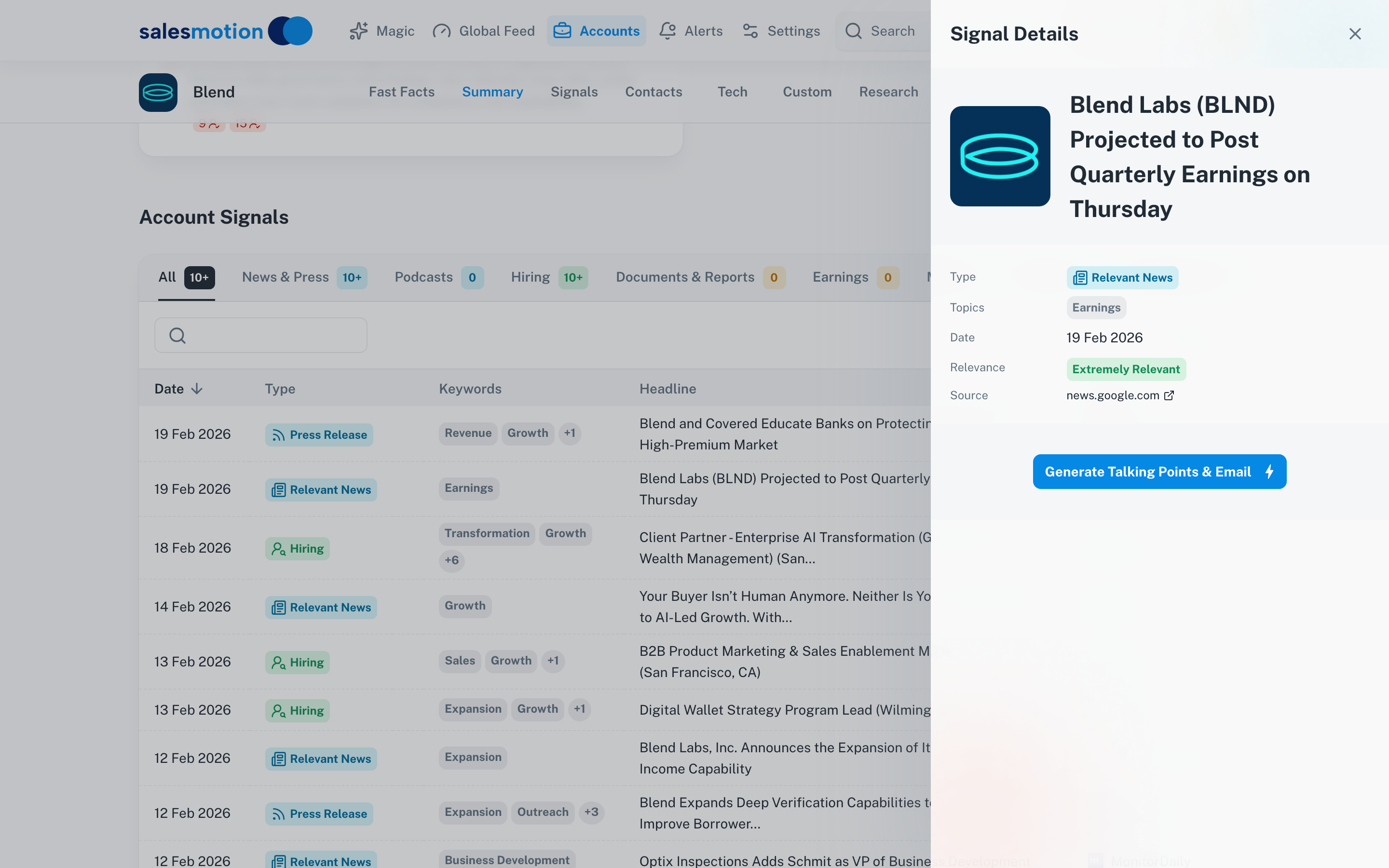 Account enrichment as events: earnings commentary, hiring and leadership signals, each with its source.
Pricing: $85/mo for individuals (track up to 100 accounts) on a monthly contract. Custom pricing for teams & enterprise. You can try the interactive demo before you buy.
Use it alongside a contact enrichment tool when your reps already know who to call but not which accounts to work this week, or what to say when they get there.
How to Choose the Right Data Enrichment Partner
There is no single best provider. The right choice depends on your go-to-market motion, your CRM and the level of enrichment you need.
- You run HubSpot and mostly enrich inbound leads: start with HubSpot data enrichment, which you already pay for on a paid plan.
- You need the highest match rate across segments: use Clay to waterfall several providers.
- You sell to enterprises and want one large database: shortlist ZoomInfo.
- You want enrichment and outbound in one tool on a budget: start on Apollo.io's free plan.
- You prospect into Europe by phone: shortlist Cognism.
- You are building your own data product or pipeline: People Data Labs or Data Axle by API.
- You need company identity and hierarchies across finance and sales: Dun & Bradstreet.
- Your ICP is private, high-growth companies: Crunchbase.
- You need account-level context on top of clean contacts: add an account intelligence layer.
Creating Your Evaluation Framework
Start by writing down your non-negotiables before you look at vendors.
- Define your must-have fields and signals: technographics, firmographics like employee count, events like funding announcements, or direct-dial phone numbers.
- Check where the data has to land: prioritize native CRM integrations (Salesforce, HubSpot) or an API your team can maintain.
- Name your primary use case: outbound prospecting needs accurate contact data at volume; lead scoring and routing needs firmographic and behavioral fields; account-based selling needs account-level context.
Taking Action: From Shortlist to Pilot
Shortlist two or three vendors and run a pilot with your actual data, not a vendor's sample. Give each one the same representative set of target accounts or leads, then measure the match rate (how many records they could enrich), the accuracy of what they returned (check a sample by hand, including your hardest region), and the fill rate for the fields you care about most. Finally, check how the enriched data reaches your reps: a field nobody sees in the CRM does not change a single conversation.
Key Takeaways
- Data enrichment companies fill gaps at three levels: lead, contact and account. Most teams need at least two of them.
- Clay leads on multi-provider waterfall enrichment; ZoomInfo on breadth in a single enterprise database; Apollo.io on enrichment plus outbound at a published price with a free plan.
- Cognism is built for Europe, Lusha and RocketReach for self-serve lookups, and People Data Labs and Data Axle for API-driven pipelines.
- HubSpot customers get data enrichment in paid plans, and HubSpot's documentation says it does not consume HubSpot Credits.
- Enterprise vendors often publish no price. ZoomInfo, Cognism and Demandbase are quote-only; Vendr's medians are the closest public benchmark where they exist.
- Static fields tell you about an account, not what is happening there now. Pair a contact enrichment tool with an account intelligence layer when timing and context matter.
Frequently Asked Questions
What is B2B data enrichment?
B2B data enrichment is the process of adding missing information to the business records you already hold: job titles, verified emails, direct dials, company revenue, headcount, technographics and, increasingly, events such as funding rounds and leadership changes. It covers lead enrichment for new inbound prospects, contact enrichment to keep existing CRM records current, and account enrichment for the company record itself.
What are the best data enrichment tools?
The strongest options depend on your need. Clay for waterfall enrichment across 150+ providers, ZoomInfo for a large verified contact and company database, Apollo.io for enrichment plus outbound with a free plan, Cognism for phone-verified mobiles in Europe, Lusha and RocketReach for self-serve lookups, and HubSpot data enrichment if HubSpot is your CRM.
What do data enrichment companies and vendors actually do?
Data enrichment vendors match your records against their own databases or a network of providers and append the fields you are missing. Some sell a sales application with enrichment built in (ZoomInfo, Apollo.io, Lusha), some orchestrate many providers (Clay), and some sell raw data by API to engineering teams (People Data Labs, Data Axle) or authoritative company identifiers (Dun & Bradstreet).
What is the difference between lead enrichment and contact enrichment?
Lead enrichment runs when a new inbound lead arrives with little more than an email address: it appends title, company and industry so marketing can score and route the lead. Contact enrichment keeps records you already have accurate over time, updating emails, phone numbers and titles as people change roles. HubSpot data enrichment and Apollo.io are common lead enrichment tools; ZoomInfo, Cognism and Lusha are common contact enrichment sources.
What is waterfall enrichment?
Waterfall enrichment queries several data providers in sequence until one returns the field you need, instead of relying on a single database. Clay is built around it, with 150+ providers and no charge when an enrichment returns no result, and Apollo.io includes waterfall enrichment from its Basic plan. The benefit is a higher match rate across segments where one provider's coverage is thin.
How much does data enrichment cost?
Self-serve tools publish their prices: Apollo.io from $49 per seat per month on annual billing, Lusha from $37.45 a month on annual billing, RocketReach from $27 a month on annual billing, Clay from $185 a month, and People Data Labs from $98 a month, most with a free plan or trial. Enterprise vendors such as ZoomInfo, Cognism and Demandbase do not publish pricing; Vendr reports medians of $33,500 a year for ZoomInfo and $68,591 for Demandbase.
How should a GTM team choose a data enrichment provider?
Start with the enrichment level you need and the system the data has to land in, then pilot two or three vendors on your own records. Compare match rate, accuracy on a hand-checked sample and fill rate for your critical fields. Most GTM teams end up with a contact source, a workflow tool such as Clay, and an account-level layer for context.
What is the difference between data enrichment and account intelligence?
Data enrichment fills in fields on contact and company records. Account intelligence monitors what is changing at each account, such as leadership changes, earnings commentary, hiring and funding, and explains why it matters for your deal. Enrichment tells you who and what; account intelligence tells you why now. Most teams use both.