Teams leave ZoomInfo when they realize a contact database tells you who exists, not who is ready to buy. The best ZoomInfo alternatives for buying signals pair live trigger detection (funding, leadership changes, hiring, earnings, tech moves) with account scoring, so reps reach out at the right moment. This guide compares signal-first alternatives (Salesmotion, UserGems, Common Room, 6sense) rather than like-for-like data vendors, and shows which fits cost-conscious teams versus enterprise GTM orgs. We include two database options (Apollo, Cognism) for teams that need both.
TL;DR: Most ZoomInfo alternative lists swap one contact database for a cheaper one. If you are leaving because the data told you who but never when, you need a different category: signal-first platforms that detect live buying triggers and score accounts. Those start at $85/mo and replace the part of ZoomInfo you actually missed.
ZoomInfo Alternatives Compared at a Glance
| Tool | Best for | Core strength | Buying signals? | Acts on signals? | Starting price |
|---|---|---|---|---|---|
| Salesmotion | Signal-first selling + outreach | Live triggers + ICP scoring + drafted outreach | Yes (1,000+ sources) | Yes | $85/mo |
| UserGems | Outbound and ABM built on CRM history | Turns first-party and CRM data into plays | Yes (30+ native signals) | AI agents and workflows | $40,000/yr |
| Common Room | Product, community, website signals | Captures first-party signals | Yes (first-party) | Workflows | $2,500/mo (annual) |
| 6sense | Enterprise predictive intent | Predictive intent + anonymous web | Yes (predictive) | Email agents and workflows | Quote-only (Vendr median $62,220/yr) |
| Apollo | Affordable database + intent topics | Low-cost all-in-one contact data | Intent topics (1 to 12 by plan) | Sequences | Free / $49/user/mo |
| Cognism | GDPR-compliant EU contact data | Compliant phone and email data | Hiring, funding, job changes; intent on Pro | List filters and CRM export | Quote-only |
Frame your evaluation around the second-to-last column. If you are switching because of timing, not data volume, a cheaper database will reproduce the same problem at a lower price.
Why Sales Teams Look for ZoomInfo Alternatives
To be fair to ZoomInfo: the database is enormous, and for pure contact discovery at enterprise scale it remains a default. The switching conversations we hear cluster around three issues.
Cost and credit mechanics. ZoomInfo publishes no dollar figures. Its own pricing page says amounts are not listed because pricing is consumption-based, so buyers cannot budget before the quote. Vendr reports a median contract of $33,500 a year based on 1,576 purchases. We broke down the full math in our ZoomInfo pricing guide.
Data tells you who, not when. A rep can pull 500 perfectly accurate contacts and still have no idea which 15 accounts are entering a buying window this quarter. Intent topics help, but they are inferred and account-level, not concrete events a rep can reference in an email.
Decay. People change jobs, companies reorganize, and exported lists age out fast. Static records get stale; the events driving change (the new VP, the funding round, the hiring surge) are the durable signal. That gap is the subject of our guide on contact data vs intent data.
 ZoomInfo is a strong contact database. The question is whether a database is what you are missing.

“We're no longer fishing. We know who the right customers are, and we can qualify them quickly. Salesmotion has had a direct impact on pipeline quality.”
Andrew Giordano
VP of Global Commercial Operations, Analytic Partners
Database Alternatives vs. Signal-Based Alternatives
Before comparing tools, decide which problem you are solving.
You actually need a database if your team cannot find accurate emails and phone numbers at acceptable cost. Apollo and Cognism solve that directly.
You need buying signals if reps have plenty of contacts but no idea who to prioritize or what to say. That is a different product category, covered in depth in our guide to buying signals software.
Most "ZoomInfo alternative" lists just swap one contact database for a cheaper one. Teams switching for intent need a different category: tools that detect live buying signals and score accounts, so reps act when a trigger fires instead of dialing down a static list.
A complete signal stack has three layers: collection (detecting the event), intelligence (what it means and who to contact), and engagement (getting a relevant message out fast). Keep that model in mind as you read the reviews; most tools below cover one layer well.
The Best ZoomInfo Alternatives for Buying Signals, Reviewed
1. Salesmotion: best for daily buying-intent signals plus ready-to-send outreach
Verdict: Monitors 1,000+ sources daily, scores accounts against your ICP, and drafts signal-anchored outreach, turning intent into action in one workflow.
Salesmotion approaches the ZoomInfo gap from the signal side. It watches leadership changes, funding, hiring patterns, earnings commentary, M&A, and custom topics across 1,000+ sources, then ranks your accounts by readiness rather than alphabet. Each signal comes with a cited research brief and a drafted email or LinkedIn message referencing the trigger. Verified contact data is included, so reps act on a signal without bouncing to another tab.
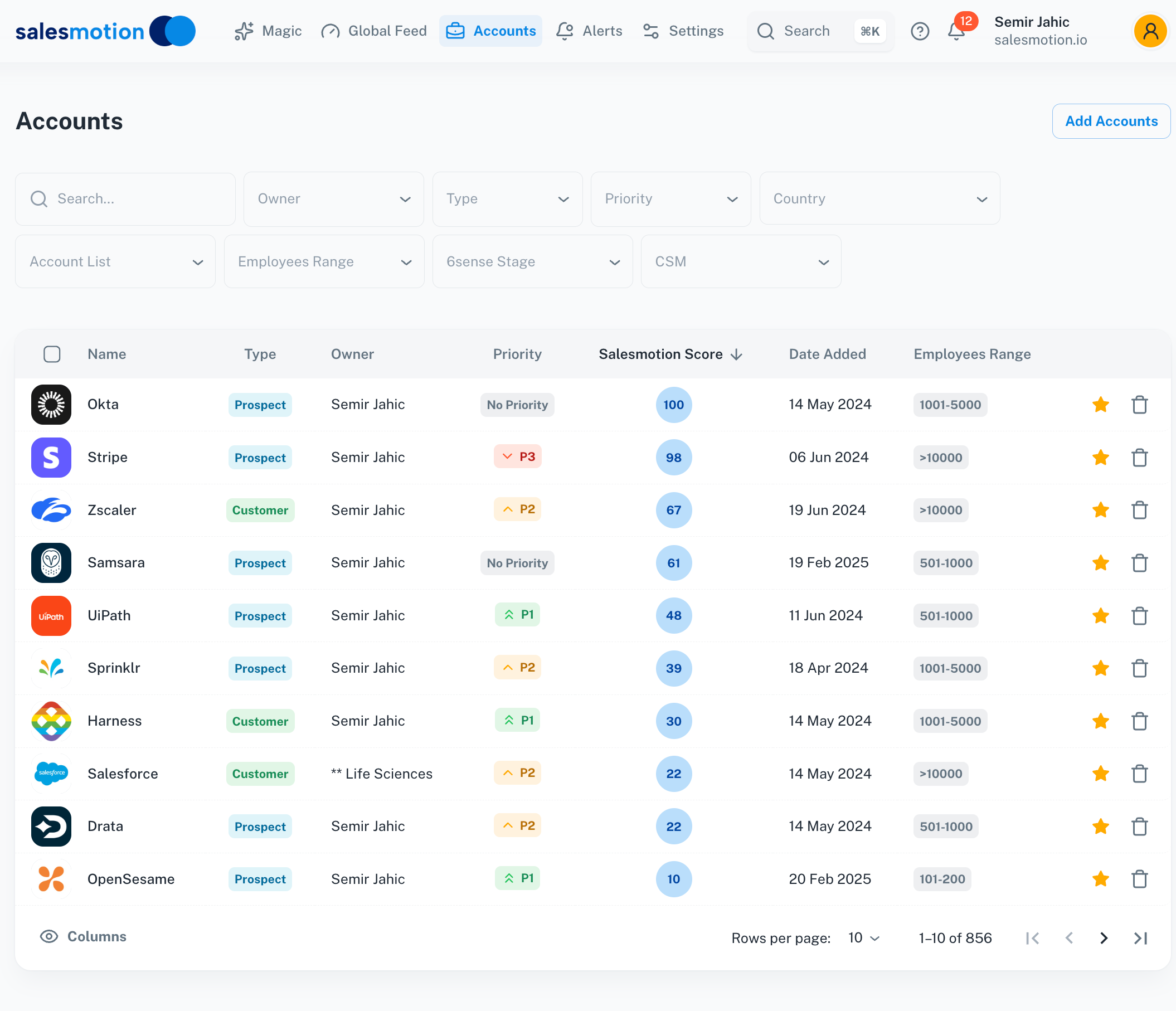 Accounts ranked by signal-based score, so reps work the territory in readiness order.
Best for: Teams switching because timing, not contact volume, is the bottleneck. Cytel consolidated five research tools (ZoomInfo, Crunchbase, SEC.gov, Google News and ClinicalTrials.gov) into Salesmotion and cut research time 50%.
Limitation: Built for signals and research on your target accounts. If you need 50,000 records a month for cold sequencing, pair it with a database.
Pricing: $85/mo self-serve individual plan, monthly billing, no annual commitment. Custom pricing for teams and enterprise with unlimited seats on team plans. See pricing.
2. UserGems: best for outbound and ABM built on CRM history
Verdict: Strongest where a team has CRM history and first-party data to mine and wants automated outbound and ABM plays.
UserGems positions itself as the AI command center for outbound and ABM, with 30+ native signals (job changes, contact-level intent, website visits, M&A, hiring and more), a Research Agent, and AI agents that research accounts and write outreach. Its edge is first-party data: past champions, closed-lost history, call transcripts and CRM records turned into prioritized plays.
 UserGems turns CRM history and buyer signals into outbound and ABM plays.
Best for: Companies with years of CRM history, customers and closed-lost deals to mine.
Limitation: Pricing starts at $40,000 a year, above Vendr's median ZoomInfo contract, plus a one-time implementation fee.
Pricing: Core at $40,000/year, Advanced at $75,000/year and Elite at $150,000/year, plus one-time implementation fees of $3k/$5k/$10k by tier. Every tier includes unlimited admin and end users. Details in our UserGems pricing guide.
3. Common Room: best for first-party product and website signals
Verdict: Captures the signals your own funnel generates: site visits, product usage, community activity, social engagement.
Common Room, owned by Zoom since July 2026, unifies first-party touches into person and account timelines, then routes plays through workflows. If your buyers research you through docs, communities, and product trials before ever filling a form, it captures first-party intent that a contact database does not hold.
 Common Room aggregates first-party buyer activity into account-level intent.
Best for: Product-led and community-led GTM motions with real traffic to mine.
Limitation: It is built around first-party, product, community and intent signals, and plans are capped by seats and contacts.
Pricing: Essential at $2,500/mo billed annually (5 seats, 100,000 contacts), with Advanced and Enterprise quote-only. No free tier or self-serve trial. Full breakdown in our Common Room pricing guide.
4. 6sense: best for enterprise predictive intent
Verdict: The heavyweight option: predictive models over anonymous web traffic, priced and deployed like the enterprise platform it is.
6sense de-anonymizes research activity and predicts buying stage, coordinating ads, SDR plays, and sales alerts from one model. For enterprise ABM programs with RevOps support, it is the deepest intent offering on this list. For most mid-market teams it is a bigger commitment than the problem requires.
 6sense layers predictive intent on top of anonymous web behavior.
Best for: Enterprise GTM orgs replacing ZoomInfo's intent layer specifically.
Limitation: Implementation is a guided onboarding rather than self-serve, and Vendr puts the median annual contract at $62,220. See our 6sense pricing breakdown.
Pricing: Not published. 6sense sells Sales Intelligence with data credits, with predictive AI, or with both. Vendr's marketplace data reports a median annual contract value of $62,220 across 386 purchases, with a range of $11,234 to $176,511.
5. Apollo: best affordable database with light intent
Verdict: The pragmatic like-for-like swap: most of ZoomInfo's database utility at a fraction of the cost.
Apollo combines 240M contacts, sequencing, and intent topics with self-serve pricing. ZoomInfo's database is larger at 500M+ contacts, but for SMB and mid-market list building the value is hard to argue with. Its intent and signal features sit on top of a database, the same architectural posture as ZoomInfo.
 Apollo is the budget-friendly database swap, with sequencing built in.
Best for: Teams whose actual complaint is ZoomInfo's invoice, not its concept.
Limitation: A phone number costs 8 credits against 1 for an email, and intent topics are capped by plan (1 on Free, 6 on Basic and Professional, 12 on Organization). See our Apollo pricing guide.
Pricing: Free plan with 900 credits a year; Basic $49, Professional $79 and Organization $119 per user per month on annual billing.
6. Cognism: best for GDPR-compliant EU contact data
Verdict: The European data specialist: phone-verified contacts and a compliance posture EU legal teams approve.
Cognism focuses on accurate, legally defensible contact data in Europe, with phone-verified mobile numbers (previously marketed as Diamond Data) as the signature feature. If European coverage or GDPR posture triggered the search, Cognism is the direct answer. Hiring, funding and job-change signals work as list filters, and Bombora-powered intent sits in the Pro package.
 Cognism leads with verified, GDPR-compliant contact data for EMEA.
Best for: EMEA-focused teams where compliance and phone accuracy decide the deal.
Limitation: Pricing is quote-only, the pricing page states no contract terms, and intent data requires the Pro package. Full math in our Cognism pricing guide.
Pricing: Not published. Cognism sells Standard and Pro packages, each listed with 5 seats included, on a credit system where one credit reveals one contact.

“Salesmotion helps you spot signals from prospect accounts, news items / job hiring alerts etc that indicate that now is a good time to reach out with a well-crafted message.”
Rob Douglas
Director of Sales, icit business intelligence
How to Choose a ZoomInfo Alternative
Diagnose the complaint first, then pick the category.
If the complaint is price: Apollo replaces the database function at a lower published price, and Cognism does it with a European focus.
If the complaint is timing: you want signal-first tooling. Here is the loop that replaces "export and blast":
- Trigger: A mid-market target announces Series C funding and posts five go-to-market roles within two weeks.
- Platform action: The account jumps to the top of the rep's scored list, with a brief covering the round, the hiring pattern, and the new CRO's background.
- Rep action: The rep sends a drafted note connecting the funding announcement to the problem your product solves, the same day.
- Outcome: Outreach lands while the budget exists and before the RFP is written. Customers running this motion report results like Frontify's 4x growth in self-sourced revenue.
If the complaint is both: run a small database plan for list building alongside a signal layer for timing. At $85/mo entry pricing for the signal layer plus Apollo from $49/user/mo, the combined cost still lands far below Vendr's $33,500 median ZoomInfo contract.
 The signal-first alternative: detection, research, and outreach in one workflow.
Decision shortcut:
Choose Apollo if you just need cheaper contact data. Choose Cognism for GDPR-compliant EU data. Choose UserGems if you have deep CRM history to mine for outbound and ABM plays. Choose Common Room for first-party product and community signals. Choose 6sense for enterprise predictive intent. Choose Salesmotion if you want daily buying-intent signals plus drafted outreach in one tool.
Key Takeaways
- Most ZoomInfo alternative lists compare databases; teams switching over timing need signal-first platforms instead.
- Buying signals are concrete events (funding, exec changes, hiring surges) a rep can reference; intent data is inferred and account-level.
- Signal-first options: Salesmotion from $85/mo, UserGems from $40,000/yr, Common Room from $30K/yr, 6sense quote-only with a $62,220 Vendr median.
- Database swaps: Apollo from $49/user/mo, Cognism quote-only for EU-compliant data.
- Many teams end up pairing a small database plan with a signal layer, still spending less than a ZoomInfo renewal.
Frequently Asked Questions
What is the best ZoomInfo alternative for buying signals?
Salesmotion is the strongest signal-first alternative: it monitors 1,000+ sources daily, scores accounts against your ICP, and drafts outreach anchored to each signal, from $85/mo. UserGems fits teams with deep CRM history to mine, and Common Room fits first-party product and community signals.
Is there a cheaper alternative to ZoomInfo?
Yes. Apollo starts free with paid plans from $49/user/mo on annual billing, and covers most SMB list-building needs. ZoomInfo itself also offers Lite, a permanent free tier with 10 credits a month. If the real gap is knowing when accounts are ready to buy, signal platforms starting at $85/mo replace the part of ZoomInfo that contact databases never delivered.
What is the difference between ZoomInfo's intent data and buying signals?
Intent data, including ZoomInfo's Streaming Intent add-on, infers interest from web research patterns. Buying signals are verifiable events: a funding round, a new CRO, a hiring surge, an earnings statement. Signals give reps a concrete reason to reach out that they can cite in the first sentence.
What is a good GDPR-compliant ZoomInfo alternative?
Cognism is the standard pick for EMEA teams: phone-verified mobiles, a compliance-first posture, and extensive Do-Not-Call coverage across Europe. Pair it with a signal layer if you also need to know which compliant contacts are actually worth calling this week.
Do ZoomInfo alternatives include contact data too?
Some do. Salesmotion includes verified emails and direct dials alongside its signals, Apollo and Cognism are contact databases first, and UserGems enriches the contacts it tracks. Common Room (400M+ contact directory) and 6sense (111M+ verified business emails) carry contact data alongside intent.
See which accounts in your territory are showing buying signals today. Book a demo or explore the interactive demo.