Most outbound stacks are 15+ tools held together with duct tape. Reps toggle between a contact database, a sequencer, a dialer, a CRM, an enrichment tool, an email warmup service, a LinkedIn automation tool, and whatever AI writing assistant someone's cousin recommended. The result: bloated spend, fractured data, and reps who spend more time managing software than selling.
TL;DR: The ideal 2026 outbound stack has exactly four layers: Intelligence, Sequencing, Dialing, and CRM. Teams running 5-7 integrated tools outperform those with 15+ point solutions. Start with the intelligence layer (account signals and research) as the foundation, then build outreach on top of that context. This guide covers tool recommendations for each layer by team size and ACV.
The numbers confirm the dysfunction. The average B2B company now uses 87 different software tools, but only 23% directly impact revenue generation. CFOs are done tolerating it. According to ProspectX's Q4 2025 analysis, companies are conducting ruthless audits of their tech stacks, cutting tools that don't directly contribute to pipeline generation or deal acceleration. The winners in 2026 are running 5-7 integrated platforms, not 15-20 disconnected point solutions.
This post is a decision framework for VPs building or rebuilding their outbound motion. Not a listicle of 47 tools you should "consider." A 4-layer architecture for what you actually need, what's redundant, and how to choose based on your specific team size, ACV, and motion type. If you're spending more than 15 minutes in a quarterly review defending your sales tech budget, this is for you.
For a broader view of the full sales technology landscape, see our guide to the best B2B sales tools. This post goes narrower and deeper: outbound-specific, opinionated, built for action.
Key Takeaways
- The 4-layer stack is the target state. Intelligence, Sequencing, Dialing, and CRM. Every tool you own should fit cleanly into one of these layers. If it doesn't, it's likely redundant.
- Intelligence is the foundation, not an add-on. Teams that start with sequencing (blasting emails before understanding accounts) burn through their TAM. Start with account intelligence and buying signals, then build outreach on top of context. Platforms like Salesmotion consolidate research, enrichment, and signal monitoring into one layer.
- Consolidation beats accumulation. Organizations with well-integrated tech stacks are 42% more likely to increase sales productivity. The cost of one more tool is never just the license fee — it's the integration tax, the training overhead, and the data fragmentation.
- AI is a feature, not a category. Stop buying standalone AI writing tools. By 2026, 78% of sales tech vendors are shipping generative AI features natively. Buy the platform, get the AI for free.
- Team size determines stack complexity. A 3-person SDR team and a 40-person enterprise team need fundamentally different architectures. Overshoot and you drown in complexity. Undershoot and you bottleneck growth.
The 4-Layer Outbound Stack Framework
Every outbound tech stack, regardless of team size or industry, needs to serve exactly four functions:
- Intelligence — Know which accounts to pursue, why now, and what to say
- Sequencing — Orchestrate multi-channel outreach at scale
- Dialing — Connect live with prospects through phone and video
- CRM — Record everything, report on it, and hand off to closers
That's it. If you can draw a clean line from every tool in your stack to one of these four layers, you have a healthy architecture. If you have tools that straddle two layers awkwardly, or tools that serve a function not in this list, you have a consolidation opportunity.
The layers are ordered by priority. Intelligence feeds Sequencing. Sequencing generates conversations. Dialing accelerates live connections. CRM captures everything. Skip the foundation and the whole structure is unstable — which is exactly what happens when teams buy a sequencer first and an intelligence layer never.
For details on how data quality impacts every layer of this stack, read our breakdown of B2B data enrichment tools.
See Salesmotion in action
Take a self-guided interactive tour — no signup required.
Layer 1: Intelligence (The Foundation)
This is where most stacks are weakest and where the highest-leverage improvements live. The intelligence layer answers three questions before a rep ever opens their sequencer: Which accounts should I prioritize? What is happening at those accounts right now? What can I say that's relevant?
Without this layer, you're doing spray-and-pray with better formatting.
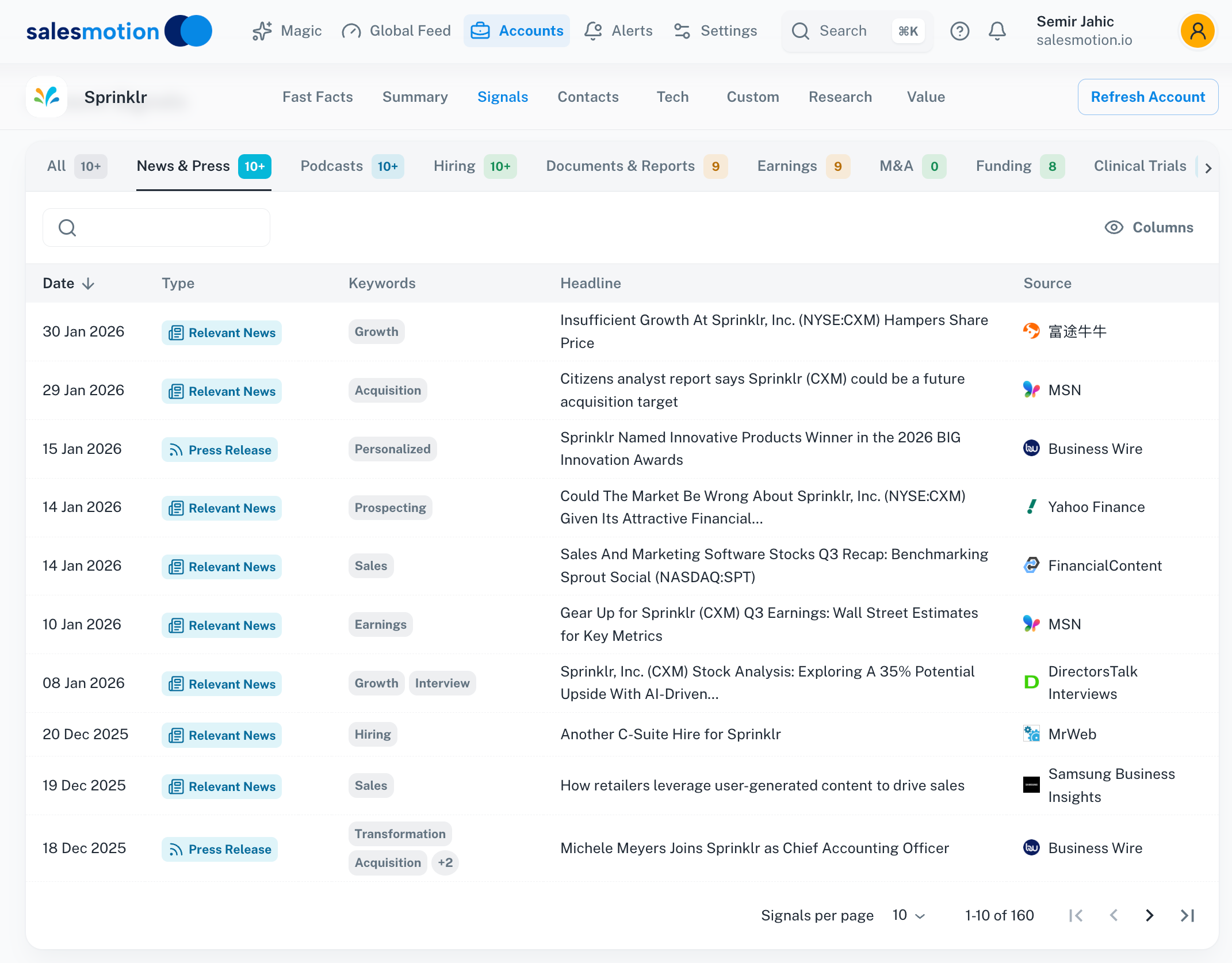 An intelligence layer aggregates signals like leadership changes, earnings mentions, and hiring surges into a single account view.
What the tools do
Salesmotion combines account intelligence, buying signal monitoring, and AI-driven research into a single platform. Instead of reps manually checking LinkedIn, press releases, job boards, and earnings calls, Salesmotion aggregates signals (leadership changes, hiring surges, tech stack shifts, funding rounds) and delivers daily briefings with context. Teams using it have cut account research time from 60+ minutes to under 5 minutes per account. Best for mid-market and enterprise teams running account-based outbound. Pricing starts at $85/month.
ZoomInfo is the incumbent contact database and intent data provider. Its strength is breadth: 100M+ business profiles, Bidstream intent data, and org chart mapping. Best for enterprise teams that need massive contact coverage. The weakness is price ($12,000+/year minimum) and the fact that intent data alone, without account context, produces noisy signals. ZoomInfo is a data warehouse. You still need to turn that data into action.
LinkedIn Sales Navigator remains essential for relationship-based selling. It's the only tool that gives you real-time visibility into prospect activity: job changes, content engagement, shared connections. At roughly $100/user/month, it's a no-brainer for any outbound team. The limitation: it's a research tool, not a workflow tool. It tells you who's interesting but doesn't automate what you do next.
6sense and Bombora provide intent data at the account level, identifying which companies are researching topics related to your product. Useful for prioritization, especially in enterprise ABM motions. The catch: intent data is probabilistic, not deterministic. An account "surging" on a keyword doesn't mean a specific buyer is ready to talk. Layer intent data on top of first-party signals (job changes, tech installs, earnings commentary) for the clearest picture. See our full analysis of intent data providers for a deeper comparison.
The honest assessment
If you could only buy one tool in this layer, make it the one that answers "what do I say and why now?" rather than the one with the most contacts. Contact data is increasingly commoditized. Context is not.
Layer 2: Sequencing (The Engine)
Once intelligence tells reps where to focus and what to say, the sequencing layer orchestrates the outreach across email, LinkedIn, and phone touchpoints. This is the engine that converts research into pipeline.
The stakes here are higher than most teams realize. A poorly configured sequencing tool doesn't just underperform — it damages deliverability, burns through prospect lists, and trains buyers to ignore you. A well-configured one compounds over time as you learn which cadences, messages, and timing patterns convert.
What the tools do
Outreach is the enterprise standard for multi-channel sequencing. Its strengths: sophisticated cadence design, A/B testing at scale, granular analytics on every touchpoint, and deep Salesforce integration. It's built for teams of 20+ reps where RevOps needs visibility and control. Pricing is opaque but starts around $130/user/month. The downside: it's complex. Small teams drown in configuration.
Salesloft (now part of Vista Equity) competes directly with Outreach and has been gaining market share with stronger conversation intelligence integration and a cleaner interface. The coaching and analytics features are genuinely differentiated. Best for mid-market teams that want sequencing plus call coaching in one platform. Pricing is in the $125-165/user/month range.
Apollo.io is the disruptor. It bundles a contact database with sequencing and basic intent data starting at $49/user/month. For startups and SMBs running outbound on a tight budget, Apollo is the most common entry point. The trade-off: data quality is inconsistent for niche verticals, and the platform tries to do everything without excelling at any single layer. Teams that outgrow Apollo typically split into a dedicated intelligence layer plus a dedicated sequencer.
Instantly carved a niche in high-volume cold email. If your motion is email-first with large prospect lists, Instantly's deliverability infrastructure (automated warmup, inbox rotation, domain management) is strong. At $30/month, it's cheap. The limitation: it's email-only. No phone, no LinkedIn, no multi-channel cadence orchestration. A single-channel tool in a multi-channel world.
What actually matters in this layer
Deliverability is more important than features. A sequencer that lands in spam is worse than no sequencer at all. Evaluate warmup infrastructure, bounce handling, and domain reputation management before you look at the cadence builder.
A/B testing must be native. If you can't test subject lines, send times, and messaging variants without exporting data to a spreadsheet, the tool is costing you insight.
CRM sync has to be real-time and bidirectional. One-way syncs create data drift, and data drift kills forecasting accuracy. Ask vendors exactly how sync conflicts are resolved.
For more on structuring the team that operates these tools, see our guide to sales operations org structure.
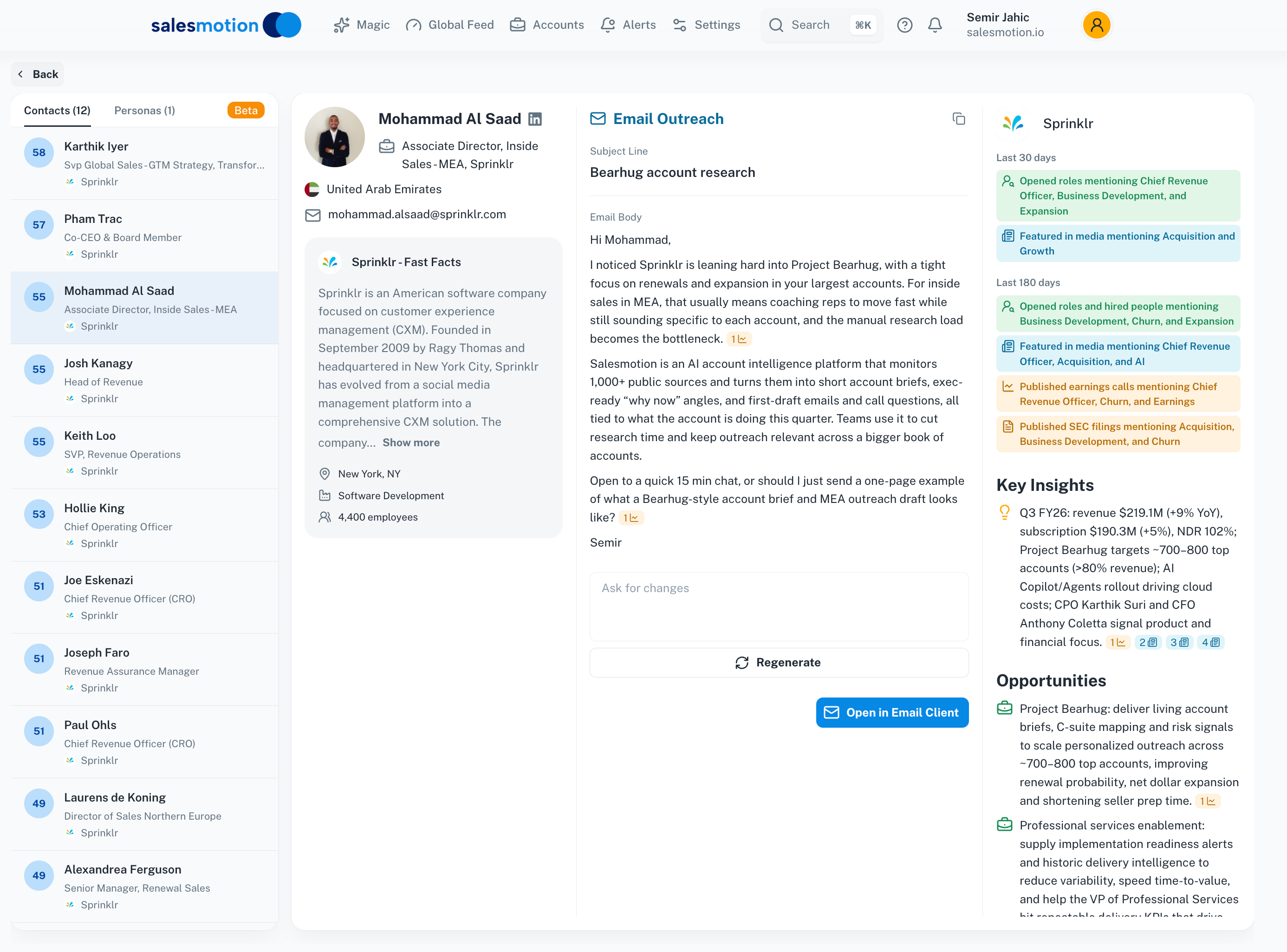 When intelligence feeds directly into outreach, every email reflects what is actually happening at the account.

“We had a variety of tools, and that was the pain — the variety. We had to go to multiple places to get streamlined data.”
Lyndsay Thomson
Head of Sales Operations, Cytel
Layer 3: Dialing (The Direct Line)
Phone is not dead. Not even close. The data is unambiguous: live conversations convert at dramatically higher rates than any async channel. Koncert's 2026 outbound trends analysis shows that teams combining parallel dialing with AI coaching are reporting 3-5x more conversations per rep per day compared to traditional sequential dialing.
The question isn't whether to dial. It's how to dial smarter and how to capture intelligence from every conversation.
What the tools do
Orum and Nooks are the leading parallel dialers. They call multiple prospects simultaneously and connect reps only when someone picks up. The productivity gains are real: instead of 40-60 dials per day, reps are hitting 150-200+. Orum is more established; Nooks has gained traction with its virtual sales floor concept. Both run $100-150/user/month.
Gong is the conversation intelligence standard. It records, transcribes, and analyzes every call and meeting, then surfaces patterns: talk ratios, competitor mentions, objection handling, next-step adherence. For managers, Gong is the coaching tool. For reps, it's a deal intelligence tool. For RevOps, it's a forecasting signal. Pricing is enterprise-tier ($100-150/user/month), but the insight density is high.
Chorus (now owned by ZoomInfo) provides similar conversation intelligence with tighter ZoomInfo integration. If you're already on ZoomInfo, the data flow between intent signals and call analysis is a genuine advantage.
PhoneBurner is the budget-friendly power dialer for smaller teams. No parallel dialing, but solid click-to-call, voicemail drop, and CRM logging. At $124/user/month, it's the middle ground between manual dialing and the $150+/seat parallel dialers.
What actually matters in this layer
Connect rate optimization. The dialer itself is a commodity. What differentiates tools is local presence dialing, caller ID management, and AI-driven best-time-to-call predictions. Ask vendors for their connect rate benchmarks.
Call intelligence that feeds upstream. The best dialing setups don't just record calls — they feed insights back into your intelligence and sequencing layers. A competitor mention on a call should update the account record. An objection pattern should inform messaging templates. If your dialer is a silo, you're missing half the value.
Layer 4: CRM (The System of Record)
The CRM doesn't need a lengthy defense. You need one. The question is which one, and how disciplined you are about using it as the single source of truth rather than a data graveyard.
What the tools do
Salesforce remains the enterprise default. Its strength is ecosystem: almost every other sales tool has a native Salesforce integration, and the customization depth is unmatched. The weakness is complexity and cost. A poorly configured Salesforce instance actively hurts productivity. Budget $50-300/user/month depending on the edition, plus admin overhead.
HubSpot CRM is the mid-market standard and a strong choice for teams under 50 reps. The free tier is genuinely usable. The paid Sales Hub ($90-150/user/month) adds sequencing, forecasting, and custom reporting. HubSpot's advantage is speed-to-value: you can be operational in days, not months. The limitation: enterprise-grade customization still trails Salesforce.
What actually matters in this layer
Integration depth with your other three layers. The CRM is only as good as the data flowing into it. Every intelligence signal, sequencing engagement, and call outcome should land in the CRM automatically. If reps are manually logging activities, your data is already inaccurate.
Reporting that connects effort to pipeline velocity. Your CRM should answer: which sequences convert? Which signal types lead to meetings? Which accounts are moving and which are stalled? If your reporting stops at "activities completed," you have a logging system, not a revenue system. Use our pipeline velocity calculator to benchmark your current motion.
Data hygiene is a process, not a tool. No CRM feature compensates for a team that doesn't enforce data entry standards. Decide on required fields, naming conventions, and stage definitions before you buy anything else.
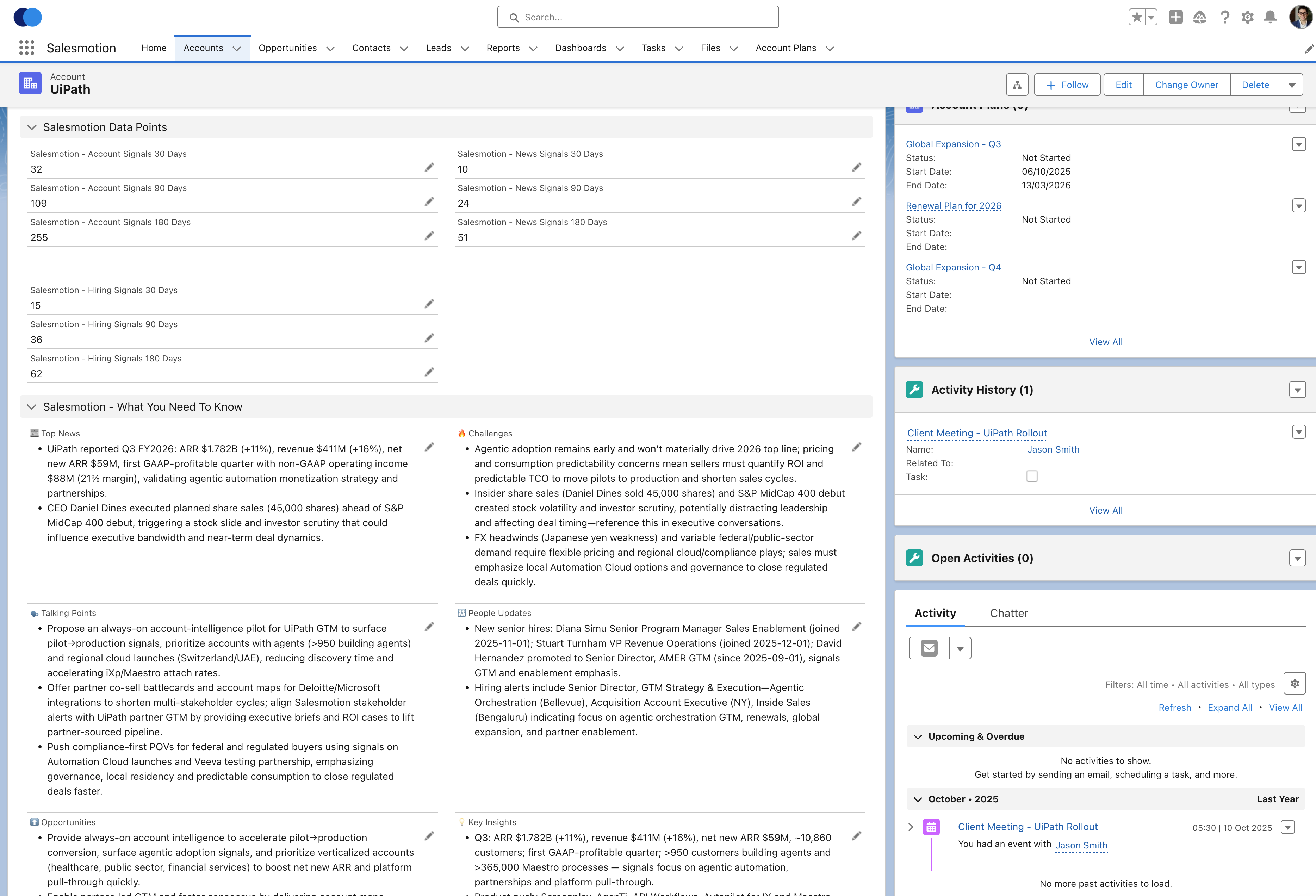 Intelligence data that syncs directly into your CRM eliminates manual logging and keeps the system of record current.
What's Noise: Tools You Probably Don't Need
Here's where this gets opinionated. These tool categories are not inherently bad — but for most outbound teams, they're redundant if you've built the four layers correctly.
Standalone data enrichment tools
If your intelligence layer (Layer 1) includes contact and account data, you don't need a separate enrichment tool. Buying ZoomInfo for contacts and then Clearbit for firmographics and then Lusha for phone numbers is paying three vendors for overlapping datasets. Salesmotion replaces the standalone enrichment, signal monitoring, and account research stack with a single platform. Pick one intelligence layer and go deep with it.
For a full breakdown of what enrichment tools actually deliver, see our data enrichment tools comparison.
Standalone email warmup services
Warmup tools like Warmbox and Mailwarm were essential in 2023. In 2026, every credible sequencing platform (Outreach, Salesloft, Apollo, Instantly) has built-in warmup and deliverability management. Paying $30-50/month per mailbox for a separate warmup service is legacy thinking. Audit whether your sequencer already handles this before adding another line item.
Generic AI writing tools
ChatGPT, Jasper, and similar general-purpose writing tools are not outbound tools. They generate plausible-sounding copy with zero awareness of your prospect's account context, recent signals, or industry dynamics. The output is "cold email that sounds like every other cold email."
The better approach: use AI that's embedded in your intelligence or sequencing layer, where it has access to account data, signal context, and historical performance data. Signal-informed AI (writing with knowledge of what's happening at the account) outperforms generic AI every time. This is the difference between "I noticed you're hiring 3 SDRs" and "Hi [First Name], hope you're well."
Standalone LinkedIn automation tools
Tools that auto-connect, auto-message, and auto-engage on LinkedIn are a deliverability risk and an increasingly enforced violation of LinkedIn's terms of service. LinkedIn is actively cracking down on automation, and account restrictions are real. Use Sales Navigator for research and manual personalized outreach. Build LinkedIn steps into your sequencer's cadences. But don't buy a standalone bot.
How to Choose: Decision Framework
Choosing the right stack isn't about which tools are "best." It's about which tools fit your motion. Answer these three questions:
1. How large is your outbound team?
1-5 reps: Consolidate aggressively. Apollo for contacts + sequencing, Sales Navigator for research, your CRM. Three tools. Adding more creates overhead that small teams can't absorb. If you want deeper intelligence, swap Apollo's built-in data for a dedicated intelligence platform and use Apollo for sequencing only.
6-20 reps: This is the inflection point where dedicated tools per layer start to pay off. Separate your intelligence layer from your sequencing layer. Pair a dedicated account intelligence platform with Sales Navigator, add Outreach or Salesloft for sequencing, and bring in a parallel dialer. CRM configuration becomes a real project, not a setup wizard.
20+ reps: Full 4-layer stack. Enterprise-grade tools at every layer. Invest in RevOps to manage integration, reporting, and optimization. At this scale, the cost of under-tooling (missed signals, uncoached reps, bad data) far exceeds the cost of over-tooling.
2. What's your average deal size?
Under $10K ACV: Velocity motion. Volume matters. Invest more in sequencing and deliverability. Keep intelligence lightweight — you can't spend 30 minutes researching a $5K deal.
$10K-$100K ACV: Balanced motion. Intelligence and sequencing are equally weighted. Every account gets at least a few minutes of research. Buying signals matter for prioritization.
Over $100K ACV: Account-based motion. Intelligence is the primary investment. Deep research, multi-threaded engagement, signal monitoring over long sales cycles. Sequencing becomes the secondary layer — you're personalizing everything, not blasting cadences.
3. Is your motion inbound-assisted or pure outbound?
Inbound-assisted: Your CRM and marketing automation are already generating leads. The outbound stack supplements with targeted prospecting into specific segments. Intelligence is used to prioritize and enrich inbound leads as much as to find new ones.
Pure outbound: Every meeting comes from proactive prospecting. Intelligence is existential. Without strong signal data and account context, your team is cold-calling from a spreadsheet. Invest in Layer 1 before anything else.
For more on building your complete prospecting toolkit, including tools beyond the outbound stack, see our full buyer's guide. If you want to see how a signal-driven intelligence layer fits into your specific stack, book a 15-minute walkthrough.
Frequently Asked Questions
How many tools should be in a 2026 outbound sales stack?
The target is 5-7 integrated platforms across the four layers, not 15-20 point solutions. According to Highspot's 2026 analysis, the most productive sales organizations are consolidating toward fewer tools with deeper integration, because organizations with well-connected stacks are 42% more likely to increase sales productivity. The specific number depends on team size: a 3-person team might run 3-4 tools, while a 40-person team legitimately needs 6-8.
What should I buy first when building an outbound stack from scratch?
Start with your CRM (Salesforce or HubSpot) and one intelligence platform. Do not buy a sequencer before you have data and context to sequence against. The most common mistake is buying Outreach or Apollo first and blasting emails into an untargeted list. That approach burns through your addressable market and trains prospects to ignore you. Build the intelligence foundation, then add sequencing once your team knows which accounts to pursue and why.
Is Apollo good enough to replace a full outbound stack?
For teams under 10 reps with deal sizes under $25K, Apollo can serve as a workable all-in-one: contacts, sequencing, and basic intent signals in a single platform. Above that threshold, you'll hit limitations — data quality issues in niche verticals, limited conversation intelligence, and sequencing features that lag behind Outreach and Salesloft. Most teams that scale past the early stage split Apollo into a dedicated intelligence tool and a dedicated sequencer. Think of Apollo as the starter stack, not the endgame.
Should I invest in AI SDR tools?
AI SDRs (tools like 11x, Artisan, and Regie) are generating significant buzz, but the category is still maturing. The promise is compelling: automated research, personalized outreach, and autonomous follow-up that operates around the clock. The reality in early 2026 is that AI-assisted human reps are outperforming fully autonomous AI SDRs on conversion rates. The best near-term approach: use AI features embedded in your existing intelligence and sequencing tools to make human reps faster, not to replace them. Revisit fully autonomous AI SDRs in 12-18 months as the technology matures.
How do I calculate ROI on my outbound tech stack?
Measure three things. First, cost per meeting booked — total stack cost (licenses + admin time + training) divided by outbound-sourced meetings per month. Second, rep efficiency — meetings booked per rep per week, and how that changes as you add or remove tools. Third, pipeline velocity — how quickly outbound-sourced deals move through your funnel compared to other sources. Use our pipeline velocity calculator to benchmark. MarketsandMarkets research shows that strategic AI-integrated stacks deliver 43% higher win rates and 37% faster sales cycles versus fragmented approaches. If your stack isn't moving at least one of these metrics, you're paying for software, not results.
How often should I audit my outbound tech stack?
Quarterly at minimum. Run a stack audit every quarter that asks three questions: (1) Which tools did reps actually use every week? Pull login data and usage reports. (2) Is data flowing cleanly between layers, or are reps manually bridging gaps? (3) Are there overlapping capabilities across tools that could be consolidated? The best sales ops teams also conduct an annual "zero-based" review where every tool must re-justify its seat at the table — no tool gets grandfathered in just because "we've always used it." With Gartner forecasting software spending growing 14.7% in 2026, the pressure to demonstrate ROI on every dollar is only increasing.