Sales tools for small businesses need to cover five jobs: a CRM to remember every customer, a source of contact data, a way to know which accounts to call and why, a tool to send outreach, and something that records your calls. For 2027 the seven picks below cover those jobs: HubSpot (free CRM), Apollo and Lusha (contact data with free plans), Salesmotion (account research and buying signals from $85 a month), LinkedIn Sales Navigator, lemlist and Avoma. Every one publishes its price, so a small team can build a working stack for less than one enterprise seat costs elsewhere.
TL;DR: Start free: HubSpot's CRM is free for up to 2 users, and Apollo and Lusha both have free plans for contact data. Pay first for the job that costs you the most deals. If you do not know which accounts to call this week, that is account research (Salesmotion, $85 a month). If you know who to call but cannot reach them, that is contact data. If you reach them but forget what was said, that is call notes (Avoma, from $19 a seat).
| Top pick | Job | Free option | Paid from |
|---|---|---|---|
| HubSpot | CRM | Free for up to 2 users | Sales Hub Starter from $20/seat/month |
| Apollo | Contact data and sequences | Free plan | Basic $49/seat/month (annual) |
| Salesmotion | Account research and buying signals | Interactive demo | $85/month, monthly billing |
Why Trust This List?
I run Salesmotion, and Salesmotion appears on this list. It is one of seven tools, not the whole answer: a small business still needs a CRM, contact data and a way to send email, and we name the tools we would buy for those jobs.
Every price on this page comes from the vendor's own pricing page, checked between 10 and 24 October 2026. Where a vendor shows a promotional price, we quote the regular one and say so. We picked tools that publish their prices and offer a free plan, a free trial or monthly billing, because a small business should not have to sit through a sales call to learn what something costs.
The buyers we speak to at small firms describe the same problem. As one owner of a sales consultancy put it:
"one of the things I'm always trying to figure out is the right timing" Owner, sales consultancy
Timing, not tooling volume, is what the stack below is built around.
Account research for small teams, from $85 a month
Salesmotion's agents watch up to 100 accounts, write cited briefs and draft outreach. Monthly billing, cancel any time.
What a Small Business Actually Needs
Small teams do not need a tool for every stage of the funnel. They need five jobs covered, usually by the founder or one or two sellers:
- A system of record. Every contact, deal and conversation in one place, so nothing depends on someone's memory. That is the CRM.
- People to contact. Verified emails and phone numbers for the buyers at the companies you sell to.
- A reason to reach out now. Which accounts changed this week: a new executive, a funding round, a hiring push, an earnings-call priority. Our B2B buying signals guide lists the signals worth watching.
- A way to send. Email sequences that go out on schedule, not by hand.
- Conversation memory. Call recordings and notes, so follow-ups reflect what the buyer said.
Bigger teams add intent data, forecasting and revenue intelligence. Those are worth skipping early; the section on what to skip explains why.

“There's been a big focus on hyper personalization and relevance in our outbounding efforts. Salesmotion has been a key partner in hitting our significantly increased meeting targets. What stands out is how simple it is. Reps can log in and get valuable account insights within 30 seconds to a minute.”
Joe DeFrance
VP of Sales, Incredible Health
Sales Tools for Small Businesses: Comparison
| Tool | Job | Free plan or trial | Starting paid price |
|---|---|---|---|
| HubSpot | CRM | Free for up to 2 users, no credit card | Sales Hub Starter from $20/seat/month |
| Apollo | Contact data + sequences | Free plan | Basic $49/seat/month annual, $65 monthly |
| Lusha | Contact data | Free plan, 40 credits a month | Starter $37.45/month annual, $49.90 monthly |
| Salesmotion | Account research + buying signals | Interactive demo | $85/month, monthly billing |
| LinkedIn Sales Navigator | Professional network | Free trial for eligible members | Core $119.99/month or $1,079.88/year |
| lemlist | Email outreach | 14-day free trial | Email plan $69/month, unlimited users |
| Avoma | Call recording + notes | 14-day free trial, no credit card | Startup $19/seat/month annual, $29 monthly |
The table runs in the order most small businesses buy: system of record first, then the tools that fill it.
The 7 Best Sales Tools for Small Businesses
1. HubSpot: Best Free CRM for a Small Business
What it is: HubSpot's free CRM, with paid Sales Hub editions on top. Contacts, companies and deals in one place.
Why it fits a small business: The free plan is "Free for up to 2 users. No credit card required," which covers a founder and a first seller. You can move to Sales Hub Starter when you need more seats or sales features.
Pricing: Published on HubSpot's pricing page. Sales Hub Starter starts at $20 per seat per month (HubSpot was also showing a lower promotional Starter price when we checked). Professional and Enterprise add one-time onboarding fees of $1,500 and $3,500, so most small businesses stay on Free or Starter.
Choose it if: you do not have a CRM yet, or your current one is a spreadsheet.
2. Apollo: Best for Contact Data and Sequences in One Tool
What it is: A contact database with built-in email sequences, sold per seat.
Why it fits a small business: One tool covers finding people and emailing them, which matters when one person does both.
Pricing: Apollo publishes its pricing: a free tier, then Basic at $49, Professional at $79 and Organization at $119 per seat per month on annual billing (3-seat minimum on Organization). Monthly billing is $65 and $99 on Basic and Professional; Organization is annual only. Our Apollo pricing breakdown covers how credits work.
Choose it if: you want contact data and sequencing from one vendor and are happy to start on the free plan.
3. Lusha: Best for Quick Contact Lookups
What it is: A contact data tool focused on verified emails and phone numbers, sold on monthly credits.
Why it fits a small business: The free plan gives up to 40 credits a month, enough to test whether its data covers your market before you pay.
Pricing: Lusha publishes its pricing: Starter at $37.45, Professional at $52.45 and Premium at $299.95 per month on annual billing ($49.90, $69.90 and $399.90 billed monthly). See our Lusha pricing guide for credit details.
Choose it if: you mostly need phone numbers and emails for people you have already identified, not a full prospecting platform.
4. Salesmotion: Best for Knowing Which Accounts to Call and Why
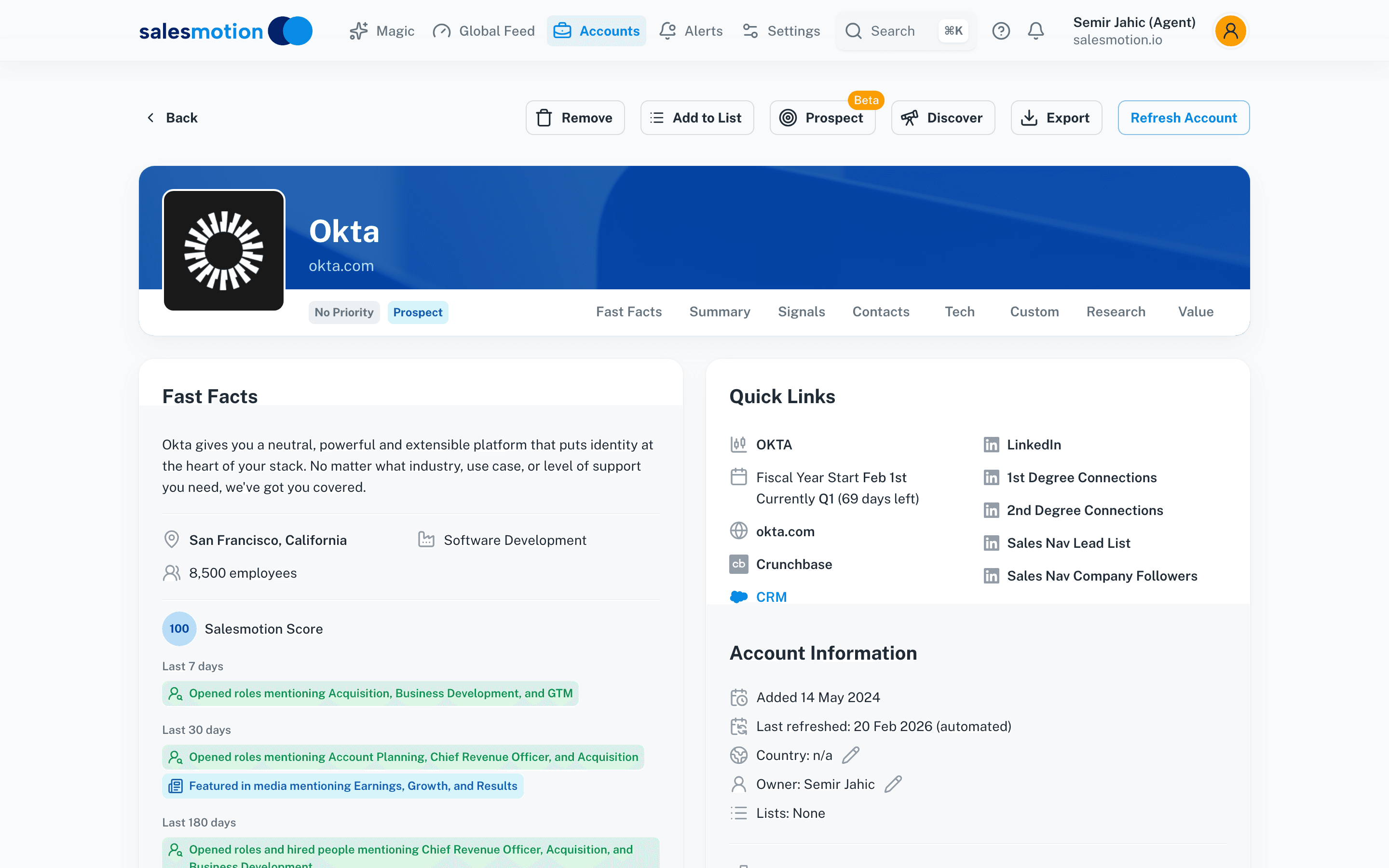
What it is: An account intelligence platform with three AI agents. The Signal Agent monitors 1,000+ public sources for 50+ signal types at the accounts you track. The Research Agent writes a cited account brief. The Outreach Agent drafts emails and LinkedIn messages from that research for you to review.
Why it fits a small business: A small team cannot spend hours researching each account before a call. The Individual plan watches up to 100 accounts, includes lookalike account discovery to find similar companies, and adds 200 contact credits a month for verified emails and phone numbers. It is a monthly contract you can cancel any time, which suits a founder testing a new market.
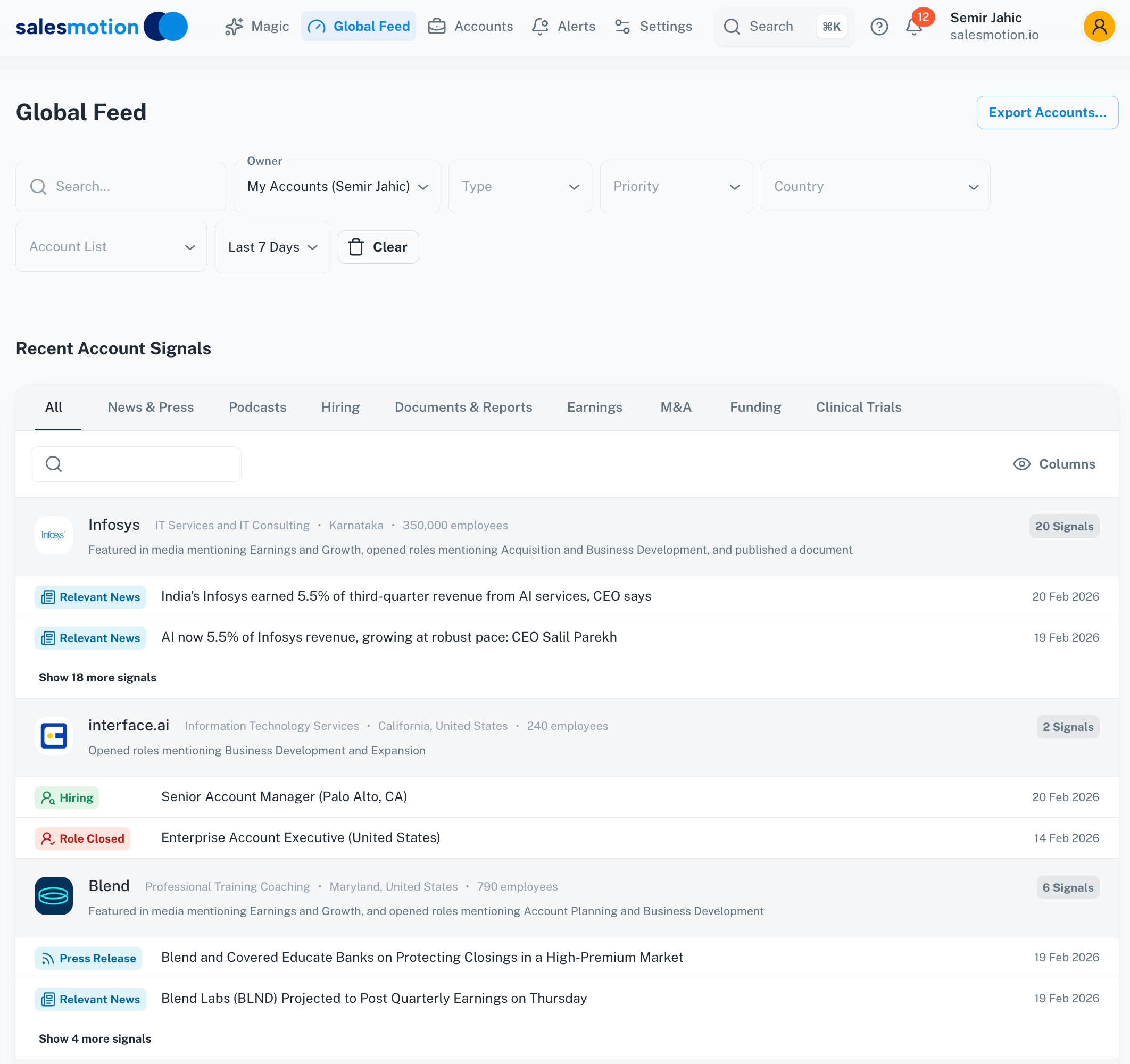 The Global Feed shows what changed at your accounts this week, with the date and source of each signal.
Pricing: $85 per month for the Individual plan, billed monthly. Teams and enterprise pricing is custom. There is no free trial; the interactive demo shows the product on sample accounts.
Choose it if: your problem is not finding names but knowing which accounts to work this week and what to say. Reps buying for themselves should also read when to pay for your own sales tools.
5. LinkedIn Sales Navigator: Best for Finding the Right People
What it is: LinkedIn's prospecting product, with 50+ search filters, Account IQ and Lead IQ summaries, and InMail.
Why it fits a small business: If your buyers are active on LinkedIn, it is the fastest way to find the right person at a target company and see shared connections.
Pricing: Published on LinkedIn's compare plans page: Core at $119.99 per month or $1,079.88 per year, Advanced at $159.99 per month or $1,799.88 per year, and Advanced Plus on request. Each plan includes 50 InMail credits a month. Our Sales Navigator pricing guide compares the plans.
Choose it if: your sales motion runs on LinkedIn and you want to search and save leads there.
6. lemlist: Best for Email Outreach on a Small Budget
What it is: An outreach tool for email sequences, with a Multichannel plan that adds other channels.
Why it fits a small business: The Email plan is priced per account, not per user, so a small team shares one subscription.
Pricing: Published on lemlist's pricing page: Email at $69 per month with unlimited users ($55 on yearly billing), Multichannel at $109 per user per month ($87 on yearly billing), then custom Enterprise. Its FAQ describes a 14-day free trial.
Choose it if: you send regular cold or follow-up sequences and want them scheduled instead of sent by hand. Our guide to cold email outreach covers what to send.
7. Avoma: Best for Call Recording and Notes
What it is: An AI meeting assistant that records, transcribes and summarizes calls and syncs notes to the CRM.
Why it fits a small business: It publishes a per-seat price, viewers are free, and the 14-day trial needs no credit card.
Pricing: Published on Avoma's pricing page: Startup at $19 per recorder seat per month on annual billing or $29 monthly. Conversation Intelligence is a $29 add-on on annual billing.
Choose it if: you run several discovery calls a week and lose details between the call and the follow-up.

“For a junior SDR, Salesmotion also became an onboarding tool. They learn the industry, they learn relevant people, and they start connecting the dots—all within one platform.”
Adam Wainwright
Head of Revenue, Cacheflow
Example Stacks and What They Cost
These totals use the published prices above. Your own cost depends on seats and billing period.
| Team | Stack | Monthly cost |
|---|---|---|
| Founder selling alone | HubSpot Free, Apollo Free, Salesmotion Individual | $85 |
| Founder plus one seller | HubSpot Free, Apollo Free, Salesmotion Individual for the person who owns the key accounts, lemlist Email | $154 |
| Small team that lives on calls | HubSpot Free, Lusha Free, Avoma Startup for two recorders (annual), Salesmotion Individual | $123 |
The pattern: keep the CRM and contact data on free plans until you hit their limits, and spend first on the job that loses you the most deals. A ten-person outbound team needs more; our starter stack for 10-person outbound teams covers that size.
What a Small Business Can Skip for Now
Enterprise intent data. Platforms such as 6sense, Demandbase and Bombora publish no prices, and Vendr's marketplace data puts their median contracts in the tens of thousands of dollars a year (see our review of intent data providers). That is a lot of budget for topic-level signals a small team rarely has time to act on.
Revenue intelligence and forecasting. Tools like Gong and Clari Forecast analyze a large pipeline and many recorded calls. With a few deals a month, a CRM and call notes do the job. Our list of revenue intelligence platforms is worth reading when the team and pipeline grow.
An enterprise stack. If you sell large, multi-stakeholder deals, the picks change; see the best enterprise sales tools. For the full category view across company sizes, see our list of B2B sales tools.
Where Salesmotion Fits
Salesmotion is the account research layer in this stack. It does not replace your CRM, your contact database or your email tool. It tells you which of your accounts changed this week, why that matters, and what to say, with the source for every claim.
For a small business that is usually the gap. Free CRMs and free contact plans are easy to find. Knowing that a target account just hired a new VP of Sales or named a priority on its earnings call is not. The Individual plan is $85 a month, covers up to 100 accounts and includes 200 contact credits a month. See pricing, or try the interactive demo first.
Key Takeaways
- A small business needs five jobs covered: a CRM, contact data, a reason to reach out, a way to send, and call notes.
- HubSpot, Apollo and Lusha all have free plans, so the CRM and contact data can start at $0.
- Pay first for the job that loses you the most deals. For many small teams that is knowing which accounts to call and why: Salesmotion is $85 a month on monthly billing.
- All seven tools publish their prices. Skip vendors that make a small business book a call to learn the price.
- Enterprise intent data and revenue intelligence can wait until the team and pipeline are larger.
Frequently Asked Questions
What sales tools does a small business need?
A small business needs a CRM (HubSpot's free plan covers up to 2 users), a source of contact data (Apollo or Lusha, both with free plans), a way to know which accounts to contact and why (Salesmotion, from $85 a month), an email outreach tool (lemlist, from $69 a month for the Email plan) and call recording (Avoma, from $19 a seat on annual billing). LinkedIn Sales Navigator is worth adding if your buyers are active on LinkedIn.
What is the best free sales tool for a small business?
HubSpot's CRM is the best free starting point: it is free for up to 2 users with no credit card. For contact data, Apollo has a free plan and Lusha's free plan includes up to 40 credits a month. Salesmotion has no free plan or trial, but its interactive demo shows the product without signing up.
How much should a small business spend on sales tools?
There is no standard figure; spend on the job that costs you deals. Using published prices, a founder selling alone can run HubSpot Free, Apollo Free and Salesmotion for $85 a month, and adding lemlist's Email plan brings it to $154 a month for a small team. Add seats and paid CRM features as the team grows.
Do small businesses need a CRM?
Yes, once more than one person talks to customers or you have more deals than you can track in your head. A free CRM such as HubSpot's costs nothing for up to 2 users and stops follow-ups from slipping. Use our ideal customer profile template to decide which accounts to load into it first.