
What the signal catalogue is
A signal is a real-world event Salesmotion detects about one of your tracked accounts — a funding round, a layoff, a new executive hire, a line in an earnings call, a job ad mentioning your category. The signal catalogue is the full menu of those events. It's where you decide which signals Salesmotion watches for across your book of business, and it's the layer that powers the Salesmotion Score, Magic insights, and Smart Summaries.
This article is the complete reference. If you want a walkthrough of how signals appear on an account and how the detail drawer works, start with Understanding Account Signals. This page is the catalogue itself — every signal, what it means, and why it matters for selling.
Every signal in the catalogue is detected from public sources only — news wires, company newsrooms, investor relations pages, public job boards, SEC filings, podcasts, and public professional profiles. There are no private databases and no scraped social feeds. See How Salesmotion Collects Data for the full source list.
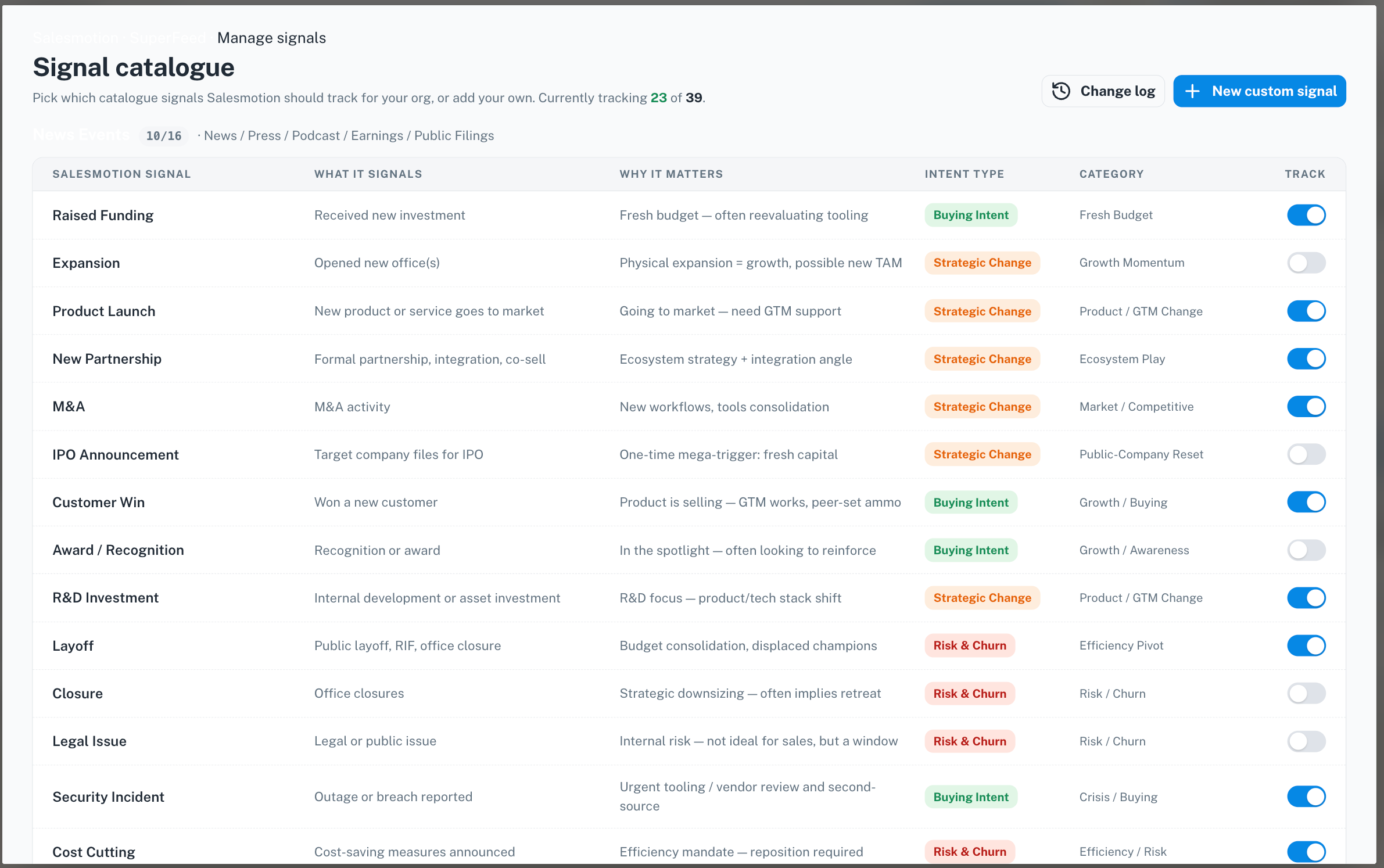 The signal catalogue. Each row is one signal you can toggle on or off, organised by intent type and category. Here, the News & Press group — from Raised Funding to Cost Cutting.
How signals are organised
Every signal in the catalogue is described along the same four dimensions, so you can scan and prioritise quickly:
| Column | What it tells you |
|---|---|
| Signal | The named event Salesmotion looks for (e.g. Raised Funding, Layoff, New Executive Hire). |
| What it signals | The underlying real-world event that triggers detection. |
| Why it matters | The sales angle — what this event means for your timing, messaging, or who to call. |
| Intent type | A short tag for how to use the signal: a fresh budget, a timing trigger, a warm intro, etc. |
| Category | The high-level bucket the signal rolls up into (see below). |
The signal categories
Every signal belongs to one of a few colour-coded categories. These are the lenses you'll use most when filtering the Global Feed or reading an account:
- Buying Intent — the account is in motion in a way that creates an opening now: fresh funding, a customer win, a new earnings cycle, a security incident forcing a vendor review.
- Strategic Change — the account's direction is shifting: a product launch, M&A, a rebrand, a new partnership, a stated priority in a 10-K. Reposition your pitch to match.
- Risk & Churn — pressure or instability: layoffs, office closures, cost-cutting, a champion leaving. A warning sign for existing customers and a "lead with the pain" angle for prospects.
- Contact & Routing — a people move that changes who you should talk to or how you get in: a past champion resurfacing, a new executive, a warm-intro path.
- Fit & Targeting — signals that tell you whether an account is a fit at all: a matching tech stack, an AI-scored likelihood to buy.
News, press & earnings signals
The richest and most frequent group. These come from news wires, company press releases, and investor relations material.
| Signal | What it signals | Why it matters | Intent type | Category |
|---|---|---|---|---|
| Raised Funding | Received new investment | Fresh budget — often re-evaluating tooling | Fresh Budget | Buying Intent |
| Customer Win | Won a new customer | Product is selling; GTM works — peer-set ammo | Growth / Buying | Buying Intent |
| Award / Recognition | Recognition or award received | In the spotlight — often looking to reinforce | Growth / Awareness | Buying Intent |
| Security Incident | Outage or breach reported | Urgent tooling / vendor review and second-sourcing | Crisis / Buying | Buying Intent |
| New Earnings Call | New quarterly earnings call or transcript | Fresh quarter = fresh priorities and budgets | Timing Trigger | Buying Intent |
| Expansion | Opened new office(s) | Physical expansion = growth, possible new TAM | Growth Momentum | Strategic Change |
| Product Launch | New product or service goes to market | Going to market — they need GTM support | Product / GTM Change | Strategic Change |
| New Partnership | Formal partnership, integration, or co-sell | Ecosystem strategy + integration angle | Ecosystem Play | Strategic Change |
| M&A | Acquires or merges with another company | New workflows, tools consolidation | Market / Competitive | Strategic Change |
| IPO Announcement | Company files for IPO | One-time mega-trigger: fresh capital | Public-Company Reset | Strategic Change |
| R&D Investment | Internal development or asset investment | R&D focus — product / tech-stack shift | Product / GTM Change | Strategic Change |
| Rebrand Announcement | New product, brand, or motion launched | Strategic reset = new ICP, new messaging | Strategic Shift | Strategic Change |
| Layoff | Public layoff, RIF, or workforce reduction | Budget consolidation, displaced champions | Efficiency Pivot | Risk & Churn |
| Closure | Office closures | Strategic downsizing — often implies retreat | Risk / Churn | Risk & Churn |
| Legal Issue | Legal or public issue | Internal risk — not ideal for selling, but worth knowing | Risk / Churn | Risk & Churn |
| Cost Cutting | Cost-saving measures announced | Efficiency mandate — reposition around savings | Efficiency / Risk | Risk & Churn |
Job & hiring signals
Hiring is one of the earliest and most honest indicators of where a company is investing. Salesmotion reads the job description itself, not just the title.
![The signal catalogue scrolled to the hiring signals — Hiring in [Department], Tech Match, Hiring with Pain Keywords, Aggressive Hiring, Leadership Hiring, and New Strategic Initiative](/blog/images/signal-catalogue/signal-catalogue-job-hiring.png) Hiring signals read the job description itself — matching your tech stack, pain keywords, seniority, and hiring velocity.
Hiring signals read the job description itself — matching your tech stack, pain keywords, seniority, and hiring velocity.
| Signal | What it signals | Why it matters | Intent type | Category |
|---|---|---|---|---|
| Hiring in [Department] | Hiring in a specific department | Direct reference to function — confirms growth signal | Hiring in Department | Buying Intent |
| Tech Match | Job description mentions a stack (e.g. Salesforce, dbt) | Confirmed user — personalise the use-case | Tech Match | Fit & Targeting |
| Hiring with Pain Keywords | JD mentions "pipeline", "CRM", "SQL", etc. | Inefficiencies in the funnel they want fixed | Pain-Based Trigger | Buying Intent |
| Aggressive Hiring | Multiple open roles (5+ jobs) | Funding or high-growth pattern | Scaling Company | Buying Intent |
| Leadership Hiring | Mid/high-level decision-makers in the JD | Good contact points or accounts to target | Org Decision Layer | Contact & Routing |
| New Strategic Initiative | Investment in a new team or business unit | A mandate forming — early window to brief the lead | Strategic Initiative | Strategic Change |
Contact & people signals
Who moves matters as much as what happens. These signals track the people inside your accounts — champions, joiners, leavers, and warm paths in.
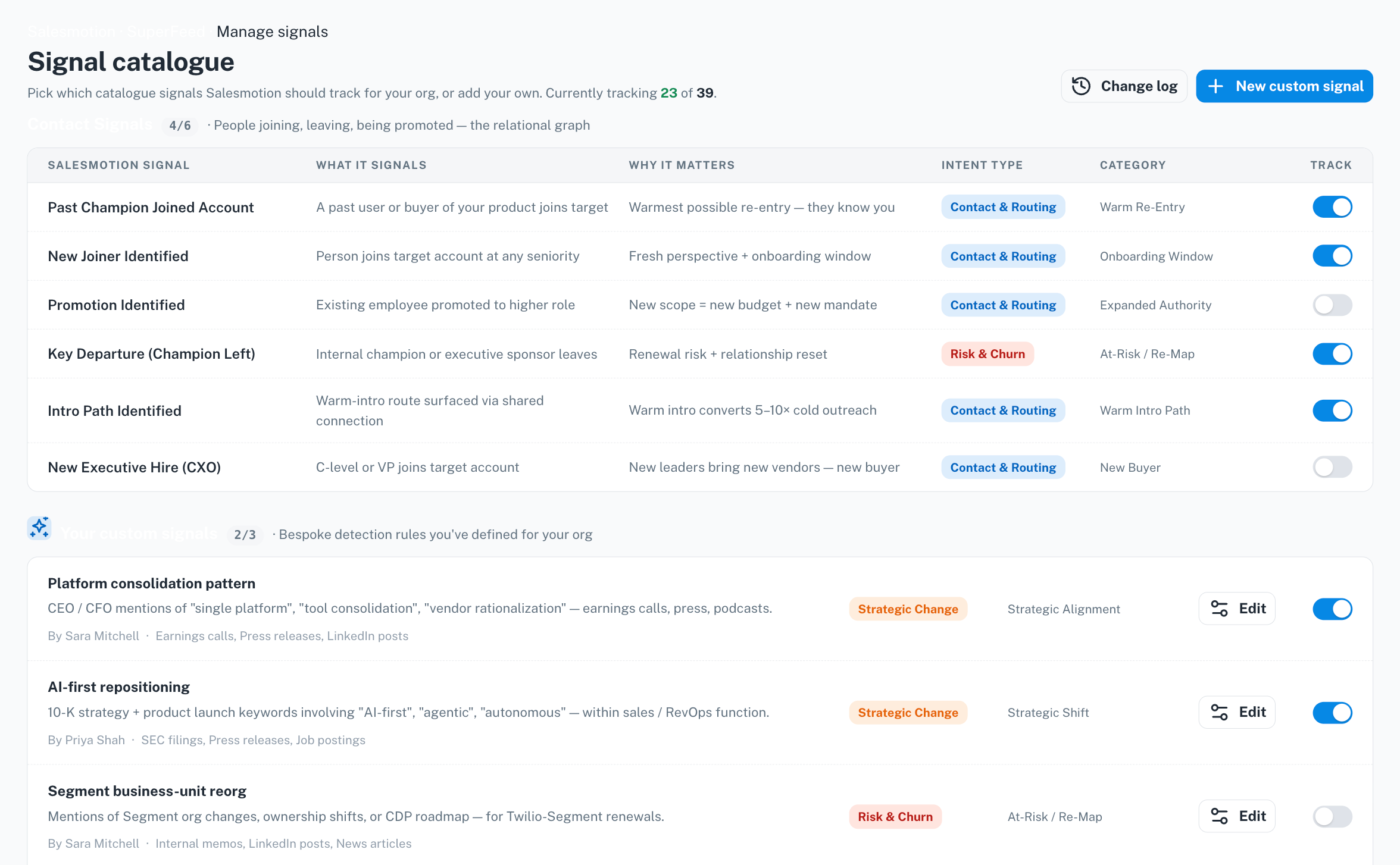 People signals track champions, joiners, promotions, departures, and warm-intro paths — the moves that change who you call and how you get in.
| Signal | What it signals | Why it matters | Intent type | Category |
|---|---|---|---|---|
| Past Champion Joined Account | A past user or buyer of your product joins a target | Warmest possible re-entry — they already know you | Warm Re-Entry | Contact & Routing |
| New Joiner Identified | Someone joins a target account at any seniority | Fresh perspective + onboarding window | Onboarding Window | Contact & Routing |
| Promotion Identified | Existing employee promoted to a higher role | New scope = new budget + new mandate | Expanded Authority | Contact & Routing |
| New Executive Hire (CXO) | A C-level or VP joins a target account | New leaders bring new vendors — new buyer | New Buyer | Contact & Routing |
| Intro Path Identified | Warm-intro route surfaced via a shared connection | Warm intros convert 5–10× cold outreach | Warm Intro Path | Contact & Routing |
| Key Departure (Champion Left) | An internal champion or executive sponsor leaves | Renewal risk + relationship reset | At-Risk / Re-Map | Risk & Churn |
Public filings & 10-K signals
For public companies, Salesmotion parses regulatory filings — turning dense documents into pointed sales angles.
| Signal | What it signals | Why it matters | Intent type | Category |
|---|---|---|---|---|
| Strategic Insights (10-K) | Public-company strategy and stated focus areas | Align your pitch to their stated priorities | Strategic Alignment | Strategic Change |
| Business Challenges (10-K) | Risk factors and pain points disclosed in filings | Surfaces explicit pain — lead with it | Pain-Based | Risk & Churn |
| Competitive Signal | A competitor is mentioned in posts, reviews, or filings | Displacement or differentiation opportunity | Competitive Play | Strategic Change |
Taxonomy & meta-signals
These sit on top of the underlying events — buckets and model outputs that help you prioritise across an entire book of business.
| Signal | What it signals | Why it matters | Intent type | Category |
|---|---|---|---|---|
| News-Based Signals | Funding, M&A, launches, leadership changes | Trigger events that shift priorities and budgets | Trigger Event | Strategic Change |
| Risk Signals | Layoffs, office closures, lawsuits | Indicates churn risk or restructuring | Risk / Churn | Risk & Churn |
| Timing / Trigger Signals | Fiscal cycle, renewal date, end-of-quarter windows | Pinpoints exact buying windows | Time-Sensitive | Buying Intent |
| Predictive / AI Signals | Model-scored likelihood to buy or churn | Prioritises pipeline using a probabilistic score | AI-Qualified | Fit & Targeting |
| Buying Stage Signals | Awareness → Consideration → Decision indicators | Tailors message and CTA to where they are | Stage-Based | Buying Intent |
| Relationship Signals | Mutual connections, shared past employers | Enables warm intros and trust-based outreach | Warm Intro | Contact & Routing |
Custom signals — track anything in the public domain
The catalogue above is the standard set, but it isn't a hard limit. If something is detectable in the public domain, Salesmotion can track it as a custom signal for your org. That means you can define detection rules tuned to your exact category, competitors, and ICP — and they'll run across all your accounts alongside the standard signals.
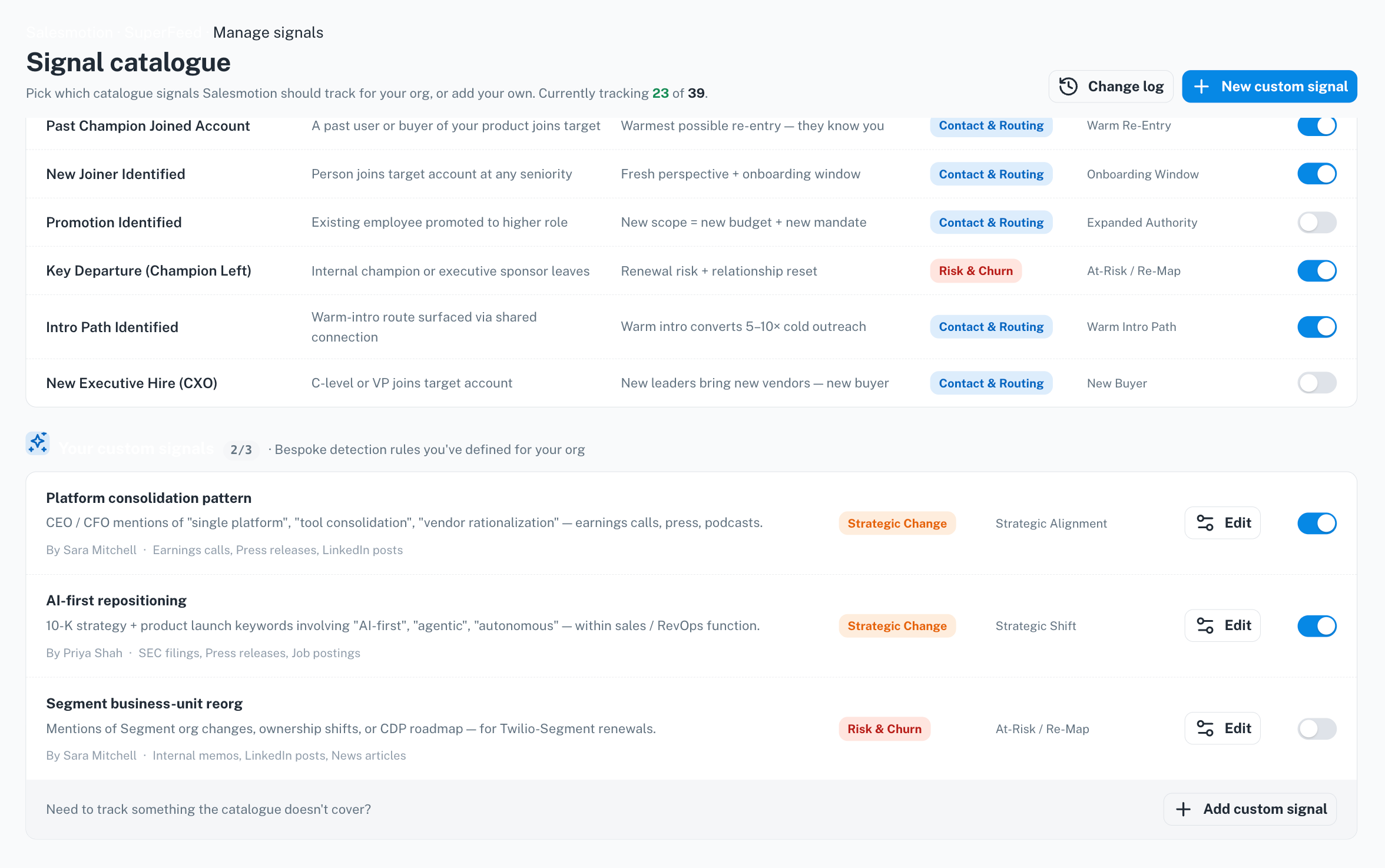 Bespoke detection rules defined for your org. Anything observable in public sources can become a tracked signal — use "Add custom signal" to define your own.
A custom signal can span any of the public sources Salesmotion already monitors — earnings calls, press releases, LinkedIn posts, news articles, SEC filings, internal-memo coverage, and podcasts. A few real examples customers track today:
- Platform consolidation pattern — a CEO or CFO mentioning "single platform", "tool consolidation", or "vendor rationalization" across earnings calls, press, and LinkedIn posts.
- AI-first repositioning — 10-K strategy or product-launch keywords involving "AI-first", "agentic", or "autonomous" within a sales / RevOps function.
- Segment business-unit reorg — mentions of org changes, ownership shifts, or roadmap changes tied to a specific product line, ahead of renewals.
Custom signals our customers commonly ask for
These are framed in plain language — exactly how you'd describe the event you want to catch. Each maps to one or more detection rules under the hood:
- Executives talking about a sales or GTM transformation on earnings calls
- A company struggling with pipeline generation (per news, earnings, etc.)
- A company that wants to introduce signal-based selling
- A company hiring sales reps who need to do prospect research
- A company hiring sales reps with a named-account list
- A company under pressure to cut costs and become more efficient
- A new CRO joining — likely to review the tech stack
- A new head of RevOps joining — likely to review the tech stack
- A new joiner in RevOps or Sales leadership at an account
- A past champion or user moving to a new company
- Multiple open sales roles indicating a sales ramp-up
- A company expanding internationally with new offices
- A company making an acquisition
- A company investing in AI for its sales team
If you can describe the event and it shows up somewhere public, it can become a signal. To request one, use Add custom signal in the catalogue, or talk to your Salesmotion contact about a detection rule for your team.
Managing which signals you track
The catalogue is configurable per org. Open Manage signals to:
- Toggle any signal on or off using the Track switch on each row. Switching off signals you don't care about keeps the Global Feed and account views focused on what matters to your team.
- See your tracking count at the top (e.g. "Currently tracking 23 of 39") so you know how broad your coverage is.
- Filter the catalogue by data object — News / Press / Podcast / Earnings / Public Filings — to review one source at a time.
- Review the Change log to see when signals were turned on or off and by whom.
- Add a custom signal with the + New custom signal button.
For tuning which accounts and keywords feed these signals, see Configuring Keywords and Setup.
Frequently asked questions
How many signals does Salesmotion track?
The standard catalogue covers ~40 named signals across news, earnings, hiring, public filings, and people moves — and that's before any custom signals your org defines. You choose which to track; most teams run a focused subset rather than all of them at once.
Can Salesmotion track something that isn't in the catalogue?
Yes. If the event is detectable in the public domain — earnings calls, press, job ads, filings, podcasts, public profiles — it can be set up as a custom signal for your org. Use Add custom signal in the catalogue or ask your Salesmotion contact.
Where do signals come from?
All signals are detected from public sources only — news wires, company newsrooms, investor relations pages, public job boards, SEC filings, podcasts, and public professional profiles. No private databases, no scraped social feeds. See How Salesmotion Collects Data.
What's the difference between a signal's "intent type" and its "category"?
The category is the high-level bucket (Buying Intent, Strategic Change, Risk & Churn, Contact & Routing, Fit & Targeting) you filter by. The intent type is a finer tag describing how to act on that specific signal — for example, a Fresh Budget angle versus a Timing Trigger versus a Warm Intro Path.
Do all accounts produce every signal?
No. Private companies won't generate earnings or 10-K signals. An account simply won't show a signal type if Salesmotion hasn't detected that kind of public activity for it. See Understanding Account Signals for how signals display on an individual account.