
What is the SWOT Analysis?
The SWOT Analysis is an AI-generated strategic assessment available on the Research tab of every tracked account. It organises the most important signals Salesmotion has gathered into four familiar quadrants — Strengths, Weaknesses, Opportunities, and Threats — giving you a structured, at-a-glance view of the account's current position.
Instead of manually reading dozens of earnings transcripts, news articles, and filings to piece together a picture, the SWOT does it for you. Every point is generated from real signals, and each one is cited so you can trace it back to the source.
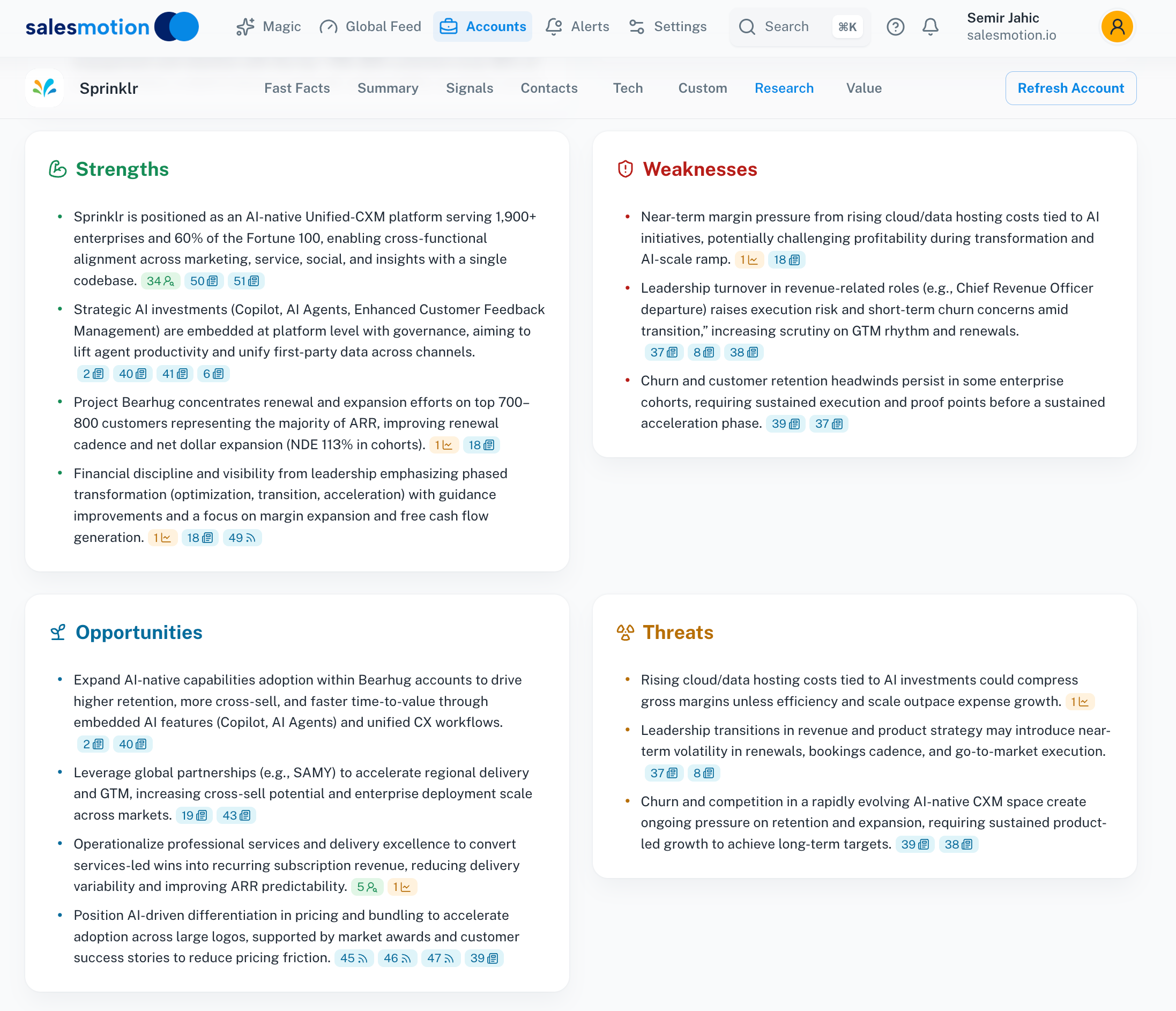 The SWOT Analysis for Sprinklr — each quadrant summarises the account's strategic position with cited, signal-backed insights.
The four quadrants
Strengths (green)
This quadrant highlights what the account is doing well and where it has a competitive advantage. Examples might include strong market position, a differentiated product, strategic investments, or a growing customer base.
Understanding an account's strengths helps you position your solution to complement or enhance what's already working. It also helps you avoid pitching against something the account considers a core competency.
Weaknesses (red)
Weaknesses surface areas where the account faces challenges — margin pressure, leadership turnover, customer churn, product gaps, or operational inefficiencies.
These are valuable for crafting your outreach. When you can speak directly to a challenge the account is experiencing, your message resonates more strongly than a generic pitch. Just be tactful — reference the challenge as context, not as criticism.
Opportunities (blue)
Opportunities highlight areas where the account could grow, innovate, or improve. These might include expanding into new markets, leveraging emerging technology, strengthening partnerships, or improving operational efficiency.
This is where you can align your solution most naturally. If an account has an opportunity to operationalise professional services or adopt AI-driven pricing, and your product helps with exactly that, you have a clear value story to tell.
Threats (orange)
Threats identify external risks or competitive pressures facing the account — rising costs, competitive dynamics, regulatory changes, leadership instability, or market shifts.
Understanding threats helps you frame your solution as a way to mitigate risk. It also gives you a more complete picture of the account's operating environment, so you can have more informed, executive-level conversations.
How citations work
Each point in the SWOT is followed by small numbered badges. These are citations — they link back to the specific signals that informed that insight. Click a citation badge to view the original signal (an earnings transcript excerpt, a news article, a filing, etc.) so you can verify the insight and get the full context.
This transparency is important. Unlike a generic summary you might find elsewhere, every claim in the SWOT is traceable to a real data source, giving you the confidence to use these insights in conversations with prospects and customers.
How to use SWOT in your workflow
Before meetings and QBRs
Open the SWOT tab before any significant account meeting. Scan the four quadrants to refresh your understanding of the account's current situation. The Weaknesses and Opportunities quadrants are especially useful for framing discussion topics and discovery questions.
In account planning
Use the SWOT alongside the Value Pyramid to build a complete account plan. The SWOT gives you the "what" — the account's strategic landscape — while the Value Pyramid gives you the "so what" — how your solution connects to their specific goals and challenges.
In outreach and proposals
Reference specific insights from the SWOT in your emails and proposals. For example, if the SWOT identifies "rising cloud hosting costs" as a threat, and your solution helps optimise cloud spend, you can lead with that insight and cite the earnings call where it was discussed.
Sharing with your team
The SWOT provides a concise, shareable summary that your entire deal team can use. Instead of asking everyone to read a 90-minute earnings transcript, share the SWOT and point to the most relevant quadrants for the upcoming conversation.
How the SWOT is generated and updated
Salesmotion's AI continuously monitors public signals for each account — news, earnings, filings, hiring, and more. The SWOT is synthesised from these signals and updated as new information becomes available. If a major event occurs (an acquisition, an executive departure, a strategy shift), the SWOT will reflect it once the underlying signals are processed.
Because the SWOT is based on publicly available data, privately held companies with limited public disclosures may have a less detailed analysis. For these accounts, combine the SWOT with your own primary research and CRM notes.
Tips for getting the most from the SWOT
- Review the SWOT before every important meeting. It takes just a few minutes and ensures you walk in with a current, well-rounded understanding of the account.
- Lead with insights from Weaknesses and Opportunities in discovery conversations. These quadrants often contain the strongest hooks for starting a meaningful dialogue.
- Click citation badges to get the full context. A one-line SWOT bullet is useful, but the underlying signal often contains additional detail you can use in your pitch.
- Pair with the Value Pyramid for a complete picture. The SWOT tells you what's happening at the account; the Value Pyramid tells you how your solution fits in.
- Share SWOT insights with your champion at the account. When they see you understand their strategic landscape, it builds credibility and trust.
Frequently asked questions
How often is the SWOT updated?
The SWOT is updated as new signals are processed for the account. After a major event — like an earnings call or a significant news announcement — the analysis will reflect those changes once Salesmotion has ingested and processed the underlying signals.
Can I edit the SWOT?
The SWOT is AI-generated and cannot be manually edited. However, you can always supplement it with your own notes and context in your CRM or account plan. Think of the SWOT as a starting point that captures the public picture — your personal knowledge of the account fills in the gaps.
Why does one account have a more detailed SWOT than another?
The depth of the SWOT depends on the volume and variety of public signals available for that account. Larger, publicly traded companies with frequent earnings calls, news coverage, and regulatory filings will typically have richer SWOT analyses than privately held companies with limited public information.