
What is the Value Pyramid?
The Value Pyramid is an AI-generated strategic framework available on the Value tab of every tracked account. It distils signals from across the account — earnings calls, news, filings, job postings, and more — into a structured hierarchy that connects the account's business goals all the way down to specific ways your solution can deliver value.
This is one of the most powerful features in Salesmotion for deal strategy, because it doesn't just tell you what the account is doing — it tells you how your solution fits into their world.
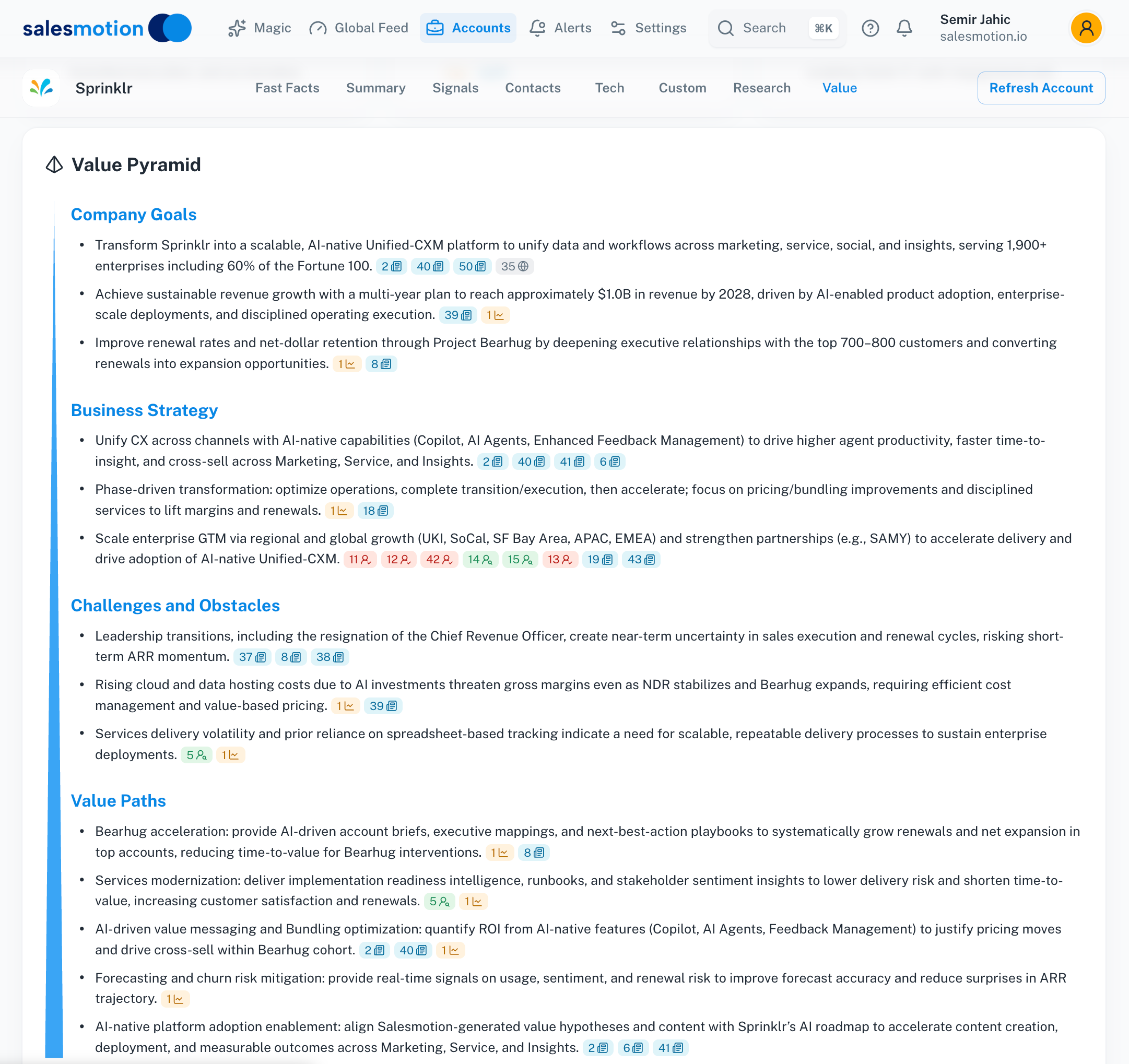 The Value Pyramid for Sprinklr — four layers that connect company-level goals down to specific value paths, each backed by cited signals.
The four layers
Company Goals
The top of the pyramid captures the account's highest-level objectives — the outcomes their leadership has publicly communicated. These might include revenue targets, market expansion plans, product transformation initiatives, or operational efficiency goals.
Understanding company goals is essential for executive conversations. When you can frame your solution in terms of helping the account achieve a stated goal, you're speaking the language of their C-suite.
Business Strategy
Beneath the goals sits the strategy — the approach the account is taking to achieve those objectives. This layer describes the "how": whether they're pursuing an AI-first platform transformation, a channel-partner expansion, a focus on enterprise accounts, or a geographic growth play.
Knowing the strategy helps you position your solution as an enabler rather than a distraction. If the account is pursuing a phased digital transformation, you can show how your offering accelerates one of those phases.
Challenges and Obstacles
This layer identifies the barriers standing between the account and its goals. Common themes include leadership transitions, rising costs, customer churn, competitive pressure, and talent gaps.
Challenges are where sales conversations get real. When you can reference a specific obstacle — "I noticed your CRO departed recently and you're navigating a leadership transition in revenue" — you demonstrate a level of understanding that most competitors won't match.
Value Paths
The bottom of the pyramid is the most actionable layer. Value Paths are AI-generated suggestions for how your solution can specifically address the account's challenges and help them achieve their goals. These are concrete, context-aware recommendations — not generic product pitches.
For example, if an account is struggling with customer churn and has a stated goal to improve renewal rates, a Value Path might suggest "churn risk mitigation through AI-driven account health monitoring" — directly connecting your capability to their need.
How citations work
Like the SWOT Analysis, every point in the Value Pyramid is backed by numbered citation badges. Click a badge to view the original signal — an earnings transcript quote, a news article, a filing excerpt — that informed the insight.
This traceability is valuable in two ways. First, it gives you confidence that the insight is grounded in real data, not speculation. Second, it gives you a source to reference in conversations: "I was reading your Q3 earnings transcript and noticed your CEO mentioned..."
How to use the Value Pyramid in your workflow
In deal strategy
The Value Pyramid is a natural fit for deal strategy sessions. Walk through the four layers with your team:
- What does the account want to achieve? (Company Goals)
- How are they trying to get there? (Business Strategy)
- What's getting in the way? (Challenges and Obstacles)
- Where do we fit in? (Value Paths)
This framework ensures your team is aligned on the account's context and your positioning before any outreach or proposal.
In proposals and presentations
Reference the Value Pyramid directly when building proposals. Start with the account's stated goals and challenges, then show how your solution addresses them. This approach turns a product-centric proposal into a customer-centric one — a shift that consistently improves win rates.
In executive conversations
Company Goals and Business Strategy give you the vocabulary to engage at the executive level. Instead of leading with features, lead with their objectives: "I understand you're working towards $1 billion in revenue by 2028 through a platform-led growth strategy — here's how we can help accelerate that."
In discovery calls
The Challenges and Obstacles layer gives you ready-made discovery questions. Instead of asking generic questions, you can validate what you've learned: "We've seen some public signals around rising hosting costs — is that something your team is actively working to address?" This shows preparation and earns trust.
Combining the Value Pyramid with the SWOT
The SWOT Analysis and the Value Pyramid complement each other. Use them together for the most complete picture:
- The SWOT gives you the external strategic landscape — what's happening to and around the account.
- The Value Pyramid gives you the internal strategic direction — what the account is trying to achieve and how your solution fits in.
Together, they form a comprehensive account intelligence brief that would normally take hours of manual research to compile.
How the Value Pyramid is generated and updated
The Value Pyramid is built by Salesmotion's AI from the same signal sources that power the rest of the platform — earnings calls, financial filings, news, job postings, and more. It is updated as new signals are detected and processed.
Because Value Paths are generated relative to your solution's capabilities, they may become more refined over time as Salesmotion processes more signals about both the account and your product positioning. Accounts with richer public data (typically larger, publicly traded companies) will have more detailed pyramids.
Tips for getting the most from the Value Pyramid
- Use Value Paths in your emails and proposals. They give you pre-built, contextual value statements that connect your solution to the account's specific needs — far more effective than generic messaging.
- Align your pitch to Company Goals. When you frame your solution in terms of the account's stated objectives, you're speaking the language of their leadership team.
- Reference Challenges to show you understand their business. Prospects are more receptive when they feel understood. Citing a specific challenge from the Value Pyramid demonstrates genuine preparation.
- Click citation badges for full context. The one-line summary in the pyramid is a starting point. The underlying signal often contains quotes, figures, and context that strengthen your pitch.
- Review before every significant meeting. The Value Pyramid changes as new signals are processed, so a quick review before an important call ensures you're working with the latest insights.
Frequently asked questions
How are Value Paths different from the SWOT Opportunities?
SWOT Opportunities describe broad growth areas or strategic openings for the account. Value Paths are more specific — they connect those opportunities (and the account's challenges) directly to ways your solution can help. Think of Opportunities as "what the account could do" and Value Paths as "how you can help them do it."
Can I customise the Value Pyramid?
The Value Pyramid is AI-generated and cannot be manually edited. However, you can use it as a starting point and adapt the insights for your own account plans, proposals, and presentations. The citation badges provide the raw material for deeper customisation.
Why do some accounts have more detailed Value Paths than others?
Value Paths are generated from public signals, so accounts with more available data — frequent earnings calls, news coverage, and regulatory filings — will typically have richer and more specific paths. For accounts with limited public data, supplement the Value Pyramid with your own research and CRM notes.