Every CRO has a slide on AI in their 2026 plan. Almost none can show the return.
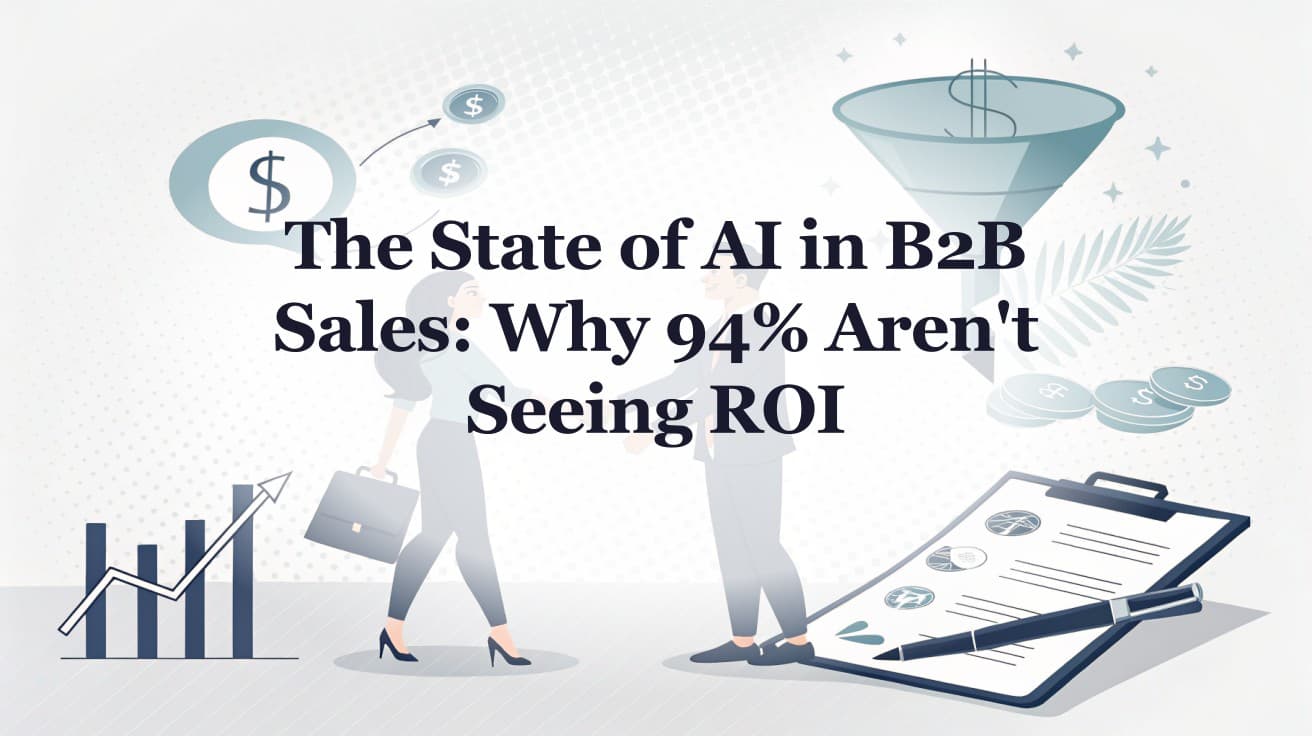
A McKinsey global survey of executives put numbers on the gap. 88% of organizations now use AI in at least one business function, but only 6% extract meaningful bottom-line value. A separate UserGems survey of 100+ B2B SaaS leaders landed in the same place. 7% saw measurable ROI, 45% saw limited returns and uncertain value, and the rest are still hoping.
This isn't an AI problem. It's an intelligence problem. The 6 to 7% that win aren't using smarter models. They're feeding their models smarter inputs.
TL;DR: AI adoption in B2B sales is widespread but rarely profitable. Most teams plug AI into stale account data, generic workflows, and untrained reps, then wonder why the output looks like every other vendor's. The teams seeing real returns rebuilt the layer underneath AI first: clean account data, live buying signals, and workflows redesigned around them.
The 94% are running AI on broken inputs
Look at how AI gets used in most sales orgs in 2026.
A rep opens ChatGPT, pastes a job title and company name, and asks for "personalized" outreach. A revenue platform auto-summarizes a discovery call from a transcript that was already in the CRM. An SDR tool blasts a "warm" sequence based on email opens from six months ago.
In each case, the AI is doing exactly what it was asked. The problem is the input. The model has no idea this account just announced a restructure, that the new CRO joined from a competitor last week, or that the buyer's earnings call mentioned cost cutting three times. So it produces something that sounds personalized but isn't.
In one of more than 370 sales and customer calls in the twelve months to October 2026, an account executive at a software firm told us: "everyone is jumping into AI. And throwing AI at bad data." That is the input problem in a seller's own words.
Gartner predicts 60% of AI projects unsupported by AI-ready data will be abandoned through 2026. In their survey of leaders dealing with AI failures, 38% pointed directly at poor data quality as the cause. The teams getting nothing back from AI aren't using the wrong models. They're feeding them the wrong fuel.
See Salesmotion on a real account
Book a 15-minute demo and see how your team saves hours on account research.
The 6% redesigned the workflow, not just the tools
McKinsey's analysis is blunt on this. Companies that combined AI deployment with redesigned workflows and clearly defined KPIs achieved 2.7x higher ROI than companies that simply added AI tools on top of existing processes. The structural change is the unlock, not the model upgrade.
For a sales team, redesigning the workflow means three things.
- The account picture is built before any rep touches it. Not after the rep digs through ZoomInfo, news sites, LinkedIn, and the CRM. Before. So the AI has something real to work with.
- Buying signals trigger the work, not arbitrary cadence rules. A rep doesn't reach out because it's "Tuesday touch day." They reach out because the target hired a new VP of Revenue Operations yesterday, or because the earnings call yesterday mentioned a strategic initiative the rep's product directly supports.
- The rep's judgment sits on top of the intelligence, not under it. AI drafts, the rep edits. AI surfaces signals, the rep decides which to act on. The human is the last layer, not the bottleneck.
This is what "human-first AI" actually looks like in operation. It's not a posture. It's a workflow design.

“The talking points are gold. If they're in Salesmotion, I know they're being discussed inside that business. That makes it easy to spark a real conversation, which is 90 percent of the battle.”
Andrew Giordano
VP of Global Commercial Operations, Analytic Partners
What this looks like with Salesmotion in the loop
Here is the workflow for a rep working a list of 50 named accounts.
Trigger. A target account posts a VP of Operations role on LinkedIn. The earnings call from last week mentions a "modernization initiative." Salesmotion flags both signals automatically.
Platform action. The account brief auto-updates with the leadership change, the earnings excerpt, the strategic initiative, and a citation for each. No prompt engineering. No tab-toggling between five tools.
Rep action. The rep opens the account, reads three minutes of context, and uses Salesmotion's prospecting view to draft an outreach anchored to the modernization initiative and the new VP's prior role. They edit the draft, add a personal observation, and send.
Outcome. The first meeting opens with the rep already knowing the buyer's stated priority. Discovery is half-done before the call. Deal velocity improves because the rep wasn't asking questions a 10-minute SEC filing read would have answered.
This is the workflow that produces the 17.3% sales ROI improvements McKinsey cited for enterprise-wide AI deployment. It is not the AI doing the heavy lifting. It is the intelligence layer underneath.
Customers running this workflow see it in their numbers. Analytic Partners cut account research time 85% (from 3 hours to 15 minutes) and grew qualified pipeline 40% year over year. Frontify lifted sales velocity 42% YoY and grew self-sourced revenue 4x in the same year. These are not "AI productivity" gains in the abstract. They are what happens when AI sits on top of a research layer it can actually trust.
Why the team buy-in problem is really an outputs problem
The most common explanation for slow AI adoption in sales is "team resistance." Reps don't want to use AI. They're worried about being replaced. They distrust the outputs.
That story is half right. The full story is that reps distrust AI because the first version they were handed produced bad outputs. Generic outreach. Hallucinated company facts. Summaries of meetings they didn't need summaries of. So they stopped using it.
The fix isn't enablement decks. The fix is making the AI output something a rep can actually send without rewriting it. That requires inputs the rep trusts.
- Cited sources. A summary that links to the original earnings call transcript or the SEC filing is verifiable. A summary that doesn't is a liability.
- Freshness dates. AI built on a 2023 dataset misses every leadership change since. Reps know this instinctively and will not trust it.
- Specificity to the account, not the segment. Generic "trends in your industry" is what got reps to ignore AI. Account-specific intelligence, this hire, this earnings line, this product launch, is what gets them to keep using it.
Once the outputs are good, the buy-in problem solves itself. Reps adopt tools that make their day easier. They reject tools that create more cleanup work.

“The AI templates were a surprise delight. We expected the data, but the pre-built email suggestions turned out to be much better than expected and a huge help, especially for newer reps.”
Sabina Malochleb-Bazaud
Senior Sales Operations Administrator, Cytel
What the 6% are doing that the 94% aren't
Across the McKinsey, Gartner, and UserGems data, the pattern of the winners is consistent.
| What 94% do | What 6% do |
|---|---|
| Plug AI into existing workflows | Redesign the workflow around AI plus buying signals |
| Train AI on whatever data is in the CRM | Pipe in fresh, cited account intelligence |
| Define success as "rep uses the tool" | Define success as time saved or pipeline created per rep |
| Treat AI as a productivity feature | Treat AI as a strategy shift requiring exec sponsorship |
| Buy 5 point tools (research, summarize, draft, score, sequence) | Consolidate to one intelligence layer for the research-to-outreach loop |
The last row is the one CFOs notice. Most teams have stacked five AI-adjacent tools that each solve 10% of the problem. The 6% picked one platform for the research-to-outreach loop, then put their AI budget there.
An enablement and operations leader at a software firm told us: "it feels like you can get the insight other places right now. ... But you can't get kind of everything in one place that makes prospecting a single click." The pieces exist. What is missing is one place where they come together.
How to move from the 94% to the 6%
The shift is operational, not technological. A 90-day version.
- Weeks 1 to 2. Audit the rep's actual day. How many tools open at once? How much time on research? How many of those tools produce outputs the rep trusts? You will be surprised.
- Weeks 3 to 6. Pick one workflow, for example named-account research to first-touch outreach. Redesign it around a single intelligence source. Cut the rest.
- Weeks 7 to 10. Measure. Time per account. Meetings per rep per week. Reply rates on signal-anchored outreach versus generic. The numbers tell you whether the new workflow works.
- Weeks 11 to 12. Scale what worked. Kill what didn't. Don't add more AI tools. Concentrate on the one that produced the most ROI.
Teams that follow this loop move from "we're experimenting with AI" to "AI is how we sell." Teams that skip it are the ones still presenting AI roadmaps with no ROI two years from now.
Key Takeaways
- AI adoption is widespread (88%+) but only 6 to 7% of teams see measurable ROI. The bottleneck is the data and workflow AI runs on, not the model.
- Companies that redesign workflows around AI achieve 2.7x higher ROI than companies that bolt AI onto existing processes (McKinsey).
- Poor data quality is the single most cited cause of AI failure. Gartner predicts 60% of AI projects without AI-ready data will be abandoned through 2026.
- "Team resistance" is usually an outputs problem in disguise. Reps reject AI when the outputs are generic, stale, or unverifiable.
- The 6% that win consolidate around one intelligence layer that handles research to outreach. They don't stack five point tools.
- The path forward is operational. Redesign one rep workflow around live account intelligence, measure it, then scale. Book a demo to see what that looks like on one of your real accounts.
Frequently Asked Questions
Why are most B2B sales teams not seeing ROI from AI?
Most teams added AI tools on top of existing workflows without redesigning the data layer underneath. AI built on stale CRM data and generic prompts produces generic outputs that reps don't trust and don't send. The 6% seeing real ROI rebuilt the inputs first: clean account data, live buying signals, and workflows that put AI where it adds value rather than everywhere at once.
What percentage of AI projects in B2B sales actually deliver measurable returns?
The numbers cluster between 6 and 7%. McKinsey's State of AI found 6% of organizations extract meaningful bottom-line value from AI despite 88% adoption. A separate UserGems survey of 100+ B2B SaaS leaders put the figure at 7% reporting measurable ROI, with 45% seeing limited or uncertain value.
How long does it take to see ROI from AI in sales?
Teams that redesign workflows around AI typically see measurable change within one to two quarters. Productivity gains in research and drafting show up in weeks. Pipeline and win-rate gains take a quarter or two to materialize because they depend on signal-anchored outreach landing real meetings. Teams that simply add AI tools to existing processes often see no ROI even after a year.
What is the single biggest cause of AI failure in B2B sales?
Bad inputs. Gartner's analysis found 38% of leaders facing AI setbacks cited poor data quality as the direct cause, and predicted 60% of AI projects unsupported by AI-ready data would be abandoned through 2026. Generic AI tools running on stale account data will produce generic outputs every time, regardless of how sophisticated the model is.
Should we wait for AI to mature before investing more?
No. The 6% who win compound their advantage every quarter. They build clean signal pipelines, train reps on the new workflow, and accumulate institutional knowledge about what works. Teams waiting for "mature AI" are also waiting to fall further behind. The right move is to pick one high-leverage workflow, redesign it around live account intelligence, and prove the ROI before expanding.