For a 10-person outbound team, the best sales intelligence setup depends on your biggest bottleneck. If reps spend hours researching accounts before calls, you need an account intelligence platform like Salesmotion (custom team pricing for unlimited users). If your primary gap is contact data and sequencing, Apollo.io ($49-119/user/mo) is the best value. If you need both deep intelligence and contact data, pair Salesmotion with Apollo for enterprise-grade coverage at a fraction of what ZoomInfo or 6sense would cost. Avoid enterprise-priced tools like ZoomInfo ($15K+/yr) and 6sense ($60K+/yr) unless your deal sizes justify the spend — most small teams get far more ROI from focused tools that solve one problem well.
I have been building and selling sales tools for over a decade, and the single biggest mistake I see small teams make is buying tools built for 200-person sales floors. Enterprise platforms are designed to extract maximum revenue from large organizations. A 10-person team does not need — and should not pay for — anonymous visitor deanonymization, multi-touch attribution, or ABM orchestration. You need accurate data, actionable intelligence, and a way to reach prospects. This guide focuses on what actually works when every dollar in the tech budget has to earn its keep.
Why Small Teams Need Different Tools
The sales intelligence market has ballooned into a $5.5 billion industry, but most of that spending comes from enterprises. Tools like ZoomInfo, 6sense, and Demandbase are built for organizations with dedicated RevOps teams, six-figure tech budgets, and 12-month implementation cycles. Small outbound teams have fundamentally different requirements:
- Budget sensitivity. A $60K annual contract that is a rounding error for a 500-person sales org is your entire tech stack budget.
- Speed to value. You cannot wait 90 days for implementation. The tool needs to work on day one.
- Simplicity over features. Every feature that requires configuration is a feature that will not get used. Small teams need tools reps actually open every day.
- Pricing that scales with growth, not headcount. Per-seat pricing punishes you for growing. Account-based or flat-rate pricing lets you add reps without renegotiating contracts.
The good news: the best tools for small teams are not watered-down enterprise products. They are purpose-built platforms that deliver more signal per dollar than anything available five years ago.
See the product in action
Take a self-guided tour of the Salesmotion platform — no signup required.
Best Sales Intelligence Tools by Use Case for Small Teams
Before diving into individual tools, here is the cheat sheet. Match your biggest gap to the right category:
| Use Case | Best Tool | Why It Wins for Small Teams | 10-Person Team Cost |
|---|---|---|---|
| Account intelligence + signals | Salesmotion | Unlimited users on team plans, 1,000+ source account briefs, no per-seat fees | Custom |
| Contact data + sequencing | Apollo.io | All-in-one prospecting with built-in dialer and email sequences | $490-$1,190/mo |
| Quick contact lookup | Lusha | Simple, fast, free tier available | Free-$790/mo |
| Data enrichment workflows | Clay | 150+ data providers, AI-powered research agents | $134-$720/mo |
| Relationship selling | LinkedIn Sales Navigator | Professional network data + InMail | ~$1,000-$1,800/mo |
| Conversation intelligence | Gong | Call recording + deal inspection | $16,000+/yr + platform fee |
Notice what is not on this list: ZoomInfo ($30K-75K+/yr for a 10-person team), 6sense ($50K-150K+/yr), and Demandbase ($50K-150K+/yr). These are excellent products for enterprises. They are terrible investments for small teams.

“We're saving about 6 hours per week per seller on account research alone. That's time they can reinvest in actually selling.”
Derek Rosen
Director, Strategic Accounts, Guild Education
Pricing Comparison: What a 10-Person Team Will Actually Pay
This is the table I wish someone had shown me when I was building my first sales team. Per-seat pricing looks affordable until you multiply it by 10:
| Platform | Pricing Model | Monthly Cost (10 users) | Annual Cost (10 users) | Public Pricing? |
|---|---|---|---|---|
| Salesmotion | Account-based (unlimited users) | Custom | Custom | Yes |
| Apollo.io | Per-user/month | $490-$1,190/mo | $5,880-$14,280 | Yes |
| Lusha | Per-user/month | Free-$790/mo | Free-$9,480 | Yes |
| Clay | Credit-based | $134-$720/mo | $1,608-$8,640 | Yes |
| LinkedIn Sales Nav | Per-user/month | ~$1,000-$1,800/mo | ~$11,880-$16,200 | Partially |
| ZoomInfo | Per-seat + credits | Custom | $30,000-$75,000+ | No |
| 6sense | Custom enterprise | Custom | $50,000-$150,000+ | No |
| Gong | Per-user + platform fee | Custom | $66,000+ | No |
| Demandbase | Custom enterprise | Custom | $50,000-$150,000+ | No |
The pattern is clear: platforms with transparent pricing serve small and mid-market teams. Platforms that hide pricing behind "contact sales" are optimized for enterprise deal sizes. If you have to ask for a quote, you are probably not their target customer.
Salesmotion's account-based team pricing is worth calling out specifically. Most intelligence tools charge per seat, which means adding your 11th rep costs you another $50-150/month. Salesmotion's flat, account-based unlimited-user team plan means your cost stays flat whether you have 5 reps or 50. For a growing team, that pricing model alone can save you thousands annually.
The 7 Best Sales Intelligence Tools for Small Outbound Teams
1. Salesmotion — Best for Account Intelligence Without Enterprise Pricing
Salesmotion is purpose-built for the problem small outbound teams face every day: walking into calls without enough context. Instead of a contact database, Salesmotion aggregates intelligence from over 1,000 public and private sources into account briefs that cover earnings commentary, leadership changes, hiring patterns, competitive moves, and strategic initiatives. The signal layer monitors your entire territory 24/7 for buying signals and surfaces them with full context and cited sources.
What makes Salesmotion particularly well-suited for small teams is the pricing model. Flat, account-based team pricing covers unlimited users — your entire team gets full access for a flat rate. Compare that to per-seat tools where 10 users at $100/seat locks you into headcount-based scaling.
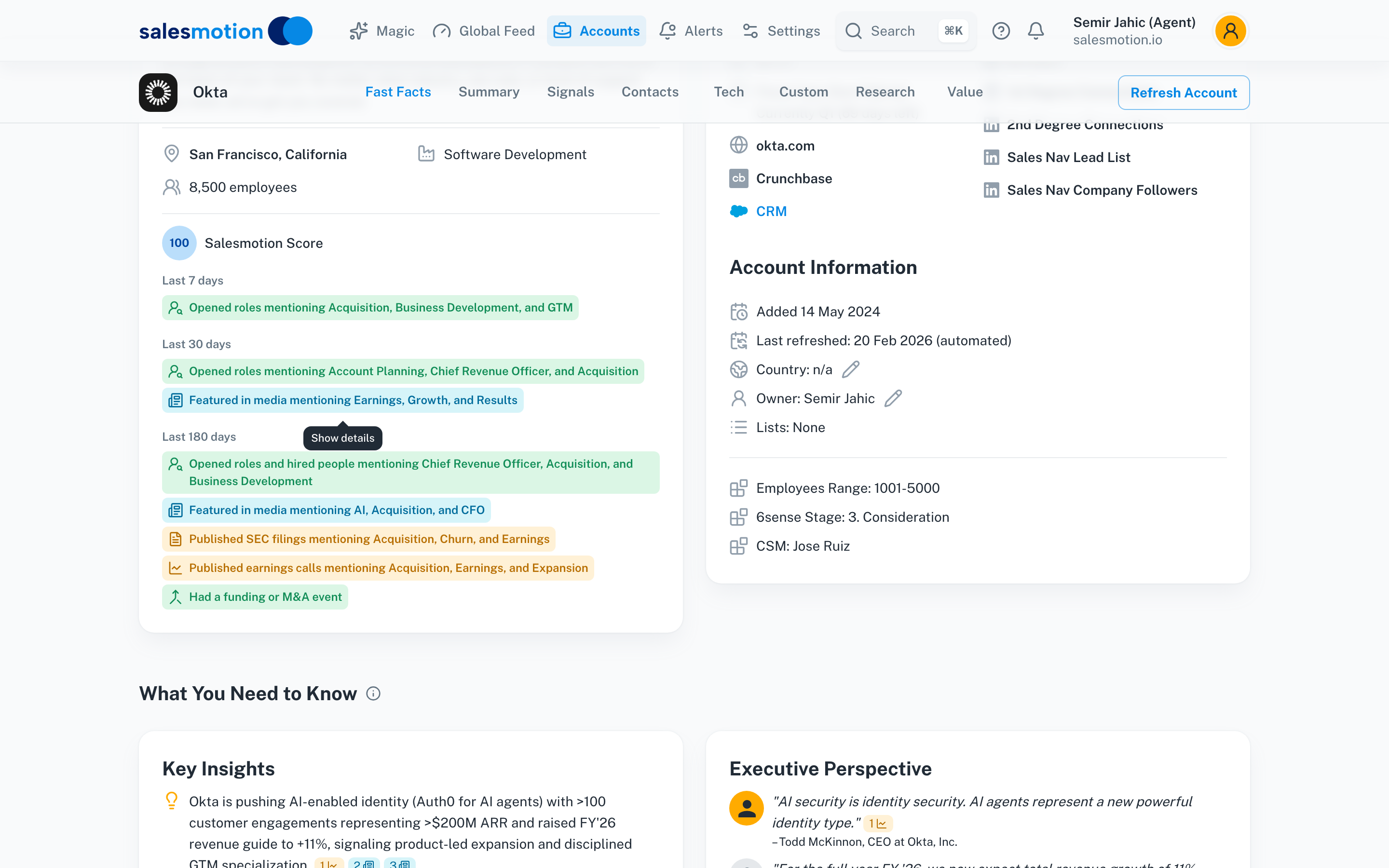 Salesmotion synthesizes 1,000+ data sources into a single account brief — replacing hours of manual research with a one-click summary.
Real results from small teams:
- Cacheflow (4-person sales team: 3 AEs + 1 SDR) reduced prep time by 60% and tripled their average deal size from $5K-7K to $18K-20K within 6 months. As Adam Wainwright, Head of Revenue, put it: "For every hour of customer meetings, we were spending about an hour and a half on prep. With Salesmotion, we cut that prep time by 60%."
- Guild Education saved 6 hours per seller per week on account research. Director of Strategic Accounts Derek Rosen noted: "In a single account, it easily saves me 30 minutes. Multiply that by 10 or 20 accounts and it's massive."
Key strengths:
- 1,000+ source account briefs with cited sources
- 50+ signal types monitored 24/7 across your territory
- Unlimited users on team plans — no per-seat fees
- HubSpot and Salesforce integrations
- Operational in 24 hours, not months
Where it falls short:
- Not a contact database — you will still need a data provider for email addresses and phone numbers
- No free tier — starts at $85/mo for individuals; custom pricing for teams (unlimited users)
- Overkill for transactional sales motions where account depth does not matter
Pricing: $85/mo (Individual) / Custom (Team, unlimited users) / Custom (Enterprise). See pricing details.
2. Apollo.io — Best for All-in-One Prospecting on a Budget
Apollo.io combines a 230M+ contact database with built-in email sequencing, a dialer, and a meeting scheduler. For small teams that need one tool to do everything from prospecting to outreach, Apollo is the most cost-effective option on the market.
Apollo's free tier includes 10,000 email credits and basic sequencing, making it a legitimate starting point for teams with zero budget. The paid tiers ($49-119/user/mo) unlock more credits, advanced filters, and AI-powered writing assistance.
Key strengths:
- Contact data + sequencing + dialer in one platform
- Free tier that is actually usable (not just a trial)
- AI email writer generates personalized outreach based on prospect data
- Strong intent data signals on higher tiers
Where it falls short:
- Contact data accuracy lags behind ZoomInfo, especially for direct dials
- Account intelligence is shallow compared to dedicated platforms — you get firmographics, not strategic insights
- Per-seat pricing adds up: 10 users on the Organization plan ($119/user) is $1,190/mo
Pricing: Free / $49/user/mo (Basic) / $79/user/mo (Professional) / $119/user/mo (Organization)
3. Lusha — Best for Quick Contact Lookup
Lusha is the simplest tool on this list, and that is its strength. The browser extension surfaces verified contact details (direct dials and emails) as you browse LinkedIn or company websites. For small teams that just need accurate contact data without the complexity of a full platform, Lusha delivers.
Key strengths:
- Dead-simple browser extension — no learning curve
- High-quality direct dials, especially in North America
- Free tier with 50 credits/month (enough to test before committing)
- GDPR and CCPA compliant
Where it falls short:
- No sequencing, dialer, or engagement tools — purely a data lookup tool
- Limited account intelligence or signal monitoring
- Credits run out fast on higher-velocity teams
Pricing: Free / $36/user/mo (Pro) / $59/user/mo (Premium) / $79/user/mo (Scale)
4. Clay — Best for Custom Enrichment Workflows
Clay is a data orchestration platform that connects 150+ data providers into waterfall enrichment workflows. Instead of relying on a single database, Clay runs your prospect list through multiple providers sequentially, maximizing match rates and data accuracy.
For technically-minded small teams, Clay is powerful. You can build custom AI research agents that pull data from multiple sources, score leads, and generate personalized outreach — all in a spreadsheet-like interface. The learning curve is steeper than other tools on this list, but the flexibility is unmatched.
Key strengths:
- 150+ data providers in waterfall enrichment — best possible match rates
- AI research agents for custom workflows
- Credit-based pricing means you pay for what you use
- Integrates with CRMs and outreach tools
Where it falls short:
- Steep learning curve — requires time investment to set up workflows
- Credit-based pricing can be unpredictable if workflows are not optimized
- No built-in sequencing or dialer
- Not a "turn it on and go" solution like Apollo or Lusha
Pricing: $134/mo (Starter) / $314/mo (Explorer) / $720/mo (Pro) — credit-based
5. LinkedIn Sales Navigator — Best for Relationship-Driven Selling
LinkedIn Sales Navigator is the default choice for teams whose selling motion depends on warm introductions, social selling, and relationship building. The advanced search filters, job change alerts, and InMail credits help reps identify and engage prospects within the LinkedIn ecosystem.
For small teams selling into mid-market and enterprise accounts, Sales Navigator is often the first tool purchased — and for good reason. The data is self-reported (users update their own profiles), which means titles, company affiliations, and career histories are more accurate than third-party databases for many segments.
Key strengths:
- Self-reported professional data with high accuracy
- Job change alerts for timely outreach
- InMail credits for direct outreach to prospects outside your network
- Account lists and lead recommendations
Where it falls short:
- Per-seat pricing scales linearly — 10 users at $100-180/seat adds up quickly
- No email addresses or phone numbers — you still need a contact data provider
- Limited account intelligence beyond what is on LinkedIn profiles
- No buying signals beyond job changes
Pricing: ~$100/user/mo (Advanced) / ~$180/user/mo (Advanced Plus)
6. Cognism — Best for EMEA-Focused Teams
Cognism is the go-to choice for teams selling into European markets. Its phone-verified European contact data and GDPR-first approach solve the compliance challenges that US-centric tools struggle with. If your 10-person team has significant EMEA territory, Cognism should be on your shortlist.
Key strengths:
- Phone-verified European contact data (Diamond Data)
- GDPR-compliant by design — built for EU data regulations
- Strong direct dial accuracy in EMEA markets
- Bombora intent data integration included
Where it falls short:
- Less competitive for North America-only teams (ZoomInfo and Apollo have stronger US data)
- Custom pricing with no public price page — harder to budget
- Limited account intelligence and research automation
Pricing: Custom, quote-based. Typically $25,000-50,000+/yr for team deployments.
7. Gong — Best for Conversation Intelligence (If Budget Allows)
Gong is the leading conversation intelligence platform, and it deserves a mention because understanding what happens on calls is critical for small teams trying to improve. Gong records, transcribes, and analyzes every customer interaction to surface deal risks, coaching opportunities, and competitive mentions.
The caveat: Gong's pricing ($1,600/user/yr + $50K platform fee) makes it prohibitively expensive for most 10-person teams. If you can afford it, the insights are invaluable. If you cannot, tools like Fireflies.ai or Otter.ai provide basic transcription at a fraction of the cost.
Key strengths:
- Best-in-class conversation analytics and deal inspection
- AI-powered coaching insights based on winning behaviors
- Revenue forecasting using conversation signals, not just CRM data
Where it falls short:
- Platform fee ($50K+/yr) makes it inaccessible for most small teams
- Not a prospecting tool — analyzes existing conversations only
- Requires sufficient call volume to generate meaningful insights
Pricing: ~$1,600/user/yr + $50,000 annual platform fee
How to Build an Outbound Sales Tech Stack for a 10-Person Team
Here is the framework I recommend based on budget:
Budget Stack ($200-500/mo)
For teams just getting started or with minimal tech budget:
- Apollo.io Free — Contact data + basic sequencing ($0)
- Lusha Free — Supplementary direct dials ($0)
- LinkedIn Sales Navigator — One or two licenses for senior reps ($200-360/mo)
This gets you contact data, a way to reach prospects, and social selling capabilities. The limitation is that you are doing all account research manually — reps will still spend 30-60 minutes per account on Google, LinkedIn, and news sites before each call. That is acceptable at low volume but becomes a bottleneck as pipeline grows.
Mid-Range Stack ($1,000-2,000/mo)
For teams ready to invest in efficiency:
- Salesmotion Team Plan — Account intelligence + signals for the entire team (custom pricing)
- Apollo.io Basic — Contact data + sequencing for 10 users ($490/mo)
This is the sweet spot. Salesmotion handles the "why and when to reach out" while Apollo handles the "who to contact and how to reach them." Together they give you a full intelligence and engagement stack for less than what most teams pay for ZoomInfo alone.
Premium Stack ($2,500-4,000/mo)
For well-funded teams that want every advantage:
- Salesmotion Team Plan — Account intelligence + signals (custom pricing)
- Apollo.io Professional — Full contact data + advanced sequencing ($790/mo for 10 users)
- LinkedIn Sales Navigator — Social selling for all reps ($1,000-1,800/mo)
- Clay Starter — Custom enrichment for high-value target accounts ($134/mo)
Total: ~$2,900-3,700/mo. This matches the capability of enterprise stacks costing $150K+/yr, and every tool on this list can be set up in under a week. Compare that to the 3-6 month implementation cycles typical of ZoomInfo Enterprise or 6sense.
Real-World ROI: What Small Teams Actually See
The numbers from our own customers illustrate why small teams get outsized returns from sales intelligence:
Cacheflow had just 3 AEs and 1 SDR when they adopted Salesmotion. Within 6 months, their average deal size grew from $5K-7K to $18K-20K — a 3x increase. The prep time savings alone (60% reduction) meant each rep gained back several hours per week to spend on actual selling instead of Googling.
Guild Education saved 30 minutes per account in research time. For their strategic account team managing 10-20 accounts each, that added up to over 6 hours saved per seller per week. As Derek Rosen, Director of Strategic Accounts, explained: "It's not even just about saving time — it's about uncovering things we otherwise might not research."
These are not 500-person sales organizations. These are lean teams where every hour of selling time matters and every dollar of tech spend needs to justify itself within a quarter. The pattern is consistent: small teams that invest in intelligence tools see faster ramp times for new hires, shorter prep cycles, and higher-quality conversations that lead to larger deals.
What to Avoid: Common Mistakes Small Teams Make
Buying ZoomInfo too early. ZoomInfo's contact database is the best in the industry. It is also priced for organizations doing $10M+ in revenue. At $30K-75K+/yr, it is rarely the right first investment for a 10-person team. Start with Apollo for contacts and graduate to ZoomInfo when deal sizes justify the spend.
Signing multi-year contracts. Enterprise vendors love locking small teams into 2-3 year deals with annual escalators. Your needs will change dramatically in year one. Insist on annual contracts or monthly billing until you have at least a year of data on usage patterns.
Buying intent data before you have a research process. Intent signals tell you an account is researching your category. But if your reps do not know how to act on that signal — what to say, who to contact, what the account cares about — the intent data is wasted. Build your account research process first, then layer in intent.
Overloading reps with tools. Every new tool is another login, another tab, another workflow to maintain. Small teams perform best with two to three core tools, not seven. If your reps are toggling between five platforms to prepare for a single call, you have a tool sprawl problem, not a data problem.
Ignoring CRM integration. Intelligence that lives in a standalone platform gets abandoned within weeks. Your tools need to push insights into Salesforce or HubSpot where reps already work. If the integration requires custom development or a dedicated admin, it is the wrong tool for a small team.
Evaluating Sales Intelligence Tools: A Checklist for Small Teams
Before signing any contract, run through this checklist:
- Total cost for your actual team size. Multiply per-seat prices by your headcount. Add platform fees. Include credits or overages you will realistically use.
- Time to value. Ask specifically: how long from contract signature to reps using it daily? Anything over 2 weeks is a red flag for a small team.
- CRM integration depth. Does it push intelligence into Salesforce or HubSpot where reps work, or does it live in a separate tab they will forget about?
- Contract flexibility. Monthly billing or annual-only? Auto-renewal clauses? Cancellation terms?
- What it replaces. A good tool should eliminate at least one existing tool or manual process. If it just adds another layer without removing anything, the ROI math is harder to justify.
- Data accuracy for your territory. If you sell into EMEA, test European contact data specifically. If you sell into SMB, test whether the tool covers smaller companies or only enterprises. Request a trial with your actual target accounts, not the vendor's demo data.
- Support responsiveness. At enterprise vendors, a 10-person team is a small account. You may get routed to self-serve support. Ask about your support tier before signing.
Key Takeaways
- Small outbound teams (5-15 reps) should avoid enterprise-priced tools like ZoomInfo, 6sense, and Demandbase. The per-seat and platform fees are designed for organizations 5-10x your size.
- For account intelligence and buying signals, Salesmotion's unlimited-user team plan (custom, account-based pricing) is the most cost-effective option for teams of any size — your cost stays flat whether you have 5 reps or 50.
- For contact data and outreach in one tool, Apollo.io ($49-119/user/mo) offers the best value with a usable free tier.
- The ideal mid-range stack for a 10-person team pairs Salesmotion (intelligence + signals) with Apollo (contacts + sequencing) for less than most teams pay for a single enterprise platform.
- Prioritize time to value. Small teams cannot afford 90-day implementations. The best tools for this segment are operational in days, not months — Cacheflow was fully operational on Salesmotion within 24 hours.
- Always calculate total team cost, not per-seat pricing. A tool that costs $79/user/month sounds cheap until you realize it is $9,480/year for 10 users.
Frequently Asked Questions
What is the best sales intelligence tool for a 10 person outbound team?
For a 10-person outbound team, the best sales intelligence tool depends on your primary gap. For account intelligence and buying signals, Salesmotion offers the best value with its custom, account-based team pricing covering unlimited users — your entire team gets full access for a flat rate instead of paying per seat. For contact data plus built-in sequencing, Apollo.io at $49-119/user/month gives you everything from prospecting to outreach in one platform. Most high-performing 10-person teams use two core tools: one for intelligence (understanding accounts and timing) and one for contacts and engagement. Pairing Salesmotion with Apollo gives you enterprise-grade coverage at a fraction of enterprise-suite cost. Avoid enterprise-priced tools like ZoomInfo ($30K-75K+/yr) and 6sense ($50K-150K+/yr) unless your average deal sizes are above $50K.
What sales tools do top performing B2B reps use?
Top-performing B2B reps in 2026 typically use a focused stack of two to four tools. The common pattern is: an account intelligence platform for pre-call research and signal monitoring (tools like Salesmotion that surface buying signals and account context from hundreds of sources), a contact data provider for accurate emails and phone numbers (Apollo.io, ZoomInfo, or Lusha), LinkedIn Sales Navigator for social selling and relationship mapping, and a conversation intelligence tool like Gong for post-call analysis and coaching. The key difference between top performers and average reps is not having more tools — it is using fewer tools more deeply. Research from Salesforce's State of Sales report shows the average sales team uses 10+ tools but reps actively use only 3-4 daily. Top performers focus on tools that directly reduce research time and improve call quality rather than adding complexity to their workflow.
How to build an outbound sales tech stack 2026?
Building an effective outbound sales tech stack in 2026 starts with three layers: intelligence (understanding who to target and why), data (accurate contact information), and engagement (reaching prospects). For a small team, start with the mid-range stack: Salesmotion for account intelligence and signal monitoring (custom team pricing, unlimited users) paired with Apollo.io for contact data and sequencing ($490-790/mo for 10 users). Add LinkedIn Sales Navigator for one or two senior reps doing social selling. This gives you full coverage for under $2,000/mo. As you grow, layer in Clay for custom enrichment workflows and Gong for conversation analytics. The principle is simple: buy tools that solve your current bottleneck, not tools that address problems you might have in two years. If reps are spending hours researching accounts, invest in intelligence first. If they have good account context but cannot find contact details, invest in data first. For a deeper comparison of all major platforms, see our complete sales intelligence buyer's guide.