An adtech company built their own earnings call analysis and meeting brief automation using Claude and a few APIs. Total build time: about two hours. For their 200 target accounts, it worked. The reps liked it. The intelligence was "good enough." They churned from their account intelligence platform within the quarter.
Teams reach for a build because the manual version is brutal. We watched a late-phase CRO business-development director run the same routine to send one email: pull a list, bulk-enrich, filter by title, open each site, read the Pipeline and Programs pages, infer the trial phase, then draft. Ten to fifteen minutes for a single outreach.
This is the build-vs-buy story teams carry into 2027, and it is playing out at every company with a technical founder or a sharp RevOps engineer. The tools are genuinely better now. Claude, Perplexity, and workflow platforms like n8n make it possible to assemble working intelligence in an afternoon. The question is no longer "can you build it?" The question is "should you, and for how long will it hold?"
TL;DR: Building account intelligence internally is viable for small, technical teams managing fewer than 200 accounts. Beyond that, the math breaks. Custom AI agent development costs $25,000-$300,000+ upfront, with ongoing operational costs of $3,200-$13,000/month. Initial creation represents less than one-third of total cost of ownership. Off-the-shelf platforms run $500-$5,000/month with zero maintenance burden. Be honest about where you sit on the spectrum before committing either way.
The Case for Building (Yes, Really)
Let's start with the uncomfortable truth that most vendor blogs skip: for some teams, building is the right call.
A healthcare analytics company built an internal intelligence tool with three dedicated people. Roughly $200K per year in fully loaded headcount. Their reps were satisfied. The system covered their specific use cases, pulled from exactly the sources they cared about, and integrated directly into their internal workflows. It worked because they had the engineering resources to maintain it.
A GTM advisor we work with built strong prompt workflows using Perplexity and Claude Projects, with spreadsheet uploads of target accounts. He gets solid account briefs in minutes. For his advisory work across a manageable number of accounts, the output is genuinely useful.
A frontline workforce platform is actively evaluating whether to hire a "first GTM engineer" to build custom agents rather than purchasing a platform. Their reasoning: they want full control over the data pipeline and believe a dedicated builder can iterate faster than a vendor.
These are not naive decisions. These are rational calculations made by smart operators. And if you fit the profile, building can absolutely work.
When building wins
Building makes sense when all of the following are true:
- Fewer than 200 target accounts. API rate limits, data volume, and maintenance overhead stay manageable at this scale.
- A technical founder or dedicated engineer who will own the system long-term, not just build it and move on.
- Simple data requirements. If your intelligence needs are limited to news, job postings, and basic company data available through free or cheap APIs, a custom build covers it.
- No need for real-time monitoring. If point-in-time queries before meetings are sufficient, you do not need always-on infrastructure.
- You accept the maintenance commitment. Someone will spend 5-10 hours per week keeping API connections alive, fixing broken scrapers, and updating prompts.
If that describes your team, build. Seriously. A two-hour build with Claude and a handful of APIs will give you 80% of what you need. Save the $500-$5,000 per month and spend it on something else.
Where Building Breaks: The Five Walls
The teams described above represent the minority. Most revenue organizations hit at least one of these walls within 6-12 months.
Wall 1: The scale cliff
Below 200 accounts, a custom system hums along. API calls stay within rate limits. One person can debug issues in real time. Data volume is manageable.
At 500 accounts, cracks appear. At 1,000+, the system collapses. API calls start timing out or hitting rate limits. Data pipelines back up. The Slack channel fills with noise because there is no signal prioritization layer. Processing time balloons from minutes to hours.
The math is straightforward: if a sales intelligence agent saves 10 hours per week across 15 AEs, that recovers roughly $15,000 per week in productive selling time. But only if the system actually works at the scale your team needs.
Wall 2: Non-technical users
The two-hour build works when the person using it is the person who built it. They know its quirks, its limitations, and how to work around the rough edges.
Hand that same system to an account executive who has never written a prompt, and the experience degrades fast. They do not know how to troubleshoot a broken API connection. They do not know which fields to fill in the spreadsheet. They do not know why the system returned garbage for one account but worked fine for another.
What I tell reps who want to build their own: you have to learn the tool, set it up, debug it. It breaks, you check again. In that time you could have made 20 phone calls and maybe booked a meeting.
Purpose-built platforms invest millions in UX because the end user is a salesperson, not an engineer. That investment is invisible until your DIY system needs to serve a team of 15 AEs who just want to open a tab and get a briefing. The adoption math is unforgiving: one prospect described a prior tool bought for roughly 80 licensed users that settled at about 3 daily actives, and a DIY build inherits that gravity.
Wall 3: Data sources behind walls
Here is what a weekend build cannot access: earnings call transcripts behind paywalls, SEC filing analysis requiring specialized parsing, podcast monitoring with no standard API, patent filings, clinical trial databases, and dozens of premium news sources.
These are the sources that contain management-level strategic signals. A Claude workflow reads whatever you point it at. Getting earnings-call transcripts, filings and hiring data in front of it, kept current for every account, is the part you would have to build.
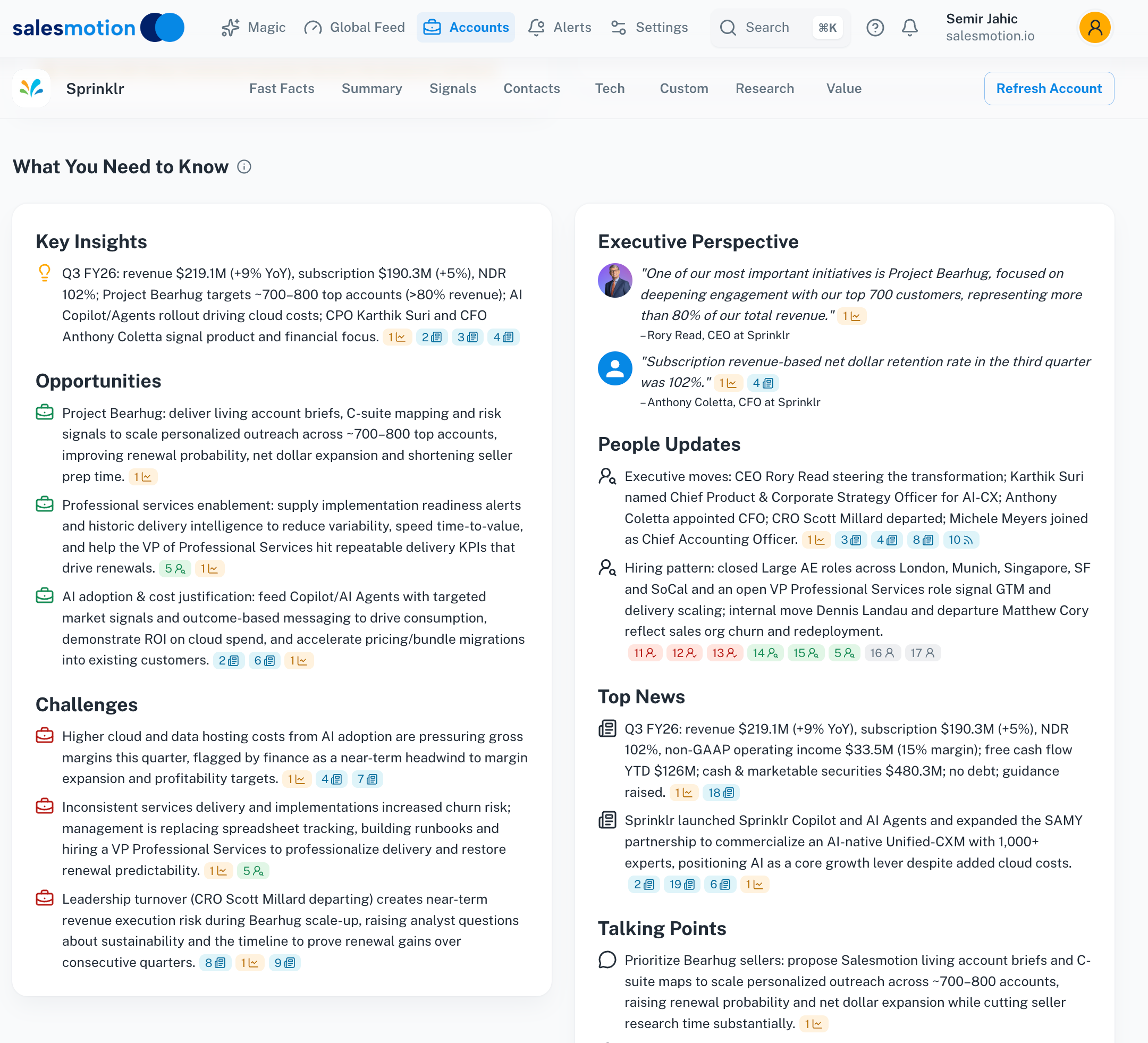 A platform approach aggregates paywalled sources, earnings analysis, and signals into a single account brief that updates continuously.
Accessing premium data sources individually costs $2,000-$10,000 per month in API subscriptions. Even then, parsing earnings transcripts, SEC filings, and patent databases requires specialized NLP that is not available in standard automation platforms.
Wall 4: CRM integration and workflow embedding
A standalone intelligence tool that lives in a separate tab is a tool that gets abandoned. The research on sales tool adoption is clear: tools that do not embed into existing workflows see less than 40% sustained usage after 90 days.
Building a reliable, bidirectional CRM integration is a project in itself. Salesforce and HubSpot APIs are well-documented but complex. Handling field mappings, deduplication, sync conflicts, and permission models adds weeks of engineering work. Then maintaining that integration as the CRM evolves adds ongoing overhead.
Wall 5: Point-in-time vs. continuous monitoring
This is the most underestimated gap. A custom build answers the question "tell me about this account right now." A platform answers "what changed at this account since yesterday, and why does it matter to you?"
The difference is the infrastructure required for continuous monitoring: webhooks, event processing, change detection, signal scoring, and alerting. Building this from scratch is not a weekend project. It is a dedicated engineering effort that requires persistent infrastructure, monitoring, and on-call support.
The deeper reason continuous monitoring matters is timing. In life sciences, a cold RFP wins under 20% of the time versus over 60% for a relationship shaped early, and the best signals sit 6-9 months ahead of the RFP. A query-on-demand stack is reactive by definition, so it surfaces the catalyst after the window has closed. Enterprise SaaS reps see it too: 20-60% of accounts have unknown readiness, a teenager rather than an adult, so they burn 4-5 educational meetings on prospects who were never ready.

“The Business Development team gets 80 to 90 percent of what they need in 15 minutes. That is a complete shift in how our reps work.”
Andrew Giordano
VP of Global Commercial Operations, Analytic Partners
The Hidden Cost Math
Most build-vs-buy analyses dramatically undercount the "build" side. Here are the numbers that rarely make it into the spreadsheet.
Upfront development
Custom AI agent development ranges from $25,000 to $300,000+, with mid-sized enterprise projects landing at $60,000-$150,000. Even a "simple" build with existing LLM APIs requires prompt engineering, data pipeline setup, output formatting, error handling, and basic UI work.
Ongoing operations
Production AI agents cost $3,200-$13,000 per month in operational expenses. That includes API usage (LLM calls, data source APIs, CRM syncs), infrastructure (hosting, databases, queues), and the engineering time to keep it running.
The critical insight: initial creation represents less than one-third of total cost of ownership. The other two-thirds is maintenance, iteration, and the inevitable firefighting when sources break.
A portfolio operations lead at a private equity firm told us: "They've already built internal agents that are doing a bunch of research just off public data. It's pretty good. ... But I hate that they have to maintain this stuff, and then you have a whole team that needs to deal with this." The build worked. The complaint is about everything that came after it.
The costs nobody budgets for
- API rate limits and paywall bypass. The free tier that worked during prototyping hits limits fast in production. Premium API tiers add $500-$3,000 per month per source.
- Data freshness decay. Static scraping breaks constantly as websites update their structure. Maintaining scrapers across 20+ data sources is a part-time job.
- Employee time reallocation. The engineer maintaining your intelligence pipeline is not working on product features, infrastructure, or other high-leverage projects. At a fully loaded cost of $150-$250 per hour, 10 hours per week of maintenance represents $78,000-$130,000 per year in opportunity cost alone.
- Bus factor risk. When the builder leaves (and they eventually will), you inherit a system that only one person understood. Rebuilding or replacing it under pressure is expensive and disruptive.
The comparison table
| Cost category | Two-hour DIY build (year 1) | Platform approach (year 1) |
|---|---|---|
| Initial development | $0-$500 (your time) | $0 (SaaS subscription) |
| Monthly operations | $3,200-$13,000/mo | $500-$5,000/mo |
| Engineering maintenance | $78,000-$130,000/yr | $0 |
| Premium data sources | $24,000-$120,000/yr | Included |
| CRM integration | $10,000-$30,000 build + maintenance | Included |
| Cross-account search ("which of my 1,000 accounts mentioned X in the last 3 months") | Build your own index + monitoring | Included |
| Total year 1 | $150,000-$450,000+ | $6,000-$60,000 |
The two-hour build is never actually two hours. It is two hours to prototype, then two months to productionize, then twelve months of maintenance that nobody planned for.
What the Two-Hour Build Actually Does (and Does Not)
Let's be specific about what you get from a Claude + API build in an afternoon.
What it does:
- Summarizes recent news for a specific account from free sources
- Generates talking points based on publicly available information
- Pulls basic company data (size, industry, recent funding)
- Creates a passable meeting brief for a single account on demand
What it does not:
- Monitor 500+ accounts continuously for signal changes
- Access paywalled earnings transcripts, patent filings, or premium news
- Score and prioritize signals by relevance to your selling motion
- Integrate bidirectionally with your CRM
- Serve non-technical users through an intuitive interface
- Alert you proactively when a buying signal fires at 2am
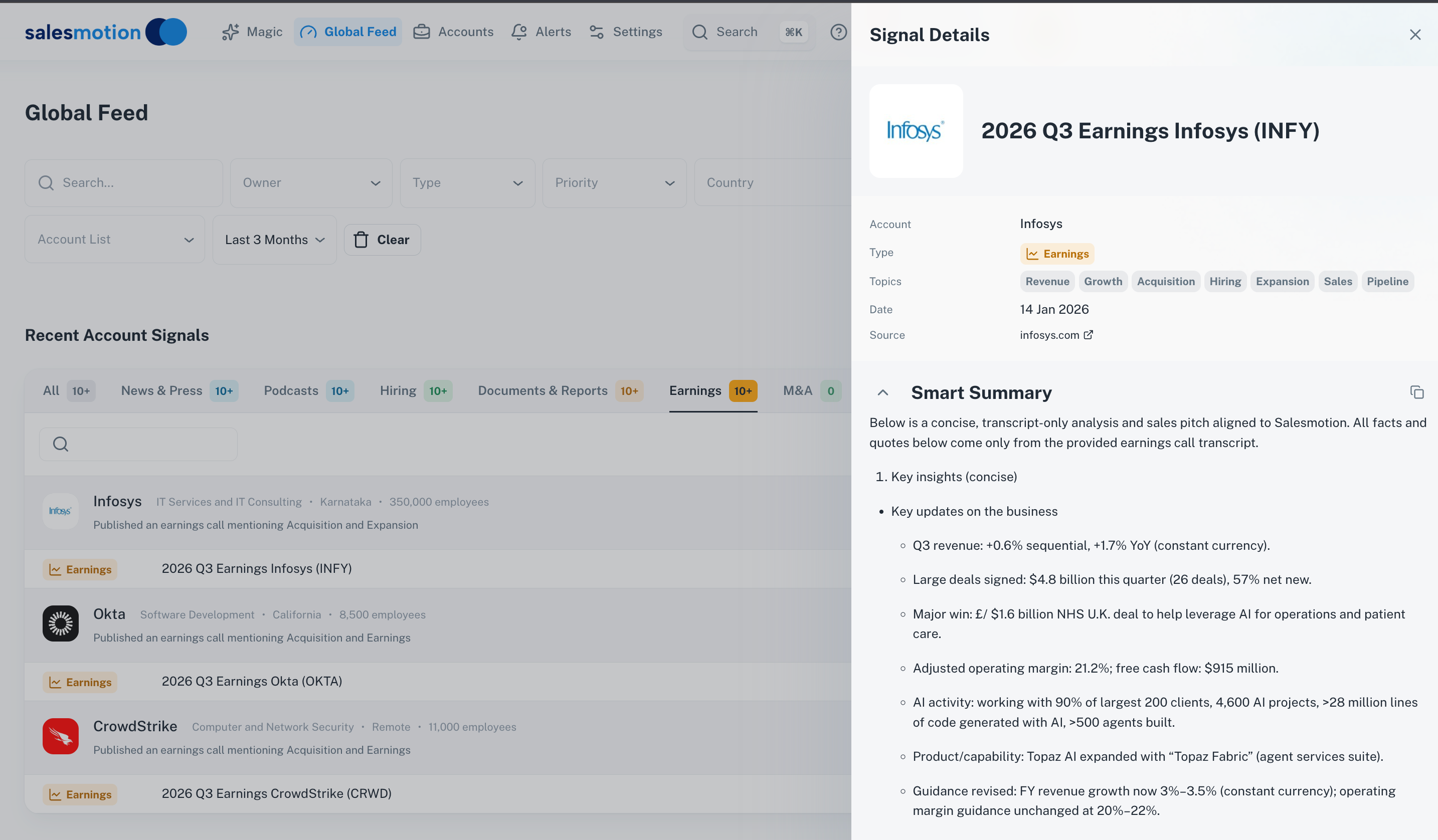 Earnings call analysis requires specialized parsing of paywalled transcripts, something a DIY build cannot replicate without significant data source investment.
The gap between these two lists is where deals are won and lost. An account executive who walks into a meeting knowing that the CFO mentioned "consolidating vendor relationships" on last quarter's earnings call has a structural advantage over one who summarized a Google News feed.
See Salesmotion in action
Take a self-guided interactive tour — no signup required.
The Decision Framework
Instead of debating build vs. buy in the abstract, use this framework to make the decision based on your specific situation.
Build if:
- Fewer than 200 target accounts
- Dedicated technical resource with long-term ownership commitment
- Simple intelligence needs (news, jobs, basic firmographic data)
- Point-in-time queries are sufficient (no need for continuous monitoring)
- You are comfortable with 5-10 hours per week of ongoing maintenance
Buy if:
- 200+ target accounts or growing
- Sales team includes non-technical users who need intelligence daily
- You need paywalled data sources (earnings, patents, SEC filings)
- CRM integration is required for adoption
- You need proactive signal monitoring, not just on-demand queries
- The person who would build it has higher-leverage work to do
Hybrid approach: Some teams start with a build for a specific use case (pre-meeting briefs for the founder's top 50 accounts) and layer in a platform as the team scales. This is a legitimate strategy as long as you plan the transition point in advance rather than discovering it during a crisis.
For technical teams who still want to own the orchestration, Salesmotion exposes an MCP server and a REST API, so the signal and research layer becomes a feedstock for your own agents without owning the data pipeline and its maintenance bill.
Teams like Cytel consolidated five separate tools into Salesmotion and cut research time by 50% within the first week. Cacheflow reduced prep time by 60% and tripled deal sizes within six months. Analytic Partners increased qualified pipeline by 40% after switching from a fragmented multi-tool approach. These outcomes are not unique to these companies. They reflect what happens when the DIY intelligence trap is replaced by purpose-built infrastructure.
The Real Question Is Not Build vs. Buy
The question that actually matters: is building and maintaining account intelligence infrastructure the highest-leverage use of your technical team's time?
For a pre-seed startup with a technical founder and 50 target accounts, the answer might genuinely be yes. Build it, use it, and revisit the decision when you hit 200 accounts.
For a team with 15 AEs, 1,000+ target accounts, and a growing tech stack that already needs consolidation, the answer is almost certainly no. Your engineering resources are better spent on product, infrastructure, or the automation layer that sits on top of intelligence, not on maintaining data pipelines and scraper infrastructure.
The adtech company that built their two-hour solution made the right call for their situation. If your situation looks like theirs, do the same. If it does not, do the math honestly and make the decision that gives your team the best chance of hitting quota this quarter and next.
Key Takeaways
- Building account intelligence internally is genuinely viable for teams with fewer than 200 target accounts, a dedicated technical resource, and simple data requirements
- Custom AI agent development costs $25,000-$300,000+ upfront, with ongoing operational costs of $3,200-$13,000 per month, and initial creation represents less than one-third of total cost of ownership
- The five breaking points are scale (500+ accounts), non-technical users, paywalled data sources, CRM integration requirements, and the gap between point-in-time queries and continuous monitoring
- Off-the-shelf platforms run $500-$5,000 per month with zero engineering maintenance, included premium data sources, and native CRM integration
- The real question is not whether you can build it, but whether maintaining intelligence infrastructure is the highest-leverage use of your technical team's time
- Start with a build if the math works for your stage, but plan the transition point to a platform approach in advance rather than discovering it during a scaling crisis
Frequently Asked Questions
How long does a DIY account intelligence build actually take to maintain?
The initial build takes 2-40 hours depending on complexity. But maintenance is where the real time goes. Production AI agents require 5-10 hours per week of ongoing engineering attention: fixing broken API connections, updating scrapers when website structures change, handling edge cases, expanding data sources, and troubleshooting output quality issues. Over a year, that is 260-520 hours of engineering time, or $39,000-$130,000 in fully loaded costs. The two-hour prototype is just the beginning.
Can I use Clay or n8n to build account intelligence that competes with a dedicated platform?
Tools like Clay and n8n are excellent for connecting APIs and building data workflows. They lower the barrier to creating a functional prototype significantly. Clay adds 150+ data providers, native job-change, news and web-intent signals, and CRM sync on its Growth plan. What stays with your team, as with any custom build, is the design and upkeep: which sources to pull, how to score and prioritize signals, and who maintains the workflows. For teams evaluating this path, the Clay alternatives comparison provides a detailed breakdown of what workflow tools offer versus purpose-built intelligence platforms.
At what account count should I switch from building to buying?
The inflection point is typically 200-500 accounts. Below 200, API rate limits are manageable, data volume is low, and one person can troubleshoot in real time. Between 200-500, cracks appear: processing times increase, signal-to-noise ratio drops without a prioritization layer, and maintenance hours creep upward. Above 500, most DIY systems require dedicated engineering support that exceeds the cost of a platform subscription. The account count is a proxy for the real trigger, which is when maintenance time starts competing with higher-leverage engineering work.
What is the total cost of ownership for a custom-built AI sales intelligence agent?
For mid-sized enterprise deployments, expect $60,000-$150,000 in initial development (prompt engineering, pipeline architecture, UI, integrations) plus $3,200-$13,000 per month in operational costs (API usage, infrastructure, monitoring). Add $2,000-$10,000 per month if you need premium data sources like earnings transcripts or patent databases. Total first-year cost ranges from $150,000 to $450,000+, compared to $6,000-$60,000 for a platform subscription that includes all data sources, integrations, and maintenance. The gap widens in year two and beyond as maintenance costs compound while platform costs remain flat.
Can I just use ChatGPT for prospecting?
ChatGPT is strong for one-off tasks like summarizing a transcript. It can search the web, run a limited number of scheduled tasks and reach a CRM through connected apps. It does not watch a whole territory or give every rep the same result, and recent facts still need checking. It is a useful assistant, not a prospecting system.
How do I evaluate whether my DIY build is actually working?
Measure three things: (1) rep adoption, meaning what percentage of your sales team actually uses the system before every meeting, not just the person who built it; (2) intelligence quality, meaning are reps getting insights they would not have found manually, or just summarized Google results; and (3) maintenance cost, meaning how many engineering hours per week go into keeping the system running. If adoption is below 60%, intelligence rarely includes paywalled or non-obvious insights, or maintenance exceeds 5 hours per week, the build is costing more than it delivers.
Building With Agentic Coding Tools
The economics above still hold, but the starting point moved. Assembling a working prototype with an agentic coding tool is now genuinely fast, which changes where the argument sits: the question is no longer whether you can build it, but what happens in month three when source coverage, entity resolution, and relevance scoring each turn out to be their own ongoing projects.
For that version of the decision, including the three cases where building is the right call and the hybrid most technical teams settle on, see can't I just build this with Claude Code.