
A lot of teams arrive at demandbase account based marketing the same way. Sales says the leads aren't ready. Marketing says the campaigns are generating engagement. RevOps sits in the middle, trying to explain why three systems show three different versions of the same account.
TL;DR: Demandbase account based marketing organizes targeting, engagement and measurement around one shared account list instead of individual leads. Teams use it to select and tier accounts, read engagement as a pattern, coordinate ads with sales outreach, and report on account progression. For 2027 planning, pair it with real-time account intelligence so sellers also know why an account matters now and what to say first.
The root problem usually isn't effort. It's fragmentation. One team is looking at form fills, another is watching ad engagement, and sellers are still relying on whatever they can piece together from CRM notes, LinkedIn, and memory.
That setup breaks fast in B2B. Buying decisions rarely come from one person, one click, or one campaign. They come from a cluster of signals across an account over time. That's why account-based marketing became more than a trend. It gave revenue teams a better unit of analysis: the account, not the lead.
Demandbase matters in that shift because it helps teams organize targeting, engagement, and measurement around the same account list. If you're reworking your ABM motion from the ground up, this primer on account-based marketing strategy is a useful baseline. And if part of your challenge is broader visibility into how buyers discover vendors across emerging channels, these AI Search Visibility Tools from Sight AI are worth reviewing alongside your ABM stack.
Rethinking Revenue with Demandbase Account Based Marketing
A familiar scene. Marketing launches campaigns against a named account list. Website traffic goes up. Content downloads come in. Sales still says, "None of these are real opportunities."
They're not wrong. But marketing usually isn't wrong either.
The issue is that lead-centric systems flatten account behavior into isolated events. A pricing page visit from procurement looks separate from a webinar registration by an operations director. A sales call with an IT manager sits in a different system entirely. No one gets the full picture quickly enough to act on it.
Why lead funnels break in complex B2B
In simple sales cycles, lead volume can still work as a rough planning metric. In enterprise and mid-market B2B, it often creates noise.
What matters more is whether the right accounts are showing coordinated activity. That includes:
- Breadth of engagement: Multiple people from the same company interacting across channels.
- Depth of research: Movement from light content to product, pricing, or competitive evaluation.
- Timing: Signals that cluster close together, which usually matters more than isolated activity.
- Sales context: Whether the account is already open, dormant, expanding, or in active evaluation.
Demandbase helps because it creates a shared operating layer around the account. Instead of asking, "Which leads should we send to sales?" teams can ask better questions.
Better questions produce better execution
Those questions sound more like this:
| Old lead question | Better account question |
|---|---|
| Which names converted? | Which target accounts are heating up? |
| Which campaign drove the form fill? | Which touches influenced account progression? |
| Which rep owns the lead? | Which team should act on this account now? |
The practical shift is simple. Stop treating isolated activity as demand. Start treating coordinated account behavior as buying motion.
That doesn't solve everything by itself. But it changes the operating model. Sales and marketing finally have a reason to look at the same dashboard, use the same target account definitions, and judge performance on the same basis.
See Salesmotion in action
Take a self-guided interactive tour — no signup required.
Understanding the Demandbase ABM Platform
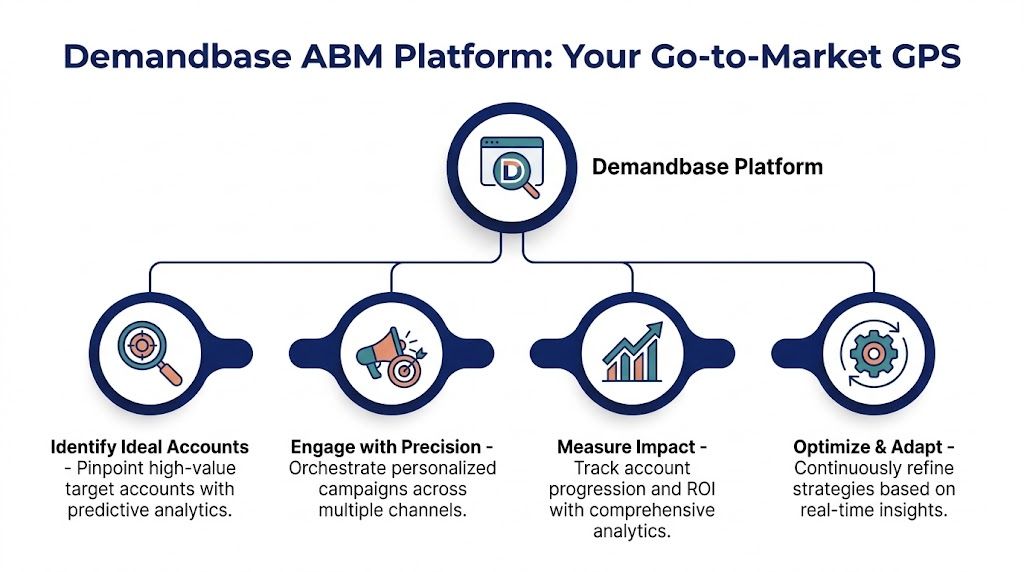
Demandbase works best when you think of it as a go-to-market GPS. Not just a map. A decision system.
It helps identify which accounts matter, where those accounts are showing interest, how to engage them, and how to measure whether that activity is moving pipeline. That matters because most ABM programs fail in the handoffs. Good targeting sits in one tool, campaign execution in another, and seller actionability in a third.
In market terms, ABM became mainstream quickly. In 2020, 61% of companies had an ABM program in place or were piloting one, and that rose to 70% by 2021. Mature programs saw strong returns, with 46% reporting at least a 50% ROI and an average 33% increase in ACV for ABM-won deals according to ABM adoption and ROI research summarized here.
The platform in plain English
Demandbase generally plays across three jobs that revenue teams care about.
First, it helps identify accounts. That means defining ideal account profiles and finding companies that fit based on firmographic, technographic, and behavioral inputs.
Second, it helps engage those accounts through coordinated advertising, web experiences, and sales-facing insights.
Third, it helps measure account movement. Not just lead creation, but progression across the account journey.
How the main clouds fit together
You can think about the platform in these functional layers:
- ABX capabilities: Teams align account selection, segmentation, orchestration, and measurement. It's the planning and operating core.
- Advertising capabilities: Demandbase has long been strong here. Marketing teams use it to run account-targeted display and support awareness or re-engagement against named accounts.
- Sales intelligence capabilities: This layer gives reps and sales leaders more context on account activity, interest areas, and account prioritization.
Each layer has value alone. The full payoff comes when they work together.
What this looks like in practice
A clean deployment usually follows this sequence:
- Define the account universe. RevOps, marketing, and sales agree on tiers, segments, exclusions, and ownership.
- Watch for movement. Demandbase surfaces engagement and intent patterns across those accounts.
- Activate by channel. Marketing serves account-specific ads and web experiences while sales prioritizes outreach based on account context.
- Review progression. Teams look at whether target accounts are advancing, stalling, or dropping off.
Operator note: Demandbase is strongest when your team already has discipline around account ownership, lifecycle stages, and CRM hygiene. It won't fix a broken operating model by itself.
That's the trade-off. The platform is powerful, but it assumes you're ready to manage ABM as a system, not a campaign.

“Salesmotion is instrumental in helping me prioritize net-new accounts, understand their strategic initiatives, and cover more ground. With a lot of green-field accounts, I'm heavily leaning on the AI insights to tier my accounts and focus my time. The platform is incredibly intuitive and easy to use.”
Rob Webster
Enterprise Account Executive, Synthesia
How Demandbase Powers Your ABM Strategy
The easiest way to understand demandbase account based marketing is to follow one account through the workflow.
Start with a target account list. Not a huge pile of logos. A deliberate set of companies that fit your market, product, and sales motion. Demandbase then becomes the system that helps you monitor those accounts, detect movement, and coordinate the next touch.
Step one is account selection, not campaign launch
Teams often rush into ads and outreach before the account strategy is stable. That's backwards.
A better workflow starts by narrowing the universe using criteria like fit, territory, current customer status, strategic priority, and product relevance. Demandbase can support that with segmentation logic and account-level visibility, but the key discipline comes from RevOps and GTM leadership agreeing on what belongs in each tier.
For example, a SaaS company might separate:
- Tier 1 accounts: Strategic enterprises with active executive coverage
- Tier 2 accounts: Strong-fit accounts for scaled ABM plays
- Expansion accounts: Existing customers with whitespace or cross-sell potential
- Watchlist accounts: Good fit, not yet showing enough activity for active seller focus
That segmentation matters because not every account deserves the same spend, the same SDR time, or the same personalization depth.
Step two is reading account activity as a pattern
Demandbase's useful contribution is that it doesn't force you to treat every touch as equal. It can aggregate account interactions using Engagement Points and Heatmaps, bringing together website visits, content downloads, and intent signals into a view that sales and marketing can use. It also supports the handoff into a Marketing Qualified Account, or MQA. According to Demandbase's explanation of Engagement Points, Heatmaps, and MQAs, this model is tied to stronger outcomes, with opportunities from ABM-targeted accounts closing at 53% compared with 19% for traditional demand generation.
That sounds technical, but the operating takeaway is practical. You're looking for momentum at the account level, not applause from individual leads.
Step three is orchestration across channels
Once an account starts warming up, teams can act in parallel.
Marketing can adjust advertising, rotate industry-specific creative, or personalize website messaging. SDRs can work from a call path tied to the account's recent research areas. AEs can review open opportunities, prior conversations, and expansion potential before reaching out.
A strong motion usually includes:
- Marketing plays: Display, retargeting, landing page personalization, content sequencing
- Sales plays: Outreach tied to the account's topic interest, stage, and account history
- RevOps controls: Ownership rules, stage definitions, suppression logic, and reporting
If sales can't explain why an account is prioritized, the score won't earn trust. The account story matters as much as the score itself.
What works and what doesn't
What works is coordinated timing. Marketing air cover plus informed rep outreach is still one of the most reliable ABM combinations.
What doesn't work is flooding sellers with every signal the platform detects. A rep doesn't need fifteen notifications. They need a concise answer to three questions: why this account, why now, and what should I say first?
Measuring What Matters with Demandbase Analytics
Most ABM dashboards fail because they keep old demand gen metrics and just relabel them.
Clicks, impressions, and raw lead counts still have a place, but they don't tell a revenue leader whether target accounts are progressing. Demandbase is more useful when you shift the reporting conversation toward account movement, buying committee engagement, and pipeline quality.
Metrics that matter more than lead volume
The first reporting change is conceptual. You're not trying to prove that activity happened. You're trying to prove that the right accounts moved.
That usually means focusing on:
- Account engagement trend: Whether engagement is expanding across the account over time
- Account coverage: Whether the target list is broad enough across segments and territories
- Journey progression: Whether accounts move from awareness to active evaluation
- Sales acceptance: Whether MQAs convert into real seller action and opportunity creation
- Pipeline influence: Whether targeted account programs show up in opportunities and expansion paths
These are harder metrics to govern. They also matter more.
How to make dashboards useful
A practical dashboard for leadership shouldn't be crowded. It should answer a small set of decisions.
| Dashboard question | Useful Demandbase lens |
|---|---|
| Are we focused on the right accounts? | Target account engagement by segment or territory |
| Is account interest broadening? | Heatmap patterns across people and channels |
| Are handoffs working? | MQA volume versus seller follow-up and opportunity creation |
| Is ABM affecting pipeline quality? | Account progression and deal movement by account set |
The best teams also compare account lists, not just aggregate totals. Strategic named accounts behave differently from scale accounts. Expansion accounts behave differently from net-new enterprise targets. If you lump them together, your reporting hides the truth.
Where teams get stuck
The common trap is over-scoring. Teams create too many thresholds, too many lifecycle states, and too many custom dashboards. Reps stop trusting the logic. Marketing can't explain changes from one quarter to the next.
Practical rule: If your sales managers can't review the account dashboard in a forecast meeting and decide where to shift attention, the dashboard is too complex.
For teams refining their measurement model, this guide to account-based marketing metrics is a helpful companion.
Another trap is treating engagement as outcome. It isn't. Engagement is evidence. It becomes valuable when it helps your team prioritize accounts earlier, improve timing, and diagnose why certain account segments convert better than others.

“The Business Development team gets 80 to 90 percent of what they need in 15 minutes. That is a complete shift in how our reps work.”
Andrew Giordano
VP of Global Commercial Operations, Analytic Partners
Demandbase in Action Across Different Verticals
The platform gets easier to evaluate when you stop thinking in product terms and start thinking in operating scenarios.
Different industries use Demandbase differently because their buying triggers, account lists, and seller motions aren't the same. The core engine stays similar. The application changes.
SaaS teams using competitive research signals
A B2B software company usually cares about fit, current stack, and signs of active evaluation. In that environment, Demandbase is often used to watch for accounts showing research behavior around relevant problem areas or competitor categories.
A practical play looks like this: marketing runs industry-specific ads and customized site experiences for named enterprise accounts, while SDRs watch for accounts that move from light educational engagement into product and pricing behavior. AEs then step in with outreach that references the business problem, not just the content viewed.
What tends to work is alignment around account stage. What tends to fail is having marketing chase broad software interest while sales wants only late-stage activity.
Manufacturing teams working by region and initiative
Manufacturing motions often involve geography, distributor relationships, and operations-led buying groups. Demandbase can help segment target accounts by region, industry, and strategic initiative, then coordinate messaging across plants, business units, or parent accounts.
One common example is a team targeting companies investing in supply chain modernization. Marketing can focus awareness and education across a set of named accounts, while field sellers use account engagement patterns to decide where to spend in-person time.
That matters because field capacity is limited. Account-level prioritization helps teams decide which facilities, regions, or enterprise groups deserve immediate attention.
Financial services teams reacting to external change
In financial services and adjacent regulated sectors, buying urgency often clusters around change. New compliance pressures, shifts in risk posture, or leadership mandates can trigger interest quickly.
Demandbase is useful here because it gives teams a way to organize campaigns and sales coverage around a controlled set of accounts without relying entirely on inbound lead capture. Marketing can build highly specific content tracks for relevant account segments, while sales watches for increases in research and on-site activity from those targets.
The common thread across verticals
The winning pattern isn't industry-specific. It's operational.
- Clear account selection: Teams know which accounts matter and why.
- Coordinated plays: Marketing and sales aren't running separate motions.
- Useful prioritization: Sellers get ranked accounts with context, not generic activity logs.
- Stage-based execution: The message changes as the account moves.
The platform is flexible. The discipline around it is what determines whether it feels strategic or just expensive.
Bridging the Gaps in Your Demandbase Strategy
This is where most teams hit the wall.
Demandbase is good at surfacing account activity. It can tell you an account is engaging, researching, or trending in the right direction. What it often doesn't do on its own is solve the last mile problem. What should a seller do right now, with this account, in this context?

Signal detection isn't the same as signal interpretation
This distinction matters more than teams realize.
Demandbase can flag that an account is researching competitor topics or showing intent around a category. But as outlined in this Demandbase-related discussion of account targeting gaps, a key friction point is signal interpretation. The platform can surface activity like competitor research on sites such as G2, but it doesn't reliably tell the team whether that reflects active replacement intent or routine market scanning. That creates noise, especially when sellers are juggling many accounts.
Adoption frequently breaks down. Reps don't ignore signals because they hate data. They ignore signals because they can't tell which ones deserve interruption.
The real trade-off for RevOps
More signals sounds good. In practice, more signals often means more triage work.
A RevOps team can build scoring models, routing rules, and alert thresholds to reduce the noise. That helps. But many still run into three problems:
- Ambiguity: Several accounts may show similar activity, but only one is worth immediate seller time.
- Timing risk: A weak signal in an active deal may matter more than a stronger signal in a cold account.
- Lack of narrative: Sellers see that something happened, but not why it matters commercially.
The platform answers "who is active." Revenue teams still need a system that answers "why now" and "what should the rep do next."
Buying committees change faster than account scores
The second gap is more operational and often more damaging. Account-level engagement can look healthy while the internal deal dynamics are getting worse.
A champion leaves. A new executive joins. Procurement enters late. An implementation stakeholder suddenly gains influence. Demandbase can show account activity, but it doesn't fully choreograph stakeholder shifts inside the deal.
That gap becomes even more obvious when complex evaluations span many people and multiple functions. If you're evaluating platform choices in that category, this review of Demandbase alternatives for modern revenue teams is useful because it frames where account platforms end and deeper account intelligence starts.
How strong teams compensate
They don't rip out Demandbase. They add process around it.
Common fixes include:
- Weekly signal review: RevOps and sales managers review the top account changes together, not just raw alerts.
- Action rules by segment: Enterprise accounts get different thresholds than scaled commercial accounts.
- Human-readable account briefs: Sellers need synthesized context, not only score movement.
- Stakeholder tracking outside the score: Teams separately monitor champion strength, executive change, and buying committee shape.
Demandbase remains valuable in this setup. It just shouldn't be mistaken for the full operating system for seller actionability.
Integrating Demandbase with Real-Time Account Intelligence
The next step isn't replacing demandbase account based marketing. It's extending it.
Demandbase gives teams a strong account layer for targeting, orchestration, and measurement. What many teams need on top is real-time account intelligence that explains the business context behind movement inside the account.

What complementary intelligence should add
The gap isn't just more data. It's better actionability.
As noted in this discussion of stakeholder blind spots in account-based programs, account-level tracking can miss buying committee changes and influence shifts. That's a serious issue in larger B2B deals because the account may still appear engaged even while your original sponsor loses power or a new decision-maker enters the process.
A complementary layer should help with things like:
- Real-world triggers: Executive hires, funding activity, earnings commentary, strategic partnerships, hiring patterns, and org changes
- Stakeholder context: Who joined, who left, who appears to own the initiative now
- Interpretation: Why a trigger matters to your product, territory, or open opportunity
- Next-step guidance: A recommended seller action, not just an alert
Why this changes seller behavior
Sellers don't need another stream of notifications. They need timing plus relevance.
A generic alert that an account is surging on a topic may help with prioritization. A contextual alert that says the company just hired a new operations leader, opened roles tied to your category, and referenced a strategic initiative in public communication is much easier to act on. It gives the rep a reason to reach out and a point of view to lead with.
That distinction is the difference between "checking in" and sending a message that sounds researched.
A practical integration model
A lot of teams get good results with a split-responsibility model:
| System role | Best use |
|---|---|
| Demandbase | Account selection, orchestration, engagement measurement, MQA workflow |
| Real-time intelligence layer | Trigger detection, stakeholder change tracking, signal interpretation, seller briefing |
For teams sharpening that second layer, this overview of B2B intent data and how to use it operationally is a useful reference point.
Good ABM programs create visibility. Great ones create action. The difference is whether sellers get context they can use in the moment.
The market is heading in this direction. The account platform identifies where attention should go. The intelligence layer explains why the moment matters and helps the rep respond while the window is still open.
Frequently Asked Questions About Demandbase ABM
Is Demandbase just a better CRM for account-based marketing?
No. CRM systems store account, contact, opportunity, and activity records. They're essential, but they aren't designed to identify account intent, coordinate ABM advertising, or calculate account engagement in the way a dedicated ABM platform does.
Demandbase sits on top of the core system of record and helps teams work at the account level. It becomes more valuable when CRM ownership, stages, and data hygiene are already solid.
What's the practical difference between intent data and real-time buying signals?
Intent data usually tells you that an account appears interested in a topic, category, or set of related themes. That's useful for prioritization and campaign planning.
Real-time buying signals are more situational. They can include leadership changes, hiring moves, product launches, public strategy updates, or other business events that create a reason for outreach now. The most effective teams use both. Intent shows directional interest. real-time signals explain urgency and message relevance.
Can Demandbase work for both net-new and expansion motions?
Yes. In practice, many teams use account-based programs across both motions. The playbooks are different, though.
For net-new, the focus is usually account selection, awareness, and early buying group engagement. For expansion, the focus shifts to whitespace, product interest, and signs that a customer team is evaluating adjacent priorities. Shared account data helps in both cases, but the routing rules and seller actions should differ.
How long does it take to see value from Demandbase?
That depends on your operating maturity more than the platform itself.
Teams with a clean target account list, clear ownership, and strong sales-marketing alignment usually reach useful insights faster. Teams that still need to fix lifecycle stages, account matching, and handoff rules often spend more time on setup before they trust the output.
A realistic expectation is to look for early value in better prioritization and cleaner sales-marketing conversations first. Pipeline impact follows when the team consistently acts on those signals.
What's the biggest mistake teams make with demandbase account based marketing?
Treating the platform like a magic answer.
The strongest teams use Demandbase as infrastructure. They pair it with disciplined account selection, clear action thresholds, seller enablement, and a complementary intelligence layer for context. The weakest teams buy the platform, turn on alerts, and assume adoption will happen by itself.
Do smaller teams need the full platform to run ABM well?
Not always.
If your market is narrow and your account list is manageable, you can run a focused ABM motion with simpler tooling and strong process. Demandbase tends to make more sense when account volume, segmentation, ad orchestration, and measurement complexity start to strain manual workflows.
If your team already has the account layer in place but still struggles with signal overload, weak "why now," or inconsistent seller action, Salesmotion is worth a look. It adds autonomous research, real-time trigger monitoring, and actionable outreach context on top of your target accounts so reps know what changed, why it matters, and what to do next.