Let’s get straight to the point: managing a remote sales team isn’t about recreating the office online. It's about fundamentally rethinking how you lead. The shift is from managing by presence to leading by outcomes.
TL;DR: Managing a remote sales team well comes down to four things: a purposeful communication rhythm (a daily huddle, a weekly pipeline review, weekly 1-on-1s), outcome metrics such as signal-to-meeting conversion and pipeline velocity instead of activity counts, digital-first onboarding, and tools that automate account research and signal monitoring so reps spend their time selling.
This means building a culture founded on trust and autonomy, not micromanagement. It requires equipping your team with intelligent tools that replace manual grunt work with automated, actionable insights, letting them focus on what they do best—selling.
The End of the Traditional Sales Floor

The old office-centric sales playbook is officially obsolete. The familiar buzz of a physical sales floor, once considered essential for motivation and learning by osmosis, has been replaced by a new, more effective reality.
For companies that adapt successfully, leading a distributed sales team is a permanent strategic advantage, not a temporary compromise.
But "getting it right" doesn’t mean scheduling more Zoom calls or demanding constant Slack check-ins. With over half of all knowledge workers now in hybrid or remote roles, that approach is a fast track to burnout. Real success is built on a foundation of trust, clear goals, and genuine empowerment.
From Guesswork to Intelligence
The biggest challenge in managing a remote sales team isn’t distance; it's the visibility gap. When you can't walk the floor, it's easy to feel disconnected from your team's daily activities and the true health of your pipeline.
The outdated response? Demand more activity reports and sit in on more calls—essentially micromanaging your reps. This only breeds resentment and pushes your best people toward the exit.
The modern solution is to trade manual guesswork for signal-driven sales intelligence. This is about equipping your team with systems that create clarity and focus, not just more oversight. When reps are empowered with automated intelligence, they spend less time on tedious research and more time building relationships and closing deals.
The goal isn't to monitor your team; it's to empower them. By providing tools that automate research and surface timely opportunities, you enable autonomy and drive performance simultaneously.
This shift from an analog, office-based model to a digital, remote-first one represents a complete overhaul of process, mindset, and tooling. It’s far more than a change in scenery.
To see just how different things are, look at how core sales activities have evolved.
Old Playbook vs. Modern Playbook
| Activity | The Old Way (Office-Centric) | The Modern Way (Remote-First) |
|---|---|---|
| Performance Tracking | Measured "effort" (calls, emails) | Measures outcomes (pipeline velocity, conversion rates) |
| Account Prep | Manual, inconsistent rep research | Automated, deep account briefs (e.g., Salesmotion Research Agent) |
| Opportunity Timing | Relies on luck and cold outreach | Triggered by real-time buying signals (e.g., Salesmotion Signal Agent) |
| Coaching Focus | Correcting tactical mistakes | Developing strategic selling skills |
| Team Culture | Built on physical proximity and group energy | Built on trust, shared goals, and purposeful communication |
This isn’t just about doing the same things remotely. It's about doing entirely new things that technology now makes possible.
By embracing modern tools, you're not just managing a remote sales team. You're building a smarter, more agile, and far more effective revenue engine for the future.
See Salesmotion in action
Take a self-guided interactive tour — no signup required.
Designing Your Remote Sales Structure for Peak Performance

When you send your sales team home with laptops, you’re not just changing their location—you’re changing the entire operating model. Success in a remote world doesn't happen by accident. It requires a deliberate structure that fosters both accountability and autonomy, creating an environment where high performance is the default.
It all starts with how you communicate. In an office, much of the alignment happens organically through casual chats and overheard conversations. Remotely, you must engineer that connection without drowning everyone in Zoom fatigue.
The classic mistake is trying to replicate every in-office interaction with a scheduled video call. This creates back-to-back calendars, frazzled reps, and zero time for actual selling. The real goal is to build a purposeful rhythm that balances connection with deep work.
Build a Purposeful Communication Rhythm
A smart communication cadence provides the structure your team needs to stay aligned on what matters. More importantly, it protects the focus time they need for high-value activities.
Here’s a balanced rhythm that works wonders:
- Daily Huddle (15 minutes): A quick, non-negotiable video stand-up. Each person shares their top priority, a recent win, or any roadblocks. This is for alignment, not a deep problem-solving session.
- Weekly Pipeline Review (60 minutes): A structured deal strategy meeting. Reps come prepared to discuss their most important opportunities, focusing on concrete next steps and where they need help to move deals forward.
- Weekly 1-on-1s (30-45 minutes): Arguably a manager’s most important meeting. Let the rep lead. The agenda should be their goals, challenges, and career development—not just another pipeline scrub.
Make every interaction count. If a meeting can be an email or a Slack update, make it one. Reserve synchronous time for collaborative problem-solving, strategic discussions, and relationship-building.
Shift from Activity Metrics to Outcome-Focused KPIs
When you can't physically see your team at their desks, the temptation to track what's easily visible—call logs, emails sent, hours logged—is immense. Avoid this trap. These are vanity metrics that reward "busyness" over effectiveness and push your reps toward low-quality, high-volume outreach.
Effectively managing remote teams effectively means measuring what actually grows the business.
Instead of just tracking calls per day, measure the signal-to-meeting conversion rate. This tells you how well your team is turning actual buying signals into qualified pipeline.
And instead of just counting closed deals, obsess over pipeline velocity. This metric shows you how fast deals are moving through your funnel, helping you spot bottlenecks before they become major problems. A clear understanding of your sales operations is critical for pinpointing where these clogs are most likely to happen. This approach prioritizes outcomes over output, which is how you build a true culture of performance and accountability.
Digitize and Accelerate Your Onboarding
In a remote setting, you lose the benefit of "learning by osmosis," where a new hire could sit next to a top performer and absorb best practices. Your onboarding must be digital-first, structured, and self-serve.
Build a centralized resource hub that becomes your team’s single source of truth. This isn’t a nice-to-have; it’s essential for reducing ramp time.
This hub should contain:
- A Detailed Sales Playbook: Your ideal customer profile, buyer personas, sales process stages, and core messaging—all in one place.
- A Library of Call Recordings: Curated examples of great discovery calls, killer demos, and expert objection handling.
- Tool-Specific Training Modules: Short, digestible video tutorials on using your CRM, sales engagement platform, and intelligence tools like Salesmotion.
This approach lets reps learn at their own pace and revisit key materials anytime. The data is compelling: a study of 1,200 European B2B sales teams found that fully remote reps spend an average of 6.2 hours on active selling each day, compared to just 4.1 hours for their office-based colleagues.
That’s a 51% productivity jump, fueled by fewer distractions and no commute. When you combine that with a structured digital onboarding program—which can slash ramp-up time by 26%—you get reps building pipeline much, much faster.

“Salesmotion has been a game-changer for me. I used to spend 12 hours a week on prospect research, now it's down to 4. Plus I'm finding stuff I was totally missing - podcasts, news mentions, the good bits.”
George Treschi
Account Executive, FY25 President's Club, Sigma
Replacing Manual Work With Automated Intelligence
Your best reps are spending far too much time on tasks that have nothing to do with selling. This hidden "manual research tax" is a massive drain on productivity, especially when you're managing a remote team where reps can’t just absorb intel from colleagues in the office.
All those hours spent digging through news articles, LinkedIn profiles, and earnings reports are hours not spent building relationships and closing deals.
This isn’t a problem to manage; it's a problem to eliminate. The answer lies in smart automation and practical AI. By offloading the tedious, time-consuming administrative work, you give your top performers the one thing they need most: more time to sell.
The goal isn't to replace your reps. It's to give each one a dedicated research assistant that works 24/7. This is where AI-powered tools like Salesmotion become a true force multiplier for your team.
The Power of an AI Research Agent
Imagine an AI agent with a single job: to build deep, structured briefs for every one of your target accounts. This Research Agent works autonomously, scanning thousands of public sources—from press releases and SEC filings to LinkedIn activity and industry podcasts—and synthesizes it all into one actionable view.
Instead of a messy folder full of random news clips, your rep gets a crisp, insightful brief. It clearly outlines key company initiatives, potential risks, the competitive landscape, and even suggests talk tracks to start the conversation.
This isn't about data dumping. It's about translating raw information into strategic insight. The agent delivers the "so what?" behind the data, giving your reps a strong point of view before they even pick up the phone.
The result? The two or three hours a top-tier rep would normally spend on pre-call prep are now done in minutes—and it's refreshed continuously. This levels the playing field, ensuring every rep prepares for calls with the same depth of intelligence as your number one performer. You can find out more about the different tools available by checking out our guide on sales automation software.
A Tale of Two Call Preps
To see the dramatic difference this makes, let's walk through a real-world scenario. A sales rep, Sarah, is preparing for a crucial call with a high-value prospect.
Scenario 1: The Manual Grind
Without an AI assistant, Sarah’s prep looks something like this:
- She spends 45 minutes on Google News, sifting through dozens of articles about the prospect's company, desperately trying to find a relevant hook.
- She then burns another 30 minutes on LinkedIn, trying to map out the org chart and figure out the priorities of the executive she’s meeting.
- Finally, she spends 45 minutes trying to piece it all together into a coherent narrative and a few talking points for her call.
Total time spent: 2 hours. Her preparation is decent, but surface-level. She feels rushed and only moderately confident, hoping her insights are relevant enough to make an impact.
Scenario 2: The AI-Powered Advantage
With an AI Research Agent, Sarah’s workflow is completely transformed:
- She opens her CRM and finds a fully-formed account brief automatically generated and attached to the account record.
- The brief highlights that the prospect just announced a major international expansion in their latest earnings call and recently hired three new VPs of enterprise sales.
- The brief even provides a direct talk track, connecting her product’s value proposition to the challenges of scaling into new markets.
Total time spent: 15 minutes reviewing the brief and refining her strategy. Sarah walks into the call with deep, specific knowledge and immense confidence. She’s not just selling a product; she’s acting as a strategic advisor informed by real-time intelligence.
This isn't a futuristic vision; it's a practical application of technology available today. By automating the grunt work, you empower your team to focus on the human side of selling—building rapport, understanding nuance, and ultimately, closing more deals. When you're managing a remote sales team, this shift isn’t just a nice-to-have; it’s essential for scaling performance.
Running a Signal-Driven Sales Cadence
In a remote sales world, generic outreach is the fastest way to get ignored. The secret to breaking through the noise isn’t more volume; it’s better timing. This means shifting your team away from static sales cadences—where everyone blasts the same message to a cold list—and toward a dynamic, signal-driven approach.
This is especially critical when managing a remote sales team. You can't rely on reps overhearing office chatter about a big move at a target account. You need a system that spots critical buying signals, flags them for your team, and tells them exactly what to do next.
This is the shift from reps spending hours on manual research to an intelligent workflow where they can focus on what they do best: selling.
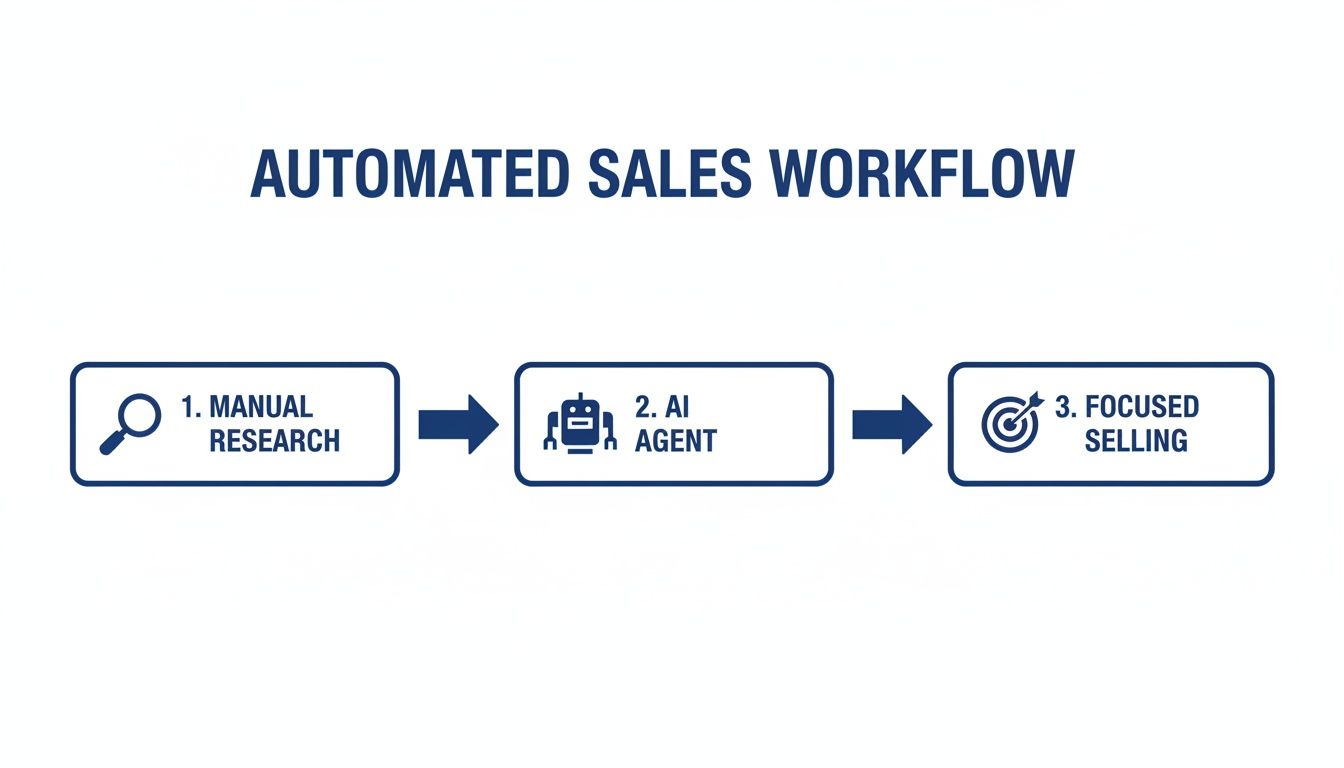
This process completely changes how a team operates. It automates the grunt work of research and lets reps zero in on accounts that are actually ready to talk.
Activating the Signal Agent
Think of this as giving your team a dedicated Signal Agent. It's an AI-powered system that monitors your target accounts 24/7, looking for any event that signals a buying opportunity. It’s like having an intelligence analyst assigned to every company on your list.
This agent isn’t just scraping news headlines. It’s trained to spot the specific triggers that matter to your business, such as:
- Executive Moves: A new CRO or VP of Sales is hired.
- Funding Events: The company announces a fresh Series C round.
- Strategic Shifts: A competitor gets a negative mention on an earnings call, signaling a crack in their armor.
- Expansion Plans: The company is suddenly hiring a dozen new people in a new territory.
These signals provide the "why now" that separates great reps from average ones. They give your team a compelling, timely reason to reach out that immediately stands out from the generic pitches flooding a prospect's inbox.
The real power of signal-driven selling is that it focuses your team's energy on accounts that already have momentum. Instead of guessing who might be interested, you’re engaging prospects at the exact moment they’re most likely to need you.
From Signal to Action: A Real-World Scenario
So, how does this actually work? Let’s take a look.
Imagine one of your reps, Alex, is trying to crack a big enterprise account that’s been radio silent for months.
Then, on Tuesday morning, an alert fires from his Signal Agent: "Target Account X just posted five new Enterprise Sales Director roles."
This is where the magic happens. The system doesn't just flag the event; it interprets it. The alert explains that this hiring spree is a strong indicator that the company is struggling with its current sales process and needs to scale its enterprise revenue—a problem your solution is built to solve.
But it doesn't stop there. The alert also suggests the next best action: a personalized outreach sequence aimed at the VP of Sales. It even provides a draft email that references the new job postings and connects that signal directly to your core value prop. For more ideas on how to build these, you can explore various sales cadence templates that are perfect for different signals.
Instead of staring at a blank screen, Alex has a warm, hyper-relevant reason to engage. He takes a minute to review the suggested outreach, adds a personal touch, and hits send.
This simple workflow transforms a cold shot in the dark into a warm, consultative conversation. Alex is no longer just another salesperson pushing a product; he's an informed advisor bringing a timely solution to a visible business problem. This is how you run a modern remote sales team—by arming them with the intelligence to stop digging and start selling.

“The Business Development team gets 80 to 90 percent of what they need in 15 minutes. That is a complete shift in how our reps work.”
Andrew Giordano
VP of Global Commercial Operations, Analytic Partners
Coaching and Measuring What Truly Matters
When your team goes remote, the old sales management playbook gets tossed out the window. You can’t manage by walking around anymore. The temptation is to fall back on what’s easy to track: call logs, email counts, and other activity metrics. But that's a trap.
These are just vanity metrics. They tell you your team is busy, but they don't tell you if they're being effective. In a distributed sales world, your focus must shift from tracking raw effort to measuring what actually drives pipeline and revenue.
Ditching Vanity Metrics for Pipeline Health
The best remote sales leaders are obsessed with one thing: pipeline health. They don't waste time asking, "How many calls did you make this week?" Instead, they're asking questions like, "How many of our key buying signals did we successfully convert into qualified meetings?"
That simple shift changes the entire game. It forces reps to stop chasing quantity and start thinking strategically about where they invest their most valuable asset: their time.
Instead of getting bogged down in activity reports, start tracking metrics that tell the real story:
- Signal-to-Meeting Conversion Rate: How effective is your team at turning a real-world event—like a funding announcement or a new exec hire—into a real meeting? This directly measures your team's relevance.
- Pipeline Velocity: How quickly are deals moving through the funnel? If velocity slows, it’s a bright red warning light for future revenue and shows you exactly where deals are getting stuck.
- Average Deal Size by Source: Are deals from signal-based outreach larger than your cold outbound efforts? This data gives you the evidence to double down on what’s working.
When you zero in on these outcome-focused numbers, your coaching sessions become infinitely more valuable. You’re not just checking boxes; you're working together to solve real problems. For more ideas on how to track this, check out our guide on improving sales rep productivity.
Using AI to Coach on Strategy, Not Tactics
This is where things get really interesting. AI gives sales leaders coaching superpowers that were pure science fiction a few years ago. By taking tedious, manual work off your reps' plates, you can finally coach them on what actually matters: strategy, messaging, and deal execution.
Take Salesmotion's Outreach Agent as an example. It pulls in rich intelligence from account research and real-time signals, then drafts hyper-personalized outreach. As a manager, you can review that AI-generated draft with your rep before it ever goes out.
The coaching conversation is no longer about, "Did you remember to mention our new feature?" It becomes a strategic huddle: "Given this account's recent expansion news, is this the right value proposition to lead with? Should we target the new VP of Ops instead?"
This elevates your role from a micromanager to a true strategic coach. You’re shaping the "why" and "how" of every interaction, not just auditing the "what." Understanding proven performance management best practices is fundamental to building this kind of culture.
The Impact of Intelligent Tooling
The data doesn't lie. Giving your team smart, signal-driven tools is one of the fastest ways to boost quota attainment. As sales cycles get longer, research shows that reps who lean into AI are 3.7 times more likely to hit their number.
These high-performers spend 20-25% more of their time actually talking to customers—a massive advantage gained by automating the non-selling tasks that bog everyone else down. Tools like Salesmotion directly attack these time-sinks, like the manual research tax and the struggle to find a compelling "why now," creating a huge competitive edge.
This shift creates a culture of data-backed coaching. Instead of relying on gut feel, you can have pointed conversations grounded in what the data says is working. You can pinpoint exactly where a rep is struggling—is it turning signals into meetings, or is it advancing deals after the first demo?
This is how you scale performance across a remote team. You stop guessing and start building a repeatable playbook for success, turning every rep into a more strategic seller.
Even with a solid playbook, managing a remote sales team presents its own set of challenges. New leaders often ask about the same things: keeping the culture alive, picking the right tech, and holding people accountable without becoming a micromanager.
Let's cut through the noise and get straight to what works.
How Do You Maintain a Strong Sales Culture Remotely?
A great sales culture isn't about being in the same room; it’s about shared purpose and trust. When your team is remote, you just have to be more deliberate in building it. Start by over-communicating the company's vision and constantly reinforcing how the sales team’s wins contribute to that vision.
Celebrate every win, big or small, as it happens. When a rep closes a huge deal, don't save it for the weekly roundup. Light up the team-wide Slack channel with genuine excitement. That’s your virtual sales gong, and it gets everyone fired up.
Finally, make space for your team to be human. Set up a "water cooler" channel for non-work chatter, or schedule optional virtual coffee breaks. These small rituals build the personal bonds that hold a team together when things get tough.
What Is the Best Tech Stack for a Remote Sales Team?
Your tech stack is your digital sales floor. Every tool must earn its place. It's not about having the most software; it's about having the right software that works together seamlessly.
At a minimum, your stack needs these core, interconnected tools:
- A CRM as the Single Source of Truth: This is non-negotiable. Whether you're on Salesforce or HubSpot, your CRM must be the central command for all account and deal data.
- A Sales Engagement Platform: You can't scale outreach without one. Tools like Outreach or Salesloft are essential for running structured cadences.
- A Communication Suite: A combination of a solid video tool like Zoom and a real-time chat app like Slack is the connective tissue for your team.
- An Intelligence Platform: This is what separates good teams from great ones. A tool like Salesmotion that automates research and surfaces buying signals gives your team an unfair advantage.
The secret is integration. When your intelligence platform pushes insights directly into your CRM and triggers sequences in your sales engagement tool, you eliminate manual work. Reps can stop researching and start acting on opportunities the second they appear.
How Do You Ensure Accountability Without Micromanaging?
Accountability in a remote team comes from clarity and trust, not constant oversight. The first step is setting crystal-clear expectations. Your team must know exactly what a win looks like. This means shifting from tracking activity to tracking outcomes.
Stop obsessing over call volume. Instead, track the signal-to-meeting conversion rate. This focuses the entire team on quality, not just quantity.
The data is overwhelming. A staggering 77% of remote workers report being more productive from home, and their bosses agree—94% find that output is the same or even higher. This performance jump, which can range from 13% to 40%, is thanks to fewer distractions and more deep work. Generative AI is poised to accelerate this. McKinsey estimates it could unlock $1.2 trillion in sales productivity by automating routine tasks—exactly what platforms like Salesmotion do with their automated Research and Signal Agents. You can explore more data in these work-from-home statistics.
Hold regular one-on-ones, but let the rep run the meeting. This is their time to discuss roadblocks, strategy, and career goals—not your time to interrogate them about their pipeline. This approach builds trust and empowers them to truly own their results.
By replacing manual guesswork with automated intelligence, Salesmotion gives your remote team the focus and insight they need to win. Our AI agents handle the research and signal monitoring, so your reps can spend their time selling. See how we can transform your remote sales performance at https://salesmotion.io.