Most reps still treat earnings calls like investor content. That's a mistake. Public company executives use those calls to say, in plain language, what matters now: where margins are under pressure, where budgets are moving, what initiatives are getting air cover, and which problems are serious enough to discuss on the record.
TL;DR: Earnings calls tell sales reps what a public company's leadership is prioritizing, in their own words and on the record. Pull the transcript from the investor relations page, SEC EDGAR or Seeking Alpha, scan it for cost pressure, consolidation, expansion, executive change and budget shifts, then write outreach that ties one of those signals to a problem you solve. The method works the same way for every reporting season you plan around in 2027.
That matters because generic selling isn't carrying the number. Quota attainment averaged 70-85% of OTE in 2025, and long B2B cycles put real pressure on reps to focus on accounts with actual momentum, not just accounts that fit an ICP on paper, according to the RevOps compensation analysis. If you're serious about using earnings call insights for sales reps, this is one of the cleanest ways to find real urgency instead of inventing it.
Why Earnings Calls Are Your Unfair Advantage
Earnings calls are one of the fastest ways to find real buying motion before your competitors see it.

A transcript gives you something rare in enterprise sales: leadership stating priorities, constraints, and pressure points in their own words, on the record. That matters because strong outreach is not built on generic personalization. It is built on signals you can trace to budget, scrutiny, and timing.
The unfair advantage is not "I listened to the call." Plenty of reps do that once and never use the insight again. The advantage comes from turning each call into a repeatable workflow: extract the signal, map it to likely initiatives, pressure-test it against the account, then use it in discovery, multithreading, and follow-up. That is how earnings call insights for sales reps become a selling system instead of a research habit.
Why this source hits differently
Company websites are polished. Earnings calls are accountable.
Executives can dress up strategy in a press release. On an earnings call, they have to explain what is driving performance, where execution is slipping, what investors are questioning, and which initiatives deserve funding. That gives reps a better read on the account than another round of surface-level "saw your recent post" outreach.
A useful transcript usually gives you four things fast:
- Priority language: the exact words leadership uses to describe what matters this quarter
- Pressure signals: margin pressure, pipeline weakness, slower expansion, hiring restraint, or spend scrutiny
- Execution clues: where a transformation, rollout, or cost program is behind schedule
- Political context: whether the CEO is pushing growth while the CFO is tightening control
That last point matters more than many reps realize. If a CFO keeps returning to efficiency, payback, and operating discipline, your message needs to survive financial scrutiny. If leadership is pressing for faster expansion, the message can lead with speed, coverage, and revenue impact. Same account. Different entry point.
Practical rule: Use transcripts to sharpen your sales hypothesis, not to prove you did homework.
Top reps do not paste executive quotes into cold emails and hope that passes for relevance. They use the language to build a point of view: what changed, who likely owns it, what friction it creates internally, and where their solution can help.
Why this improves call quality
Better prep produces better conversations.
A rep who walks into a meeting with a clear hypothesis asks tighter questions, listens for confirmation or disconfirmation, and adjusts faster. A rep who shows up with generic discovery questions usually burns the first ten minutes earning the right to discuss problems leadership already named publicly.
There is also a compounding effect across the deal cycle. The same signal can shape your first email, your discovery agenda, your internal champion pitch, and your follow-up after the call. Add adjacent documents like DEF 14A proxy filings, and you can often connect company priorities to executive incentives and board oversight. That is how you move from "interesting research" to a signal-based selling engine.
If you want a broader framework for turning these kinds of triggers into account strategy, this breakdown of enterprise sales signals that actually matter is a useful companion.
See Salesmotion in action
Take a self-guided interactive tour — no signup required.
Where to Find Transcripts and What to Scan For
The hard part isn't access. It's avoiding wasted time.

You can usually pull what you need from three places:
| Source | What it's good for | What to watch out for |
|---|---|---|
| Company Investor Relations page | Fast access to recent earnings decks, transcripts, and webcast replays | Some companies only keep a limited archive |
| SEC EDGAR | Official filings and supporting documents | Less convenient to browse if you're moving quickly |
| Seeking Alpha | Easier transcript discovery across multiple companies | Verify context against official company materials when needed |
IR pages are the fastest starting point. EDGAR is useful when you want the official filing trail. Seeking Alpha helps when you're working through a larger account list and need speed.
Run a 60-second qualification scan
Don't read the transcript top to bottom on first pass. Open it and search for terms tied to your category, the buyer's mandate, and signs of motion.
Start with terms like:
- Transformation language: "digital transformation," "sales transformation," "modernization"
- Efficiency language: "cost optimization," "productivity," "simplification," "margin pressure"
- Investment language: "AI investment," "automation," "platform," "infrastructure"
- Operating pain: "supply chain," "headcount," "procurement," "execution"
- Buying clues: competitor names, vendor mentions, internal initiative names, technology categories
You're not trying to prove a deal exists. You're checking whether leadership is talking about a problem your team can help solve.
A transcript is worth your time when it contains both a business priority and evidence that leadership is paying attention to it.
What makes a transcript worth a deeper read
A mention by itself isn't enough. Context matters more than keyword frequency.
For example, "AI" can mean strategic investment, defensive posturing, or pure investor relations theater. The useful signal is in the surrounding language. Are they discussing budget, execution risk, expected outcomes, or ownership?
Use a quick pass like this:
- Search the transcript for your key themes.
- Read the surrounding exchange, especially analyst questions and executive follow-ups.
- Look for repetition across prepared remarks and Q&A.
- Mark urgency words such as "now," "this year," "focus," "priority," or "discipline."
- Save one usable line you can reference in outreach or call prep.
A sales leader at a fintech software firm told us: "I often will ask ... to summarize what questions are asked every quarter, because that usually is the chink in the armor that I can then bring up in a discussion". Repeated analyst questions are a fast way to find the issue leadership would prefer not to dwell on.
If you want a more structured way to summarize what matters after that scan, this guide to an earnings call account brief is a solid template.

“Consolidation of prospect company information that I can use frequently to be way better informed when I'm doing my outbound, preparing for a meeting, or building relationships. Ease of use and Customer Support is excellent.”
Werner Schmidt
CEO & Co-Founder, Lative
How to Translate C-Suite Speak into Actionable Insights
A transcript gets valuable when you stop reading it word-for-word.
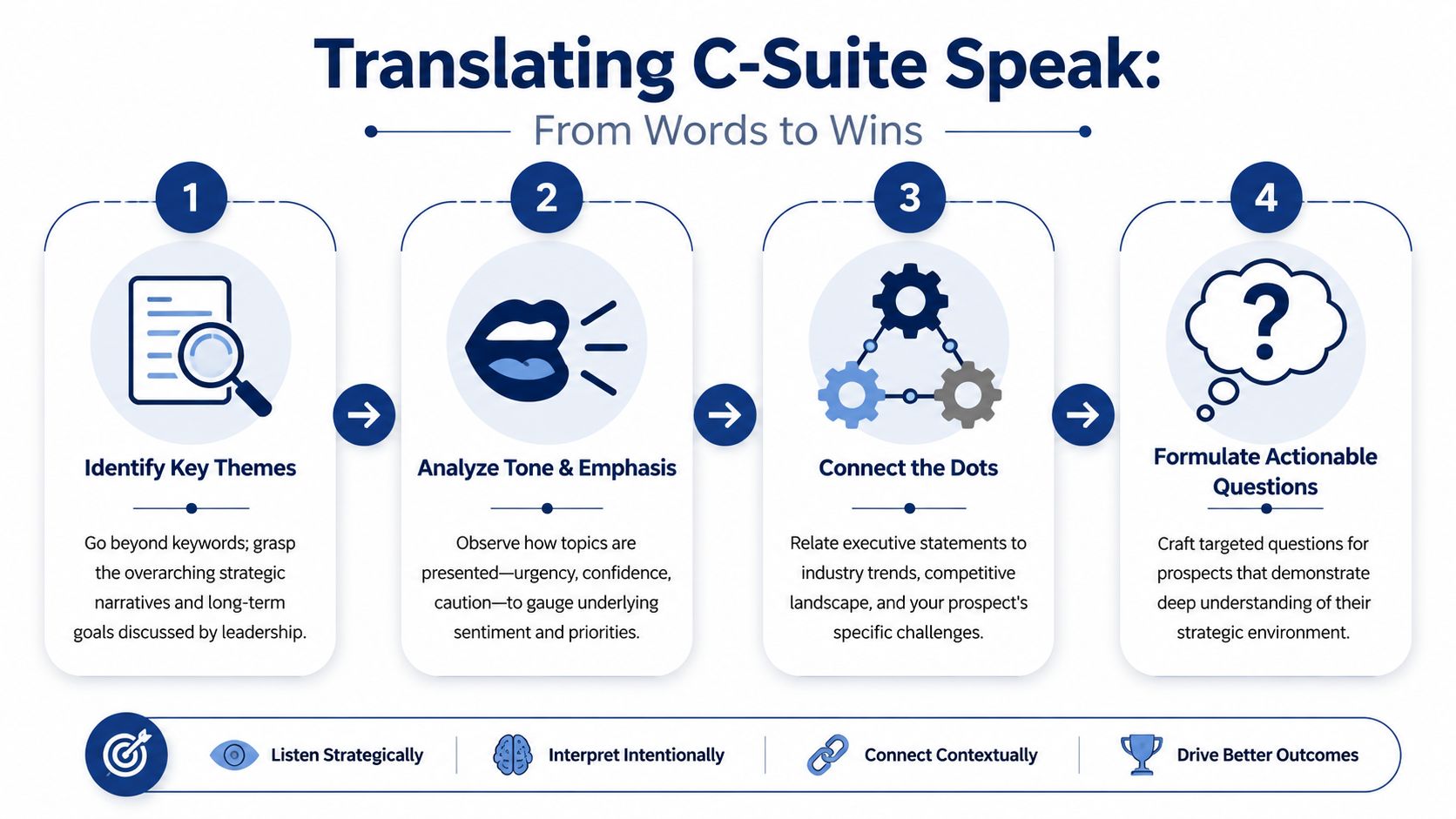
Executives rarely say, "We need to buy your software." They talk in operator language. They talk about efficiency, strategic focus, execution, capital allocation, organizational change, and priorities. Your job is to convert that into a sales hypothesis.
The cleanest way to do that is a Five Signal Framework.
Cost pressure
This signal shows up when leaders focus on margin, productivity, operating discipline, or spend scrutiny. It's often strongest in CFO remarks, but it can also appear in Q&A when analysts push on profitability.
What it sounds like:
- rising expenses
- efficiency mandates
- pressure on margins
- a need to optimize spend
What it means for a seller:
- your message should lead with waste reduction, simplification, time saved, or payback clarity
- broad transformation language usually underperforms here
- reps should avoid pitching "more capability" if finance is clearly pushing for tighter control
Vendor consolidation and stack simplification
This is one of the highest-value signals in enterprise sales because it often points to active change, not passive interest. Leadership may frame it as standardization, simplification, rationalization, or platform strategy.
A rep who hears this should immediately ask:
- Are they trying to reduce overlap?
- Is procurement likely involved?
- Does my category map to a replacement motion, not just a net-new one?
Weak reps get burned by pitching features. Strong reps position around fewer tools, lower complexity, and clearer accountability.
If leadership is talking about consolidation, don't sell another tool. Sell fewer moving parts.
Growth and expansion
This signal sounds exciting, but it needs verification. Expansion language can mean real investment, or it can be a forward-looking aspiration with no operational backing.
The methodology in the Future of Prospecting earnings call analysis is useful here. It frames five categories of signals and notes that acting on earnings call signals within 24-48 hours can boost win rates by up to 74%. It also says top teams see 10-20% reply rates with personalized outreach quoting a CEO or CFO, compared with 1-5% for generic campaigns. The same source warns against relying on unverified forward-looking statements.
That warning matters. If a company says it's exploring a new market, don't rush out a "congrats on expansion" email unless you can validate it through hiring, partner activity, product moves, or budget language.
Executive change and budget shifts
Leadership turnover is a signal because priorities often move with the person, not just the company. A new CEO, CFO, CRO, or CIO usually means a fresh evaluation of projects, vendors, and success metrics.
Budget shifts are related but distinct. Listen for commentary about reallocating spend, increasing investment in one area, or pausing another. A project can be strategically important and still lose budget.
My own experience: the CRM would never tell me they just got a new CFO or just did a massive layoff. That is the stuff your rep tells you on a forecast call when he says he is going to miss.
Here's a simple interpretation model:
| Signal | What it usually tells you | Best sales response |
|---|---|---|
| Executive change | New agenda, new standards, possible reset of active initiatives | Lead with perspective and diagnosis |
| Budget shift | Buying criteria may be changing | Anchor on outcomes and business case |
| Expansion theme | New motion may be forming | Verify with other sources before outreach |
| Cost pressure | Efficiency scrutiny is real | Tighten message around measurable business impact |
One practical example stands out. A prospect described Salesmotion's earnings call parsing as "awesome" because their team used it for CEO meeting prep by finding mentions of "sales transformation" across multiple quarters. That's what good analysis looks like. Not one isolated quote, but a pattern across time. A single mention can be noise. Repeated language across quarters usually means the initiative survived internal scrutiny.
Go Beyond Earnings with DEF 14A Proxy Filings
Most reps stop at the transcript. The sharper ones keep going.

A DEF 14A proxy filing won't give you the same live strategic texture as an earnings call. It gives you something else. Accountability. Specifically, it shows how boards and executive teams define performance, what they measure, and what leadership gets rewarded for.
Why proxy filings matter to sellers
When you read the Compensation Discussion and Analysis section, you're looking for the KPI logic behind leadership behavior.
That changes how you prepare. If earnings calls tell you what the company says is important, proxy filings help you infer what executives are personally incentivized to deliver.
Look for language around:
- Strategic objectives tied to annual or long-term incentive plans
- Operational priorities repeated in performance discussions
- Risk and governance themes that shape executive decision-making
- Business transformation language that appears in both compensation rationale and shareholder messaging
You won't always find neat, seller-friendly phrasing. That's fine. You're not hunting for a copy-paste line. You're building a tighter picture of what matters enough to be measured at the top.
How to use DEF 14A without getting weird
The mistake here is obvious. Don't message an executive like you've been digging through their compensation details for an advantage. That's clumsy and tone-deaf.
Use the filing to sharpen your own thinking.
For example:
- if leadership compensation emphasizes profitability and execution, your outreach should get tighter and more operational
- if the filing highlights retention, transformation, or strategic platform work, that's a clue about what gets airtime internally
- if the company talks innovation in earnings but compensates around efficiency and discipline, you should trust the operational incentive structure more than the glossy narrative
Proxy filings help you understand pressure. That's different from personalization, and it matters.
This is advanced account research, not a line to drop casually in an email. If you want a walkthrough on how to apply it in strategic selling, this guide on using DEF 14A for account research and value selling is worth studying.

“This is my singular place that very simply summarizes a company's top initiatives, strategies and connects them to my solution. Something I would spend hours researching manually, now it's automated.”
Derek Rosen
Director, Strategic Accounts, Guild Education
Crafting Your Why You Why Now Message
Most reps waste good research at the exact moment it should pay off.
They spot the signal, feel smarter, then send the same generic note they were going to send anyway. Earnings call insights only matter when they change timing, angle, and language. That is the difference between "I did research" and "I have a reason to be in this conversation now."
A strong why you why now message does one job. It ties an executive-level priority to a problem your buyer is likely feeling in the field, then gives them a low-friction next step.
What strong outreach actually sounds like
Buyers do not need a recap of their own earnings call. They need a point of view on what that signal means operationally.
Use this structure:
- Name one real signal
- Translate it into likely pressure on the team
- Connect that pressure to the problem you solve
- Ask for a next conversation that matches the level of certainty
Bad version:
Hi Sarah, we help enterprise teams improve productivity with our AI-powered platform. Open to a quick intro?
Better version:
Hi Sarah, leadership's recent focus on cost discipline usually creates pressure to improve output without adding headcount. We help revenue teams find where execution gets stuck across handoffs, follow-up, and account coverage. If that is part of the operating conversation this quarter, I can share how teams usually assess it.
That message works because it earns relevance. It stays close to the business. It also avoids the common mistake of sounding overly certain about an internal initiative you only see from the outside.
Three message patterns that hold up in the field
For a cost pressure signal
Hi [Name], leadership's latest commentary put real emphasis on efficiency and execution. That usually shows up as pressure to remove wasted motion without creating another reporting project. We work with revenue teams that need tighter workflow visibility when spending is under scrutiny. Worth comparing notes if that is active on your side.
For a growth or expansion signal
Hi [Name], the company is talking more about expansion. In practice, that often exposes gaps in territory coverage, messaging consistency, and follow-through across the field. We help sales teams tighten execution during growth pushes. Happy to share what I would audit first in your environment.
For an executive or operating shift
Hi [Name], the recent shift in operating priorities usually triggers a review of current process and vendor fit. Teams start asking whether their existing workflow still matches the new standard for speed, visibility, and accountability. If that review is happening, I can share a practical framework for identifying timely buying signals and turning them into action.
Use the message in calls too
The email gets you in. The call proves you understood the account.
Open with a question that turns the public signal into private context. Keep it specific enough to show preparation, but open enough for the buyer to correct you.
Try lines like:
- "Leadership spent time on cost discipline. Where is that creating the most pressure in day-to-day execution?"
- "There was clear emphasis on consolidation. Has that turned into active vendor review or tighter approval standards?"
- "Expansion came up several times. What has become harder for the field as that priority has picked up?"
Those questions work because they move from signal to workflow. That is the core habit behind signal-based selling workflows for revenue teams.
One more practical point. Do not treat earnings calls as the only input. The strongest messaging gets sharper when transcript themes line up with DEF 14A incentives, hiring patterns, leadership changes, and account-level operating signals. When multiple signals point in the same direction, your outreach stops sounding personalized and starts sounding accurate.
If you are building this into a repeatable team process, the category view on Hubspot Sales Intelligence features is useful for seeing how teams connect account context, research, and workflow support without burying reps in manual prep.
Building Your Signal-Based Selling Engine
Manual transcript work is powerful. It also doesn't scale well if you're covering a serious patch.
One rep can do this well across a handful of high-value accounts. A team trying to monitor dozens of targets across earnings calls, SEC filings, hiring changes, leadership moves, and adjacent signals will eventually hit the same wall. Too much research. Too little selling time.
What the engine looks like
A signal-based workflow is straightforward:
- Monitor the right sources: earnings transcripts, investor updates, SEC filings, hiring patterns, and org changes
- Filter for relevance: not every mention is actionable
- Add interpretation: why the signal matters to your offer and to this stakeholder
- Route it into workflow: CRM, Slack, email, or call prep
- Trigger outreach fast: while the context is still fresh
Teams start combining manual research habits with software at this stage. If you're evaluating the broader category, the roundup of Hubspot Sales Intelligence features is useful because it shows how revenue teams think about account context, enrichment, and workflow support across the stack.
Where automation actually helps
Automation shouldn't replace judgment. It should remove low-value labor.
That means tools are useful when they:
- track source changes without constant rep effort
- summarize what changed in plain language
- preserve source links for verification
- help reps act quickly instead of creating another dashboard to ignore
Salesmotion is one option in this category. It uses Signal, Research, and Outreach agents to monitor target accounts across public sources like earnings transcripts, SEC filings, hiring activity, press releases, and executive changes, then turns those signals into briefs, alerts, and draft outreach inside rep workflows. That's the practical shift from one-off research to a repeatable system.
If you're building this motion across a team, this framework for signal-based selling is a good operating model.
Sales teams don't need more noise. They need clearer reasons to reach out. If you want a way to turn earnings calls, SEC filings, hiring changes, and executive moves into usable account intelligence without making reps do the research by hand, take a look at Salesmotion.