Most advice on account-based marketing lead generation starts in the wrong place.
It tells you to build a target account list, align sales and marketing, and create personalized campaigns. None of that is wrong. It’s just incomplete. A static list doesn’t create pipeline. Timing does. Relevance does. The ability to notice a real change inside an account and act on it before the window closes does.
That’s the part many teams miss. They treat ABM like a list-building exercise when it’s really an operating model for catching buying momentum early and turning it into action fast. The list matters, but the list is only the container. The workflow is what produces meetings, opportunities, and revenue.
Why Your ABM Strategy Is Missing the Point
A lot of ABM programs look disciplined on paper and still underperform in practice.
The team has an ICP. The accounts are named. Marketing built the campaign map. Sales signed off. Then nothing happens for weeks except broad sequencing, stale ads, and generic follow-up. That’s not an account-based marketing lead generation problem caused by bad intentions. It’s usually a problem of missing signal detection and poor operational speed.

The market has already settled the question of whether ABM matters. In 2025, 71.2% of organizations actively use ABM strategies, with an average ROI of 137%. These programs generate 10–30% more qualified leads than standard inbound efforts and can account for 25–45% of total revenue in mature programs, according to account-based marketing statistics compiled by MarketingLTB.
That sounds impressive, and it is. But those outcomes don’t come from having a prettier target account spreadsheet. They come from teams that know when an account is becoming active and can respond with something more specific than “just checking in.”
Static targeting is not the same as active buying insight
Many organizations overinvest in account selection and underinvest in account movement.
An account can fit your ICP and still be a terrible lead generation priority today. Another account can look average on paper, then become highly relevant because a new executive arrives, hiring spikes in a strategic function, or the company starts signaling a new initiative in public. If your ABM workflow can’t detect and interpret those shifts, your reps are working blind.
That’s why broad advice on Account Based Marketing Best Practices is useful as a foundation, but not enough on its own. Best practices tell you what a good program should include. They don’t always tell you how to operationalize speed, relevance, and consistent execution across hundreds of accounts.
ABM breaks when teams confuse target selection with trigger-based execution.
The real bottleneck is actionability
Most revenue teams aren’t short on data. They’re short on usable context.
They have CRM records, LinkedIn updates, news alerts, intent feeds, call notes, and website engagement data. What they often don’t have is a system that connects those fragments into a clear answer to one question: why should a rep contact this account right now?
That’s the difference between manual ABM and scalable ABM. Manual ABM creates pockets of excellence. One strong rep does the homework, spots a shift, writes a sharp email, and books a meeting. Scalable ABM turns that behavior into a repeatable process.
A good ABM engine doesn’t just identify the right accounts. It continuously tells you which of those accounts deserve attention now, what changed, who likely cares, and how to approach them with a real point of view.
See Salesmotion in action
Take a self-guided interactive tour — no signup required.
Build a Target Account List That Breathes
A target account list should not sit untouched for a quarter.
If it does, the team starts treating old assumptions like current truth. Priorities drift. Sales works from recent conversations. Marketing works from a frozen list. RevOps spends time reconciling two different realities. A useful TAL changes as accounts change.
Start with selection discipline
The first job is still choosing the right accounts. Skip that and the rest falls apart.
Campaigns focused on the wrong accounts without sales input fail over 90% of the time. Successful programs build lists of 50-200 accounts and use deep research to understand buying committees. 84% of marketers using this method report very or extremely successful efforts, according to Huble’s account-based marketing statistics.
That tells you two things. First, tighter focus wins. Second, sales input is not a courtesy step. It’s a control mechanism.
Use layers, not one filter
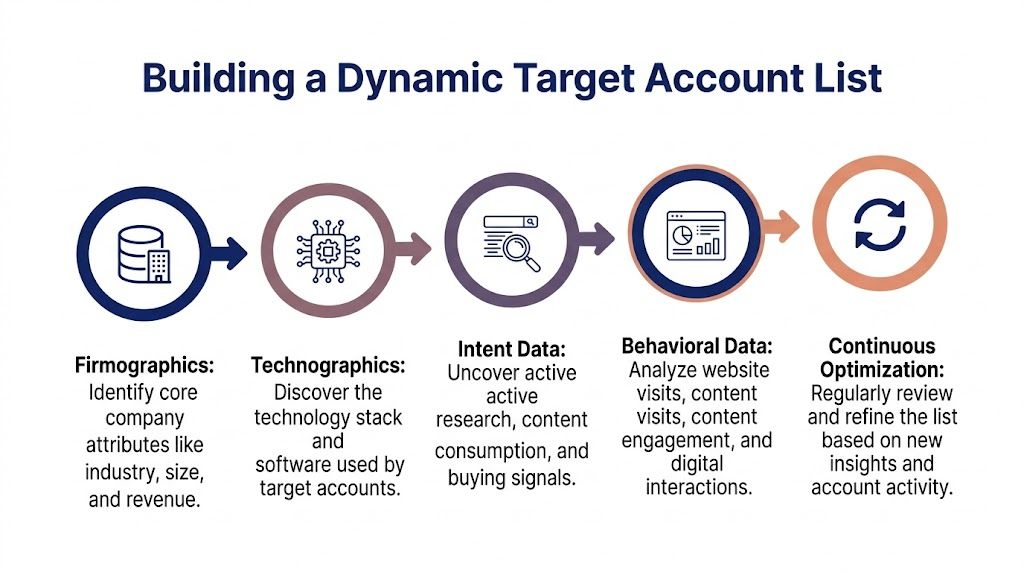
A breathing TAL starts with an ICP, but the ICP has to be more than industry and company size. The practical version usually combines multiple layers:
- Firmographic fit. Industry, business model, geography, segment, and company profile.
- Operational fit. Whether the account has the type of team structure or internal motion your solution serves well.
- Technographic fit. The tools they already use and the ecosystem they operate in.
- Intent and engagement fit. Signs they’re actively researching, comparing vendors, or revisiting relevant problems.
- Trigger fit. New events that make the account more urgent now than it was last month.
Many teams often make the list too broad. They say yes to every account that could buy instead of narrowing to accounts that are both a fit and a plausible near-term priority.
Build the list with sales in the room
The best TAL workshops are blunt.
Ask sales which accounts repeatedly stall and why. Ask customer success which current customers expanded fastest and what was true before the deal. Ask leadership where strategic whitespace matters. Then force ranking begins. If every account feels important, the criteria are weak.
A simple working model looks like this:
-
Define the absolute requirements Set the baseline fit criteria. If an account misses these, it doesn’t enter the list.
-
Score strategic upside
Consider expansion potential, deal quality, and relevance to the company’s market priorities. -
Review buying complexity
Some accounts are perfect on paper but structurally hard to penetrate. That doesn’t remove them, but it should affect sequencing and resourcing. -
Check for live movement
Public signals matter here. Leadership hires, funding, hiring patterns, product launches, and organizational shifts often tell you whether this account is static or becoming active.
Research is where manual ABM slows down
Once the list is built, teams frequently hit the same wall. Deep account prep takes too long.
A rep can spend hours pulling together earnings commentary, press releases, executive background, hiring trends, recent interviews, job posts, LinkedIn activity, and buying committee clues. That level of prep is valuable. It’s also hard to maintain across an active list.
Practical rule: if account research only happens before a big meeting, the TAL is already stale.
The fix is not “do less research.” The fix is to automate the gathering and synthesis so humans can spend their time on judgment and conversation.
That’s why modern account planning needs continuously refreshed briefs instead of one-time notes. A good brief should answer a few practical questions fast:
- What is changing at this account
- Which initiatives appear to be active
- What risks or pressures are visible
- Who likely influences the buying decision
- What talk tracks are relevant now
Keep the TAL alive after launch
Target account management is often treated like a quarterly planning event. It should be a recurring operating rhythm.
A breathing list has three statuses in practice:
| TAL status | What it means | What the team does |
|---|---|---|
| Active priority | Fit is strong and signals suggest current movement | Increase touches, coordinate sales and marketing, monitor stakeholders closely |
| Watchlist | Fit is strong but timing is unclear | Keep monitoring, limit heavy personalization until new movement appears |
| Deprioritized | Fit has weakened or signals have gone cold | Reduce effort and revisit later |
In this context, a disciplined process beats enthusiasm. Without statuses, reps keep chasing accounts that looked promising months ago while fresher opportunities sit untouched.
For teams formalizing this process, a useful reference is this guide to target account management, especially if you’re trying to standardize how accounts move in and out of focus.
A target account list should breathe because companies do. People move, priorities shift, budgets change, and initiatives start in public long before they show up in your CRM. If your TAL doesn’t reflect that reality, it becomes a filing cabinet, not a lead generation engine.

“We're no longer fishing. We know who the right customers are, and we can qualify them quickly. Salesmotion has had a direct impact on pipeline quality.”
Andrew Giordano
VP of Global Commercial Operations, Analytic Partners
Install Your Automated Signal Intelligence Engine
You don’t need more alerts. You need fewer alerts with better judgment.
Teams often have fragments of signal monitoring in place. Google Alerts. LinkedIn habits. CRM reports. Maybe an intent feed. The problem isn’t access. The problem is that raw signals arrive without ranking, context, or consequences. Reps see activity and still don’t know whether it matters.
The primary job of an automated signal intelligence engine is not collecting noise. It’s translating activity into action.
Why manual monitoring breaks
The shift toward AI agents for real-time signal monitoring matters because the manual alternative is too expensive and too inconsistent. Most ABM content talks about signals, but doesn’t explain how AI can synthesize 1,000+ sources into opinionated briefs. Without that automation, reps waste 2-3 hours per brief, as noted in Improvado’s discussion of lead generation strategies.
That wasted time doesn’t just hit productivity. It creates uneven execution. Your strongest reps do the work. Average reps skim headlines. New reps don’t know what to look for. The result is a team where relevance depends on individual effort instead of system design.
Separate signals by urgency
Not all triggers deserve the same response.
A practical way to operationalize account-based marketing lead generation is to group signals by how strongly they indicate an opening for outreach. This keeps the team from treating every update like a green light.
High-priority signals
These usually justify fast review and likely outreach.
- Executive changes. New CRO, CMO, VP Sales, VP RevOps, or other leaders tied to your value.
- Funding or investor activity. Capital often precedes hiring, expansion, or systems change.
- M&A activity. Integration pain creates urgency and complexity at the same time.
- Public strategic shifts. Earnings commentary, new markets, product launches, restructuring.
Medium-priority signals
These don’t always require immediate outreach, but they raise account temperature.
- Job postings tied to your category or adjacent teams
- Department growth that suggests process strain or upcoming tooling needs
- Tech stack changes that imply replacement, expansion, or integration work
- Leadership content activity that reveals priorities or language you can mirror
Context signals
These often don’t trigger a message alone, but they improve messaging quality.
- Podcast appearances
- Press interviews
- Company blog themes
- Partner announcements
- SEC filings and investor language
Turn the signal into a point of view
A signal is just a fact until someone answers “so what.”
That’s where most workflows break. A rep sees “new CRO hired” and sends a generic congratulation email. Another rep sees “hiring for sales operations” and sends a templated pitch. Neither message proves understanding.
This table is the right operating model.
| Buying Signal (The What) | Potential Meaning (The Why) | Actionable Insight (The So What) |
|---|---|---|
| New CRO hired | Revenue leadership may be resetting process, pipeline expectations, or tooling priorities | Reference the change in leadership and speak to early-stage revenue visibility, execution gaps, or transition risk |
| Funding announced | The company may be accelerating hiring, expansion, and internal systems investment | Tie outreach to scaling pressure and the need to support new go-to-market complexity |
| Cluster of relevant job postings | Teams may be building a new motion or exposing operational bottlenecks | Use the roles as evidence of initiative, then frame your message around that initiative rather than your product |
| Competitor mentioned in a public forum | The account is actively evaluating the market or responding to competitive pressure | Position around strategic differentiation and timing, not feature comparison |
| Leadership interview or podcast | Executives are often explicit about priorities, blind spots, and upcoming changes | Mirror their language and anchor outreach to stated priorities so the message feels earned |
“The best trigger is the one your rep can explain in one sentence and use in one email.”
Delivery matters as much as detection
Signals lose value when they arrive in the wrong place or with no next step.
An effective signal engine pushes context into the systems the team already uses. Slack alerts work for fast visibility. CRM alerts work for account history and coordination. Email summaries can work for managers or strategic account reviews. The key is consistency. The same signal should not appear one way in marketing, another way in sales, and nowhere in RevOps.
The better approach is to route only meaningful alerts, with a short brief attached:
- What happened
- Why it likely matters
- Who at the account may care
- Recommended next action
- Direct link to the underlying source
That’s a much better operating model than dropping links into a channel and hoping reps do detective work.
For teams evaluating tools, this overview of best signal tracking platforms is useful because it frames the decision around workflow fit, not just data coverage.
Signal intelligence only works when it reduces effort and improves judgment at the same time. If your system creates more tabs, more alerts, and more interpretation work, it’s not helping. It’s just moving the burden around.
Turn Triggers into Timely, Relevant Outreach
Good ABM programs achieve distinction from noisy ones in this way.
A trigger by itself doesn’t create pipeline. Outreach does. But not any outreach. It has to sound like someone understood the account, understood the stakeholder, and understood why the timing matters. That’s harder than often admitted.
ABM can yield 3x more pipeline per account than traditional lead gen, but a proven methodology depends on trigger-fired personalization. At the same time, 90% of marketers struggle with generic content, and success depends on shared KPIs and multi-touch attribution, according to Modern B2B’s review of ABM strategies and pitfalls.

The practical issue is simple. Most reps don’t need help sending more emails. They need help sending fewer bad ones.
Scenario one: new CRO hire
A new CRO is one of the clearest triggers in B2B sales. Revenue leadership changes often lead to new expectations around forecasting, pipeline quality, territory design, team structure, and tool effectiveness.
A weak email says:
Congrats on the new role. We help revenue teams grow pipeline. Open to chatting?
That message wastes the trigger. It sounds automated and self-centered.
A stronger version sounds like this:
Subject: Noticed the CRO transition at Acme
Hi Dana,
I saw you recently stepped into the CRO role at Acme. New revenue leadership usually inherits a mix of expectations and incomplete visibility, especially when growth plans are already in motion.
I also noticed Acme is expanding commercial hiring, which suggests the team is building toward a broader go-to-market push. In that situation, most leaders I speak with want a clearer view of where real buying momentum is forming across target accounts, not just more top-of-funnel activity.
If improving account prioritization and rep timing is part of your first-quarter focus, I can share how teams structure signal-driven outreach around executive changes, hiring patterns, and public account movement.
Worth a conversation next week?
What changed? Three things.
- The trigger is explicit.
- The likely business implication is named.
- The message connects the trigger to a specific operational challenge.
Scenario two: funding announcement
Funding is not a reason to send a congratulation note. It’s a reason to infer what pressure comes next.
The generic version usually says: “Congrats on the raise. We’d love to help as you scale.” That could go to anyone.
A better outreach sequence builds around likely next steps.
Email one
Subject: After the funding round
Hi Marcus,
I saw the recent funding announcement. Rounds like this usually create two immediate pressures. Teams need to move faster, and they need better visibility into which accounts are actually worth that effort.
If your team is increasing outbound coverage or entering new segments, this is usually where prioritization breaks. Reps spread effort too widely, personalization drops, and timing gets fuzzy.
I have a point of view on how revenue teams use account signals to focus outreach around real account movement instead of static lists. Happy to send it over if useful.
Email two
Subject: One follow-up on scaling after funding
Marcus,
One thing I’ve seen repeatedly is that headcount growth doesn’t fix weak timing. It often magnifies it. More reps means more outreach, but not necessarily more relevance.
If your team is building coverage now, it may be worth pressure-testing how accounts get prioritized and what triggers actually prompt rep action.
This kind of sequence respects the trigger without sounding opportunistic.
Scenario three: job postings reveal an initiative
Job postings are underrated because they don’t feel dramatic. In practice, they’re often one of the cleanest windows into current priorities.
If a target account starts hiring in RevOps, sales enablement, or a product-adjacent function, the safe assumption is not “they need our software.” The better assumption is “they are trying to solve a business problem that may connect to our value.”
Field note: talk to the initiative behind the hire, not the hire itself.
A useful email here sounds like this:
Subject: Hiring pattern at Northstar
Hi Priya,
I noticed Northstar is hiring across revenue operations and sales enablement. When those roles open together, it usually means the commercial team is trying to tighten execution, not just add capacity.
That often creates a gap between account strategy and rep behavior. Teams know who they want to win, but they don’t always have a clean way to spot timing signals and turn them into usable outreach.
If that’s part of the work underway, I’m happy to share how other revenue teams structure trigger-based account coverage without adding another manual process to the rep workflow.
Why AI-generated outreach changes the economics
The advantage of AI here isn’t writing polished sentences. It’s chaining context together fast enough that reps can review and send while the trigger is still fresh.
A good workflow looks like this:
-
A trigger is detected
Example: new CRO, funding event, executive interview, or role cluster. -
Relevant account context is assembled
Recent initiatives, stakeholder priorities, company direction, and likely implications are summarized. -
A sequence is drafted around the trigger
The emails reference what changed, why it matters, and what conversation is worth having now. -
The rep edits for tone and judgment
No rep should send blind automation. But editing a strong draft is far faster than starting from zero.
If you want a clear definition of what should count as a usable trigger, this guide on what is a trigger event is a solid reference.
The goal isn’t personalization for its own sake. It’s relevance with timing. Buyers can tell when outreach was prompted by a real business event and when a team just sprayed a template at a named account. In account-based marketing lead generation, that difference decides who gets ignored and who gets a reply.
“We have very limited bandwidth, but Salesmotion was up and running in days. The template made it easy to load our accounts and embedding it in Salesforce was simple. It was one of the easiest rollouts we've done.”
Andrew Giordano
VP of Global Commercial Operations, Analytic Partners
Measure What Matters and Align Your Revenue Team
ABM gets messy when teams keep measuring it like lead gen.
If marketing is still optimizing for individual lead volume while sales is working account progression, friction is guaranteed. The team argues about attribution, follows up on the wrong contacts, and celebrates activity that doesn’t move a real opportunity forward.
This gets worse when accounts outside the target list start showing intent.
A poorly addressed gap in ABM is handling leads from outside the target account list, which causes missed opportunities. That problem gets amplified by poor sales-marketing alignment, which impacts lead generation in 44% of companies, according to Gartner data cited by Annuitas on ABM problems. A unified system that scores signals from non-TAL accounts can turn those overlooked triggers into pipeline.
Stop reporting MQL success inside an account model
In a true ABM motion, the useful question is not “Did this lead hit a score threshold?”
The useful questions are:
- Is the account showing coordinated engagement?
- Are the right stakeholders involved?
- Has the buying group expanded?
- Did outreach create a meeting with a relevant person?
- Is the account moving toward opportunity creation?
These metrics reflect buying reality better than isolated lead counts.
Use account-level KPIs
A workable scorecard usually includes a mix of progression, coverage, and revenue indicators.
Progression metrics
These tell you whether target accounts are moving.
- Meetings booked at the account level
- Opportunity creation
- Pipeline influence
- Pipeline velocity
- Stage progression across named accounts
Coverage metrics
These tell you whether your team is reaching the buying committee.
- Buying committee penetration
- Multi-contact engagement
- Role diversity across engaged stakeholders
- Sales follow-up speed after a meaningful trigger
Operational metrics
These tell you whether the machine is functioning.
- Signal-to-action rate
- Research freshness
- Rep adoption of trigger-based outreach
- Sales and marketing SLA adherence
If a metric can improve while target accounts stay cold, it probably doesn’t belong at the center of your ABM dashboard.
Create an SLA for account-based execution
Alignment doesn’t happen because both teams say they support ABM. It happens because responsibilities are explicit.
A practical SLA usually answers these questions:
| Area | Marketing owns | Sales owns | Shared rule |
|---|---|---|---|
| TAL maintenance | Refresh fit and engagement inputs | Validate strategic priority | Review account status on a fixed cadence |
| Trigger response | Surface account activity and context | Follow up with judgment and personalization | Agree which triggers require action |
| Stakeholder mapping | Expand contact coverage from campaigns and research | Validate influence and relationship quality | Maintain one account view |
| Non-TAL leads | Route and score external interest | Accept, reject, or promote into account review | Escalate promising accounts quickly |
This is especially important for non-TAL activity. Good companies get inbound interest from accounts they didn’t preselect. If the team has no rule for that, those leads sit in limbo. Marketing calls them qualified. Sales ignores them. Revenue loses.
The healthier model is simple. If a non-TAL company shows meaningful engagement or relevant external movement, it should enter a review queue with the same account-level scrutiny as named accounts. Some will stay outside the main program. Some deserve promotion.
Give both teams one view of account reality
Many ABM programs fail because data is split by object and by team.
Marketing sees campaign engagement. Sales sees contacts and opportunities. RevOps sees process leakage after the fact. None of them sees the full account picture in one place. That’s why unified intelligence matters so much. The team needs one account record that includes contacts, engagement, external signals, and sales activity together.
For leaders redesigning their dashboard, this breakdown of ABM metrics and revenue KPIs is useful because it separates vanity metrics from metrics that support account decisions.
The strongest ABM teams don’t argue about whether a single lead is good. They ask whether the account is heating up, whether the right people are in motion, and whether the team is acting on that evidence fast enough.
The Future of ABM Lead Generation is Autonomous
Manual ABM still works in isolated moments.
A top rep can research an account thoroughly, spot a good trigger, write a strong message, and open a conversation. A sharp manager can coordinate marketing and sales around a short list of strategic accounts. But that model doesn’t scale well. It depends too much on individual discipline, rep experience, and available time.
The next version of account-based marketing lead generation is operational, not artisanal.
Teams are moving away from one-time account planning and toward always-on systems that keep account intelligence fresh, watch for meaningful change, and turn those changes into usable outreach before momentum fades. That shift matters because the actual bottleneck in ABM has never been the idea. It has been execution consistency.
Autonomous workflows solve the ugliest parts of the process:
- manual research that steals selling time
- fragmented signals spread across too many tools
- weak “why now” in outreach
- stale target lists that don’t reflect current account movement
- reporting models that reward lead noise instead of account progress
What changes then is the role of the revenue team. Reps spend less time hunting for scraps of context and more time using context well. Managers spend less time asking for better personalization and more time coaching on message quality and deal strategy. RevOps spends less time stitching together reports and more time improving prioritization logic.
If you’re tracking where sales workflows are heading more broadly, this perspective on AI Sales is worth reading because it connects automation to real commercial execution rather than treating AI as a generic productivity add-on.
The teams that win won’t be the ones with the biggest account lists or the loudest outbound engine. They’ll be the ones that know what changed, why it matters, and how to respond before everyone else does.
Salesmotion helps revenue teams run this model in practice. Its AI agents monitor target accounts, build structured research briefs, detect meaningful triggers, and generate outreach grounded in real account context so reps can focus on conversations that are timely, relevant, and far more likely to turn into pipeline. If you want to see how that works in a live workflow, explore Salesmotion.