Alternatives

Top 8 ZoomInfo Competitors & Alternatives (2027)

ZoomInfo covers 500M+ contacts and 100M+ companies and quotes pricing per organization on annual subscriptions. These eight alternatives suit teams that want a published rate card (Apollo.io, Lusha), European phone data (Cognism), or account intelligence that sits alongside a contact database (Salesmotion, which monitors 1,000+ public sources for 50+ signal types and writes cited account briefs, from $85/mo on a monthly contract).

Semir JahicBy Semir JahicCEO & Co-Founder, SalesmotionLast reviewed

Top picks at a glance

  1. #1

    Salesmotion

    Best for: Enterprise and mid-market sales teams that need deep account intelligence alongside their contact data

  2. #2

    Apollo.io

    Best for: Startups and SMBs that want contact data and sales engagement in one self-serve platform

  3. #3

    Cognism

    Best for: Sales teams selling into European markets or organizations with strict compliance requirements

At a glance

How the top ZoomInfo competitors compare

Side-by-side comparison of the key capabilities that matter most.

FeatureSalesmotionApollo.ioCognismLusha6sense
Account ResearchSalesmotion: 1,000+ sources, cited AI briefsApollo.io: AI research on contacts and accountsCognism: AI company research; firmographic and technographic filtersLusha: Company records, signals and ICP scoring6sense: RevvyAI account research and meeting prep
Contact DataSalesmotion: Verified contacts with contextApollo.io: 240M contacts, 30M companiesCognism: Phone-verified mobiles, refreshed every 30 daysLusha: 515M+ contacts, 29M+ companies6sense: 111M+ verified business emails; 750M+ buyer profiles
Buying SignalsSalesmotion: 50+ signal types, monitored 24/7 across 1,000+ sourcesApollo.io: Intent topics, signal filters, job changesCognism: Hiring, funding, job changes; Bombora intent on ProLusha: 26 buying signals refreshed weekly6sense: Signalverse intent and predictive modeling
CRM IntegrationSalesmotion: Salesforce & HubSpot (Enterprise; on request on other plans)Apollo.io: Salesforce and HubSpotCognism: Salesforce, HubSpot and PipedriveLusha: Salesforce, HubSpot, Pipedrive, Zoho and more6sense: CRM, sales engagement platform and Chrome extension
Getting StartedSalesmotion: Live in minutes, not monthsApollo.io: Self-serve; free plan and 14-day trialCognism: Quote from sales; free data sampleLusha: Self-serve; free plan with 40 credits a month6sense: Demo request; three quoted configurations
Pricing ModelSalesmotion: $85/mo for individuals. Custom pricing for teams & enterprise.Apollo.io: Free; Basic $49, Professional $79/user/mo (annual); CustomCognism: Custom, quote-onlyLusha: Free (40 credits/mo); Starter $37.45/mo, Pro $52.45/mo (annual)6sense: Custom, quote-only
AI CapabilitiesSalesmotion: AI research briefs, talking points, outreach draftsApollo.io: AI Research, AI Assistant, AI scoresCognism: AI company research, AI persona builder, AI searchLusha: Deep Intelligence ICP scoring and AI recommendations6sense: RevvyAI, Sales Copilot, AI Email Agents
Rating (G2)Salesmotion: 4.8/5Apollo.io: 4.7/5Cognism: 4.6/5Lusha: 4.3/56sense: 4.3/5

Why teams look for ZoomInfo alternatives

ZoomInfo has long been the go-to platform for B2B contact data, and for good reason: it has one of the largest contact databases in the market, and it has added an AI layer in Copilot, GTM Workspace and GTM Studio. But many sales teams are finding that contact data alone is no longer enough to win deals. Modern selling requires deep account intelligence, real-time buying signals, and research a rep can trust.

The most common reasons teams look for ZoomInfo alternatives are budget and scope. ZoomInfo quotes per organization on annual subscriptions with consumption-based pricing, so some teams want a published, self-serve rate card instead. Others already have the contacts they need and want account context: what a company cares about, what changed this quarter, and why they might buy.

ZoomInfo's biggest competitors address these needs with different approaches: some focus on signal-based selling and AI research, others on phone-verified European data, and others on combining contact data with sales engagement. Below, we break down the top eight alternatives and where each one wins.

Sites like ZoomInfo: which similar tool fits which team

Searches for sites like ZoomInfo, companies similar to ZoomInfo and tools like ZoomInfo usually mean one of the jobs below. ZoomInfo does most of them in one contract; the alternatives each do one or two of them on their own terms.

  • Contact data plus sequences on a published rate card with a free plan: Apollo.io.
  • Self-serve contact lookup with a free plan and a Chrome extension: Lusha.
  • Phone-verified mobile numbers for Europe: Cognism.
  • Predictive account prioritization on an intent network for ABM: 6sense.
  • Multi-provider enrichment built by an Ops team: Clay.
  • A single-user contact plan with an accuracy guarantee: UpLead.
  • First-party LinkedIn profile data and InMail: LinkedIn Sales Navigator.
  • Which accounts to work this week and why, with cited research next to the contacts you already have: Salesmotion.
  • Companies like your best customers, found from an account you already track and watched for signals once added: Salesmotion Lookalikes.

Why buyers look for a ZoomInfo alternative: what we hear on sales calls

In the 55 sales and customer calls we held between August and October 2026, ZoomInfo came up in 11, more often than any other data vendor. In most of them it was the team's default contact source, and buyers who had it usually planned to keep it for contacts, in particular for US phone numbers.

When the conversation turned to alternatives, the trigger was usually the renewal date and the cost of seats, not the data itself. The question buyers asked us most directly was whether they would still need ZoomInfo once they had an account intelligence tool. Our answer: if your reps live on direct dials and bulk lists, keep a contact database. If they already have the contacts and spend their time researching accounts before each call, the setup we see most is a smaller contact plan plus an account intelligence layer for research and timing.

ZoomInfo Renewal Went Up? What to Do Before You Sign

Do four things before you sign: audit what your team actually used, negotiate on the parts of the contract that drive the price, check your notice window, and test an alternative before the renewal date. ZoomInfo's own pricing page says paid plans auto-renew, that you should confirm the notice period before the renewal window, and that renewal prices can rise above your initial rate, so it suggests asking your account team to cap renewal increases in the contract (checked 18 Nov 2026). Our guide to the ZoomInfo renewal price increase covers each step in detail.

  • Audit usage. Ask your ZoomInfo admin or account team for seat logins, credits used and exports over the last 12 months, and list the seats that rarely log in. Price the renewal on what your team used, not on what it was sold.
  • Negotiate the levers. ZoomInfo prices on consumption, with a minimum seat count and add-ons such as Streaming Intent, Engage, international data, extra seats and API and MCP access. Drop add-ons you do not use, right-size seats and credits, ask for the renewal cap in writing, and ask about term length and payment flexibility. ZoomInfo's pricing page also suggests asking for a longer cancellation notice window.
  • Check the notice window. Paid plans auto-renew, so find the notice period in your order form, put the date in your calendar, and send written notice before it if you might change plans.
  • Run a parallel test. Thirty to sixty days before the date, run an alternative on monthly terms (see the options below) on a slice of your accounts, then compare coverage and usage. Take the result into the negotiation either way.

What buyers tell us

We held 55 sales and customer calls between August and October 2026. In 22 of them the question was not who to contact but which accounts to work this week, and when.

“I just feel like we have a lack of visibility into ... what accounts are actually hot”
Sales leader, healthcare technology
“one of the things I'm always trying to figure out is the right timing”
Owner, sales consultancy
“I'm looking more for surveillance on my accounts to pick up the stuff that I might miss.”
Regional sales manager, cybersecurity

Why Trust This Guide?

Semir Jahic, CEO & Co-Founder of Salesmotion

I'm Semir Jahic, CEO of Salesmotion. I've been a ZoomInfo customer at Salesforce and Clari, so I know the product well. Before building an account intelligence platform, I spent years evaluating and buying sales tools for enterprise teams. This guide comes from firsthand experience, not feature comparisons pulled from G2. We work with sales teams at Analytic Partners, Guild Education, Frontify, and Cytel.

Semir Jahic — CEO & Co-Founder, Salesmotion

Detailed Breakdown

The best ZoomInfo alternatives and similar tools

An in-depth look at each platform, including features, pricing, and limitations.

1

Salesmotion

Our Pick
G2: 4.8/5 (26 reviews)

Salesmotion is an account intelligence platform that inverts the typical sales research workflow. Rather than starting with a contact database, it starts with deep account understanding. Three AI agents monitor 50+ signal types across more than 1,000 public sources, write cited account briefs, and draft outreach anchored to that research.

Where ZoomInfo starts from contact records, org charts and its own buyer signals, Salesmotion starts from what the company has said in public: what it is investing in, what leadership said on earnings calls, what initiatives it has announced, and why your solution matters right now. Every data point in a brief traces back to its source. This makes it especially useful for enterprise and mid-market teams selling complex solutions.

Salesmotion also provides verified contact data, and most teams run it alongside their contact database rather than in place of one. It has native Salesforce and HubSpot integrations, and on the Enterprise plan its REST API and MCP server (including the Salesmotion connector for Claude) let Claude, ChatGPT and other assistants call the same intelligence.

Best for:Enterprise and mid-market sales teams that need deep account intelligence alongside their contact data

Key Features

  • Cited AI account briefs from 1,000+ public sources
  • Real-time monitoring of 50+ signal types (leadership changes, funding, earnings, tech adoption)
  • Personalized talking points and outreach drafts anchored to real research
  • Salesforce and HubSpot integration (included with Enterprise, on request on other plans)
  • REST API and MCP server for Claude, ChatGPT and other assistants (Enterprise plan)
  • From $85/month on a monthly contract

Limitations

  • Built for account depth; ZoomInfo is the stronger fit when raw contact volume is the goal
  • Works best alongside a contact database or sequencer
  • Starts at $85/month, where ZoomInfo Lite is free with 10 credits a month
Pricing: $85/mo for individuals — flexible monthly billing. Custom pricing for teams and enterprise on request.
2

Apollo.io

G2: 4.7/5Visit site

Apollo.io combines a large B2B contact database with built-in sales engagement tools, making it one of the most popular ZoomInfo alternatives for teams that want prospecting and outreach in a single platform. With 240M contacts and features like email sequences, a dialer, intent topics and AI research, Apollo aims to be an all-in-one sales toolkit.

Apollo is particularly attractive for startups and SMBs because it publishes its rate card, keeps a permanent free plan, and starts paid plans with a 14-day trial.

Best for:Startups and SMBs that want contact data and sales engagement in one self-serve platform

Key Features

  • 240M contacts and 30M companies
  • Built-in email sequences and a US dialer
  • Intent topics on every plan, plus signal filters
  • AI Research and AI Assistant
  • Free plan with 900 credits per seat per year and 2 sequences
  • Chrome extension

Limitations

  • Unused credits expire at the end of each billing cycle
  • A phone number costs 8 credits against 1 for an email
  • Organization has a 3-seat minimum and is annual only
Pricing: Apollo publishes its pricing: a free tier, then Basic at $49 and Professional at $79 per seat per month on annual billing ($65 and $99 billed monthly). Teams needing custom volumes, SSO and advanced security move to a Custom plan through sales; the former Organization plan is no longer listed.
3

Cognism

G2: 4.6/5Visit site

Cognism is a B2B data provider built for prospecting into Europe. Its headline strength is phone-verified mobile numbers, for which Cognism claims up to 3x higher connect rates, with decision-maker data refreshed every 30 days. That is particularly valuable for teams that rely on cold calling.

Beyond contact data, Cognism offers hiring, funding and job-change signals, intent data powered by Bombora on its Pro package, AI company research, and MCP and API access. It exports to Salesforce, HubSpot and Pipedrive.

Best for:Sales teams selling into European markets or organizations with strict compliance requirements

Key Features

  • Phone-verified mobile numbers
  • Decision-maker data refreshed every 30 days
  • Do-Not-Call coverage across Europe
  • Hiring, funding and job-change signals
  • Bombora Company Surge intent on the Pro package
  • MCP and API access

Limitations

  • No published rates; every quote comes out of a sales conversation
  • Intent data and on-demand mobile verification sit in the Pro package
  • Positioned first for teams prospecting into Europe
Pricing: Cognism does not publish list pricing; contracts are quoted per organization; it sells Standard and Pro packages, each listed with 5 seats included, on a credit system where one credit reveals one contact.
4

Lusha

G2: 4.3/5Visit site

Lusha is a self-serve B2B contact data platform that emphasizes ease of use and fast time-to-value. With a free plan and published pricing, it is a strong entry point for teams that need contact data without an enterprise contract. Its database covers 515M+ contacts and 29M+ companies, with 26 buying signals refreshed weekly.

Lusha also offers an API and MCP, works inside Claude and ChatGPT, and carries ISO 27701, ISO/IEC 42001 and SOC 2 Type II certifications.

Best for:Individual reps and small teams that need self-serve access to contact data at a published price

Key Features

  • 515M+ contacts and 29M+ companies
  • 165M+ emails and 117M+ direct dials
  • 26 buying signals on named companies, refreshed weekly
  • Deep Intelligence ICP scoring and lookalikes
  • Lusha API and MCP
  • Free plan with 40 credits a month

Limitations

  • Credit-based: a phone reveal costs 5 credits against 1 for an email
  • Teams larger than 5 users go through Lusha's sales team
  • The Scale plan is quote-only
Pricing: Lusha publishes its pricing: a free plan with 40 credits a month, then Starter at $37.45, Pro at $52.45 and Premium at $299.95 per month on annual billing ($49.90, $69.90 and $399.90 billed monthly). Scale is quote-only.
5

6sense

G2: 4.3/5Visit site

6sense is an enterprise platform that uses AI to predict which accounts are in-market to buy. It is built on Signalverse, its own intent network, with predictive modeling on top, so marketing and sales teams can focus on accounts that are actively researching solutions.

The platform spans advertising, AI email agents, web deanonymization and sales intelligence, and RevvyAI offers account research, meeting prep and talking points for reps. 6sense is best suited for B2B organizations running ABM programs across marketing and sales.

Best for:Enterprise marketing and sales teams running ABM programs that want predictive intent

Key Features

  • Signalverse intent data and predictive modeling
  • Account Prioritization and Sales Copilot
  • Advertising and AI Email Agents
  • Web Deanonymization
  • RevvyAI account research and meeting prep
  • MCP Server; buyer context in CRM, sales engagement and Chrome

Limitations

  • No published prices; every configuration is quoted
  • Credits unlock and export contact and company records; quantities are not published
  • Built as a combined marketing and sales platform, which suits teams with an ABM program
Pricing: 6sense does not publish list pricing; contracts are quoted per organization. Vendr's marketplace data reports a median annual contract value of $62,220 across 386 purchases, with a range of $11,234–$176,511.

Clay lets GTM teams build custom enrichment pipelines in a spreadsheet-like interface. Alongside its own people and company database, it connects to 150+ data providers that you can chain together (a technique known as waterfall enrichment), and you are not charged when an enrichment returns no result.

Clay has become popular with technical growth and RevOps teams that want full control over how prospect data is sourced, enriched and personalized. It has since added Claygent and Account Agents for research, a native Sequencer, and an MCP for ChatGPT, Claude and Codex.

Best for:Technical GTM teams that want to build custom multi-source enrichment workflows

Key Features

  • 150+ data providers plus Clay's own people and company database
  • Waterfall enrichment across multiple providers
  • Spreadsheet-like workflow builder
  • Claygent and Account Agents for research
  • Native Sequencer and CRM integrations
  • Unlimited seats on every plan, including Free

Limitations

  • A build surface: you design the tables, workflows and agents
  • Usage-based, so the bill tracks enrichment volume
  • CRM auto-sync, webhooks and web intent signals start on the Growth plan
Pricing: Clay publishes its pricing: a free tier (500 actions and 100 data credits a month), Launch from $60 a month ($54 billed annually) with 15,000 actions and 3,000 data credits, Growth from $205 a month ($185 billed annually) with 40,000 actions and 6,000 data credits, and custom Enterprise. Both paid plans scale up in steps as you buy more actions. Paid plans start with a 14-day trial, include unlimited seats, and meter usage in Actions and Data Credits. Customers on the legacy Starter, Explorer and Pro plans can stay on them.
7

UpLead

UpLead is a B2B contact database built around accuracy. It backs its data with a 95%+ accuracy guarantee, verifies email addresses in real time whenever you export leads, and says it refunds bounces and poor data.

One credit unlocks one contact with email and mobile direct dial. UpLead publishes its prices and sells single-user plans by the month or the year, so a small team can build verified prospect lists on a self-serve plan; the Professional plan for teams is annual and quoted.

Best for:Individuals and small teams that want verified contact data on a published self-serve plan

Key Features

  • 95%+ data accuracy guarantee, with refunds for bounces
  • Real-time email verification at export
  • Email and mobile direct dial for one credit per contact
  • Technographics across 16,000+ technologies (Plus plan)
  • Buyer Intent Data (Professional plan)
  • Chrome extension and CRM integrations including Salesforce and HubSpot

Limitations

  • Free trial, Essentials and Plus are single-user accounts; team seats are on Professional
  • Additional credits cost $0.60 each on Essentials and $0.50 on Plus
  • Built for contact data; Salesmotion is built for account research and signal monitoring
Pricing: UpLead publishes its pricing: a 7-day free trial with 5 credits, then Essentials at $99 a month (170 credits) or $74 a month billed annually, and Plus at $199 a month (400 credits) or $149 a month billed annually. Professional is annual only and quoted.
8

LinkedIn Sales Navigator

LinkedIn Sales Navigator provides access to LinkedIn's network of 1+ billion members with advanced search, relationship mapping and InMail outreach. The data is first-party: profiles are maintained by members themselves, and alerts tell you when a saved lead changes job or role.

Sales Navigator also includes AI research and drafting on LinkedIn data through Account IQ, Lead IQ and Message Assist. It works best as the relationship and people layer of a stack, and most teams keep it alongside a contact database and an account intelligence tool.

Best for:Teams that prioritize social selling and relationship intelligence

Key Features

  • First-party data from 1+ billion LinkedIn members
  • Advanced search with 50+ filters
  • Relationship Explorer, Relationship Map and TeamLink
  • Account IQ, Lead IQ and Message Assist
  • 50 InMail credits a month on every plan
  • Integrates with Salesforce, HubSpot, Microsoft Dynamics and Oracle

Limitations

  • Advanced Plus is quote-only
  • Signals come from LinkedIn data: job changes, buyer intent and engagement
  • Lists stay inside LinkedIn; leads and contacts can be created in a connected CRM
Pricing: LinkedIn publishes Sales Navigator pricing: Core at $119.99/month or $1,079.88/year, Advanced at $159.99/month or $1,799.88/year, and Advanced Plus on request. All three plans include 50 InMail credits a month.

ZoomInfo pricing vs competitors: published prices

ZoomInfo does not publish list prices, so its row shows how ZoomInfo describes its own pricing, next to the rate cards of the alternatives that publish one.

Prices checked 10 October 2026 on each vendor's public pricing page. Vendors change prices, so follow the source link for today's figure.

ZoomInfo pricing vs competitors: published prices, prices checked 10 October 2026
ToolPublished priceSourceChecked
Salesmotion logoSalesmotion$85/mo for 1 user and up to 100 tracked accounts, billed monthly; custom for teamssalesmotion.io/pricingCurrent
ZoomInfo logoZoomInfoCustom, consumption-basedpipeline.zoominfo.com10 October 2026
Apollo.io logoApollo.ioFree; Basic $49, Professional $79/user/mo (annual); Customapollo.io18 November 2026
Lusha logoLushaFree (40 credits/mo); Starter $37.45/mo, Pro $52.45/mo (annual)lusha.com10 October 2026
Cognism logoCognismCustom, quote-onlycognism.com10 October 2026
6sense logo6senseCustom, quote-only6sense.com10 October 2026
Clay logoClayFree; Launch from $60/mo, Growth from $205/mo ($54/$185 annual)clay.com25 October 2026
LinkedIn Sales Navigator logoLinkedIn Sales NavigatorCore $119.99/mo; Advanced $159.99/mobusiness.linkedin.com10 October 2026

Logos and product names belong to their owners and are shown only to identify each product.

Is There a ZoomInfo Alternative With Monthly Terms?

Yes, several. ZoomInfo's own pricing page says its paid plans are annual subscriptions, mostly billed annually upfront, with no standard monthly billing option (payment flexibility can be discussed with its account team). The alternatives below publish a monthly option on their own pricing pages, checked 18 Nov 2026:

  • Apollo.io: offers month-to-month billing that can be cancelled anytime, next to discounted annual billing and a permanent free plan.
  • Lusha: Starter, Pro and Premium are billed monthly or annually, and there is a free plan.
  • LinkedIn Sales Navigator: Core and Advanced are sold by the month or the year; Advanced Plus is priced on request.
  • UpLead: Essentials and Plus are billed monthly or annually; Professional is annual only.
  • Clay: Launch and Growth can be billed monthly or annually.
  • Salesmotion: the Individual plan is a monthly contract with no annual commitment, at $85/mo for up to 100 accounts with 200 contact credits a month. Teams and enterprise are priced on request.

What Monthly Terms Cost You

Monthly billing buys the right to stop, and you pay for it in the rate. Apollo.io, Lusha, UpLead and Clay all price annual billing lower than monthly, so a monthly plan is the low-risk way to test a tool on your own accounts and an annual plan is the cheaper way to keep it. Cognism and 6sense are quote-only, so ask about term length when you request the quote. If you are replacing ZoomInfo at renewal, run the monthly plan for one or two months before the renewal date, then decide.

Customer Story

How Frontify achieved 4x self-sourced revenue and 42% faster sales velocity

4x

self-sourced revenue

42%

faster sales velocity

35%

higher win rates

Read the full case study

Founder's Take

“ZoomInfo is the default enterprise data platform for a reason: 500M+ contacts, 100M+ companies and human researchers behind the data. But it is an annual, quote-based contract, and most teams I talk to still have reps manually researching accounts before every meeting. The issue isn't contact data anymore; it's context. Knowing who to email is table stakes. Knowing why they'd take your call this week is what closes deals.”
Semir Jahic

Semir Jahic

CEO & Co-Founder, Salesmotion

Summary

Key Takeaways

  1. 1ZoomInfo covers 500M+ contacts and 100M+ companies, with Copilot as its AI sales agent on top. It publishes no list pricing; its own pricing page says pricing is consumption-based.
  2. 2Apollo.io is the self-serve alternative: contact data plus email sequencing on a published rate card, with a permanent free plan.
  3. 3Cognism is built for European prospecting, with phone-verified mobile numbers, sold on a credit system where one credit reveals one contact.
  4. 46sense is the enterprise ABM play, built on its own intent network and predictive modeling. 6sense does not publish list pricing; contracts are quoted per organization. Vendr's marketplace data reports a median annual contract value of $62,220 across 386 purchases, with a range of $11,234–$176,511.
  5. 5Salesmotion is the account intelligence layer that sits alongside a contact database: cited AI account briefs, 50+ signal types and context-rich outreach from 1,000+ public sources.
  6. 6The gap most teams describe isn't contacts, it's account context. Having 500M contacts doesn't tell reps which 50 accounts matter this quarter and why.
  7. 7Many mid-market teams pair a self-serve contact data tool with an account intelligence platform, which covers both the who and the why.
An honest take

When Salesmotion is the wrong choice

We'd rather you pick the right tool than the wrong one. Salesmotion isn't for everyone — here's when another option on this page is the smarter call.

  • Your reps need a large contact database with direct dials and org charts. That is ZoomInfo's core job, and Apollo.io and Lusha do it on published rate cards. Salesmotion includes 200 contact credits a month on the Individual plan; it is not a replacement database.
  • You want one enterprise contract that covers data, intent and sales engagement. ZoomInfo and 6sense sell that bundle. Salesmotion is one focused layer: account research, buying signals and outreach drafts.
  • You want to start free. ZoomInfo Lite gives 10 credits a month and Apollo.io has a permanent free plan. Salesmotion starts at $85/month for 1 user and up to 100 tracked accounts.
  • You sell high-volume, low-ACV deals. Account depth pays off on considered deals with a named account list.

Ready to see a better way to sell?

Salesmotion replaces hours of manual research with real-time account intelligence your reps can use today.

Product

See Salesmotion in Action

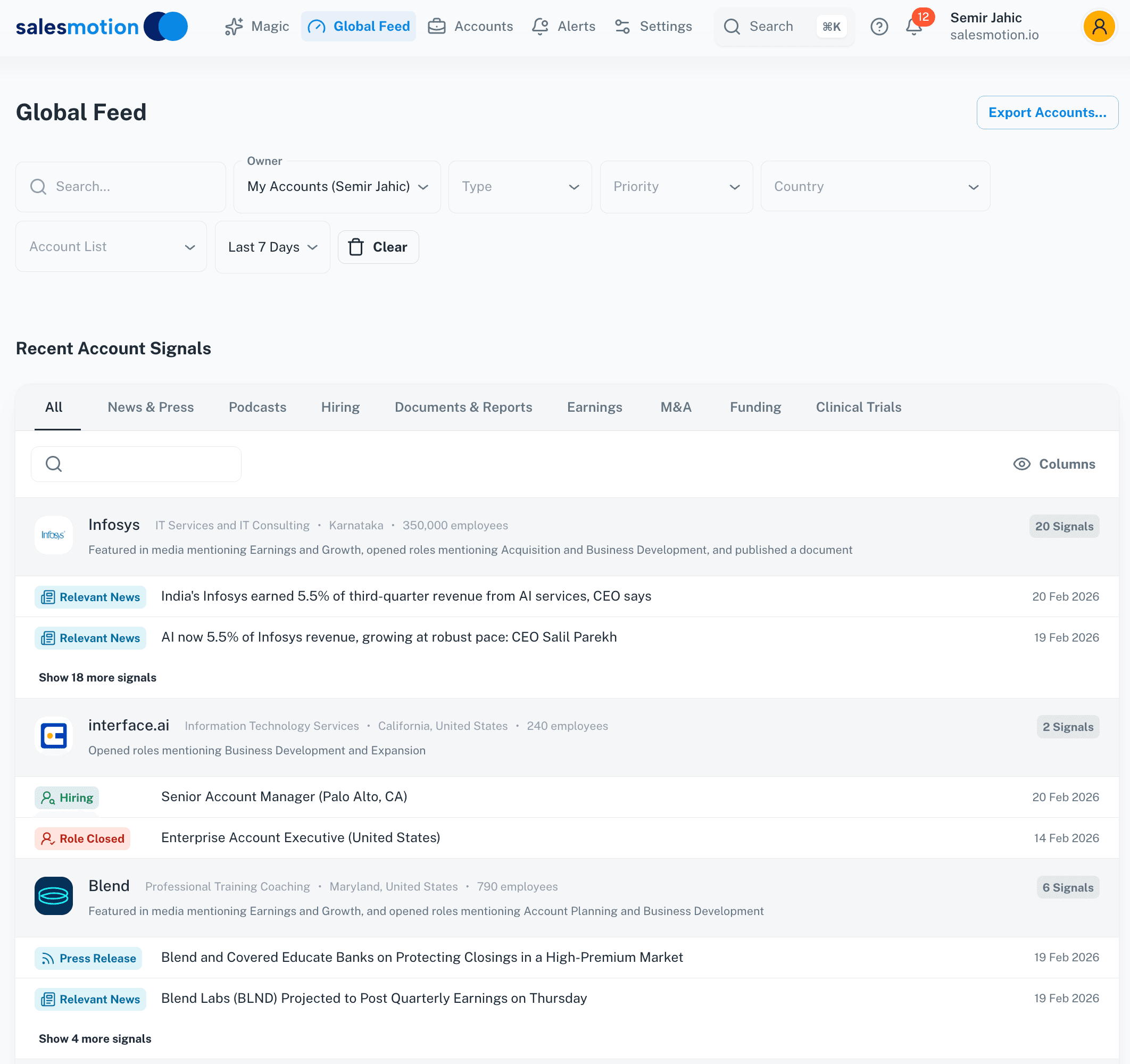
Salesmotion global signal feed showing real-time buying signals across monitored accounts
Real-time buying signals across your entire territory — no manual research needed.
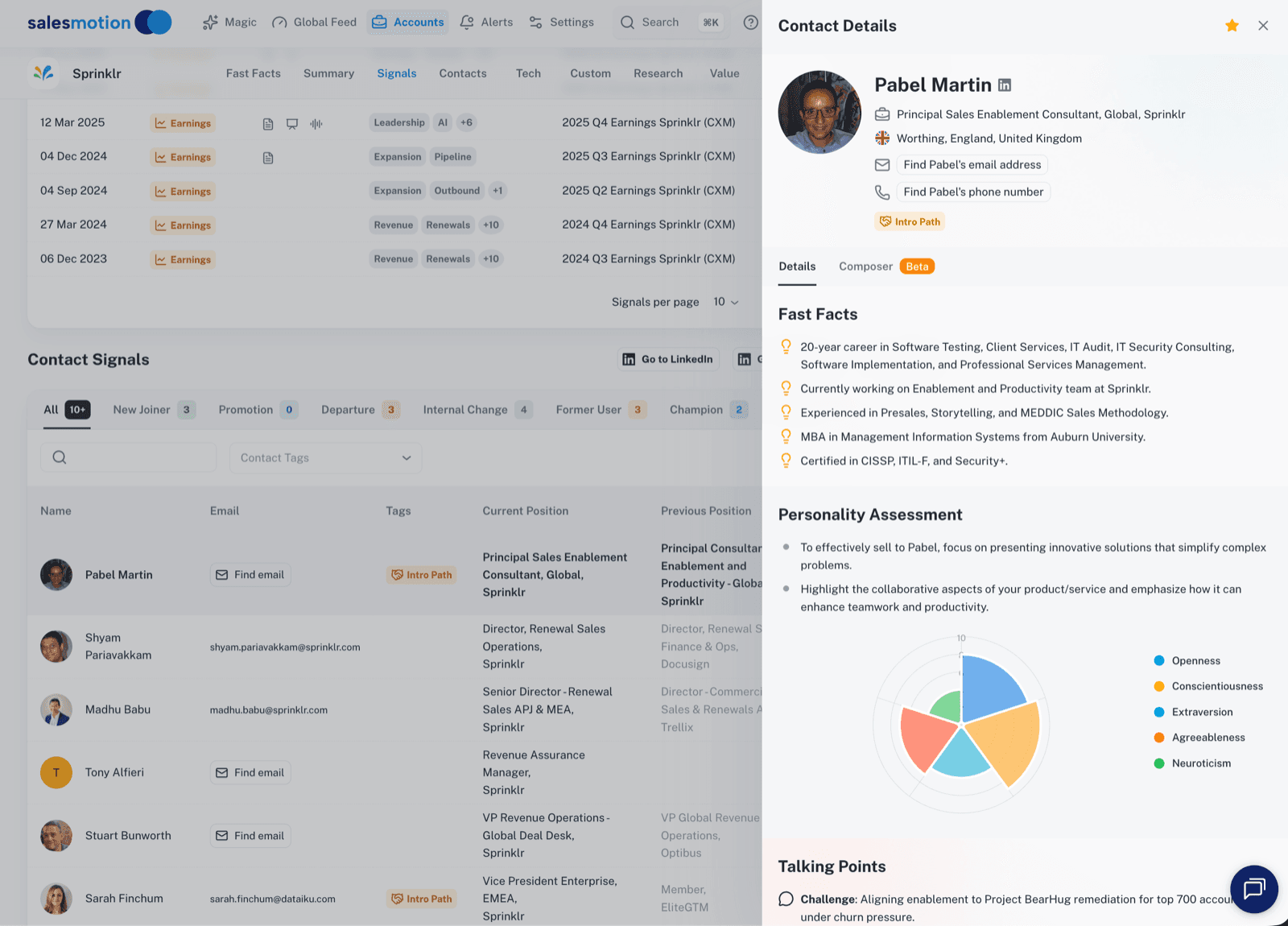
Salesmotion account contacts view showing verified contact data with full account context
Verified contacts enriched with deep account intelligence and buying signals.
FAQ

Frequently Asked Questions

What are the best sites like ZoomInfo?

The closest sites like ZoomInfo for contact data are Apollo.io and Lusha, which publish their prices and have free plans, and Cognism for European mobile numbers. 6sense is the company most similar to ZoomInfo for enterprise intent and ABM. UpLead and LinkedIn Sales Navigator cover smaller parts of the same job. Salesmotion is not a ZoomInfo clone: it is the account intelligence layer that tells reps which accounts to work and why, with cited briefs from 1,000+ public sources, from $85/mo on a monthly contract.

Do I still need ZoomInfo if I use Salesmotion?

It depends on how your reps work. If they rely on direct dials, bulk lists and org charts, keep a contact database such as ZoomInfo, Apollo.io or Lusha. Salesmotion includes 200 contact credits a month on the Individual plan, which covers verified contacts on a focused account list, not bulk prospecting. Many teams run both: the database for who, Salesmotion for which account, why now and what to say.

Who are ZoomInfo's biggest competitors?

ZoomInfo's biggest competitors fall into three groups. Contact database competitors include Apollo.io, Cognism, Lusha, and UpLead, which all sell B2B contact data. Intent and ABM platforms like 6sense compete with ZoomInfo's intent data and enterprise offerings. And account intelligence platforms like Salesmotion compete on the research and buying signals side, the 'why reach out now' layer that sits alongside a contact database. LinkedIn Sales Navigator also competes for prospecting budget with first-party, member-maintained profile data.

Does ZoomInfo have a free trial or a free version, and is there a free alternative?

Yes to both. ZoomInfo Lite is a permanent free tier with 10 credits a month, no credit card and no expiration, and ZoomInfo's Professional and Copilot plans each offer a free trial. Among the alternatives, Apollo.io has a permanent free plan with 900 credits per seat per year, Lusha has a free plan with 40 credits a month, and Clay has a free tier. Among account intelligence platforms, Salesmotion's individual plan is $85/mo, self-serve with monthly billing, so you can start and stop without negotiating an enterprise contract.

My ZoomInfo renewal went up. What should I do before I sign?

Audit usage, negotiate, check your notice window and run a parallel test. ZoomInfo's pricing page says paid plans auto-renew and that renewal prices can rise above the initial rate, and it suggests asking for a cap on renewal increases in the contract. Pull seat and credit usage for the last 12 months, drop unused add-ons and seats, confirm the notice period in your order form, and test an alternative on monthly terms before the date. Our guide to the ZoomInfo renewal price increase has the full checklist.

Is there a ZoomInfo alternative with monthly terms?

Yes. ZoomInfo's paid plans are annual subscriptions with no standard monthly billing option, according to its own pricing page. Apollo.io, Lusha, LinkedIn Sales Navigator (Core and Advanced), UpLead (Essentials and Plus) and Clay all publish a monthly billing option, checked 18 Nov 2026. Salesmotion's Individual plan is $85/mo on a monthly contract with no annual commitment. Monthly plans cost more per month than annual ones, so use them to test before you commit.

Which ZoomInfo alternative works for life-sciences sales teams?

ZoomInfo and the contact databases on this page are horizontal: they cover people and companies in every industry. Teams that sell to biotech and pharma sponsors, such as CROs, CDMOs, labs and consultancies, usually also need trial and pipeline context: which sponsors are running trials, in which phase and therapeutic area, and what changed this week. Salesmotion for life sciences adds that layer, with sponsor discovery filtered by therapeutic area, phase and modality, trial activity from ClinicalTrials.gov, buying signals and decision-makers, next to whichever contact database you keep.

How much does ZoomInfo cost, and are there cheaper alternatives?

ZoomInfo does not publish list pricing; contracts are quoted per organization; its own pricing page states that no specific dollar amounts are published because pricing is consumption-based. Vendr reports a median contract of $33,500 a year based on 1,576 purchases, with a range of $7,233–$156,053. ZoomInfo Lite is a permanent free tier with 10 credits a month. The lower-cost starting points are Apollo.io and Lusha, which publish their rate cards and have free plans: Apollo.io is Free; Basic $49, Professional $79/user/mo (annual); Custom and Lusha is Free (40 credits/mo); Starter $37.45/mo, Pro $52.45/mo (annual). Salesmotion is $85/mo for individuals. Custom pricing for teams & enterprise. Cognism and 6sense are quote-only, so comparing them with ZoomInfo takes a quote from each. See our ZoomInfo pricing breakdown for a detailed comparison.

Is Apollo.io a good ZoomInfo replacement?

For many SMB and mid-market teams, yes. Apollo.io is the most popular ZoomInfo alternative for teams that want contact data plus email sequencing on a published, self-serve rate card, and it includes intent topics and AI research on every plan. ZoomInfo's data set is larger (500M+ contacts against Apollo's 240M) and adds org charts, technographics and the Copilot AI sales agent, so enterprise teams that rely on those may keep it. See our Apollo alternatives guide for a deeper comparison.

Which ZoomInfo alternative is best for European data?

Cognism. It positions itself as built for growth in Europe, with phone-verified mobile numbers, decision-maker data refreshed every 30 days and extensive Do-Not-Call coverage across Europe. Lusha is also strong on compliance, with GDPR certification by ePrivacyseal.

What are the top alternatives to ZoomInfo for finding buying signals?

Salesmotion, 6sense, Apollo.io, Lusha and Cognism all surface buying signals, each from different sources. Salesmotion monitors 1,000+ public sources for 50+ signal types and attaches a cited account research brief to each account. 6sense prioritizes accounts on its own intent network and adds RevvyAI account research and meeting prep. Apollo.io includes intent topics and signal filters on every plan, Lusha tracks 26 buying signals refreshed weekly, and Cognism covers hiring, funding and job changes, with Bombora intent on its Pro package. For signals a rep can quote in outreach, with every data point traced to its source, Salesmotion is built for that job.

Can I use ZoomInfo and Salesmotion together?

Yes, and many teams do. ZoomInfo is the contact database: who works there and how to reach them. Salesmotion is the account intelligence and signal layer that sits alongside it: which accounts to work now and why, with cited briefs and 50+ signal types from 1,000+ public sources. Both connect to Salesforce, so the research and the contacts meet in the CRM.

Why is ZoomInfo so expensive?

ZoomInfo's cost follows from how it is packaged, and it does not publish a price list. Its pricing page says paid plans are annual subscriptions with a minimum number of seats, mostly billed annually upfront, with usage metered in credits. Streaming Intent, sales engagement, international data, additional seats and API and MCP access are named as add-ons. ZoomInfo does not publish list pricing; contracts are quoted per organization; its own pricing page states that no specific dollar amounts are published because pricing is consumption-based. Vendr reports a median contract of $33,500 a year based on 1,576 purchases, with a range of $7,233–$156,053. ZoomInfo Lite is a permanent free tier with 10 credits a month. Teams that need only part of that package can compare it with a published rate card such as Apollo.io or Lusha, or add a focused account intelligence tool such as Salesmotion ($85/mo on a monthly contract).

Should I use ZoomInfo or 6sense Sales Intelligence?

Choose ZoomInfo if contact data is the main need, and 6sense Sales Intelligence if predictive account prioritization is. ZoomInfo reports verified data on 500M+ contacts and 100M+ companies and sells Copilot, its AI sales agent, on top. 6sense Sales Intelligence combines data credits with Predictive AI built on its own intent network, and reports 111M+ verified business email addresses. Neither publishes a price, so ask both for a quote on the same seats and credit volume. If the gap is knowing why an account is worth a call this week, Salesmotion adds cited account briefs and 50+ signal types alongside either one.

How do ZoomInfo and 6sense compare on pricing?

Neither publishes a price list. ZoomInfo does not publish list pricing; contracts are quoted per organization; its own pricing page states that no specific dollar amounts are published because pricing is consumption-based. Vendr reports a median contract of $33,500 a year based on 1,576 purchases, with a range of $7,233–$156,053. ZoomInfo Lite is a permanent free tier with 10 credits a month. 6sense does not publish list pricing; contracts are quoted per organization. Vendr's marketplace data reports a median annual contract value of $62,220 across 386 purchases, with a range of $11,234–$176,511. The two meter different things: ZoomInfo sells annual subscriptions with usage metered in credits, and 6sense Sales Intelligence combines data credits with Predictive AI built on its own intent network. Ask both for a quote on the same seats and credit volume.

Need to make the case internally?The Salesmotion business case has the cost, the time math and named customer results on one page, with a short version you can paste into an email or a slide.Read the business case

Related Comparisons

Explore more head-to-head comparisons and alternatives guides.

Give every rep three AI agents to build more pipeline.

A Signal Agent, Research Agent, and Outreach Agent — working every day so your team spends less time researching and more time closing.