Forget the jargon for a moment. The demand generation definition is simple: it’s the art of creating genuine desire for your solution among your ideal customers, often before they even know they have a problem. It’s a full-funnel strategy designed to build brand awareness and educate your entire target market—not just the small fraction actively looking to buy today.
TL;DR: Demand generation is a full-funnel strategy that creates awareness of and desire for your solution across your whole target market. It has two sides: demand creation for the majority who are not yet in a buying cycle, and demand capture for the few who are ready now. Measure it by pipeline and revenue, not clicks.
What Is Demand Generation, Really?

Here's the most effective way to frame it. Lead generation is like picking the few ripe apples on a tree. It's fast, but you'll run out of fruit quickly.
Demand generation is cultivating the entire orchard. You're tilling the soil, planting seeds, and nurturing the trees to ensure a predictable, abundant harvest season after season. It’s the engine for sustainable, long-term revenue growth.
This strategic shift explains why the market for demand generation software is booming. It reached USD 4,486.39 million in 2022 and is projected to hit USD 8,350.8 million by 2028. Businesses are investing because it delivers reliable results.
Creating Demand, Not Just Capturing It
The fundamental idea is to move from a reactive to a proactive strategy. Instead of waiting for a prospect to search "best CRM for startups," you create content that helps a startup founder realize their spreadsheet-based system is quietly hindering their growth.
You aren't just answering a question; you're creating the moment of realization that leads to the question.
This approach builds incredible trust and authority. When that founder eventually decides they need a CRM, your brand is the first—and perhaps only—one they consider. Why? Because you've been providing value for months with no strings attached.
Demand generation is a continuous strategy that educates buyers at every stage, building awareness and interest so your brand is the default choice when a problem arises. It's about becoming a trusted advisor before you ever become a vendor.
Distinguishing It From Related Fields
So, where does demand generation fit within the broader marketing landscape? Let’s clarify the two most common points of confusion.
To fully grasp demand generation, it's crucial to understand it’s a much broader discipline than lead generation, with entirely different goals. It's also helpful to explore the key differences between growth marketing and demand generation to see how it fits into the bigger picture.
Here’s a clear breakdown of how demand generation and lead generation compare.
| Aspect | Demand Generation | Lead Generation |
|---|---|---|
| Primary Goal | Create awareness and desire for your solution within a target market. | Capture contact information from people who have shown interest. |
| Focus | Educating the entire market (long-term). | Converting existing interest into leads (short-term). |
| Key Metrics | Website Traffic, Brand Mentions, Content Engagement, Pipeline Velocity. | Cost Per Lead (CPL), MQLs, Conversion Rate, Gated Content Downloads. |
| Core Activities | Podcasting, thought leadership articles, ungated eBooks, social media. | Gated content, demo request forms, contact-us forms, webinars. |
| Analogy | Cultivating an entire orchard for a future harvest. | Picking the ripe apples that are ready now. |
Ultimately, demand generation is about creating the very market you intend to lead. You stop chasing customers and start cultivating them through consistent education and value.
For a deeper look, check out our guide to modern B2B demand generation. This proactive approach is how winning companies move from finding opportunities to creating them on demand.
See Salesmotion in action
Take a self-guided interactive tour — no signup required.
The Building Blocks of a Modern Demand Strategy

An effective demand generation program isn't just a collection of marketing tactics; it’s a well-oiled machine. Each component works in concert to educate your market, build authority, and fill your sales pipeline with genuinely interested prospects. You're building a system, not just running disconnected campaigns.
This system is built on a few core pillars. When executed correctly, they create a multi-channel engine that turns curiosity into conversations and, ultimately, revenue.
Core Components of the Demand Engine
A modern demand strategy relies on an integrated mix of channels and tactics. Each piece has a specific job, from sparking initial awareness to building deep, unshakable trust.
The magic happens when these elements amplify one another. A great blog post isn't just a blog post; it’s an asset you can promote with paid ads, use to spark discussions on social media, and have people discover through search for years.
Here’s what that looks like in practice:
- Insightful Content: This is the fuel for your engine. We're talking about ungated assets like deep-dive blog posts, educational webinars, original research, and podcasts. You're solving real problems for your audience without asking for an email address upfront.
- Strategic SEO: Your content must be findable when your audience needs it most. A modern demand gen strategy fully embraces advanced search tactics, including Answer Engine Optimization, as covered in this B2B SaaS SEO and AEO strategy. When your audience has a problem, your solution should be there waiting.
- Targeted Paid Media: Think of paid channels like LinkedIn or search ads as your amplifier. They let you place your best educational content directly in front of your ideal customers, accelerating awareness and driving traffic to your most valuable assets.
- Authentic Social Engagement: This is where you build community and let your brand's personality shine. It’s not about broadcasting sales pitches. It’s about joining real conversations, sharing expert opinions, and becoming a credible voice in your industry.
You can't properly define demand generation without breaking it down into these parts. It’s the smart integration of content, SEO, paid media, and social that turns marketing from a cost center into a predictable revenue driver.
This integrated approach also reframes how you measure success. For revenue leaders, this strategy pairs perfectly with AI agents that can monitor buying signals and provide your team with the context needed to craft better outreach. In fact, a significant shift is underway in B2B organizations, with 43% now measuring ROI through spend efficiency and 40% focusing on CPL and conversions. It’s a move away from pure volume toward tangible value.

“The moment we turned on Salesmotion, it became essential. No more hours on LinkedIn or Google to figure out who we're talking to. It's just there, served up to you, so it's always 'go time.'”
Adam Wainwright
Head of Revenue, Cacheflow
How to Measure What Actually Matters
Activity is not achievement. It's easy to get lost in vanity metrics like clicks, impressions, and social media likes. But to a CRO or any executive, those numbers are just noise unless they connect directly to the bottom line.
To prove the value of your demand generation program, you must measure what truly matters: revenue. Forget tracking activity for its own sake. The real goal is to build an undeniable, data-backed bridge between your marketing efforts and their financial impact.
Moving Beyond Vanity Metrics
The best definition of demand generation is one tied to business outcomes. Imagine showing your board how a series of educational webinars directly correlated with a 15% increase in qualified sales pipeline three months later. That’s the power of focusing on the right KPIs.
This requires tight alignment between sales and marketing. This shift is already happening—a recent study revealed that 42% of B2B teams now consider revenue their number one KPI, connecting brand-building activities directly to financial results. You can discover more insights about B2B marketing KPIs that are proving most effective.
The core principle is simple: if you can't tie a marketing activity to pipeline or revenue, it’s not a priority. A successful program provides clear, quantifiable evidence of its contribution to the business's financial health.
This focus on business impact is what separates good marketers from great ones. It shifts the conversation from "How many clicks did we get?" to "How much qualified pipeline did we create?"
The KPIs That Executives Actually Care About
When you're ready to measure real impact, your dashboard should reflect what the C-suite is examining. These metrics tell a story about efficiency, growth, and profitability—the language of business.
Here are the essential KPIs that link your demand generation efforts directly to revenue:
- Marketing-Sourced Pipeline: The total value of sales opportunities that originated from your marketing activities. It's the most direct indicator that your efforts are creating real sales conversations.
- Pipeline Velocity: How quickly are deals moving from initial awareness to closed-won? An increase in velocity indicates your educational content is creating more informed and motivated buyers, shortening the sales cycle.
- Customer Acquisition Cost (CAC): This metric measures the total cost of your marketing and sales efforts to acquire a new customer. An effective demand program should lower your CAC over time by generating a steady stream of high-intent, well-educated prospects.
- Marketing-Influenced Revenue: Even if marketing doesn't source a deal directly, it often plays a crucial role. This metric tracks all revenue from deals where marketing had a touchpoint, demonstrating its broad impact across the entire customer journey.
Tracking these KPIs provides an undeniable view of your program's financial contribution. For a more detailed guide on which numbers to watch, you might be interested in our deep dive on essential demand generation metrics. By focusing on these outcomes, you prove that demand generation isn't just a marketing function; it's a core driver of business growth.
The Two Sides of Demand: Creation vs. Capture
To truly master demand generation, you have to see it as two sides of the same coin: creating demand and capturing it. Many marketers focus only on one side—capturing the interest that already exists. But the most effective programs excel at both. This dual approach is the core of any real demand generation definition.
Think about it: at any given time, only about 5% of your total addressable market is in a buying cycle. The other 95%? They’re not actively looking for a solution. They might not even know they have a problem. If you only focus on that tiny 5%, you're fighting in a crowded, expensive arena while ignoring the massive pool of your future customers.
Demand Creation: The 95% Strategy
Demand creation is all about engaging that other 95%. This is the long game. It’s about educating the market, raising awareness of a challenge they hadn’t considered, and building your brand as a trusted authority. The goal is simple: when they finally enter a buying cycle, your name is the first one that comes to mind.
You achieve this with value-first content that doesn't require a form fill.
- Thought leadership articles that challenge your audience's assumptions.
- Educational webinars that teach a new skill or framework.
- Podcasts featuring industry experts discussing future trends.
- Brand campaigns designed to build a genuine, emotional connection.
For example, a B2B SaaS company might publish a detailed, completely ungated report on the hidden costs of manual data entry. They’re not pushing their software. They're illuminating a pain point their ideal customer experiences daily, creating future demand for their automated solution.
By consistently educating the market, you're not just joining the conversation—you're starting it. You become the go-to resource, building brand equity that pays dividends for months and even years.
Demand Capture: The 5% Strategy
While demand creation warms up future buyers, demand capture is laser-focused on converting the 5% who are ready to buy right now. These individuals are actively searching for a solution, and your job is to make it incredibly easy for them to find and choose you.
This is where your high-intent, conversion-focused tactics come into play:
- Google Ads targeting keywords with clear buying intent (e.g., "best project management software").
- Demo request pages that are simple and frictionless to complete.
- Competitor comparison pages that help prospects weigh their options.
Returning to our SaaS example, the same company would run search ads for a term like "data automation platform." When a user clicks, they land on a page that immediately communicates the product's value and features a prominent "Request a Demo" button. The goal here is conversion, not education.
A winning strategy requires both. Creating demand fills the top of your funnel with a pipeline of future customers, while capturing demand converts today’s active buyers into revenue.
“Automatic account profile detail I can use to manage my territory. Using Salesmotion AI to generate value statements per persona, account, etc. Using Salesmotion to give me a starting point based on new hires, or news alerts is critical.”
Adam Wainwright
Head of Revenue, Cacheflow
How Intelligent Automation Amplifies Your Efforts
Generating demand is a challenging, long-term endeavor. But acting on that demand at precisely the right moment is where the real magic happens. This is where intelligent automation can transform a solid demand generation strategy into a pipeline-building machine.
It solves the single biggest challenge in B2B marketing: turning broad interest into timely, relevant conversations for your sales team.
Think about all the companies engaging with your content—reading your blog posts, watching webinars, and following you on social media. They are signaling interest, but most of it is passive. Which of those accounts is ready to talk now? No sales team has the time to manually research every single one. It's an impossible task.
From Broad Interest to Actionable Opportunity
This is exactly where AI-powered account intelligence changes the game. Instead of just knowing a company downloaded your eBook, imagine knowing the exact moment that company announced a major expansion, hired a new executive, or had their CEO mention a strategic priority in a podcast that aligns perfectly with what you sell.
These are the buying signals that matter. They are the triggers that convert a passive prospect into an active opportunity.
True demand activation isn't about chasing every flicker of interest. It's about using intelligence to identify the precise moment an account’s needs and your solution converge, then acting on it instantly.
How AI Agents Bridge the Marketing-to-Sales Gap
Modern sales intelligence platforms act as an extension of your team, connecting the dots 24/7. Let’s break down how different AI agents, like those within Salesmotion, can work together to systematically activate the demand your marketing team has worked so hard to create.
-
The Signal Agent: Think of this agent as your always-on lookout. It monitors thousands of public sources for every company on your target account list. When a high-value trigger occurs—like a Series C funding announcement—it doesn’t just forward a news link. It flags the event and explains why it’s important for your sales team.
-
The Research Agent: The moment a signal is flagged, this agent gets to work. It instantly builds a deep, structured brief on the account, pulling in context from earnings calls, recent hires, and strategic initiatives. This eliminates the hours of manual research that reps simply don't have time for.
-
The Outreach Agent: This is where intelligence turns into action. The Outreach Agent takes the signal and the research and drafts a hyper-relevant outreach message. The email is anchored to the real-world event, making it personal and timely. It closes the gap between marketing’s broad awareness efforts and sales' need for a compelling reason to reach out today.
This automated workflow solves the "so what?" problem. Instead of reps receiving a generic "MQL" notification, they get a ready-to-send email based on a specific, actionable trigger. This is how you systematically convert generated interest into real pipeline.
To get a better sense of how this works, you can explore more about using AI in sales to create these timely opportunities. This process ensures no signal goes unnoticed and every valuable moment of intent is captured.
A Modern Demand Generation Workflow in Action
Theory is great, but let's make this practical. The best way to understand how demand creation, capture, and intelligent automation fit together is to see them in a real-world scenario.
Imagine a B2B software company aiming to become the go-to expert on new industry regulations. Their demand creation play is a series of high-value, completely free webinars explaining how to navigate the complex new compliance rules. No forms, no gates—just pure value.
From Engagement to Opportunity
The webinars are a success, drawing hundreds of attendees from their ideal customer profile (ICP) accounts. This is where many marketing teams would stop, simply logging attendance. But for a modern demand team, this is where the real work begins.
Instead of just celebrating the high attendance, the company has Salesmotion's AI agents quietly monitoring every single company that participated.
A few weeks pass. Then, the Signal Agent flags a game-changing trigger: one of the high-value accounts that attended the webinar series just hired a new Chief Compliance Officer. That’s the "why now"—the perfect moment to engage.
This automated flow is what turns a passive touchpoint into a timely sales trigger.
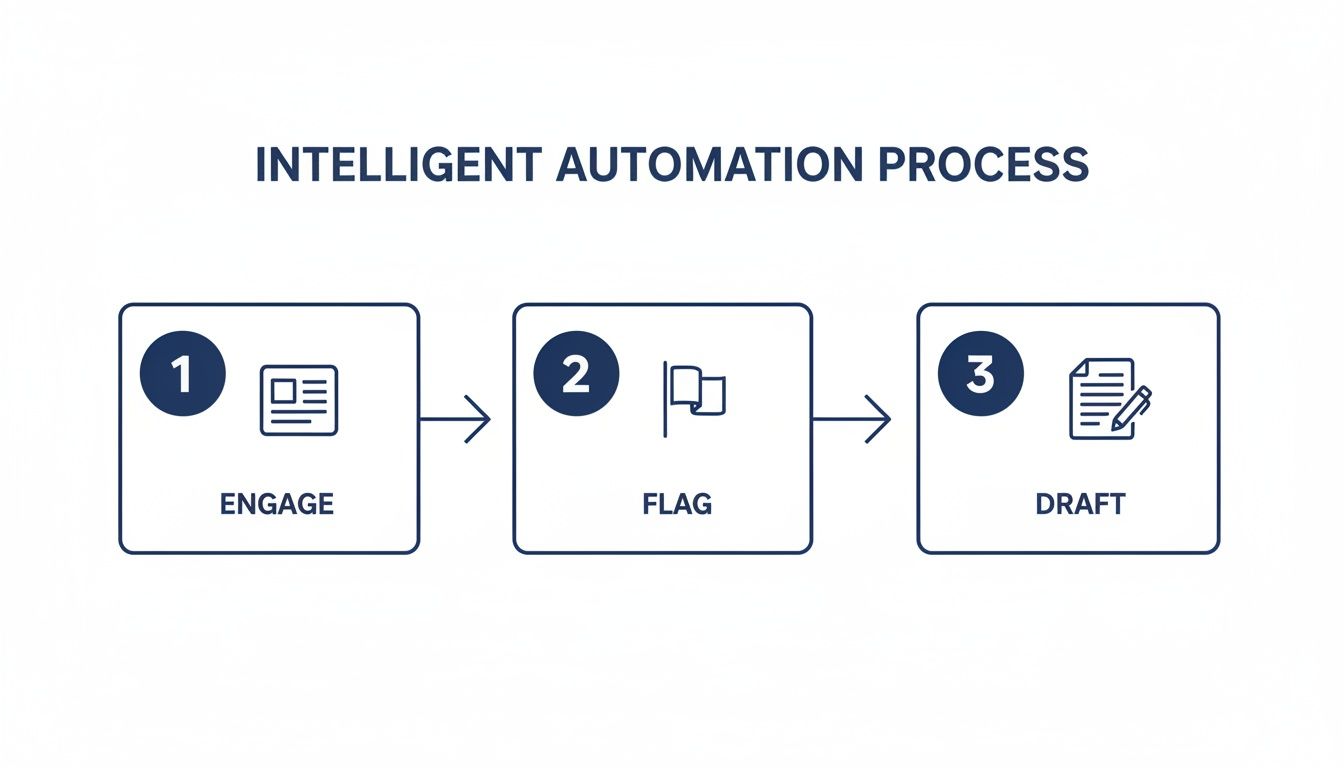
This simple workflow connects the dots between marketing's awareness efforts and sales' need for a relevant, timely reason to reach out.
The instant the signal is flagged, the Research Agent kicks in. It compiles a quick, digestible brief for the account executive, outlining the new hire’s background, previous roles, and public priorities. The hours of manual research an AE would normally spend are completed in seconds.
Activating the Signal
Now armed with this intelligence, the Outreach Agent drafts a hyper-relevant email. It’s not a generic template. It specifically references the company's attendance at the webinar and congratulates them on the new executive hire. The message is so specific and timely it's almost impossible to ignore.
This is the heart of modern demand generation. It’s not just about creating brand awareness; it’s about having the systems in place to spot a buying signal and act on it the second it appears.
The sales rep reviews the AI-drafted email, adds a quick personal touch, and hits send. The result? The new compliance officer is impressed by the relevant outreach and agrees to a meeting.
This demonstrates the direct line from creating market-wide demand to capturing a high-value opportunity. Building this process is a critical part of an effective pipeline generation plan.
Frequently Asked Questions
Let's tackle a few common questions that arise when leaders get serious about demand generation.
Is Demand Generation Just Another Name for Inbound Marketing?
No, they aren’t the same, though it's a common point of confusion. They are related, but demand generation is a much broader strategy.
Think of it this way: Inbound marketing is excellent for capturing people who are already looking for a solution. They're typing their problems into Google, and your content helps them find answers.
Demand generation does that, too, but it also creates demand where none existed before. It educates audiences who aren't even aware they have a problem yet. Inbound is a crucial tactic within a larger demand generation program, not a substitute for it.
How Long Does It Take to See Real Results?
Demand generation is a long-term strategy, not a get-rich-quick scheme. You will likely see encouraging early signals—like increased website traffic or better content engagement—within the first 90 days.
However, for the results that truly matter to the business, like a healthier pipeline and shorter sales cycles, patience is key. In most complex B2B environments, it typically takes 6-12 months for the full impact to become clear and measurable.
What Is the First Step to Starting a Demand Program?
Before you write a single blog post or launch a campaign, the first step is to become deeply knowledgeable about your ideal customer.
This means conducting in-depth customer interviews and analyzing the accounts you’ve already won. You need to understand their world, their goals, and their most pressing challenges inside and out. Every successful demand generation strategy is built on this customer-centric foundation. Everything else comes second.
Ready to stop guessing and start activating real demand? Salesmotion uses AI agents to monitor your target accounts for buying signals, giving your team the timely, relevant context they need to start more conversations. Learn how Salesmotion builds pipeline.