The head of sales at a global telecom provider put it bluntly during our evaluation call: "Salespeople are inherently time-poor. They seek the path of least resistance." His team had tried two external data tools before. Both showed low adoption. The diagnosis was familiar to anyone who has led a sales org: information overload versus actionable insights. Junior reps lacked the business acumen to interpret earnings calls. Senior reps didn't have the patience to dig through dashboards. And the tool became shelfware within 90 days.
He is not alone. This is the meta-objection every VP of Sales carries into new conversations about intelligence tooling. They have been burned by expensive ZoomInfo contracts that only the ops team touches, by 6sense dashboards that nobody outside marketing ever opens. The skepticism is earned.
TL;DR: Sales intelligence tools fail because they add steps instead of removing them, deliver raw data instead of actionable context, and live outside the CRM where reps actually work. The fix is push-based alerts, CRM-embedded experiences, and AI-generated drafts that turn signals into action. Teams that get these three things right see daily usage rates jump from under 15% to over 60%.
The Adoption Problem Is Worse Than You Think
The average sales team now uses 10 or more tools, but reps actively use only about three of them. The rest collect dust. According to Pendo research, 67% of purchased software features go entirely unused. And the problem runs deeper than wasted licenses: over half of sellers say they cannot quantify the ROI from new tools introduced in the past year.
Meanwhile, 70% of B2B sales reps missed quota in 2024. The connection between tool overload and underperformance is not coincidental. Reps drowning in desktop alerts have trained themselves to ignore all of them. Less than 10% of sales reps receive proper training on strategic AI deployment, according to recent Gartner research. The result is a vicious cycle: tools underperform because reps don't use them, and reps don't use them because tools underperform.
This is not a training problem. It is a design problem.
What Buyers Actually Tell Us (The Uncomfortable Data)
The clearest evidence comes from real evaluation conversations and usage data that buyers share when they are shopping for a replacement.
A Top-5 CRO's Internal Survey
A top-5 contract research organization surveyed 50 users of their existing intelligence platform. The results were sobering. Only 10-15% used it daily. Another 20% checked in several times per week. The rest? Stale accounts gathering digital dust.
When asked why, the feedback was specific: signals felt "too broad, not specific enough" to their therapeutic areas and account contexts. A clinical development lead tracking oncology trials doesn't need a generic "leadership change" alert. They need to know that a specific pharma company just replaced their VP of Oncology R&D, which could accelerate or stall a partnership conversation. The tool couldn't make that distinction.
Overall satisfaction: 3.4 out of 5. Not terrible, not useful. Just... there.
The same picture shows up in the raw seat math. A RevOps leader at a mid-market software company ran the numbers on a prospecting tool bought the year before. The license count read 80. The number of people opening it on any given day read 3. Nobody had cancelled it, nobody defended it, and nobody could explain what it was for anymore. A separate sales leader, describing a stack the company had accumulated, put it even more starkly: only about 10% of reps ever touched any of those tools. Low adoption is not a one-off accident. It is the median outcome wearing your specific logo.
An Adtech Company's Champion Problem
An adtech company had a single power user who loved their intelligence tool. He built workflows, set up alerts, and evangelized internally. The rest of his team never logged in. When the champion left for another role, adoption dropped to zero overnight. The tool churned within two months.
This pattern is more common than vendors admit. When adoption depends on a single champion rather than genuine team-wide value, you are one resignation away from losing your entire investment.
The Manual Tracking Trap
A leadership training company discovered that their champion's efforts to track tool usage across the sales team were "very manual and inconsistent." They had no reliable way to measure whether reps were actually using the intelligence in their conversations or just clicking through to satisfy a manager's checkbox. Without visibility into real adoption, they could not diagnose the problem, justify the spend, or make the case for renewal.

“All of the vendors that I've worked with, all of the onboarding that I have had to deal with, I will say, hands down, Salesmotion was the easiest that I have had.”
Lyndsay Thomson
Head of Sales Operations, Cytel
Three Root Causes Behind Low Adoption
After analyzing dozens of these conversations, a clear pattern emerges. The reasons reps abandon intelligence tools cluster around three root causes.
Root Cause 1: The Tool Adds Steps Instead of Removing Them
Most intelligence platforms are designed as destinations. You log into a separate portal, navigate a dashboard, apply filters, scan results, copy the relevant insight, switch to your CRM, paste it into a note, and then make your call. That is six steps before any selling happens.
Reps already spend 72% of their week on non-selling activities. Any tool that adds friction to that workflow, even a small amount, will lose to the path of least resistance. And the path of least resistance is "skip it and wing the call."
This is not hypothetical. A BD director at a clinical research organization walked us through the routine before reaching out to a single account: pull a list, bulk-upload it to an enricher, filter by title, then open each company website and read the About Us, Leadership, Pipeline, and Programs pages to infer which phase the account is in, before drafting one email. The director described it as 10 to 15 minutes of back-and-forth just to reach out to one company. Multiply that across a territory and the tool stops being a shortcut.
The math is simple. If checking the tool takes five minutes per account and a rep has 15 calls today, that is 75 minutes spent on a tool that was supposed to save time. Most reps do the math instinctively and opt out.
Root Cause 2: Output Isn't Specific Enough to Be Actionable
There is a meaningful difference between data and intelligence. Data says: "Company X had a leadership change." Intelligence says: "Your champion's boss was replaced by someone from a competitor's account. Here is what that likely means for your renewal conversation, and here are three talking points for your next call."
The top-5 CRO's feedback captured this perfectly. Their reps didn't need more signals. They needed signals filtered through their specific context: their therapeutic area, their deal stage, their relationship map. Generic signals create noise. Contextual signals create action.
This is also where junior reps struggle most. The global telecom provider's head of sales observed that his BDRs lacked the business acumen to interpret an earnings call summary and translate it into a relevant conversation opener. The tool gave them the raw material but expected them to be analysts. They are not analysts. They are sellers.
Root Cause 3: The Tool Lives in Its Own Tab
Every standalone tool competes with every other standalone tool for a rep's attention. And the CRM always wins that competition, not because it is better, but because it is mandatory. Pipeline updates, activity logging, deal progression: these happen in Salesforce or HubSpot regardless of what other tools exist.
Intelligence that lives outside the CRM is intelligence that lives outside the workflow. CRM-embedded experiences consistently outperform standalone portals in adoption metrics because they meet reps where they already are, not where the vendor wishes they would go.
Three Fixes That Actually Drive Adoption
Diagnosing the problem is the easy part. Here is what actually works.
Fix 1: Push-Based Alerts, Not Pull-Based Dashboards
The single most impactful change is shifting from "go check the dashboard" to "the dashboard comes to you." Push-based alerts delivered to email, Slack, or directly inside the CRM eliminate the biggest adoption killer: requiring the rep to remember the tool exists.
One BD rep described the fear that kills pull-based tools exactly. If a busy week swallows the schedule and the feed gets missed, the signal is gone, because nobody scrolls back far enough to find it later. A tool that only rewards the disciplined rep on a quiet day will not survive a normal rep on a normal week. Push delivery removes that risk: the signal finds the rep instead of waiting to be discovered.
The global telecom provider's insight was precise: "Different user types need different approaches. SDRs use it as a fishing pond for basic signals. AEs need deeper insights for value-based selling." Most intelligence tools treat all reps the same. The ones that succeed let you configure alert types, thresholds, and delivery channels by role.
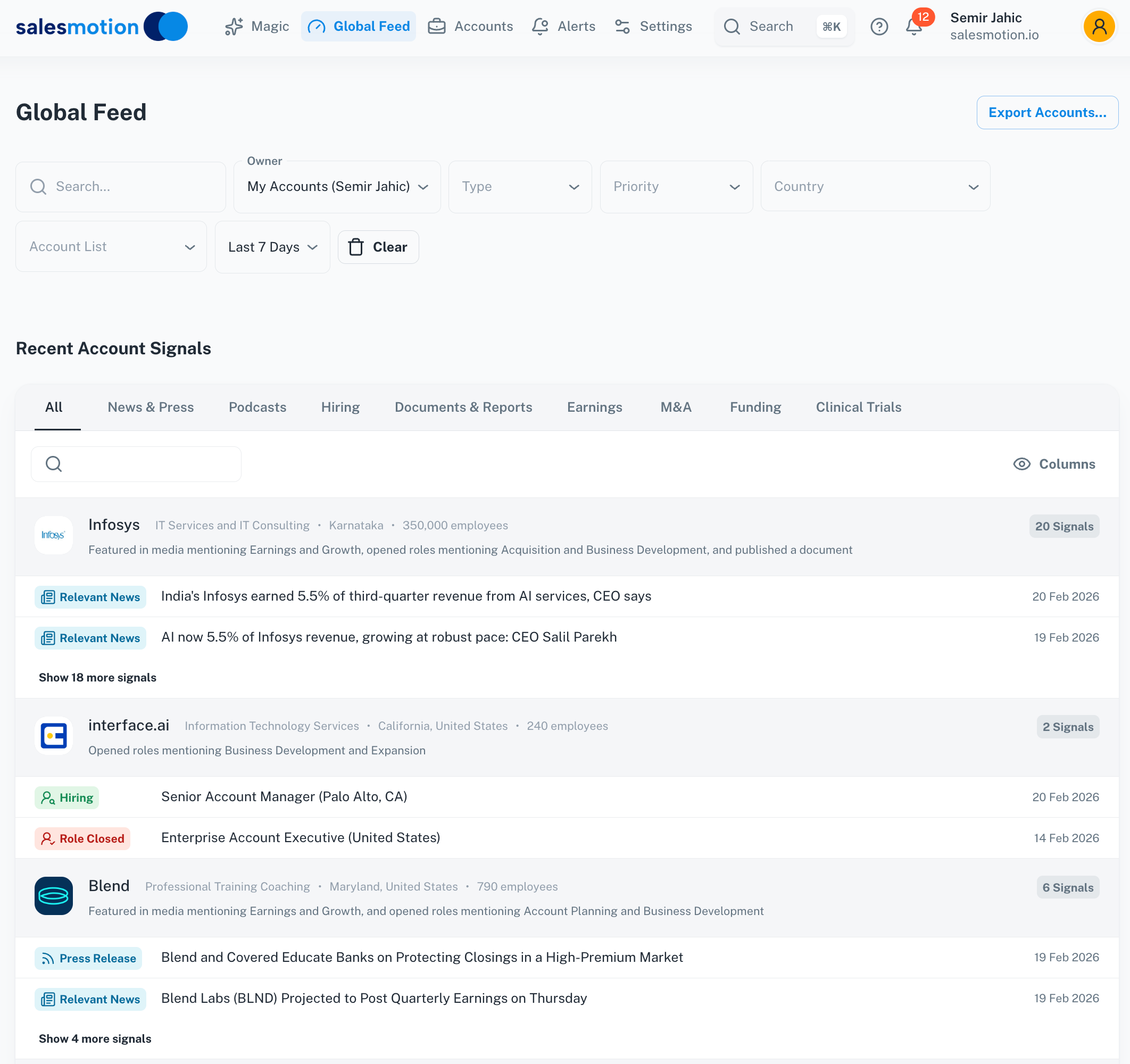 A push-based signal feed surfaces relevant account changes categorized by type and priority, so reps see what matters without hunting for it.
BDRs might want daily alerts for new job postings at target accounts. AEs might want weekly digests focused on earnings mentions and leadership transitions for their top 20 accounts. Managers might want aggregated signal trends across the entire book. One-size-fits-all alerting is just a different flavor of noise.
The research supports this approach. Tools that deliver value within 14 days see 92% one-year retention rates. Push-based alerts accelerate time-to-value because they deliver useful output before the rep even has to do anything.
Fix 2: CRM-Embedded Experience
If your intelligence tool requires reps to leave their CRM, you have already lost. The best adoption outcomes come from tools that surface insights inside account records, contact pages, and opportunity views, right where the rep is already working.
This means more than a basic data sync. A field that says "intent score: 78" inside Salesforce is marginally better than nothing, but it still requires the rep to interpret what that number means and decide what to do about it. True embedded intelligence surfaces the specific signal, the recommended action, and the relevant context directly within the CRM record.
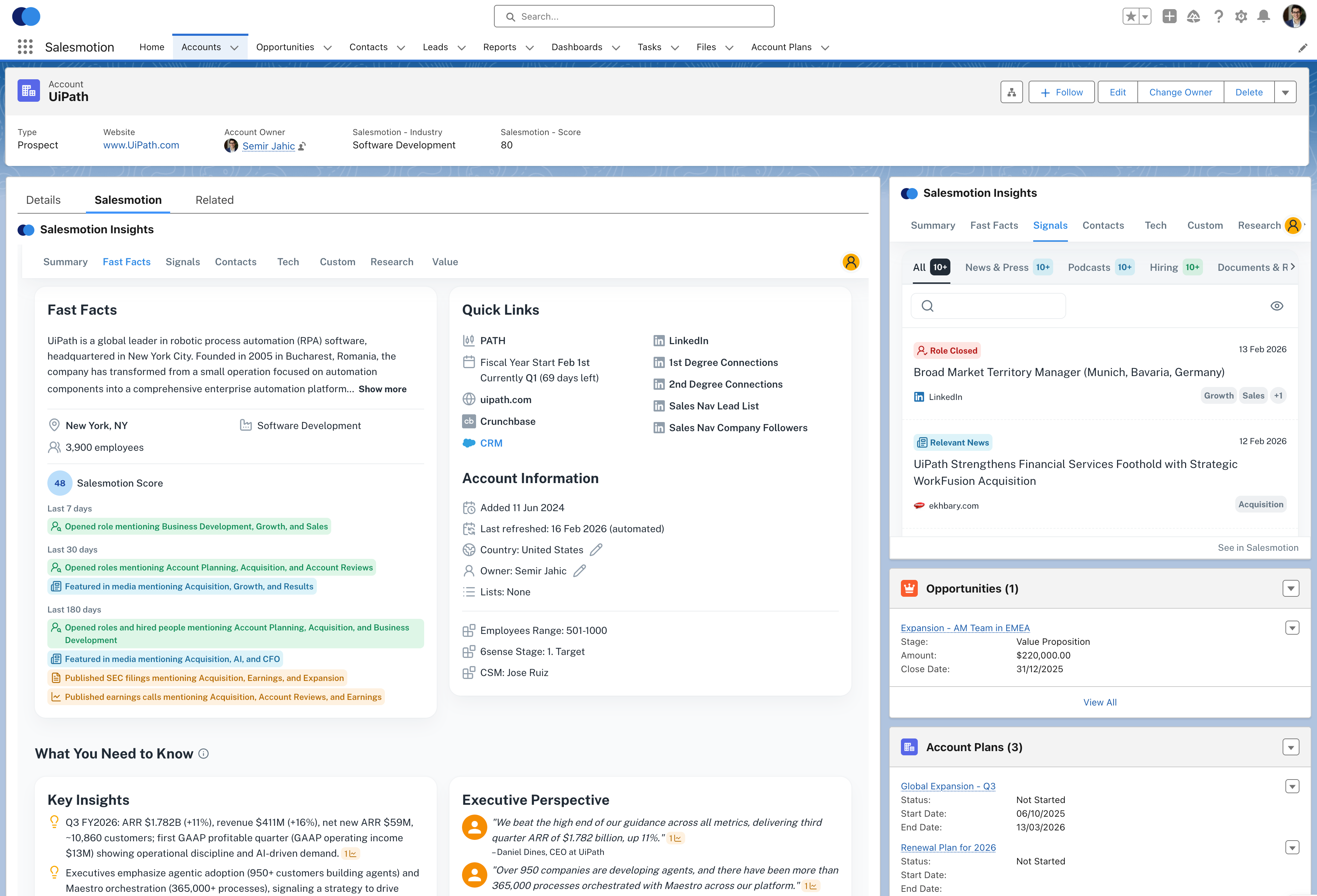 Intelligence embedded directly inside Salesforce. Reps see account signals, context, and recommended actions without leaving their CRM.
The adoption difference is dramatic. Tools with strong CRM integration achieve 94% deployment success rates versus 72% for tools with weak integration. That is not a marginal improvement. It is the difference between a successful rollout and a failed one.
Fix 3: AI-Generated Drafts, Not Raw Data
The final adoption barrier is the gap between insight and action. Even when reps receive a relevant signal at the right time in the right place, they still need to figure out what to do with it. "Your prospect's company just announced a 15% workforce reduction" is useful information. But "Here is a three-sentence email acknowledging the restructuring and positioning your solution as a way to do more with less" is actionable.
AI-generated drafts, whether for email outreach, call prep notes, or executive briefings, bridge the gap between knowing and doing. They are especially valuable for the junior reps who struggle most with translating signals into conversations. Instead of asking a BDR to read an earnings transcript and formulate talking points, give them the talking points directly.
This is not about replacing the rep's judgment. It is about giving them a starting point that is 80% right, so they spend their time refining a draft rather than staring at a blank screen. The best reps will customize heavily. The rest will use the draft with minor edits. Both outcomes are better than the alternative: ignoring the signal entirely because acting on it felt like too much work.
See Salesmotion on a real account
Book a 15-minute demo and see how your team saves hours on account research.
What Adoption Success Actually Looks Like
Cytel, a global biostatistics firm, described Salesmotion as having the "easiest onboarding across all vendors." That phrase matters more than any feature comparison. When a buyer says onboarding was easy, they are really saying: my team actually uses it. The gap between "powerful tool" and "adopted tool" is almost entirely about friction.
The pattern across teams that achieve strong adoption is consistent. They chose tools that removed steps rather than adding them. They embedded intelligence inside existing workflows rather than asking reps to build new habits. And they delivered output that was specific enough to act on immediately rather than requiring interpretation.
Contrast that with the common ZoomInfo experience: expensive contracts where a handful of power users extract value while the rest of the team reverts to LinkedIn and Google. The tool is powerful. It is also, for most reps, more work than it is worth.
The Honest Question to Ask Before You Buy
Before evaluating any intelligence tool, ask one question: will my lowest-performing rep actually use this?
Not your top performer. Not your ops team. Not the champion who volunteers for every pilot. Your most skeptical, most time-pressed, most change-resistant rep. If the tool can win that person over, it will win everyone. If it can't, you are buying expensive shelfware for the second or third time.
Some buyers already test this way. A sales-operations lead at a sales-training firm told us two of her four sellers will use any new tool daily and two never will, so she tests adoption seller by seller before buying.
The three fixes are not complicated. Push-based alerts instead of pull-based dashboards. CRM-embedded instead of standalone. AI-generated drafts instead of raw data. But implementing all three requires choosing a platform that was built around these principles from the start, not one that bolted them on after the fact.
The global telecom provider eventually chose Salesmotion because it addressed all three root causes simultaneously. His team went from under 15% daily usage on their previous tool to consistent engagement across both SDR and AE roles. The difference was not the data. The data was similar. The difference was how it reached his reps.
Key Takeaways
- The adoption problem is structural, not motivational. Reps ignore intelligence tools because those tools add friction, deliver generic output, and live outside the CRM. Blaming reps for low adoption is blaming the symptom, not the cause.
- 10-15% daily usage is the norm, not the exception. Real buyer data from enterprise evaluations confirms that most intelligence tools achieve shockingly low engagement beyond a small group of power users.
- Push beats pull every time. Tools that deliver signals proactively see dramatically higher adoption than tools that require reps to "go check the dashboard."
- CRM embedding is non-negotiable. Strong CRM integration drives 94% deployment success versus 72% for weak integration. If intelligence lives outside Salesforce or HubSpot, most reps will never see it.
- AI-generated drafts bridge the knowing-doing gap. Raw data requires interpretation. Drafts require editing. The difference in effort is the difference between adoption and abandonment.
- Test adoption with your most skeptical rep, not your most enthusiastic one. If the tool can't win over a time-pressed, change-resistant seller, it will become shelfware.
Frequently Asked Questions
Why do sales reps resist new intelligence tools even when leadership mandates usage?
Mandates create compliance, not adoption. Reps may log in to satisfy a checkbox, but they won't integrate the tool into their actual selling workflow unless it genuinely saves them time. The core issue is that most intelligence tools add steps to an already overloaded process. When reps are already spending 72% of their week on non-selling activities, any tool that increases that burden will face resistance regardless of top-down pressure. Real adoption comes from the tool being the path of least resistance, not from enforcement.
How do you measure whether an intelligence tool is actually being adopted versus just opened occasionally?
Look beyond login frequency. The metrics that matter are: signals acted on (did the rep click through and make a call or send an email?), CRM note creation sourced from the tool, and pipeline influence (are deals that used intelligence insights progressing faster?). A rep who logs in daily but never acts on what they see is not adopted. A rep who receives three push alerts per week and acts on two of them is. Also watch the ratio of daily actives to licenses, not seats sold. If 80 paid seats produce 3 daily users, the tool has failed regardless of its feature list. And apply the busy-week test: the honest measure is not how the tool looks in the demo, it is whether reps still use it during the worst week of the quarter, when discipline collapses and only the automatic triggers survive. Also watch for the "champion dependency" pattern. If usage drops when one person is on vacation, your adoption is fragile.
What is the fastest way to improve adoption of an intelligence tool we already own?
Start with the delivery mechanism. If your tool currently requires reps to log into a separate portal, find every possible way to push its output into the CRM and communication channels your team already uses. Configure role-specific alerts so BDRs, AEs, and managers each receive signals relevant to their workflow. Reduce the number of alerts to only high-confidence, high-relevance signals, because volume kills attention. And run a 30-day pilot with your most skeptical team, not your most enthusiastic one. If they adopt it, the rest will follow.
How long should it take to see real adoption after rolling out a new tool?
The data is clear: tools that deliver value within 14 days see 92% one-year retention, while tools that take more than 30 days drop to 67%. If your team hasn't shown meaningful usage within two weeks of rollout, something is fundamentally wrong with the implementation, not the training. The fix is usually not "more training sessions." It is simplifying the tool's output, embedding it deeper into existing workflows, and ensuring the first thing every rep sees is immediately relevant to an account they care about.
Should we prioritize data quality or user experience when choosing a sales intelligence tool?
User experience wins every time. The most comprehensive dataset in the world is worthless if reps do not engage with it. That said, this is a false choice at the premium end of the market. The real question is whether the tool presents its data in a way that requires interpretation or delivers it as ready-to-use intelligence. A tool with slightly less data coverage but excellent CRM integration and AI-generated action items will outperform a data-rich tool that lives in a standalone tab. Adoption drives ROI. ROI does not drive adoption.