When comparing account-based marketing and lead generation, think of it this way: ABM is like fishing with a spear, while lead generation is like fishing with a net. ABM uses precision to target high-value opportunities, whereas lead generation casts a wide net to capture as many individual leads as possible.
TL;DR: Lead generation maximizes volume and wins when deals are small, sales cycles are short, and the ICP is broad. ABM maximizes depth on a named list of high-value accounts and wins when deals are large, complex, and multi-stakeholder. Most revenue teams planning 2027 blend both: lead gen for reach, ABM for the accounts that matter most.
This choice isn't just about marketing tactics; it’s a strategic decision that shapes your entire revenue engine—from team structure and goals to the metrics you track. Let's break down these two powerful, but fundamentally different, go-to-market philosophies.
Key Takeaways
- ABM and lead gen solve different problems. Lead generation maximizes volume; ABM maximizes depth on a narrow list of high-value accounts. Picking one shapes team structure, metrics, and tech stack.
- ABM wins when deals are large, complex, and multi-stakeholder. Lead gen wins when deal size is small, sales cycles are short, and ICP is broad.
- The metrics are different — don't mix them. ABM measures account engagement, target-account meeting rate, and pipeline coverage from the named list. Lead gen measures MQLs, CPL, and SQL conversion. Reporting one against the other is misleading.
- Most modern revenue teams blend both. Use lead gen to expand reach into ICP-adjacent accounts, then promote engaged accounts into a 1:few ABM motion with personalized intelligence and outreach.
See Salesmotion in action
Take a self-guided interactive tour — no signup required.
ABM vs Lead Generation: The Definitive Breakdown

For years, lead generation was the default playbook for most B2B companies. It’s a volume-based approach focused on one objective: filling the top of the sales funnel. Marketing teams run broad campaigns to attract a large number of individuals, who are then qualified as leads and passed over to sales. It’s a classic funnel where many enter, but few become customers.
Account-based marketing (ABM) flips that funnel entirely. Instead of starting with a wide pool of individuals, you begin by identifying a curated list of best-fit companies that perfectly match your Ideal Customer Profile (ICP). All your sales and marketing resources are then concentrated on engaging these high-value accounts and building deep relationships with the key players inside them.
ABM treats each target account as a market of one. It's a strategic shift from chasing a high volume of individuals to orchestrating personalized buying journeys for entire buying committees at the companies most likely to become your best customers.
Both approaches are designed to drive revenue, but their methods and mindsets are worlds apart. Understanding this distinction is the first step toward building a predictable and scalable go-to-market strategy as you plan for 2027. To see how this fits into the broader marketing landscape, check out our guide on the difference between lead generation and demand generation.
Quick Comparison: ABM vs Lead Generation
To grasp the practical differences, let's look at the two approaches side-by-side. This table breaks down the core tenets of each model.
| Dimension | Account-Based Marketing (ABM) | Lead Generation |
|---|---|---|
| Primary Goal | Drive pipeline and revenue from a specific list of high-value accounts. | Generate a high volume of individual leads (MQLs) for the sales funnel. |
| Target Audience | A finite, named list of best-fit accounts and their buying committees. | Broad buyer personas defined by role, industry, and company size. |
| Key Metrics | Account engagement, pipeline velocity, deal size, win rate within targets. | Cost Per Lead (CPL), Marketing Qualified Leads (MQLs), conversion rates. |
| Sales Alignment | Deep partnership; sales and marketing co-own the strategy and account list. | Linear handoff; marketing generates leads, sales qualifies and pursues. |
The table highlights a crucial trade-off. Traditional lead generation prioritizes quantity and efficiency at the top of the funnel. Its success is measured by the ability to generate a steady, predictable flow of leads at an acceptable cost.
In contrast, ABM prioritizes quality and revenue impact. Success isn't about the number of leads generated this month, but about meaningful engagement, pipeline growth, and—most importantly—closed-won revenue from your target accounts. The focus shifts from, "How many leads did we get?" to "Did we win the accounts that truly matter to our business?"

“Salesmotion has been a game-changer for me. I used to spend 12 hours a week on prospect research, now it's down to 4. Plus I'm finding stuff I was totally missing - podcasts, news mentions, the good bits.”
George Treschi
Account Executive, FY25 President's Club, Sigma
Why ABM Delivers Superior ROI on High-Value Deals

When revenue leaders compare account-based marketing against lead generation, the conversation inevitably turns to one thing: return on investment. While lead generation is effective for building a wide funnel, ABM is engineered from the ground up to drive bottom-line results, especially for companies pursuing large, complex deals.
The reason is simple: resource efficiency. ABM stops the waste of time and budget on leads that will never convert. You stop shouting into the void and start having targeted conversations with the accounts that can actually move your revenue needle.
Focusing Resources Where They Matter Most
Consider the math of a traditional lead generation model. You might need to generate and process 1,000 leads just to land one enterprise customer. A massive portion of your team's time and budget is spent on individuals who lack the budget, authority, or are simply a poor fit for your solution.
ABM completely inverts this model. You start with a hand-picked list of accounts you already know are a great fit. From that point forward, every dollar you spend and every action you take is laser-focused on a company with real revenue potential. This focus naturally yields a much higher return.
ABM isn't just a marketing tactic; it's a complete revenue strategy. The goal shifts from generating a high volume of leads to creating a high volume of qualified pipeline within the accounts that can transform your business.
The data backs this up. According to ITSMA, 87% of marketers report that ABM delivers a higher ROI than any other type of marketing. Other research shows a 171% lift in average annual contract value (ACV) for companies using ABM. You can explore more of these findings on the impact of ABM vs lead generation.
Driving Key Revenue Metrics
This superior ROI isn't just an abstract number; it translates directly into the metrics that your C-suite and sales leaders care about. ABM has a direct, positive impact on the KPIs that signal real business growth.
- Larger Deal Sizes: By focusing on enterprise-level accounts and engaging the entire buying committee, you naturally uncover larger, more strategic opportunities.
- Higher Win Rates: Hyper-personalized outreach, built on deep account intelligence, makes your sales conversations more relevant from the very first touch. This relevance leads directly to higher close rates.
- Increased Pipeline Velocity: Engaging multiple stakeholders simultaneously and aligning your messaging helps you cut through the complexity that stalls sales cycles, moving deals forward faster.
- Greater Customer Lifetime Value (LTV): ABM is about building deep, lasting relationships. That strong foundation leads to better customer retention, more expansion revenue, and powerful advocacy over time.
By aligning marketing and sales around the same outcomes, ABM ensures both teams are pulling in the same direction: driving predictable, profitable growth. Of course, tracking these results is critical, which you can learn more about by reading our guide to essential account-based marketing metrics.
Ultimately, when choosing between account-based marketing vs lead generation, you must answer a simple question: are you optimizing for activity, or are you optimizing for impact?
How ABM Accelerates Sales Cycles and Increases Velocity
Long, unpredictable sales cycles are a constant source of frustration for sales leaders. Deals stall, key stakeholders go silent, and revenue forecasts feel more like a guess than a science.
Traditional lead generation can contribute to this problem by feeding the funnel with a slow drip of individual leads that require months of nurturing. ABM is designed to break this cycle by engaging the entire buying committee from the start, shortening the time from first touch to closed deal.
Instead of pinning your hopes on a single lead to champion your solution internally, you run a coordinated, multi-threaded campaign that reaches decision-makers, influencers, and even potential blockers all at once. This approach builds instant momentum.
Sales and marketing teams align on messaging and create hyper-personalized experiences for a pre-qualified list of target accounts. Cold outreach becomes a warm, relevant conversation because your message is built on a real understanding of the account’s specific challenges and goals.
This flowchart shows how to decide between a broad lead generation model and a targeted ABM approach based on your business needs.
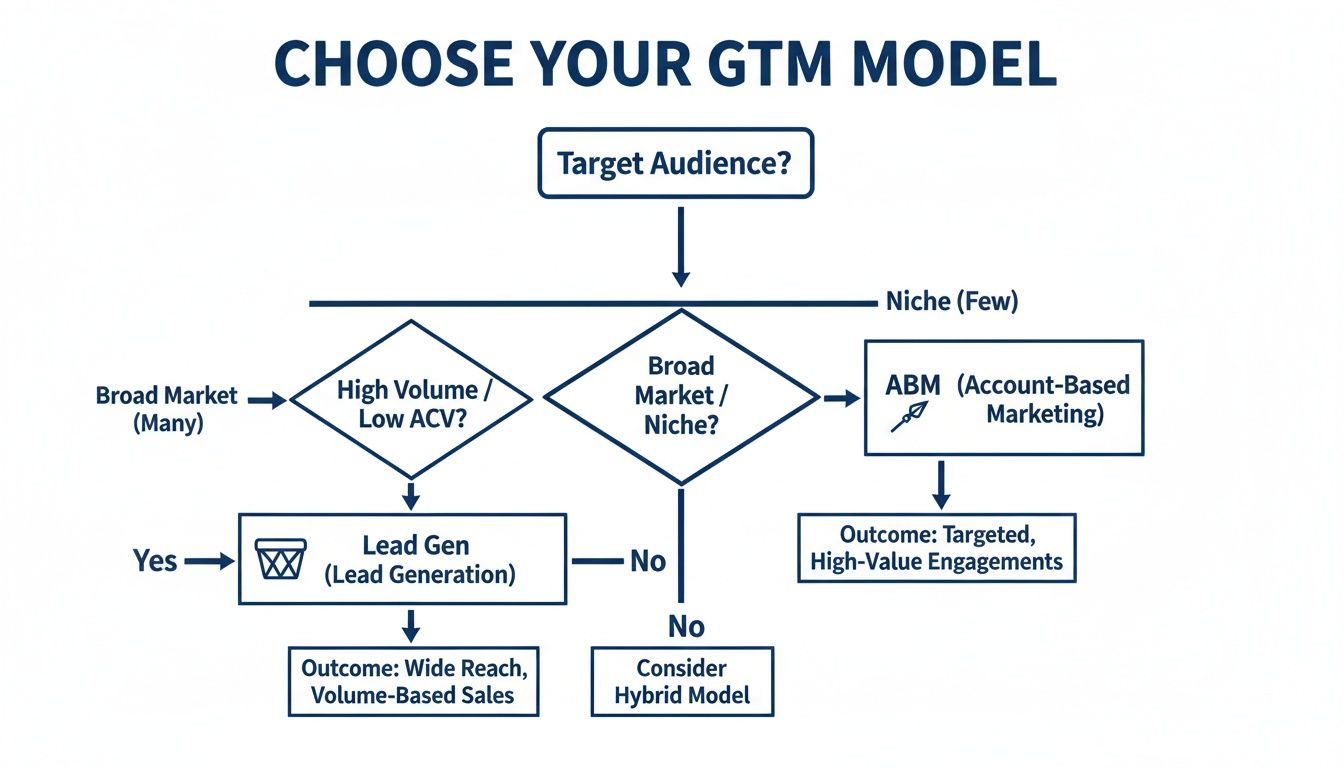
The visual makes the decision path clear. For high-volume, lower-value deals, lead generation is a solid fit. But for high-value, complex sales, the precision of ABM is a far more effective strategy.
Building Early Consensus and Momentum
In a typical lead gen process, a single lead enters the funnel, gets nurtured for weeks or months, and only then starts trying to socialize the idea internally. This is precisely where deals slow to a crawl. The lead has to fight for attention, justify the budget, and convince colleagues one by one.
ABM front-loads this entire process. By targeting multiple people at the same account with consistent messaging, you build internal consensus in parallel, not sequentially. An executive sees a targeted ad on LinkedIn, a director gets a personalized email referencing a recent company initiative, and a manager downloads a custom-tailored whitepaper.
ABM turns a single point of contact into a chorus of internal advocates. When multiple stakeholders are exposed to your value proposition simultaneously, the buying decision feels like the organization's idea, not just one person's project.
This synchronized approach collapses the early stages of the sales cycle, moving you from initial awareness to a qualified, multi-stakeholder meeting much faster. You aren't just booking a meeting; you're booking a meeting with a pre-warmed buying committee.
The Impact of Higher Quality Engagement
The data on this is compelling. A study by TOPO (now part of Gartner) found that companies with mature ABM programs see a 75% increase in deals won from their target accounts. Other research shows that ABM can shorten the sales cycle by up to 30-50% for complex deals.
To see how these numbers fit into the broader landscape, you can explore more ABM statistics and benchmarks.
This acceleration is a direct result of higher-quality engagement from day one. Instead of relying on generic nurture streams, every touchpoint in an ABM play is relevant and valuable. This leads to several key outcomes that speed up sales:
- Better-Qualified Meetings: Sales reps walk into conversations with a deeper understanding of the account's context, leading to far more productive discovery calls.
- Reduced Nurturing Time: Because accounts are pre-qualified and engagement is highly personalized, the long, slow nurturing phase so common in lead gen is dramatically condensed.
- Fewer Stalled Deals: By engaging the entire buying committee early, you identify and address potential objections and internal politics before they have a chance to derail the deal.
When comparing account-based marketing vs lead generation in the context of sales velocity, the difference is profound. Lead generation casts a wide net and hopes for the best, often resulting in a long, winding path to revenue. ABM identifies the destination first and then engineers the most direct route to get there.

“The Business Development team gets 80 to 90 percent of what they need in 15 minutes. That is a complete shift in how our reps work.”
Andrew Giordano
VP of Global Commercial Operations, Analytic Partners
ABM vs. Lead Generation: Choosing Your Go-to-Market Model
Deciding between account-based marketing and lead generation isn't about picking a universal "winner." It's a strategic business decision that must align perfectly with your market, your product, and your growth goals.
The right model for a high-volume SaaS startup targeting SMBs will be a disaster for an enterprise software company selling seven-figure deals.
The entire decision boils down to one trade-off: volume vs. value. Are you building a business that needs to acquire a huge number of smaller customers as efficiently as possible? Or are you building a business that relies on landing a smaller number of large, strategic accounts? Answering this question correctly provides the foundation for your entire go-to-market motion.
When Lead Generation Is the Right Call
Lead generation is a time-tested model for a reason—it works brilliantly in specific scenarios. If you're operating in a broad market with a massive number of potential customers, casting a wide net is the most effective way to build a predictable pipeline.
This approach is typically the best fit for businesses with these traits:
- Lower Annual Contract Value (ACV): If your average deal size is under $25,000, the economics of the sale demand a high-volume, lower-touch process. You need an efficient engine to continuously feed the top of your funnel.
- Shorter Sales Cycles: When a customer can make a purchase decision in weeks or a few months without a large buying committee, a direct path from lead to customer is highly effective.
- Broad Target Market: For companies selling to a wide audience like small and medium-sized businesses (SMBs), the scale of lead generation is a major advantage. The goal is to capture as much of that large addressable market as you can.
Plausible Example: Consider a project management software company that sells its product for $50 per user per month. Their audience is virtually any team in any industry. For them, running broad ad campaigns, producing SEO-optimized content, and targeting a wide audience is the most logical approach. Their goal is to generate thousands of sign-ups and MQLs every month—a task tailor-made for a lead generation model.
When ABM Is a Strategic Imperative
Account-based marketing is all about precision and depth. It's the go-to strategy when you're dealing with high-value, complex sales where every single deal matters. This is the model for companies that need to win big by focusing their sales and marketing resources exactly where they will have the greatest revenue impact.
You should lean heavily into ABM if your business looks like this:
- High Annual Contract Value (ACV): When you're pursuing deals worth $50,000, $100,000, or more, the investment in deep personalization and a coordinated sales and marketing effort pays for itself many times over. The risk of losing even one of these accounts is too high to rely on a volume game.
- Complex Sales Cycles: If a purchase requires sign-off from IT, Finance, Legal, and a business unit, you have to engage the entire buying committee. ABM is built to orchestrate these complex, multi-threaded conversations.
- Concentrated Enterprise Market: If your true total addressable market consists of only a few hundred or a thousand companies, treating each one as a market of its own is the only logical path forward.
Aligning your GTM model with your ACV and sales complexity is one of the most critical decisions a revenue leader can make. A mismatch between your strategy and business model is a primary cause of inefficient growth.
The Best of Both Worlds: A Hybrid Approach
For many companies, the choice between account-based marketing vs lead generation isn't black and white. The most effective play is often a hybrid model that applies the right strategy to the right market segment, creating a flexible and powerful revenue engine.
You can get a deeper look at building this kind of adaptable motion in our GTM strategy framework.
Plausible Example: Imagine a cybersecurity firm with two distinct product lines. They offer a self-serve product for SMBs with an ACV of around $10,000, and they also sell a full enterprise platform to Fortune 500 banks with an ACV of $250,000.
- For their SMB product, they run a classic lead generation engine, using content marketing and digital ads to drive a high volume of leads into a low-touch sales process.
- For their enterprise platform, they run a dedicated ABM program. Sales and marketing collaborate to penetrate a named list of 50 target financial institutions with hyper-personalized outreach and executive events.
This hybrid strategy allows them to efficiently capture the broad market while giving their most valuable prospects the focused, white-glove treatment needed to close large deals. It’s a sophisticated approach that aligns resources directly with revenue potential.
Powering Your Strategy With Account Intelligence

Whether you’re spear fishing with ABM or casting a net with lead generation, your success hinges on one thing: knowing where to find the fish. This is where modern account intelligence becomes your competitive advantage. It's the engine that operationalizes your GTM strategy, turning theory into pipeline.
Without timely, relevant data, even the best plans fail. ABM becomes an exercise in manual research, and lead generation devolves into a low-quality numbers game. Both strategies require a constant flow of intelligence to function effectively.
Account intelligence provides the critical "who, what, and why now" that separates high-performing revenue teams from the rest. It ensures every action is grounded in real-world context, bridging the gap between your strategic goals and your team's daily execution.
Intelligence for High-Performance ABM
With ABM, success is measured by depth, not breadth. The challenge isn't finding more accounts; it's deeply understanding the ones you’ve already selected. This is where manual work breaks down and modern intelligence platforms excel.
An effective ABM program needs to answer complex questions for every target account:
- What are their top corporate initiatives and strategic priorities for this year?
- Who sits on the buying committee, and what does each person care about?
- What recent event—a new product launch, a funding round, an executive hire—creates a window of opportunity for us?
Scaling this level of deep discovery manually across 50 or 100 target accounts is practically impossible. AI-powered platforms automate this entire process.
An AI Research Agent, for instance, can autonomously build structured account briefs by synthesizing information from thousands of public sources. This transforms hours of painful manual research into an automated, continuous process, giving your reps the deep context they need for true personalization.
This allows your team to stop researching and start engaging. They can craft messaging that speaks directly to an account’s reality, turning cold outreach into a relevant, timely conversation.
Intelligence for Smarter Lead Generation
For lead generation, the challenge is different. It’s not about deep research on a few accounts, but about effectively prioritizing the thousands of leads flowing into your funnel. How do you separate the signal from the noise?
This is where account intelligence makes your lead generation model smarter, not just bigger. It provides the context needed to identify and act on high-intent leads while they are still hot.
Imagine two leads fill out a form on your website. One is from a company with no recent activity. The other is from a company that just announced a major expansion and posted three new job descriptions perfectly aligned with your solution. Which lead should your sales team call first?
An AI-powered Signal Agent solves this by monitoring your entire lead database for buying signals. It alerts your team the moment a lead’s company does something worth acting on. This allows you to:
- Prioritize ruthlessly: Focus sales efforts on leads from accounts demonstrating clear intent.
- Arm reps with a "why now": Provide the exact trigger event needed for a compelling outreach.
- Improve conversion rates: Engage leads with relevant context, dramatically increasing the chances of booking a meeting.
Ultimately, when deciding between account-based marketing vs. lead generation, the choice of strategy is only half the battle. To learn more about how data underpins these modern approaches, you might be interested in our comprehensive account intelligence buyer's guide. Activating your strategy with the right intelligence is what makes it possible to achieve scalable, predictable growth, no matter which model you choose.
Frequently Asked Questions About ABM and Lead Gen
Whenever teams discuss the differences between account-based marketing and lead generation, a few key questions always come up. Understanding the theory is one thing, but making a confident decision requires clarity on the practical steps, common pitfalls, and how these models apply to businesses of different sizes.
Let's tackle those questions head-on with direct, practical answers.
How Do I Start an ABM Pilot Program?
Diving headfirst into a full-scale ABM transformation is a recipe for failure. The smartest approach is to start with a small, focused pilot program to prove the model's value and gain buy-in for a broader rollout—no massive upfront investment required.
A successful pilot depends on alignment, clear goals, and smart execution. Here’s a simple four-step playbook to get started:
- Align and Select: Get sales and marketing leaders in a room to jointly agree on a small, manageable list of 10-20 high-value target accounts that are a perfect fit for your ICP. This is a shared list that both teams co-own from day one.
- Define Success: Forget MQLs. For an ABM pilot, success is measured by account engagement (are the right people interacting with you?), meetings booked with key personas, and new pipeline created within that specific account list.
- Automate Your Intelligence: Manually researching 20 accounts is a huge time sink. Use an account intelligence tool to automate discovery. This will help you find timely buying signals (like an executive hire or funding round) and build deep account briefs without the manual grunt work.
- Develop and Execute the Play: Create a multi-channel playbook with personalized outreach for your target list. This should be a coordinated effort including customized email sequences triggered by account events, targeted LinkedIn ads, and content that speaks directly to the account’s specific business challenges.
Run your pilot for a full sales quarter. The goal isn’t to close a massive deal in 90 days. It's to prove that a focused, personalized approach generates higher-quality engagement and more qualified pipeline than your previous broad-based efforts.
What Are the Biggest Mistakes to Avoid When Shifting to ABM?
Moving from a lead-centric to an account-centric world is a major shift, and it’s full of common traps. Knowing these pitfalls from the start can be the difference between a successful program and a frustrating, expensive failure.
Here are the three most common—and damaging—mistakes:
- Poor Sales and Marketing Alignment: This is the #1 killer of ABM programs. If sales and marketing don't co-own the target account list, agree on messaging, and share the same goals, the strategy will fail. It must be a true partnership, not just a better handoff.
- Treating ABM Like 'Better Lead Gen': A classic mistake is to take a smaller list and hit them with the same generic emails. That isn’t ABM. It demands deep personalization based on real account-level intelligence and a compelling "why now" for reaching out.
- Impatience and the Wrong Metrics: ABM is a long-term revenue strategy, not a short-term lead tactic. If you measure its success with MQL volume or CPL, you'll kill the program before it can work. You must track metrics like account penetration, pipeline velocity, and average deal size within your target accounts over a realistic timeframe.
Can a Small Business Successfully Use ABM?
Yes, absolutely—but you have to be pragmatic. A startup or small business lacks the budget for the hyper-customized, "1-to-1" ABM programs that large enterprises run. The key is to focus on more scalable models of ABM.
For a small business, two great approaches make ABM work:
- The "1-to-Few" Approach: Select a small cluster of 5-10 "dream clients" that share common traits, like being in the same niche industry. Then, create mini-campaigns personalized for that cluster, not for each individual company.
- The "1-to-Many" Approach: Use technology to apply personalization at scale to a larger list of target accounts (e.g., 50-100 companies). This model relies heavily on modern tools to automate the research and signal monitoring that would otherwise be impossible for a small team.
For small businesses, technology is the great equalizer. Platforms that automatically research accounts and surface buying signals allow a small team to execute a sophisticated ABM strategy that, just a few years ago, would have required an entire department.
How Does Intelligence Improve Lead Generation?
While intelligence is often associated with ABM, it can also supercharge a traditional lead generation model. It adds a crucial layer of prioritization and relevance, transforming a high-volume funnel into a smarter, more efficient revenue engine.
Instead of treating every inbound lead as equal, you can use buying signals to instantly spot those with the highest potential. For example, a lead from a company that just announced new funding, hired a key executive, or is actively hiring for roles your solution supports is infinitely more valuable than a random form fill.
An intelligence platform automatically finds these triggers for your existing leads. This empowers your sales team to:
- Focus their energy on the leads most likely to become real opportunities.
- Tailor their follow-up with a compelling "why now" message tied to a real event at that company.
This simple shift can dramatically improve the conversion rates of your existing lead funnel, ensuring your team spends its time on conversations that have a real chance of turning into revenue.
The right go-to-market strategy—whether it's ABM, lead generation, or a hybrid of the two—is powered by timely, actionable intelligence. Salesmotion deploys autonomous AI agents to track what matters across your target accounts, transforming real-world signals into measurable pipeline growth. Learn how Salesmotion can power your revenue engine.